As research in plant science continues to advance, there is an increasing demand for high-quality plant tissue proteins in proteomics, molecular biology, and plant breeding technologies. Plant roots, stems, and leaves are critical tissues for studying plant growth, development, and environmental adaptability, involving physiological processes such as photosynthesis, nutrient absorption, and hormone regulation. Key factors affecting protein extraction from plant tissues include pH, temperature, solvent selection, and extraction duration. However, the rigid and complex structure of plant cell walls, the presence of secondary metabolites, protein degradation, and generally low protein abundance pose significant challenges for efficient protein extraction.
To address these issues, MtoZ Biolabs has developed a specialized plant tissue (root, stem & leaf) protein extraction kit with optimized formulation and streamlined workflow, enabling researchers to obtain high-purity, high-activity proteins from a wide range of plant tissues in a relatively short time, providing robust support for downstream protein detection and functional studies.
Product Overview
In response to the challenges of extracting proteins from plant organs, MtoZ Biolabs has has developed an efficient solution. The plant tissue (root, stem & leaf) protein extraction kit utilizes a specially formulated lysis buffer system combined with a protease inhibitor cocktail to rapidly disrupt cell walls and membranes under mild conditions, releasing target proteins while preserving their native conformation and minimizing degradation. The optimized formulation effectively reduces interference from polyphenols, pigments, and other active substances under ambient or low-temperature conditions, laying a solid foundation for subsequent purification and analysis of plant tissue proteins. The entire procedure is straightforward and user-friendly, enabling researchers to obtain high-quality supernatants in a short time. The extracted proteins are compatible with a wide range of downstream applications, including Western blotting, ELISA, enzymatic activity assays, co-immunoprecipitation, and mass spectrometry (LC-MS/MS). The kit provides robust support for protein studies in roots, stems, and leaves from various herbaceous and woody plants.
Product Details
|
Product Details |
Size |
Storage Conditions |
|
Plant Tissue Lysis Buffer |
40 mL |
4℃ |
|
Protease Inhibitor (100×) |
0.5 mL |
-20℃ |
Protocol
Below is the general protocol for using the plant tissue (root, stem & leaf) protein extraction kit. Researchers may adjust specific steps based on the plant species and experimental needs:
1. Sample Preprocessing
(1) Collect root, stem, or leaf tissues from the plant and remove dirt, excess moisture, and debris from the surface.
(2) Weigh the sample and finely chop it using scissors or a scalpel. Grind the tissue into a fine powder with liquid nitrogen in a mortar and pestle, or disrupt it preliminarily using a homogenizer.
Note: Perform all steps under low-temperature conditions to maintain protein stability.
2. Lysis Buffer Treatment
(1) Thaw the Plant Tissue Lysis Buffer on ice and add protease inhibitor (100×) at a ratio of 10 μL per 1 mL of buffer. Mix gently.
(2) Add the lysis buffer at a volume 3-4 times that of the tissue and incubate with shaking on ice or at 4°C for 30-60 minutes (or 3-4 hours without shaking).
This step ensures thorough disruption of the plant cell wall and protein release. The incubation time may be extended depending on tissue toughness, but over-disruption should be avoided to prevent protein degradation.
3. Centrifugation and Supernatant Collection
(1) Centrifuge at 10,000-12,000 ×g for 10-15 minutes at 4°C to remove debris such as cell fragments and cellulose.
(2) Carefully transfer the supernatant to a pre-chilled microcentrifuge tube. This is plant protein extract.
(3) Aliquot and store at -80°C. If higher purity is needed, repeat centrifugation or use a filtration device.
4. Protein Quantification and Downstream Applications
Use a standard method such as the BCA assay to quantify protein concentration. The extracted proteins can then be applied in downstream analyses, including Western blotting, mass spectrometry, and enzyme activity assays.
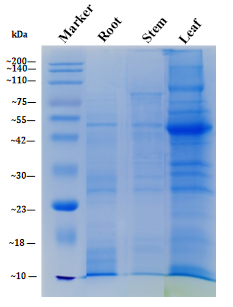
Figure 1. SDS-PAGE Gel Image of Plant Tissue Extracted by the Kit.
Features and Benefits
1. Efficient Cell Wall Disruption
Designed specifically for the tough nature of plant cell walls, it enables effective lysis of root, stem, and leaf tissues under mild conditions, maximizing protein release.
2. Reduced Interference from Active Compounds
Formulated with appropriate chelators and detergents, minimizes the binding and interference of polyphenols and pigments commonly present in plant tissues are minimized, and the purity and stability of proteins are improved to the greatest extent possible.
3. Protease Inhibition for Protein Integrity
A combination of protease inhibitors prevents excessive activation of endogenous plant proteases during extraction, preserving the structural integrity and functionality of target proteins.
4. Broad Applicability Across Plant Types
Effective not only for herbaceous plants and crops but also for some woody species and thick-walled leaf tissues, enabling reliable extraction across a wide range of organs including root, stem, and leaf.
5. Simple and Time-Efficient Operation
The plant tissue (root, stem & leaf) protein extraction kit is ready-to-use and eliminates the need for complex reagent preparation. Integrated steps streamline the workflow, allowing rapid extraction with consistent results.
6. Compatibility with Diverse Downstream Applications
Suitable for immunoassays (Western blot, ELISA), enzyme activity assays, and omics-level studies (LC-MS/MS, protein interaction analysis), delivering high-quality protein samples for varied research needs.
7. Stability and Reproducibility
Standardized formulations and procedures reduce experimental variability, supporting reliable batch processing and comparative studies.
Applications
1. Plant Growth and Development Research
By conducting horizontal and vertical proteomic comparisons of roots, stems, and leaves, researchers can reveal dynamic changes in growth hormones and cell cycle regulators throughout developmental stages. This helps uncover gene expression networks and growth mechanisms from a new perspective.
2. Environmental Adaptation and Stress Response Studies
Under abiotic and biotic stress conditions such as drought, salinity, extreme temperatures, or pathogen infection, analyzing differential protein expression provides insights into plant defense mechanisms and stress-responsive gene functions. These findings support crop breeding and agricultural improvement strategies.
3. Crop Quality and Breeding
Quantitative proteomic analysis of key crop organs (e.g., wheat, rice, corn) can identify marker proteins linked to traits such as quality, yield, and disease resistance, offering valuable tools for marker-assisted selection in breeding programs.
4. Protein Function and Interaction Networks
Using proteomics and interactomics approaches (e.g., Co-IP, Pull-down), researchers can dissect the interactions between root, stem, and leaf proteins with environmental cues and internal factors, enabling the construction of comprehensive signaling pathway networks.
FAQs
Q1: Do Different Plant Species Yield the Same Extraction Results?
A1: The kit is suitable for most herbaceous plants and some woody species. If the plant tissue has particularly tough cell walls or contains complex substances (e.g., high resin or gum content), you may need to adjust grinding or sonication steps accordingly or extend the lysis time based on specific sample characteristics.
Q2: What Should I Do If the Extracted Protein Bands Are Blurry or Show Smearing on the Gel?
A2: This may result from protein degradation or interference by residual polyphenols or pigments. Ensure that all incubation and centrifugation steps are performed under low-temperature conditions. Consider increasing the concentration of protease inhibitors or chelating agents if needed. Also, avoid overgrinding or excessive oxidation during sample preparation.
Q3: Can The Kit Extract Membrane Proteins or Ultra-High Molecular Weight Proteins?
A3: The plant tissue (root, stem & leaf) protein extraction kit is designed for total protein extraction and can efficiently isolate most proteins. However, extracting membrane proteins or ultra-high molecular weight proteins can be more challenging and may require additional treatments. For membrane proteins, we offer a dedicated membrane protein extraction kit optimized to efficiently isolate membrane-associated proteins while preserving their activity and stability. For ultra-high molecular weight proteins, post-extraction fractionation or specialized enrichment steps are recommended to improve yield and integrity.
Q4: What Downstream Applications Are Compatible with the Extracted Proteins?
A4: The extracted proteins are compatible with various downstream assays, including Western Blot, ELISA, enzymatic activity assays, Co-IP, Pull-down, and mass spectrometry (MS) analysis.