






Exosome-Mediated siRNA Delivery Service
Small interfering RNA (siRNA) is a powerful tool for gene silencing through RNA interference, and it has become integral in the treatment of various diseases including cancer, viral infections, and neurodegenerative disorders. However, siRNA molecules are negatively charged, which makes them vulnerable to enzymatic degradation and challenging to internalize across cell membranes. These natural barriers limit their in vivo delivery efficiency and bioavailability.
Recently, exosomes have gained significant attention for their natural nanoscale structure, superior biocompatibility, low immunogenicity, and ability to fuse with cellular membranes. These characteristics make exosomes an ideal platform for RNA drug delivery. In contrast to traditional synthetic carriers like liposomes and polymers, exosomes avoid immune system clearance and can cross biological barriers, including the blood-brain barrier, with enhanced tissue penetration and targeting potential. By employing strategies such as electroporation, transfection, or donor cell expression, siRNA can be efficiently encapsulated into exosomes. These exosomes can then deliver the siRNA to targeted tissues in vivo, initiating RNA-induced silencing complex (RISC)-mediated gene inhibition.
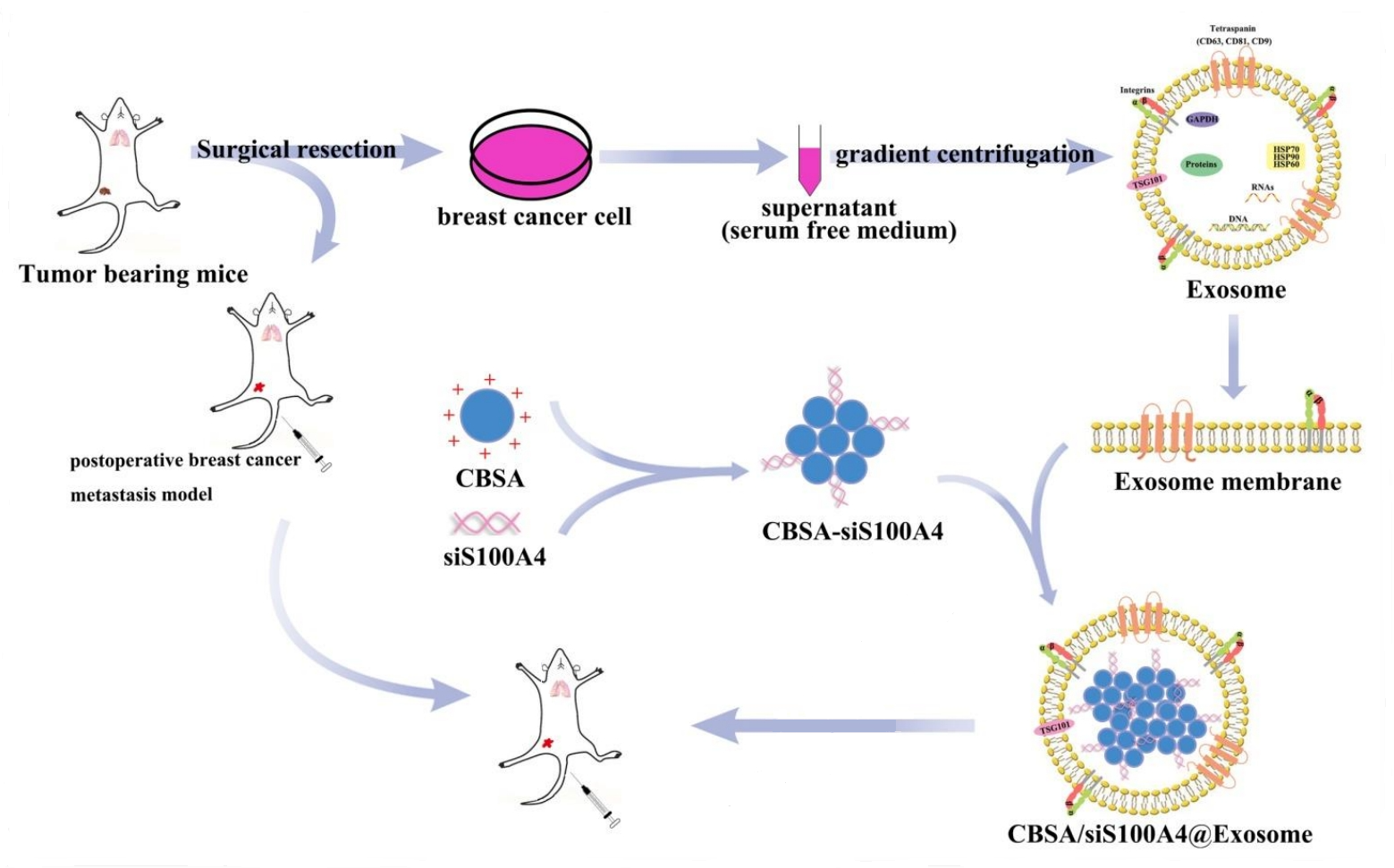
Zhao, L. et al. J.Control.Release. 2020.
Figure 1. Exosome-Mediated siRNA Delivery Process for Targeted Cancer Therapy
MtoZ Biolabs offers a comprehensive Exosome-Mediated siRNA Delivery Service built upon its advanced exosome engineering platform and stringent quality control system. This end-to-end Exosome-Mediated siRNA Delivery Service encompasses exosome isolation, purification, siRNA loading, and delivery verification, supporting robust and efficient RNA interference studies both in vitro and in vivo.
Services at MtoZ Biolabs
MtoZ Biolabs provides a standardized, modular Exosome-Mediated siRNA Delivery Service that ensures traceability, control, and verifiability at each step of the process:
1. High-Purity Exosome Preparation
Exosomes are derived from various sources such as HEK293T, MSC, A549, and more.
Exosome extraction methods (e.g., differential centrifugation, SEC) are selected based on client needs.
Quality control ensures that exosome preparations are free of cellular debris or protein contamination.
2. siRNA Loading
Clients provide the target siRNA (available in double-stranded/single-stranded and labeled/unlabeled forms).
Electroporation or transfection co-incubation methods are used for high-efficiency loading.
Fluorescence labeling of siRNA or exosomes is available for tracking.
3. System Characterization and Delivery Validation
We offer physicochemical characterization, including particle size (NTA), Zeta potential, and TEM morphology.
Loading efficiency and delivery effectiveness are assessed via qPCR for siRNA content and Western blot/qPCR for target gene expression knockdown.
We also provide fluorescence imaging and flow cytometry as visualization options.
Why Choose MtoZ Biolabs?
✔ Natural Biological Carrier with Low Immunogenicity: Exosomes are derived from autologous sources, offering better tolerance in vivo compared to synthetic carriers.
✔ Supports Multiple Loading Methods: Various loading strategies optimize the delivery of different siRNA types.
✔ Fully Traceable and Quantifiable: We offer quantifiable assessment of loading efficiency, encapsulation rates, and delivery outcomes.
✔ Scalable for Animal Model Validation: Delivery efficiency and gene silencing can be evaluated in animal models, including mice.
✔ High-Standard Quality Control: Rigorous quality control ensures consistent system stability from preparation to validation.
Applications
MtoZ Biolabs' Exosome-Mediated siRNA Delivery Service is ideal for various research and translational applications, including:
· Disease Mechanism Analysis: Exosome-based siRNA delivery targets key pathogenic genes, uncovering mechanisms in cancer, inflammation, and neurodegenerative diseases.
· Gene Function Research: Gene silencing experiments assess the biological functions of specific genes in processes such as cell proliferation, migration, and apoptosis.
· Signal Pathway Regulation: SiRNA silences key molecules in signaling pathways, allowing researchers to study regulatory networks and their effects on cell behavior.
· Exosome Engineering: We develop siRNA-loaded exosome models and validate their stability, biocompatibility, and transmembrane transport efficiency as novel drug delivery systems.
FAQ
Q1: Does the method of loading siRNA into exosomes affect their structure or activity?
We use low-damage electroporation and mild co-incubation to ensure high loading efficiency while preserving exosome membrane integrity and function. All procedures undergo structural and functional verification.
Q2: What are the advantages and disadvantages of different siRNA loading methods? How should I choose?
Electroporation is simple and efficient but requires optimization. Chemical transfection is suitable for high-throughput applications but may cause toxicity. Donor cell transfection is ideal for creating stable carriers. We will recommend the best method based on your experimental goals and application needs.
What Could be Included in the Report?
siRNA-loaded exosome samples: High-purity and stable exosomes, available in liquid or lyophilized form.
1. Size and Concentration Analysis Report: Includes NTA or DLS data for particle size distribution, concentration, and Zeta potential.
2. Exosome Identification Data: TEM images, marker protein expression (CD9, CD63, TSG101), and protein quantification results.
3. siRNA Loading and Validation Report: Includes loading efficiency and gene expression inhibition data.
4. Complete Experiment Report: Provides process details, raw data, and technical analysis.
MtoZ Biolabs’ Exosome-Mediated siRNA Delivery Service is designed to overcome key barriers in siRNA delivery, offering a stable and efficient RNA interference system. With high-purity exosomes, robust loading strategies, and precise functional validation, we provide a comprehensive solution suitable for various research and drug development applications. Additionally, MtoZ Biolabs offers a range of Exosome-Based Nucleic Acid and Drug Delivery Services, supporting miRNA, mRNA, circRNA, proteins, and small-molecule drugs. Contact us to customize your experimental design and receive expert technical support.
Related Services
|
Comprehensive Exosome Analysis Services by MtoZ Biolabs |
|||
|
Ultracentrifugation and Microfiltration based Exosome Purification |
Classical method for enriching exosomes from large-volume samples; suitable for preparative applications. |
||
|
Size Exclusion Chromatography (SEC) based Exosome Purification |
Gentle, size-based separation preserving exosome integrity; ideal for downstream functional studies. |
||
|
High-purity isolation targeting specific exosome surface markers using antibody-conjugated platforms. |
|||
|
Physical Characterization |
Measures particle size distribution and concentration; widely used for routine exosome quality assessment. |
||
|
Provides direct visualization of exosome morphology; considered the gold standard for structural validation. |
|||
|
Enables single-particle analysis of size, concentration, and zeta potential with high precision. |
|||
|
Confirms exosome identity and purity by detecting classical (e.g., CD63) and negative (e.g., Calnexin) markers. |
|||
|
Quantifies surface proteins and distinguishes subpopulations using fluorescent antibody labeling. |
|||
|
High-sensitivity single-particle analysis of exosome size, concentration, and surface marker expression. |
|||
|
Mass spectrometry-based profiling of exosomal proteins to reveal functional content and biomarkers. |
|||
|
Identifies low-molecular-weight metabolites in exosomes to explore their metabolic roles and signatures. |
|||
|
Comprehensive analysis of lipid species involved in membrane structure and signaling. |
|||
|
High-throughput sequencing of total RNA to reveal lncRNA, miRNA, and mRNA content. |
|||
|
Fluorescent or functional labeling for exosome tracking and uptake studies. |
|||
|
Custom engineering of exosomes for targeted delivery to disease-specific tissues or cells. |
|||
|
Incorporates therapeutic cargos such as RNA, proteins, or small molecules into exosomes. |
|||
|
Exosome-Associated Adeno-Associated Virus (AAV) Vector Production |
Combines exosomes with AAV vectors to enhance gene delivery and targeting efficiency. |
||
|
Assesses cellular-level effects such as proliferation, migration, and immune modulation. |
|||
|
Evaluates biodistribution and biological activity of exosomes in animal models. |
|||
How to order?




