






Exosome-Mediated circRNA Delivery Service
- Cancer Therapy Research
- RNA Drug Development
- miRNA and Protein Interaction Studies
- Immunomodulation and Cellular Function Analysis
- Exploration of Novel circRNA Functions
Exosome-Mediated circRNA Delivery Service utilizes engineered cell expression or in vitro synthesis to construct target circular RNAs (circRNAs), which are then enriched and packaged into secreted exosomes for use in functional studies, target validation, or drug evaluation in recipient cells or animal models. This service is designed to combine the molecular stability of circRNAs with the natural delivery advantages of exosomes, enabling efficient and low-immunogenic delivery of circular RNAs both in vitro and in vivo.
Circular RNAs (circRNAs) are a class of covalently closed, non-coding RNAs formed through back-splicing. They exhibit high stability, low immunogenicity, and diverse biological functions, including transcriptional regulation, acting as miRNA sponges, binding proteins, and conditionally encoding peptides. Due to their closed-loop structure, circRNAs are resistant to exonuclease degradation, making them promising candidates for next-generation RNA therapeutics and cancer immunotherapy research.
Exosomes are nano-sized extracellular vesicles actively secreted by various cell types. They possess excellent biocompatibility, stability in circulation, and intrinsic targeting capability. As natural RNA delivery vehicles, exosomes can effectively protect RNA structures from degradation and enable efficient delivery across cells and tissues. Delivering engineered circRNAs via exosomes offers an innovative platform for disease treatment and RNA-based drug development.
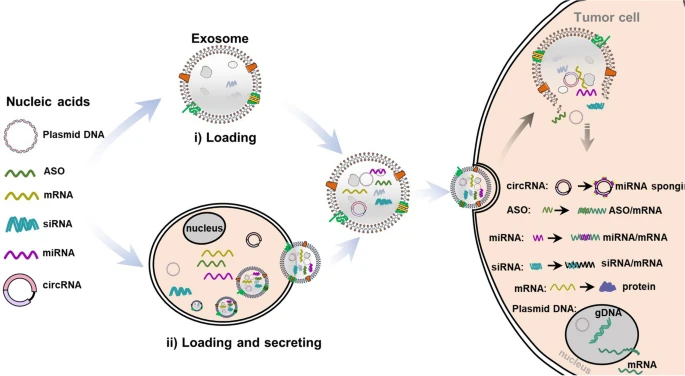
Zhang Y. et al. J Nanobiotechnol. 2022.
Figure 1. Exosome-mediated nucleic acid delivery for cancer therapy.
Services at MtoZ Biolabs
Leveraging biosynthesis and exosome engineering platforms, MtoZ Biolabs provides Exosome-Mediated circRNA Delivery Service to efficiently construct target circRNA and stably encapsulate it in high-purity exosomes to achieve precise delivery and functional expression of circRNA to target cells. Our service integrates key modules including circRNA expression system construction, cell transfection, exosome isolation and enrichment, and encapsulation efficiency validation. It is well-suited for various applications such as cancer research, RNA drug development, and intercellular communication studies, providing a powerful experimental tool for exploring the functional roles and therapeutic potential of circRNAs.
Analysis Workflow
The main workflow of Exosome-Mediated circRNA Delivery Service includes:
1. Project Design and Target circRNA Sequence Evaluation
2. circRNA Expression Construction and Cell Transfection
3. Exosome Secretion Induction and Isolation
4. Validation of circRNA Loading Efficiency
Service Advantages
1. Advanced Analysis Platform: MtoZ Biolabs established an advanced Exosome-Mediated circRNA Delivery Service platform, guaranteeing reliable, fast, and highly accurate analysis service.
2. One-Time-Charge: Our pricing is transparent, no hidden fees or additional costs.
3. Efficient Delivery with Low Immunogenicity: Exosomes offer excellent biocompatibility, enabling safe and low-toxicity delivery suitable for various cell types and animal models.
4. High-Purity Exosome Isolation and Enrichment: Multiple isolation methods (including ultracentrifugation, density gradient separation, and affinity purification) ensure exosome integrity and efficient circRNA loading.
5. Customizable Service Workflow: Supports client-defined circRNA sequences, vector types, and donor cell lines to accommodate diverse research needs.
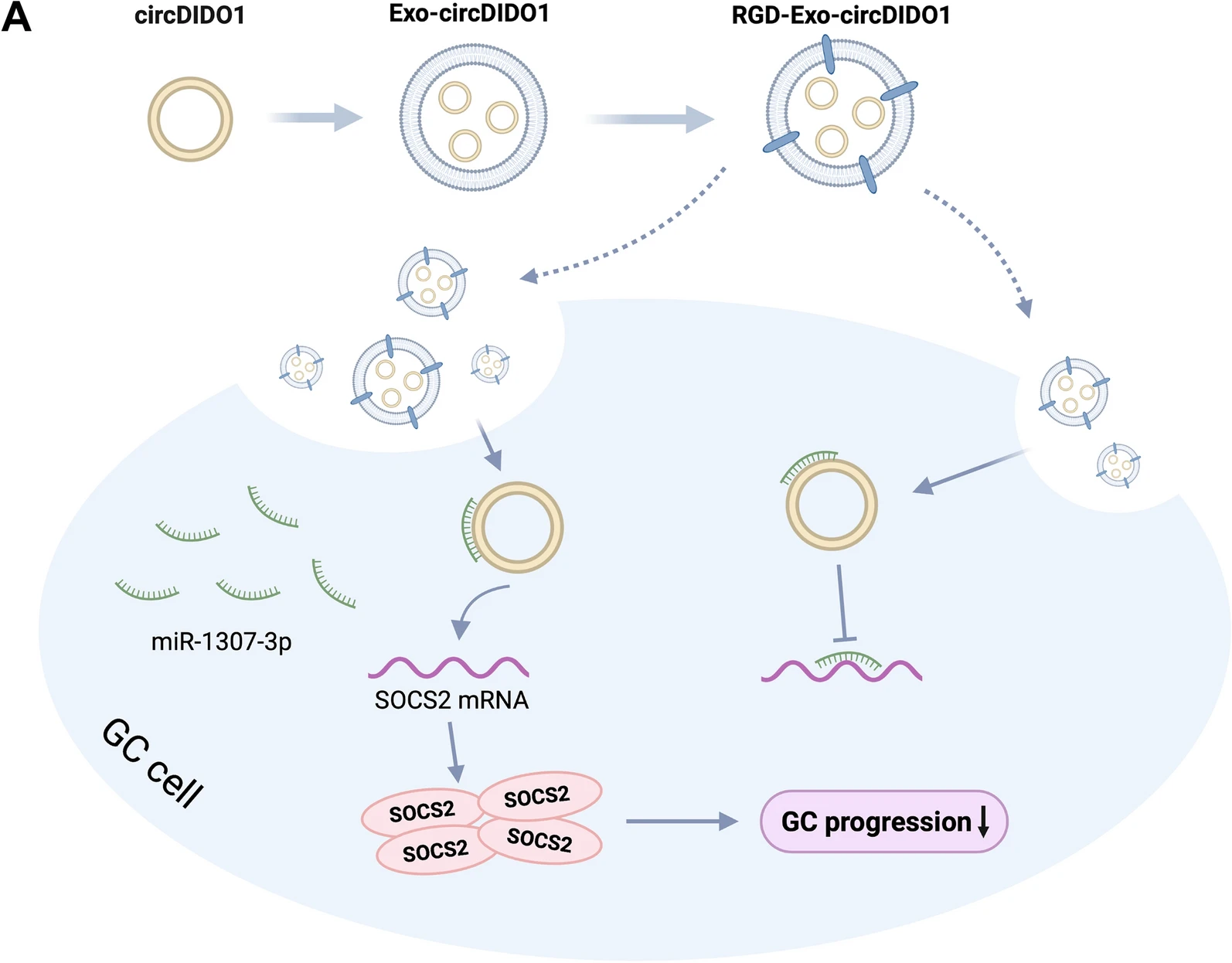
Guo Z. et al. J Transl Med. 2022.
Figure 2. RGD-Exo-circDIDO1 inhibits GC progression through miR-1307-3p/SOSC2 axis.
Applications
Application Examples of Exosome-Mediated circRNA Delivery Service:
Deliver circRNAs to regulate tumor-related signaling pathways, enhance tumor suppressor gene expression, or inhibit oncogenic miRNA activity, supporting targeted cancer intervention strategies.
Evaluate circRNAs as next-generation RNA therapeutics by delivering them via exosomes for stable expression and functional validation in vitro and in vivo.
Use exosome-delivered circRNAs to explore their roles as miRNA sponges or RNA-binding protein regulators, revealing new layers of post-transcriptional regulation.
Introduce specific circRNAs into immune cells or stem cells to investigate their involvement in immune responses, cell differentiation, or inflammation control.
Validate the translational potential of coding circRNAs and assess whether they can express functional peptides or proteins in target cells.
Related Services
Exosomes Identification Service
How to order?




