






Stroke Exosome Research Service
Stroke is a complex and life-threatening condition with high rates of disability and mortality, ranking as the second leading cause of adult deaths globally. Based on pathophysiological mechanisms, strokes are classified into ischemic and hemorrhagic types, with ischemic strokes accounting for approximately 87% of cases. Ischemic stroke is primarily triggered by atherosclerosis or thrombosis in cerebral vessels, leading to acute cerebral ischemia and hypoxia. The onset of stroke involves multiple cell types, molecular signals, and inflammatory pathways. Recent studies have underscored the crucial role of exosomes in the pathogenesis of stroke, neuroprotection, and post-stroke recovery.
Exosomes are nano-sized membranous vesicles secreted by various cell types and carry proteins, lipids, RNAs (including miRNAs), and other bioactive molecules. Capable of crossing the blood-brain barrier (BBB), exosomes play a pivotal role in mediating long-distance intercellular communication. Following stroke, brain cells, endothelial cells, and immune cells release large amounts of exosomes, which participate in neuroregeneration, repair of the neurovascular unit, immune homeostasis, and tissue remodeling. Among them, mesenchymal stem cell (MSC)-derived exosomes have garnered the most attention. Studies demonstrate that these exosomes promote recovery after stroke by modulating the inflammatory microenvironment, enhancing angiogenesis, and supporting neural network reconstruction. Additionally, exosomal miRNAs are emerging as promising non-invasive biomarkers for stroke diagnosis and therapeutic monitoring.
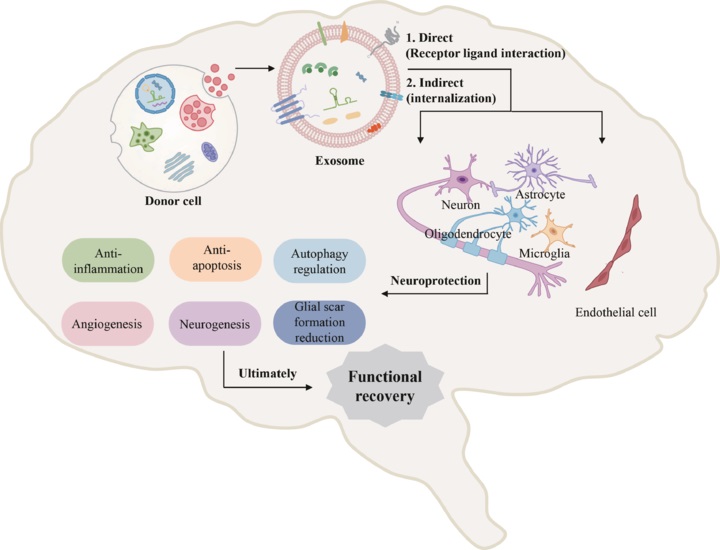
Yin, W. et al. Neural Regeneration Research. 2024.
Figure 1. Exosome-Mediated Neuroprotection and Recovery in Stroke
To support cutting-edge research in this field, MtoZ Biolabs offers dedicated Stroke Exosome Research Service. Built on our advanced multi-omics platform and standardized analysis pipeline, the Stroke Exosome Research Service is designed to help researchers explore the role of exosomes in stroke onset, progression, and intervention, accelerating the development of innovative therapeutic strategies.
Services at MtoZ Biolabs
MtoZ Biolabs delivers end-to-end Stroke Exosome Research Service that covers exosome isolation, purification, characterization, and comprehensive multi-omics profiling—including proteomics, transcriptomics, lipidomics, and metabolomics. Leveraging high-sensitivity mass spectrometry, standardized workflows, and automated data analysis platforms, we ensure reproducible, high-quality, and efficient results.
Our service offerings include, but are not limited to, the following (as shown in the diagram):
|
Comprehensive Exosome Analysis Services by MtoZ Biolabs |
|||
|
Ultracentrifugation and Microfiltration based Exosome Purification |
Classical method for enriching exosomes from large-volume samples; suitable for preparative applications. |
||
|
Size Exclusion Chromatography (SEC) based Exosome Purification |
Gentle, size-based separation preserving exosome integrity; ideal for downstream functional studies. |
||
|
High-purity isolation targeting specific exosome surface markers using antibody-conjugated platforms. |
|||
|
Physical Characterization |
Measures particle size distribution and concentration; widely used for routine exosome quality assessment. |
||
|
Provides direct visualization of exosome morphology; considered the gold standard for structural validation. |
|||
|
Enables single-particle analysis of size, concentration, and zeta potential with high precision. |
|||
|
Confirms exosome identity and purity by detecting classical (e.g., CD63) and negative (e.g., Calnexin) markers. |
|||
|
Quantifies surface proteins and distinguishes subpopulations using fluorescent antibody labeling. |
|||
|
High-sensitivity single-particle analysis of exosome size, concentration, and surface marker expression. |
|||
|
Mass spectrometry-based profiling of exosomal proteins to reveal functional content and biomarkers. |
|||
|
Identifies low-molecular-weight metabolites in exosomes to explore their metabolic roles and signatures. |
|||
|
Comprehensive analysis of lipid species involved in membrane structure and signaling. |
|||
|
High-throughput sequencing of total RNA to reveal lncRNA, miRNA, and mRNA content. |
|||
|
Fluorescent or functional labeling for exosome tracking and uptake studies. |
|||
|
Custom engineering of exosomes for targeted delivery to disease-specific tissues or cells. |
|||
|
Incorporates therapeutic cargos such as RNA, proteins, or small molecules into exosomes. |
|||
|
Exosome-Associated Adeno-Associated Virus (AAV) Vector Production |
Combines exosomes with AAV vectors to enhance gene delivery and targeting efficiency. |
||
|
Assesses cellular-level effects such as proliferation, migration, and immune modulation. |
|||
|
Evaluates biodistribution and biological activity of exosomes in animal models. |
|||
Beyond the listed services, MtoZ Biolabs also provides customized analytical solutions tailored to specific research needs.
Analysis Workflow

Why Choose MtoZ Biolabs?
✅ High-Purity Exosome Preparation: Achieved via ultracentrifugation, SEC column chromatography, or immunoaffinity enrichment, supporting diverse sample types.
✅ Versatile Sample Compatibility: Supports a wide range of sample sources, including patient peripheral blood, cerebrospinal fluid, animal models, and cell lines.
✅ Integrated Multi-Omics Capability: Combines proteomics, RNA profiling, lipidomics, and metabolomics to reveal systemic changes in disease.
✅ Fully Customized Workflow: Tailored services from mechanistic studies to therapeutic target validation, depending on research objectives.
✅ One-Time-Charge: Our pricing is transparent, no hidden fees or additional costs.
Sample Submission Suggestions
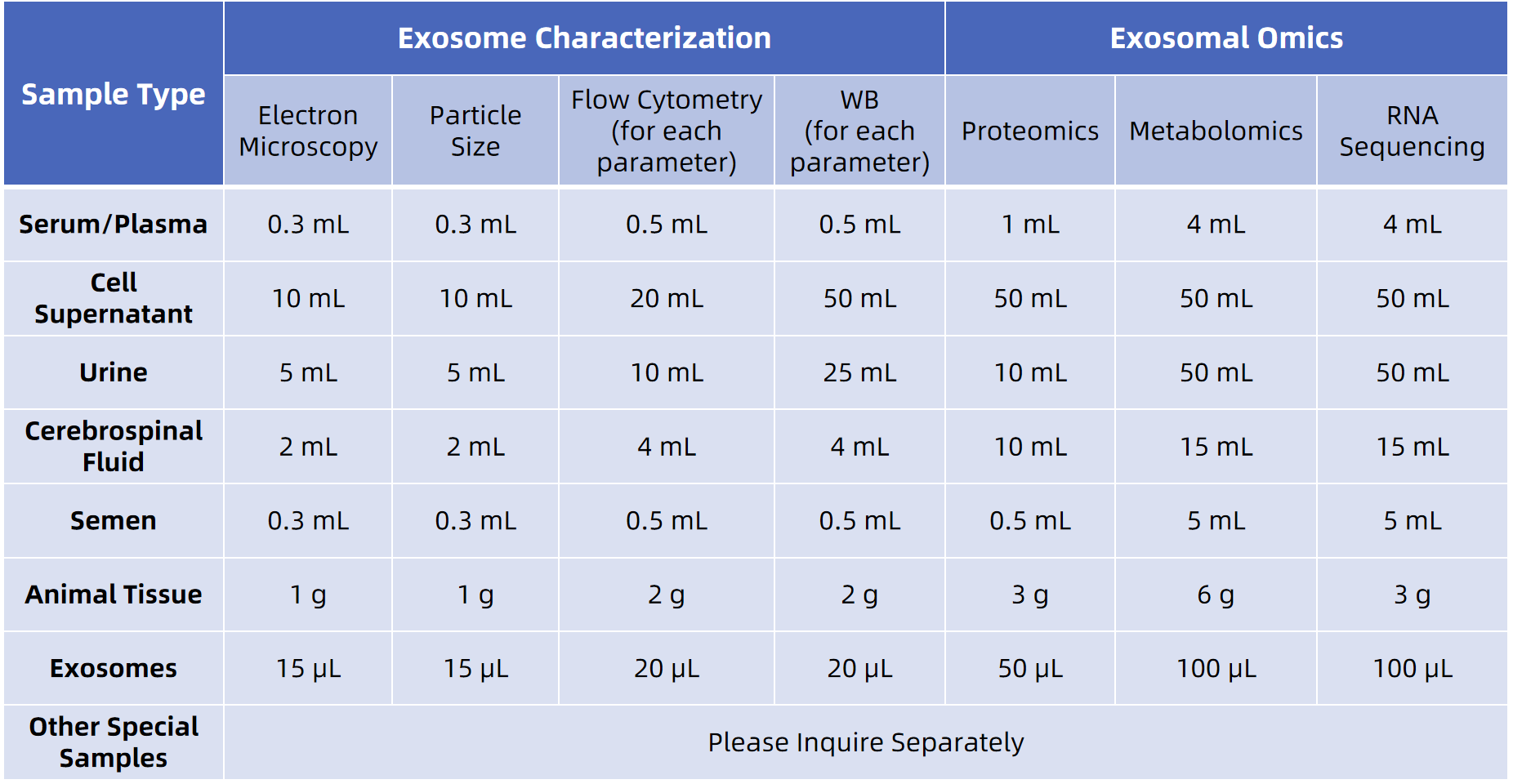
Note: Detailed SOPs for sample collection, storage, and shipment are available upon request. Please contact us to receive your customized sample handling kit.
In addition to stroke, MtoZ Biolabs also provides exosome research solutions for neurological diseases, cancers, cardiovascular diseases, and infectious diseases. Backed by advanced exosome isolation, multi-omics analysis, and bioinformatics platforms, we empower researchers to decode exosome functions across diverse disease models—driving biomarker discovery and therapeutic innovation.
Contact us today for a customized solution tailored to your research.
What Could be Included in the Report?
1. Comprehensive experimental details (materials, instruments, and methods)
2. Raw data
3. Processed omics data files
4. Quality control reports (NTA, Western blot, TEM images)
5. Functional assay results
6. Bioinformatics analysis
7. Customized report based on project requirements
Related Services
Tissue Regeneration and Repair Exosome Research Service
Infectious Disease Exosome Research Service
Cardiovascular Disease Exosome Research Service
How to order?




