






Oligosaccharide Analysis Service
- Analyze monosaccharide composition and linkage patterns;
- Elucidate branching structures and modification characteristics;
- Evaluate the degree of polymerization and molecular weight distribution;
- Perform qualitative and quantitative analyses;
- Investigate metabolic characteristics and stability behavior.
- Raw mass spectrometry or chromatographic data;
- Oligosaccharide composition and structural analysis tables (Excel format);
- Spectral and chromatographic image files (TIFF or PNG format) for comparison and presentation;
- A complete analysis report (PDF format) including experimental conditions and result interpretation.
MtoZ Biolabs utilizes multiple analytical platforms and has launched the oligosaccharide analysis service which enables precise qualitative and quantitative analysis of oligosaccharides. This service is applicable to food science, glycobiology, and biopharmaceutical research, providing data support for the functional study and quality assessment of oligosaccharides.
MtoZ Biolabs employs advanced separation and detection technologies to provide clients with multi-level oligosaccharide analysis services:
Our analysis offers a systematic understanding of the structural characteristics and biological functions of oligosaccharides, enabling researchers to gain deeper insights into their roles within biological systems.
What Is Oligosaccharide?
Oligosaccharides are short-chain carbohydrates composed of a few monosaccharide units linked by glycosidic bonds, positioned between monosaccharides and polysaccharides, and widely found in plants, animals, and microorganisms. Their diverse structures confer multiple biological functions, including immune regulation, signal transduction, and maintenance of intestinal microecological balance. With the advancement of glycomics research, oligosaccharide analysis has been widely applied in the development of biomaterials, drug delivery systems, and functional sugar products, providing an important basis for elucidating the relationship between carbohydrate structures and functions.
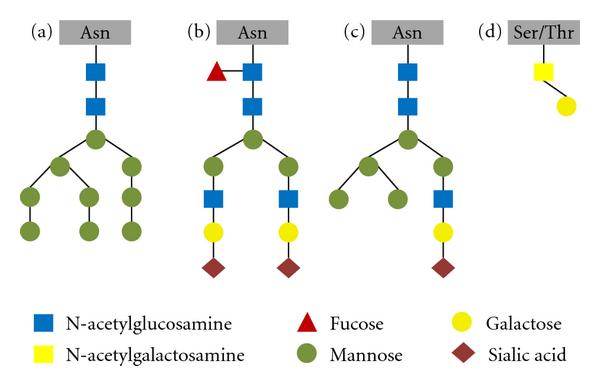
Sanchez-Pomales, G. et al. Internaional Jouranl of Electrochemistry, 2011.
Figure 1. Oligosaccharide Structure of the Most Common N-linked (a-c) and O-linked (d) Glycans.
Technical Platforms for Oligosaccharide Analysis Service
1. High-Performance Liquid Chromatography (HPLC)
Used to separate complex oligosaccharide mixtures based on differences in molecular polarity, size, and structure, achieving high-resolution separation and providing the foundation for subsequent qualitative and quantitative analyses.
2. Mass Spectrometry (MS)
(1) Gas Chromatography-Mass Spectrometry (GC-MS): Suitable for volatile or derivatized oligosaccharides, enabling precise identification of monosaccharide composition and structural characteristics.
(2) Liquid Chromatography-Mass Spectrometry (LC-MS): Combines liquid-phase separation with high-resolution mass spectrometry to achieve structural elucidation and quantitative analysis of oligosaccharides.
3. Nuclear Magnetic Resonance (NMR) Spectroscopy
Reveals oligosaccharide configurations, linkage types, and spatial structures by detecting chemical shifts and coupling constants, providing non-destructive and high-resolution structural information.
4. High-Performance Anion-Exchange Chromatography with Pulsed Amperometric Detection (HPAEC-PAD)
Allows direct separation and detection of underivatized oligosaccharides with high sensitivity, suitable for accurate analysis of monosaccharide composition and isomeric structures.
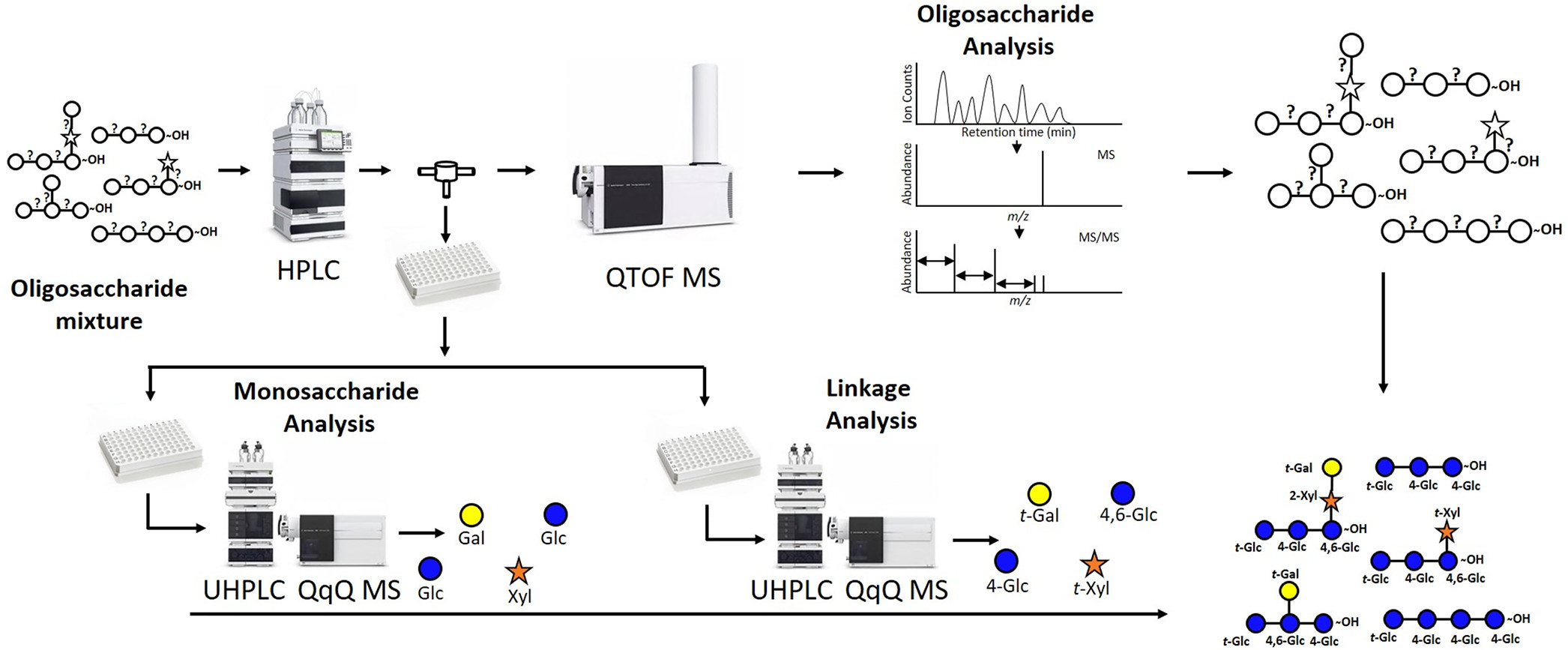
Castillo, J J. et al. Journal of the American Society for Mass Spectrometry, 2021.
Figure 2. Workflow for the De Novo Structural Elucidation of Oligosaccharides Using the LC-MS/MS.
Oligosaccharide Analysis Service at MtoZ Biolabs
MtoZ Biolabs provides analytical services including, but not limited to, the following oligosaccharides:
Why Choose MtoZ Biolabs?
✅ High-Resolution Detection: Integration of multiple analytical platforms enables precise qualitative and quantitative analysis of oligosaccharides.
✅ Multi-Dimensional Structural Elucidation: Simultaneously reveals monosaccharide composition, linkage types, and modification features.
✅ High Data Reliability: Standardized procedures ensure result reproducibility and accuracy.
✅ Professional Technical Support: An experienced analytical team provides customized solutions.
✅ One-Stop Service: Covers the entire process from sample preparation to report generation, offering comprehensive end-to-end support.
Applications of Oligosaccharide Analysis Service
1. Biopharmaceutical Research
Used for structural identification and purity analysis of medicinal oligosaccharides and glycoconjugates, supporting new drug development and quality control.
2. Microbial and Metabolic Studies
Analyzes the synthesis and degradation processes of microbially derived oligosaccharides, revealing their roles in metabolic pathways.
3. Disease Biomarker Discovery
Detects structural variations of oligosaccharides in biological samples to aid in identifying disease-associated glycan biomarkers.
4. Plant and Agricultural Research
Investigates oligosaccharide fragments from plant cell walls and storage polysaccharides to elucidate their roles in growth and stress resistance.
5. Industrial and Fermentation Monitoring
Monitors the production and transformation of oligosaccharides during fermentation processes, providing data support for process optimization.
Deliverables
1. Comprehensive Experimental Details
2. Materials, Instruments, and Methods
3. Oligosaccharide Quantification and Composition Analysis Results
4. Structural Elucidation and Related Spectral Data
5. Bioinformatics Analysis
6. Raw Data Files
FAQ
Q1: What types of samples are suitable?
A1: The oligosaccharide analysis service is suitable for various types of oligosaccharide samples, including natural oligosaccharides, synthetic oligosaccharides, and their derivatives. To ensure stable signals and reliable results, samples should have high purity, be free from proteins, salts, and other interfering impurities, and the concentration should meet the requirements for mass spectrometry or chromatographic analysis.
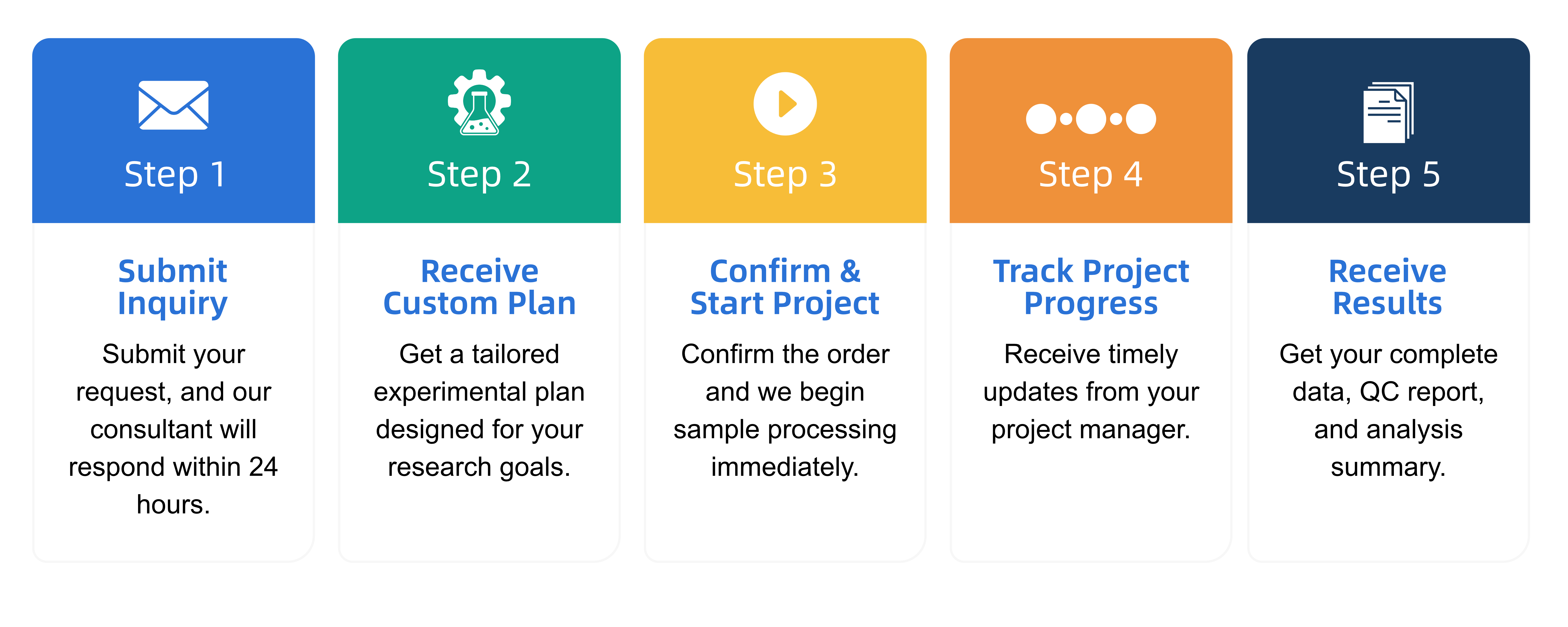
Q2: What is the service general workflow?
A2:
Q3: What data formats are provided?
A3: The service deliverables include standardized and multi-format data outputs to facilitate scientific analysis and further applications. Regular deliverables include:
If special analytical requirements exist, data formats can be customized according to project specifications.
Q4: How should I prepare my samples?
A4: To ensure analytical accuracy and reproducibility, it is recommended that sample preparation follow these guidelines:
(1) Sample form: lyophilized powder or solution forms are acceptable;
(2) Purity: avoid samples containing high salt concentrations or surfactants;
(3) Storage conditions: store at -20℃ for short-term and -80℃ for long-term preservation;
(4) Transportation: transport with cold chain or dry ice, ensuring sealed, leak-proof containers clearly labeled with sample information;
(5) Information provided: specify sample source, concentration, and solvent type to optimize analytical parameters.
For more information, please refer to Sample Submission Guidelines for Proteomics, Sample Submission Guidelines for Metabolomics.
Start Your Project with MtoZ Biolabs
Contact us to discuss your experimental design or request a quote. Whether you are exploring the biological functions of oligosaccharides or studying their structural characteristics and metabolic patterns, MtoZ Biolabs provides professional and precise one-stop analytical support.
How to order?




