






Galactooligosaccharide Analysis Service
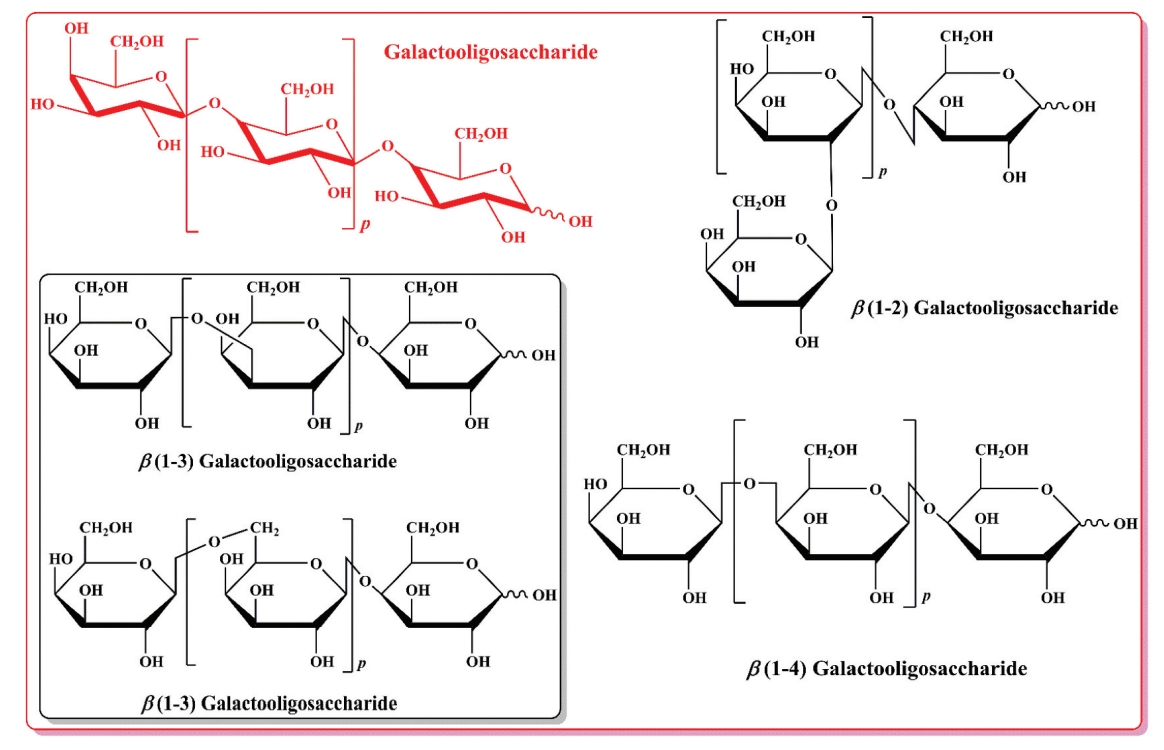
Galactooligosaccharides (GOS) are functional oligosaccharides composed of galactose units linked by β-glycosidic bonds, typically synthesized from lactose through β-galactosidase catalysis. GOS exhibit excellent thermal stability and acid resistance and can selectively promote the proliferation of beneficial bacteria such as bifidobacteria, thereby regulating gut microbiota balance, enhancing immune function, and improving metabolic health. As natural prebiotics, galactooligosaccharides have broad application value in infant nutrition formulas, functional foods, animal feed, and gut microecology research, representing an important research focus for exploring nutritional regulation and health promotion.
Iqbal, M W. et al. Food Reviews International, 2022.
Figure 1. Chemical Structures of GOS Containing β (1-2), β (1-3), and β (1-3) Bonds.
Services at MtoZ Biolabs
Based on advanced instruments and analytical platforms, MtoZ Biolabs provides the galactooligosaccharide analysis service that enables precise qualitative and quantitative detection of galactooligosaccharides. This service analyzes the composition ratio, degree of polymerization distribution, structural characteristics, and modification types of GOS in samples, as well as performs comparative evaluations of samples from different sources. Through high-sensitivity separation and accurate detection, the obtained data reveal the structural differences and physicochemical properties of GOS, providing a scientific basis for quality control and functional research. MtoZ Biolabs offers services including but not limited to the following:
1. Quantitative Analysis
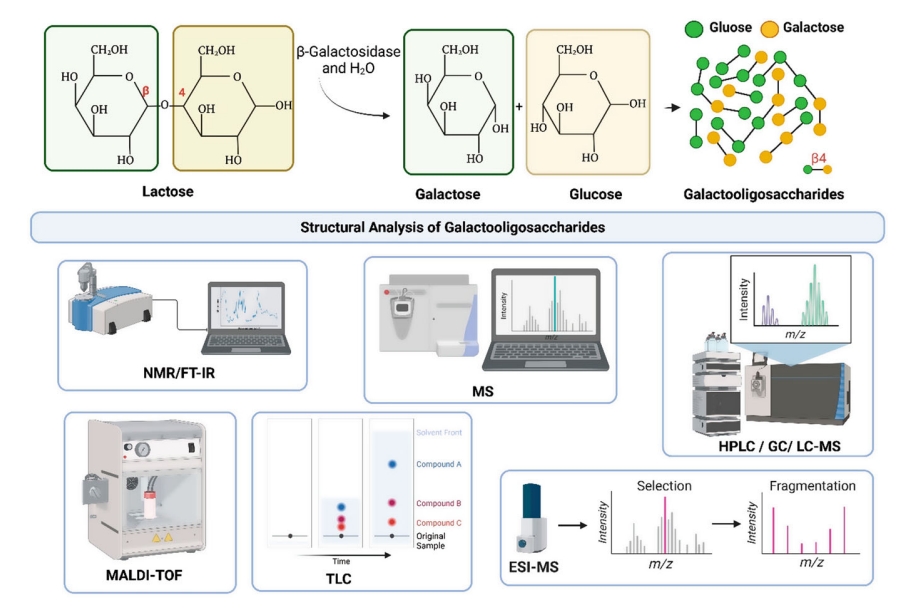
Using HPLC or LC-MS/MS techniques, the content of galactooligosaccharides in samples is accurately measured to ensure reliable results.
2. Composition Analysis
High-resolution detection is employed to analyze the ratio and linkage type of different galactose units, revealing the compositional characteristics of the sample.
3. Structural Characterization
By combining high-resolution mass spectrometry (HR-MS) and nuclear magnetic resonance (NMR), the molecular structure, bonding pattern, and modification types of galactooligosaccharides are determined.
4. Degree of Polymerization Distribution
The distribution of galactooligosaccharides with different degrees of polymerization (DP) is analyzed to assess structural complexity and potential functional differences.
5. Stability Evaluation
The changes in content and structure of galactooligosaccharides under different temperature, pH, and storage conditions are examined to evaluate their physicochemical stability.
6. Metabolic Analysis
Using metabolomic approaches, the metabolic transformation and physiological functions of galactooligosaccharides in biological systems are investigated.
Malçok, S D. et al. Microbial Production of Food Bioactive Compounds, 2025.
Figure 2. Structural Analysis Methods of GOSs.
Sample Submission Suggestions
1. Sample Types
Various sample types are accepted, including plant extracts, fermentation broths, and purified galactooligosaccharide preparations. Liquid, powder, and lyophilized forms are all supported.
Note: Samples should be free from high salt, protein, or organic solvent residues to avoid compromising detection sensitivity and data accuracy.
2. Sample Storage
Samples should be sealed and stored in the dark. For short-term storage, samples can be kept at -20°C, while long-term storage is recommended at -80°C. Avoid repeated freeze-thaw cycles to prevent oligosaccharide degradation.
3. Sample Transportation
Liquid samples should be shipped on dry ice using a cold chain system. Lyophilized samples can be transported at ambient temperature for short durations but must be protected from moisture, high temperatures, and light to ensure galactooligosaccharide stability.
Service Advantages
1. Multi-Dimensional Structural Analysis
Simultaneously analyzes the composition, degree of polymerization, and structural modifications of galactooligosaccharides, providing comprehensive molecular information.
2. Customized Analytical Solutions
Analytical strategies are flexibly designed based on sample origin and research objectives to meet diverse project needs.
3. Strict Quality Control System
Standard calibration and quality control monitoring are implemented throughout the process to ensure data accuracy and reproducibility.
4. One-Stop Service Workflow
Covers the entire process from sample preparation to report generation, offering an efficient and convenient one-stop analytical experience.
Applications
1. Microbial Metabolism Research
The galactooligosaccharide analysis service can be used to investigate the metabolic utilization and degradation characteristics of galactooligosaccharides in different microbial systems.
2. Immunoregulatory Mechanism Studies
By examining the correlation between galactooligosaccharides and immune-related metabolites, this service helps explore their potential roles in immune response regulation.
3. Synthesis and Enzymatic Reaction Optimization
The galactooligosaccharide analysis service enables monitoring of the production efficiency and structural variations of galactooligosaccharides during enzyme-catalyzed synthesis.
4. Structure-Function Relationship Research
By analyzing the structural characteristics of galactooligosaccharides with different degrees of polymerization and linkage types, their effects on biological activity and functional properties can be explored.
FAQ
Q1: Can Different Linkage Types or Modification Forms Be Identified?
A1: Yes. By analyzing mass spectrometry fragment ion information and comparing with standards, different linkage types such as β-1,4 and β-1,6, as well as modifications like acetylation and methoxylation, can be accurately identified.
Q2: Can Galactooligosaccharides Be Analyzed Together with Other Oligosaccharides?
A2: Yes. The platform supports combined analysis of multiple oligosaccharides, allowing simultaneous detection of galactooligosaccharides, fructooligosaccharides, raffinose, and other low-molecular-weight carbohydrates for comprehensive compositional evaluation.
Q3: Is Matrix Effect Considered during Analysis?
A3: Yes. All analytical workflows employ internal standard correction and matrix-matched calibration methods to eliminate ion suppression effects and improve quantitative accuracy.
How to order?




