






Pectic Oligosaccharide Analysis Service
Pectic oligosaccharides (POS) are oligosaccharides composed of monosaccharides such as galacturonic acid, galactose, and rhamnose linked through glycosidic bonds, typically derived from the enzymatic or chemical degradation products of pectins in plant cell walls. Due to their complex structure and favorable physicochemical properties, POS play an important role in plant physiological regulation, cell wall degradation studies, and biomass conversion processes. As intermediates of pectin degradation, POS are crucial in studies related to plant signal transduction, stress responses, and cell remodeling.
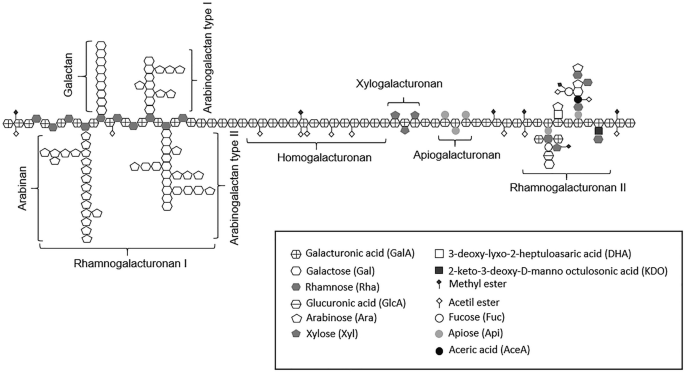
Mazzucotelli, C. et al. Handbook of Food Bioative Ingredients, 2023.
Figure 1. Schematic Representation of the Structure of Pectin.
Services at MtoZ Biolabs
Based on advanced instrumentation and analytical platforms, MtoZ Biolabs offers a comprehensive pectic oligosaccharide analysis service for the qualitative and quantitative detection of pectic oligosaccharides. This service enables detailed analysis of composition, degree of polymerization, branching characteristics, and modification forms such as methylation and acetylation. Through efficient separation and highly sensitive detection, precise data are obtained to evaluate the purity and structural characteristics of samples, providing scientific support for further research and development. MtoZ Biolabs provides, but is not limited to the following services:
1. Quantitative Analysis
Using high-sensitivity chromatography-mass spectrometry platforms, pectic oligosaccharides are accurately quantified to ensure precision and reproducibility of results.
2. Composition Analysis
Determines the ratio and linkage of monosaccharides in pectic oligosaccharides, revealing their compositional characteristics.
3. Structural Characterization
Combines high-resolution mass spectrometry and nuclear magnetic resonance (NMR) to elucidate backbone structures and branching configurations of pectic oligosaccharides.
4. Degree of Polymerization Distribution
Evaluates the distribution of pectic oligosaccharides with different degrees of polymerization, reflecting structural complexity and potential functional differences.
5. Modification Analysis
Detects methylation, acetylation, and other substitution modifications to define structural diversity.
6. Stability Evaluation
Monitors structural changes of pectic oligosaccharides under various storage and environmental conditions to assess their stability for application.
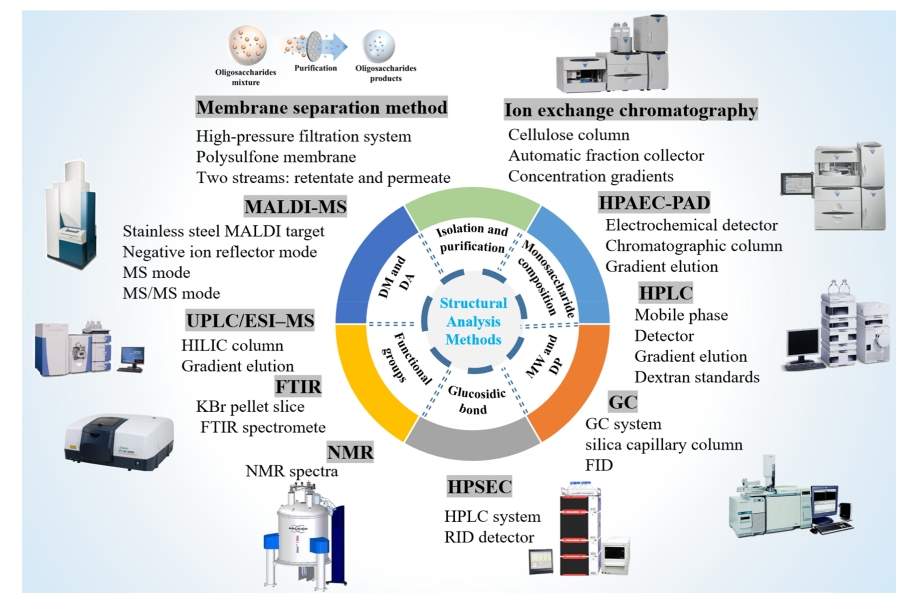
Tang, W. et al. Critical Reviews in Food Science and Nutrition, 2024.
Figure 2. Structural Analysis Methods of POSs.
Sample Submission Suggestions
1. Sample Types
A wide range of sample sources is accepted, including plant extracts, pectin hydrolysates, fermentation products, and purified pectic oligosaccharide preparations. Liquid, powder, and lyophilized sample forms are supported.
Note: Samples should be free of high salt, protein, and organic solvent residues to avoid interference with the accuracy and sensitivity of mass spectrometric detection.
2. Sample Storage
Samples should be sealed and protected from light. For short-term storage, keep at -20°C; for long-term preservation, store at -80°C. Avoid repeated freeze-thaw cycles to prevent structural degradation.
3. Sample Transportation
Liquid samples are recommended to be shipped on dry ice via cold chain transport. Lyophilized samples can be shipped at ambient temperature for short periods but must be protected from moisture, heat, and light to maintain pectic oligosaccharide stability.
Service Advantages
1. High-Resolution Detection
Utilizing advanced analytical platforms, this service enables highly sensitive detection and precise quantification of pectic oligosaccharides.
2. Flexible Analytical Solutions
Customized workflows and data processing strategies are provided according to sample type and research objectives.
3. Rigorous Quality Control
Standard calibration and quality control sample monitoring ensure accuracy and reproducibility of analytical results.
4. One-Stop Service
Covers the entire process from sample preparation to report generation, offering clients an efficient, integrated service experience.
Applications
1. Pectin Degradation Mechanism Study
By analyzing the formation and structural characteristics of pectic oligosaccharides, this service helps elucidate pectin degradation pathways and related enzymatic mechanisms.
2. Polysaccharide Interaction Study
The pectic oligosaccharide analysis service can be used to investigate the binding interactions between pectic oligosaccharides and other polysaccharides or proteins, revealing structure-function relationships.
3. Functional Oligosaccharide Development
Through structural screening and functional evaluation of various types of pectic oligosaccharides, this service supports the development of novel oligosaccharide products.
4. Metabolic Network Analysis
The pectic oligosaccharide analysis Service enables exploration of the roles of pectic oligosaccharides in carbon flux distribution and metabolic regulation.
FAQ
Q1: What Types of Pectic Oligosaccharides Can the Pectic Oligosaccharide Analysis Service Analyze?
A1: This service can detect pectic oligosaccharides with varying degrees of polymerization (DP2-DP10), including structural types derived from high-methoxyl and low-methoxyl pectins, as well as various enzymatic hydrolysis products. It can also distinguish partially substituted or branched forms.
Q2: Do Impurities in the Sample Affect the Analysis Results?
A2: Yes. High salt, protein, or organic solvent residues may cause signal suppression. It is recommended to perform sample purification or use the pretreatment service provided by MtoZ Biolabs to improve result accuracy.
Q3: Can Other Types of Oligosaccharides Be Analyzed Simultaneously?
A3: Yes. The platform supports multi-component co-analysis, allowing simultaneous detection of pectic oligosaccharides, xylooligosaccharides, galactooligosaccharides, and other oligosaccharide species.
How to order?




