






Maltooligosaccharide Analysis Service
- Raw analytical files obtained from LC-MS, HPLC, or NMR platforms;
- Processed result tables (Excel or CSV format) containing retention time, molecular weight, degree of polymerization, and relative abundance information;
- Analytical reports (PDF format) detailing experimental procedures, data quality assessment, and key findings;
- Chromatographic and mass spectrometry image files (TIFF or PNG format) for easy visualization and comparison.
MtoZ Biolabs utilizes high-resolution platforms including HPLC, LC-MS, and NMR to offer the maltooligosaccharide analysis service which enables comprehensive and precise qualitative and quantitative analysis of maltooligosaccharides. This service is applicable to fields such as saccharification process studies, polysaccharide degradation mechanism exploration, and carbohydrate metabolism regulation, providing a reliable data foundation for structural elucidation and functional research.
What Is Maltooligosaccharide?
Maltooligosaccharides is a class of oligosaccharides composed of glucose units linked by glycosidic bonds, typically produced through enzymatic hydrolysis or partial hydrolysis of starch. Due to their simple structure and recognition by various enzymes, maltooligosaccharides hold significant value in studies of carbohydrate metabolism, enzymatic reaction kinetics, and polysaccharide degradation mechanisms. They are widely applied in fields such as biotransformation, fermentation engineering, metabolic pathway analysis, and the development of functional oligosaccharides, providing a crucial research basis for exploring the structure-function relationships and bioavailability characteristics of polysaccharides.

Bláhová, M. et al. Molecules, 2023.
Figure 1. The General Structure of Maltooligosaccharides.
Maltooligosaccharide Analysis Service at MtoZ Biolabs
1. Quantitative Analysis
Using high-sensitivity chromatography-mass spectrometry platforms, maltooligosaccharides with different degrees of polymerization are accurately quantified to ensure data reproducibility and reliability.
2. Purity Analysis
The purity and impurity composition of maltooligosaccharides in samples are evaluated to provide fundamental data for subsequent structural and functional studies.
3. Structural Characterization
Through mass spectrometry and NMR platforms, glycosidic linkage types and structural isomers are identified, revealing the branching features and molecular conformations of maltooligosaccharides.
4. Degree of Polymerization Distribution
The proportional distribution of maltooligosaccharide components with different degrees of polymerization (DP) is determined to study the effect of chain length on physicochemical properties.
5. Stability Evaluation
The structural stability and degradation characteristics of maltooligosaccharides are assessed under various environmental or treatment conditions.
6. Bioactivity Analysis
The biological functions of maltooligosaccharides in different systems are analyzed, providing experimental evidence for studies on their metabolic roles and biological effects.
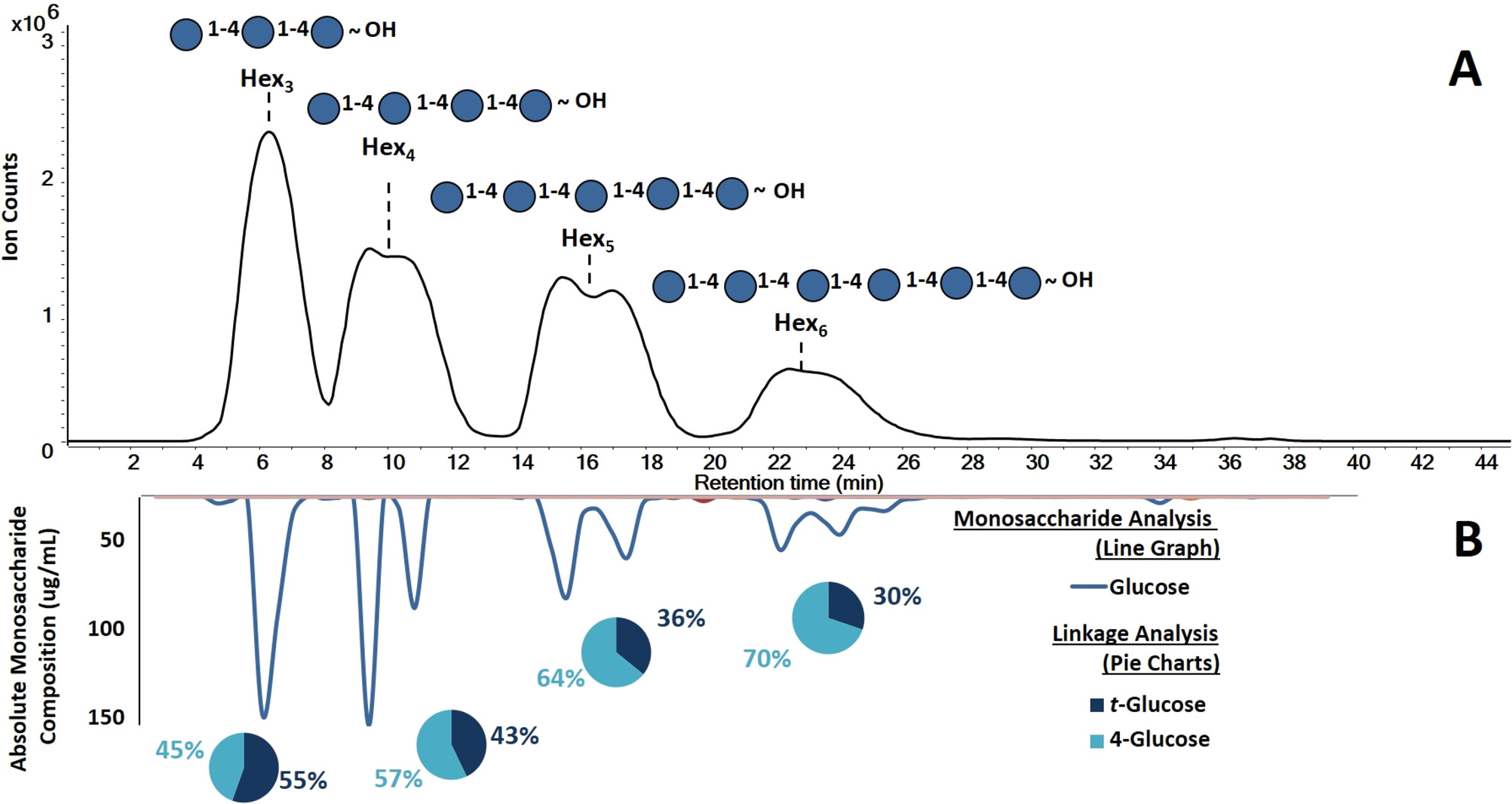
Castillo, J J. et al. Journal of the American Society or Mass Spectrometry, 2021.
Figure 2. Elucidated Maltooligosaccharide Structures Obtained from 3D LC-MS/MS Workflow.
Why Choose MtoZ Biolabs?
✅ High-Sensitivity Detection: Utilizing high-resolution mass spectrometry for precise quantification and structural characterization.
✅ Comprehensive Analysis: Covers multidimensional information including composition, degree of polymerization, structural isomers, and purity.
✅ Customized Solutions: Flexible analytical strategies tailored to sample type and research goals.
✅ Strict Quality Control: Standard calibration and QC monitoring ensure reliable, consistent data.
✅ Expert Team: Skilled in carbohydrate chemistry and MS analysis, delivering accurate data interpretation.
Applications of Maltooligosaccharide Analysis Service
1. Amylase Activity Studies
Evaluate the catalytic efficiency and product distribution of amylase or other glycoside hydrolases acting on maltooligosaccharides.
2. Carbohydrate Metabolism Research
Analyze key intermediates involved in polysaccharide degradation and oligosaccharide metabolic pathways.
3. Fermentation Substrate Monitoring
Track the degree of starch degradation and compositional changes of sugars during processing.
4. Drug Delivery and Biomaterial Development
Assess the stability and interaction characteristics of maltooligosaccharides in delivery systems or functional materials.
5. Nutritional and Functional Studies
Investigate the potential roles of maltooligosaccharides in gut microbial metabolism and health promotion.
Deliverables
1. Comprehensive Experimental Details
2. Materials, Instruments, and Methods
3. Quantitative Data Tables for Maltooligosaccharides
4. Structural Characterization Results and DP Distribution Profiles
5. Raw Mass Spectrometry and Chromatography Data Files
6. Bioinformatics Analysis
FAQ
Q1: What Types of Samples Are Suitable?
A1: The maltooligosaccharide analysis service provided by MtoZ Biolabs is applicable to various types of carbohydrate samples, including purified maltooligosaccharides, enzymatic hydrolysates, fermentation liquids, plant tissue extracts, and other related biological samples. To ensure stable analytical results, samples are recommended to be free of visible impurities, suspended particles, or protein residues, and should undergo appropriate desalting or filtration treatment.
Q2: What Is the Service General Workflow?
A2:

Q3: What Data Formats Are Provided?
A3: MtoZ Biolabs offers standardized and multi-format data delivery solutions to ensure that the results can be directly used for scientific analysis and publication. The standard deliverables include:
If special analytical requirements exist, data formats can be customized according to project specifications.
Q4: How Should I Prepare My Samples?
A4: To ensure the accuracy and reproducibility of maltooligosaccharide analysis, MtoZ Biolabs recommends that clients follow the guidelines below before sample submission:
(1) Sample type: Suitable for liquid samples or lyophilized powders;
(2) Sample purity: Avoid high concentrations of salts, lipids, surfactants, or other interfering components;
(3) Storage conditions: For short-term storage, keep at -20℃; for long-term storage, store at -80℃;
(4) Transportation: It is recommended to ship samples on dry ice using sealed, leak-proof containers;
(5) Additional information: Please provide details on sample origin, pretreatment steps, and intended analysis objectives so that we can offer the most appropriate analytical solution.
For more information, please refer to Sample Submission Guidelines for Proteomics, Sample Submission Guidelines for Metabolomics.
Start Your Project with MtoZ Biolabs
Contact us to discuss your experimental design or request a quote. Whether you are exploring the structural characteristics of maltooligosaccharides or investigating their roles in metabolic or biological systems, we can provide you with precise and reliable analytical support.
How to order?




