






Stachyose Analysis Service
Stachyose is a natural tetrasaccharide composed of two galactose molecules, one glucose molecule, and one fructose molecule. It belongs to the raffinose family of oligosaccharides (RFOs) and is widely found in leguminous plants, tubers, and seeds. In plants, it participates in energy storage, carbon metabolism, and stress regulation, playing an important role in seed germination and responses to environmental stress. Stachyose is not only of great significance in plant physiological research but has also attracted attention for its prebiotic effects and potential to promote intestinal health. Stachyose analysis is widely applied in fields such as plant metabolism research, nutritional evaluation, fermentation process optimization, and the development of functional oligosaccharide products.
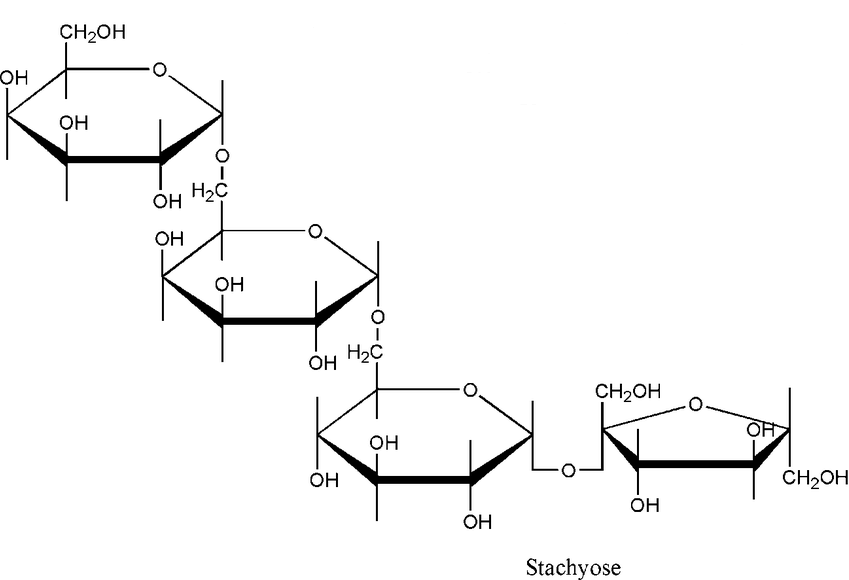
Meyer, T S M. et al. Food Production and Industry, 2015.
Figure 1. Stachyose.
Services at MtoZ Biolabs
Baesd on advanced analytical platforms, MtoZ Biolabs has launched the stachyose analysis service which enables precise quantification and structural characterization of stachyose in various samples. Through high-resolution separation and highly sensitive detection, this service provides comprehensive analysis of stachyose content, purity, and molecular structure, and integrates metabolic analysis to evaluate its distribution and stability in different biological systems. The results obtained offer a solid scientific basis and reliable data support for further research on stachyose. MtoZ Biolabs offers services including but not limited to the following:
1. Quantitative Analysis
Using HPLC or LC-MS/MS, the stachyose content in samples is precisely measured to ensure accurate and reliable data.
2. Purity Analysis
High-resolution separation and detection are employed to assess the purity of stachyose and identify possible impurities, providing a basis for quality control.
3. Structural Characterization
High-resolution mass spectrometry (MS) and nuclear magnetic resonance (NMR) techniques are used to elucidate the molecular structure and configurational characteristics of stachyose, revealing its chemical composition.
4. Metabolomic Analysis
By applying metabolomic strategies, the distribution, metabolic pathways, and dynamic changes of stachyose in different biological systems are analyzed.
5. Stability Evaluation
The content and structural variations of stachyose under different temperature, pH, and storage conditions are examined to evaluate its physicochemical stability and applicability.
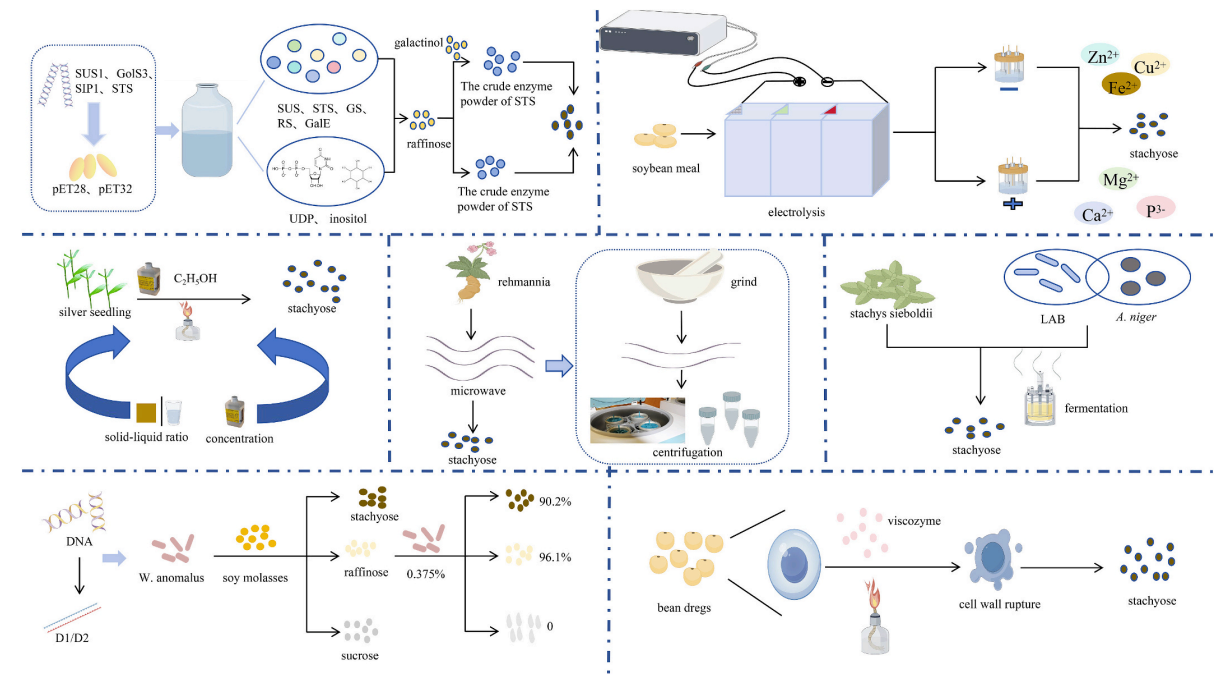
Ta, X T. et al. Food Chemistry, 2024.
Figure 2. The Main Extraction Strategies of Stachyose and Its Main Influencing Factors.
Sample Submission Suggestions
1. Sample Types
Various types of samples are accepted, including plant tissues, seed extracts, biological samples, and purified stachyose or stachyose formulations. Liquid, powder, and lyophilized forms are all supported.
Note: Samples should be free from high salt, protein, or organic solvent residues to avoid interference with analytical results.
2. Sample Storage
Samples should be sealed and protected from light. For short-term storage, samples can be kept at -20°C, while long-term storage is recommended at -80°C. Repeated freeze-thaw cycles should be avoided to prevent degradation.
3. Sample Transportation
Liquid samples are recommended to be transported on dry ice through a cold chain system. Lyophilized samples may be shipped at ambient temperature for short periods but must be protected from moisture, high temperatures, and light to ensure stachyose stability.
Service Advantages
1. High-Sensitivity Detection Platform
Supported by advanced analytical systems, high-resolution separation and precise quantification of stachyose are achieved to ensure data accuracy and reliability.
2. Professional Analytical Team
A team composed of experienced analytical experts and metabolomics researchers ensures the scientific rigor and reliability of experimental design and data interpretation.
3. Multi-Platform Integrated Analysis
Depending on project requirements, multiple analytical platforms such as HPLC, GC-MS, LC-MS/MS, and NMR can be combined to achieve comprehensive result verification.
4. Customized Solutions
Tailored analytical strategies and data processing workflows are provided according to different sample types and research objectives to enhance specificity and efficiency in research outcomes.
Applications
1. Plant Metabolism Research
The stachyose analysis service can be used to study the role of stachyose in carbon flow distribution and metabolic regulation in plants, revealing its accumulation patterns.
2. Stress Resistance Mechanism Research
By analyzing changes in stachyose content under drought, low-temperature, or salt stress conditions, this service helps explore its protective mechanisms in plant stress responses.
3. Microbial Function Research
By investigating the role of stachyose in microbial energy metabolism and carbon source utilization, this service supports the screening and optimization of industrial microbial strains.
4. Agricultural Breeding Research
The stachyose analysis service can be applied to screen crop varieties with high stress resistance or enhanced energy storage capacity, supporting quality improvement and molecular breeding studies.
FAQ
Q1: Can Accurate Differentiation and Quantification Be Achieved When Both Stachyose and Raffinose Are Present in the Sample?
A1: Yes. The high-resolution HPLC-MS/MS system at MtoZ Biolabs can accurately distinguish structurally similar oligosaccharides based on characteristic retention time, parent ion mass, and fragment ion spectra. Combined with selected ion monitoring (SIM) and multiple reaction monitoring (MRM) modes, high-specificity quantification of both stachyose and raffinose can be achieved simultaneously.
Q2: Will Stachyose Degrade Due to Chemical Conditions during Sample Pretreatment?
A2: There is a certain risk. Stachyose is sensitive to strong acids, strong bases, and high temperatures, and may undergo degradation or isomerization during extraction and concentration. MtoZ Biolabs employs mild extraction systems and carefully controls temperature and pH to maximize structural stability and ensure quantitative accuracy.
Q3: Are Different Analytical Methods Required for Various Biological Systems (Plant, Microbial, or Animal Samples)?
A3: Yes. The matrix composition varies significantly among different biological systems, necessitating tailored pretreatment methods. MtoZ Biolabs customizes optimized workflows for different sample types to improve the signal-to-noise ratio and minimize matrix effects.
How to order?




