


Post-Translational Modifications (PTMs) in Proteomics Research
What Are Post-Translational Modifications (PTMs)?
Proteins undergo various changes after their synthesis, allowing cells to regulate protein activity, stability, localization, and interactions. One important form of regulation is post-translational modification (PTM), in which chemical groups or other molecular components are covalently attached to proteins or specific amino acid residues after translation. PTMs alter charge, hydrophobicity, steric bulk, or the availability of interaction surfaces, and can change activity, localization, stability, or partner recruitment (Mann and Jensen 2003).
PTMs expand the functional diversity of proteins beyond what is encoded directly by their amino acid sequences. A single protein may undergo multiple types of modifications, and different modification patterns can influence its biological behavior under different cellular conditions.
Understanding PTMs is important because changes in protein abundance alone do not fully explain how cells regulate protein function. Modification-specific information provides another level of evidence for investigating cellular signaling, metabolic regulation, protein degradation, gene expression, and responses to environmental or experimental stimuli.
PTM proteomics uses proteomic approaches, particularly mass spectrometry (MS), to investigate modified proteins and peptides on a broader scale. It helps identify modification types, characterize modified sites, and compare modification-associated signals across experimental conditions. For researchers planning a PTM study, MtoZ Biolabs offers Post-Translational Modifications Proteomics Service. You are also welcome to contact our team to discuss your target modification, sample type, and research objectives.
Major Types of Protein Post-Translational Modifications
Protein post-translational modifications encompass a broad range of chemical and enzymatic processes. Different PTM types involve distinct amino acid residues, modifying groups, and biological functions.
|
PTM Type |
Main Modification Feature |
Research Focus |
|---|---|---|
|
Addition of a phosphate group, primarily to serine, threonine, or tyrosine residues |
Cell signaling, kinase activity, and signal transduction |
|
|
Attachment of carbohydrate structures to proteins, commonly through N-linked or O-linked glycosylation |
Protein folding, stability, cell recognition, and extracellular interactions |
|
|
Covalent attachment of ubiquitin to target proteins, typically through lysine residues |
Protein degradation, trafficking, and cellular signaling |
|
|
Addition of an acetyl group, frequently to lysine residues or protein N-termini |
Chromatin regulation, protein activity, and metabolic processes |
|
|
Addition of one or more methyl groups, commonly to lysine or arginine residues |
Chromatin regulation, transcription, and protein interactions |
|
|
Covalent attachment of small ubiquitin-like modifier (SUMO) proteins, typically to lysine residues |
Nuclear organization, transcriptional regulation, and stress responses |
|
|
Addition of a lactyl group, commonly to lysine residues |
Metabolic regulation and gene expression |
|
|
Addition of different acyl groups, such as succinyl, crotonyl, and malonyl groups, commonly to lysine residues |
Metabolic regulation and protein functional diversity |
|
|
Formation of a covalent disulfide bond (S–S) between two cysteine residues through oxidation of their thiol groups |
Protein folding, structural stability, and redox regulation |
Different PTM types offer distinct perspectives on protein regulation and require different analytical approaches. Explore our articles on phosphorylation profiling and comparative analysis, glycosylation site and glycoform characterization, and ubiquitinated protein and modification site identification to learn more about these research areas.
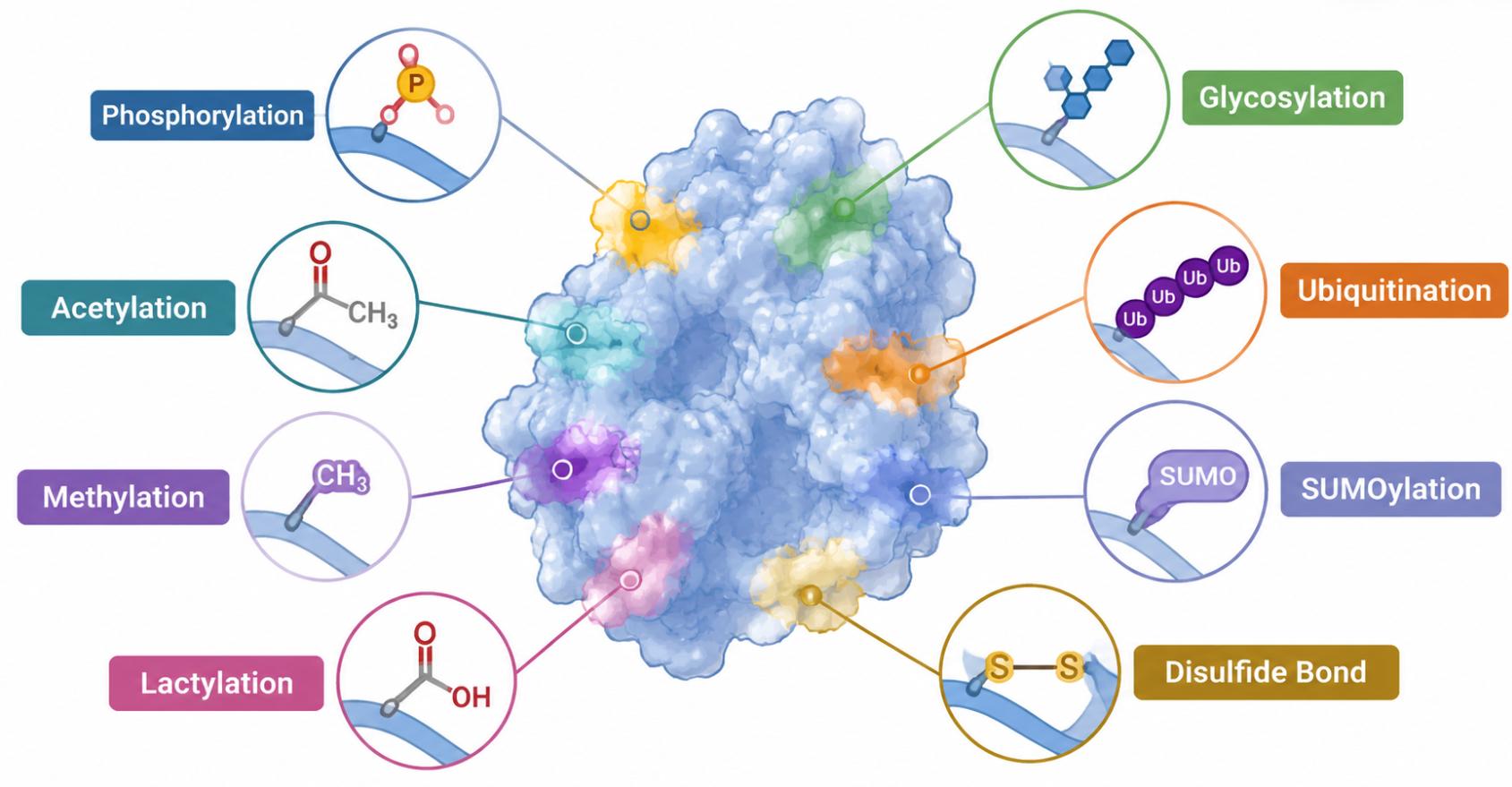
Figure 1. Representative Protein Post-Translational Modifications and Their Molecular Features.
PTM research can also focus on particular protein families rather than one modification type across the entire proteome. Histones are an important example. These proteins undergo multiple modifications, including acetylation, methylation, phosphorylation, ubiquitination, and lactylation.
Histone PTM research examines how modification patterns relate to chromatin organization and gene expression. Because several modification types can occur on histones, studying their distribution and combinations provides a way to investigate complex regulatory patterns. For a more focused introduction to this research area, explore Exploring Histone Post-Translational Modifications.
What Can PTM Proteomics Reveal?
PTM proteomics provides several complementary levels of information. The value of an analysis depends not only on identifying modified proteins but also on determining where modifications occur and how their associated signals change under different experimental conditions.
1. Identification of Modified Proteins and Peptides
One fundamental objective of PTM proteomics is to identify proteins and peptides carrying specific modifications.
2. Identification and Localization of Modification Sites
Identifying a modified protein does not necessarily establish which amino acid residue carries the modification.
However, the confidence of site localization depends on the quality and coverage of the fragmentation evidence.
3. Quantification of Modification Changes
PTM proteomics can also compare modification-associated signals across experimental conditions.
Importantly, changes in modified peptide abundance do not always indicate changes in modification levels independently of protein abundance. A modified peptide signal may increase because the corresponding protein becomes more abundant.
MtoZ Biolabs provides PTM Quantitative Analysis Services to support comparative PTM research.
4. Investigation of Target Protein Modifications
PTM research can also focus on a specific protein of interest. This approach is useful when a candidate protein has already been identified through previous experiments or literature evidence, and the research objective is to investigate its modification status or specific modification sites. Depending on the research question, modification-specific evidence can help characterize the relationship between a protein and its potential regulatory modifications.
How Does Mass Spectrometry-Based PTM Analysis Work?
Mass spectrometry-based PTM analysis combines sample preparation, modification-specific enrichment when appropriate, liquid chromatography-tandem mass spectrometry (LC-MS/MS), and bioinformatics to characterize protein modifications.
1. Study Design and Sample Preparation
The analysis begins with defining the research objective, target modification, sample type, and experimental conditions.
2. Protein Extraction and Enzymatic Digestion
Proteins are extracted from the biological material and typically digested into peptides using proteolytic enzymes such as trypsin.
3. PTM-Specific Enrichment
Some modified peptides occur at relatively low abundance compared with unmodified peptides. Enrichment can increase the representation of target modified peptides before mass spectrometry analysis.
4. LC-MS/MS Data Acquisition
After sample preparation, peptides are separated by liquid chromatography (LC) and analyzed using tandem mass spectrometry (MS/MS).
5. Database Searching and Modification Identification
MS/MS data are processed using proteomic database-searching tools. The search parameters include relevant variable or fixed modifications, depending on the experimental design.
6. Quantification and Downstream Analysis
When quantitative comparisons are included, modified peptide signals are analyzed across experimental groups.
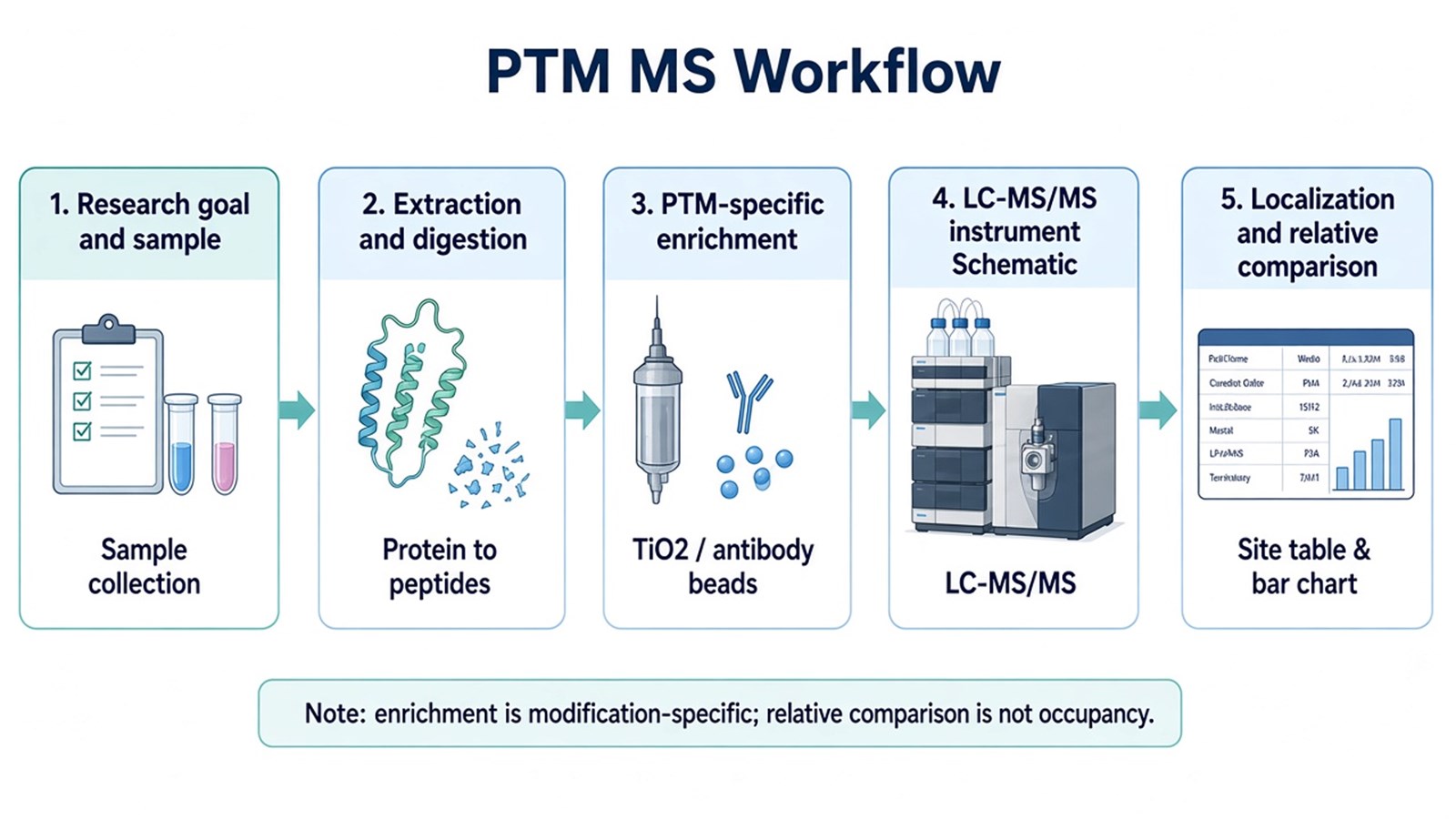
Figure 2. PTM workflow from research goal and sample to enrichment, LC-MS/MS, localization, and relative comparison.
How Do Research Goals Shape a PTM Analysis Strategy?
PTM analysis should be planned around the biological question. Several factors help determine the most appropriate analytical strategy.
1. Global Modification Profiling or Target Protein Investigation
A study may aim to characterize a broad range of modified proteins within a biological sample or investigate modifications associated with a specific protein.
- Global profiling is useful when the objective is to discover modification patterns across a protein population and identify potential candidates for further research.
- Target protein investigation is more focused. It is appropriate when a protein of interest has already been identified and the study seeks evidence of its modification status or modification sites.
These approaches address different research objectives and can complement one another during different stages of a project.
2. Modification Identification or Quantitative Comparison
Another important consideration is whether the study primarily requires modification identification or comparison across experimental conditions.
- Modification identification: Focuses on identifying modified proteins, peptides, and associated sites.
- Quantitative comparison: Examines differences in modification-associated signals between experimental groups.
- Combined identification and quantification: Integrates modification characterization with comparative analysis to investigate condition-associated changes.
The expected output should be defined before selecting the analytical workflow, particularly when quantitative comparisons are central to the study.
3. Selection of the Target Modification
Different PTM types have different chemical characteristics and analytical requirements.
4. Discovery and Candidate Validation
PTM studies may be conducted as discovery-oriented investigations or as follow-up analyses of previously identified candidates.
Planning a PTM Study: Samples, Controls, and Replicates
A well-designed PTM study begins with a clearly defined biological question and an experimental design that supports meaningful comparisons.
Before starting an analysis, several factors should be considered:
- Biological material: Define the species, tissue, cell type, or other biological source being investigated.
- Target modification: Specify the PTM type or modification class of interest.
- Experimental conditions: Describe the treatment, stimulation, disease model, genetic modification, or other conditions being compared.
- Experimental groups: Establish the control and treatment groups according to the research hypothesis.
- Biological replicates: Include sufficient independent biological replicates to characterize biological variation and support statistical comparisons.
- Sample handling: Consider collection, storage, and processing conditions that may affect protein integrity or modification stability.
- Existing research evidence: Provide candidate proteins, known modification sites, or previous proteomic results when available.
The number of samples, required protein input, and preparation strategy may vary according to the target modification, sample matrix, and analytical objective. Therefore, sample requirements should be considered together with the selected workflow rather than applying one universal preparation protocol to every PTM study.
How to Interpret PTM Proteomics Results
PTM proteomics results can contain several types of information. Understanding what each output represents helps researchers connect analytical findings with their biological questions.
|
Result Type |
What It Shows |
Research Value |
|
Modified protein identification |
Proteins associated with the target modification |
Identifies candidate proteins for further investigation |
|
Modified peptide identification |
Peptide sequences carrying modification-associated evidence |
Provides peptide-level evidence of modification |
|
Modification-site localization |
Amino acid positions supported by MS/MS evidence |
Helps identify potential regulatory residues |
|
Quantitative matrix |
Relative signals of modified peptides across samples |
Supports comparisons between experimental conditions |
|
Differential modification analysis |
Modified peptides or sites showing statistical differences |
Identifies candidates associated with experimental changes |
|
GO/KEGG enrichment |
Functional categories and pathways associated with identified proteins |
Provides biological context for the findings |
|
Protein-protein interaction (PPI) analysis |
Known or predicted relationships among identified proteins |
Helps explore potential functional connections |
These results should be interpreted at the appropriate level of evidence.
For example, identifying a modified protein does not automatically establish a specific modification site. Similarly, a statistically different modified peptide signal does not necessarily indicate an equivalent change in modification occupancy.
When interpreting quantitative results, it is important to consider the abundance of the corresponding total protein. Functional enrichment and protein interaction analyses can help generate biological hypotheses, but they do not independently establish causal relationships.
A combination of modification identification, site-level evidence, quantitative comparison, and complementary validation can provide a more comprehensive understanding of PTM-associated regulation.
Frequently Asked Questions
1. Can relative PTM fold changes be reported as site occupancy?
No. Occupancy compares modified and unmodified forms of the same site on a calibrated scale. Relative enriched-peptide signals without that design are condition comparisons, not occupancy percentages.
2. When Does a PTM Project Need Enrichment?
When the modified peptides are sparse relative to the unmodified peptide background, enrichment raises the chance of detecting the target chemistry. The enrichment route must match the modification class.
3. Does the Identification of a Modified Protein Confirm Its Biological Function?
No. Identifying a modified protein or site provides molecular evidence of a modification but does not independently establish its functional consequences. Additional experiments, such as targeted validation, mutagenesis, or functional assays, may be needed to investigate the biological role of a specific modification.
4. What Is PTM Crosstalk?
PTM crosstalk refers to interactions between different post-translational modifications that influence one another's occurrence or biological effects. For example, two modifications may compete for the same amino acid residue, occur at neighboring sites, or participate in coordinated regulatory processes. Studying PTM crosstalk helps investigate how multiple modifications collectively contribute to protein regulation.
5. What Are the Differences Between Bottom-Up, Middle-Down, and Top-Down PTM Analysis?
These approaches differ in how proteins are prepared and analyzed by mass spectrometry:
- Bottom-Up: Proteins are digested into peptides before analysis. It is widely used for large-scale PTM identification, site localization, and quantitative profiling.
- Middle-Down: Proteins are partially digested into larger peptide fragments, helping preserve information about multiple nearby modification sites.
- Top-Down: Intact proteins are analyzed without prior digestion, allowing characterization of proteoforms and combinations of modifications on individual protein molecules.
Start Your Project with MtoZ Biolabs
MtoZ Biolabs provides mass spectrometry-based PTM analysis services covering multiple modification types and research requirements. Whether your project focuses on global modification profiling, specific protein modifications, or quantitative comparisons, our team can help determine an appropriate analytical approach.
Explore our PTM Identification Services and PTM Quantitative Analysis Services to learn more about the available analytical options. You are also welcome to contact our team for a free consultation to discuss your target modifications, sample requirements, and research objectives.
Reference
- M. Mann, O.N. Jensen (2003). Proteomic analysis of post-translational modifications. Nat. Biotechnol., 21, 255-261. https://doi.org/10.1038/nbt0303-255
- S.A. Beausoleil, J. Villen, S.A. Gerber, J. Rush, S.P. Gygi (2006). A probability-based approach for high-throughput protein phosphorylation analysis and site localization. Nat. Biotechnol., 24, 1285-1292. https://doi.org/10.1038/nbt1240
How to order?