






Glycoproteomics: Analysis of Protein Glycosylation Sites and Glycoforms
Protein glycosylation is a heterogeneous post-translational modification in which carbohydrate structures are attached to proteins. Differences occur in both glycosylation site occupancy and the glycan structures present at each occupied site. Glycoproteomics uses mass spectrometry to characterize glycosylated proteins by linking glycan information to specific peptides and proteins. It helps researchers identify glycoproteins, localize glycosylation sites, characterize site-specific glycoforms, and compare glycosylation profiles across experimental conditions. (Thaysen-Andersen and Packer 2014)
If you are considering glycoproteomics analysis for your research, you can explore the MtoZ Biolabs Glycoproteomics Analysis Service. For an overview of other protein modification types, see Post-Translational Modifications (PTMs) in Proteomics Research.
What Is Protein Glycosylation?
Protein glycosylation is a post-translational modification in which carbohydrate structures, known as glycans, are attached to proteins through covalent bonds. This modification can influence protein folding, stability, trafficking, molecular recognition, and interactions with other molecules. Glycosylation is heterogeneous because proteins can carry glycans at different sites and with different structures. These variations contribute to the diversity of glycoproteins and their biological functions.
Glycoproteins, Glycopeptides, and Glycosylation Sites
A glycoprotein is a protein carrying one or more attached glycans. The amino acid residues where glycans are attached are called glycosylation sites. Following enzymatic digestion, glycoproteins generate glycopeptides, which retain both the peptide sequence and its attached glycan. Mass spectrometry-based glycoproteomics analyzes these glycopeptides to connect glycan information with specific protein sequences and glycosylation sites. This site-specific information distinguishes glycoproteomics from released-glycan analysis, which examines glycans after they have been detached from their carrier proteins.
Major Types of Protein Glycosylation
Protein glycosylation is commonly classified into N-linked and O-linked glycosylation according to the amino acid residue and chemical linkage involved.
- N-linked glycosylation: Glycans attach to the nitrogen atom of asparagine (Asn), commonly within the sequence motif Asn-X-Ser/Thr, where X is any amino acid except proline. This sequence identifies potential N-glycosylation sites, but actual site occupancy requires experimental evidence.
- O-linked glycosylation: Glycans attach to the oxygen atom of serine (Ser) or threonine (Thr). Unlike N-linked glycosylation, O-linked glycosylation generally lacks a universal sequence motif, making site prediction and localization more challenging.
Important O-linked forms include mucin-type O-glycosylation and intracellular O-GlcNAcylation. These forms differ in their glycan structures and biological contexts.
Understanding Glycoforms
A glycoform refers to a protein or site-specific protein form carrying a particular glycan structure. Different glycoforms can occur at the same glycosylation site, contributing to site-specific glycosylation heterogeneity.
Common N-linked glycan types include:
- High-mannose: Glycans containing predominantly mannose residues.
- Hybrid: Glycans combining features of high-mannose and complex-type structures.
- Complex: Glycans containing different monosaccharides arranged in branched structures.
O-linked glycoforms also exhibit structural diversity, with different core structures such as Core 1 and Core 2. Additional variations, including fucosylation and sialylation, further increase glycan diversity.
Characterizing these glycoforms helps researchers investigate how glycan structures vary across protein sites and experimental conditions.
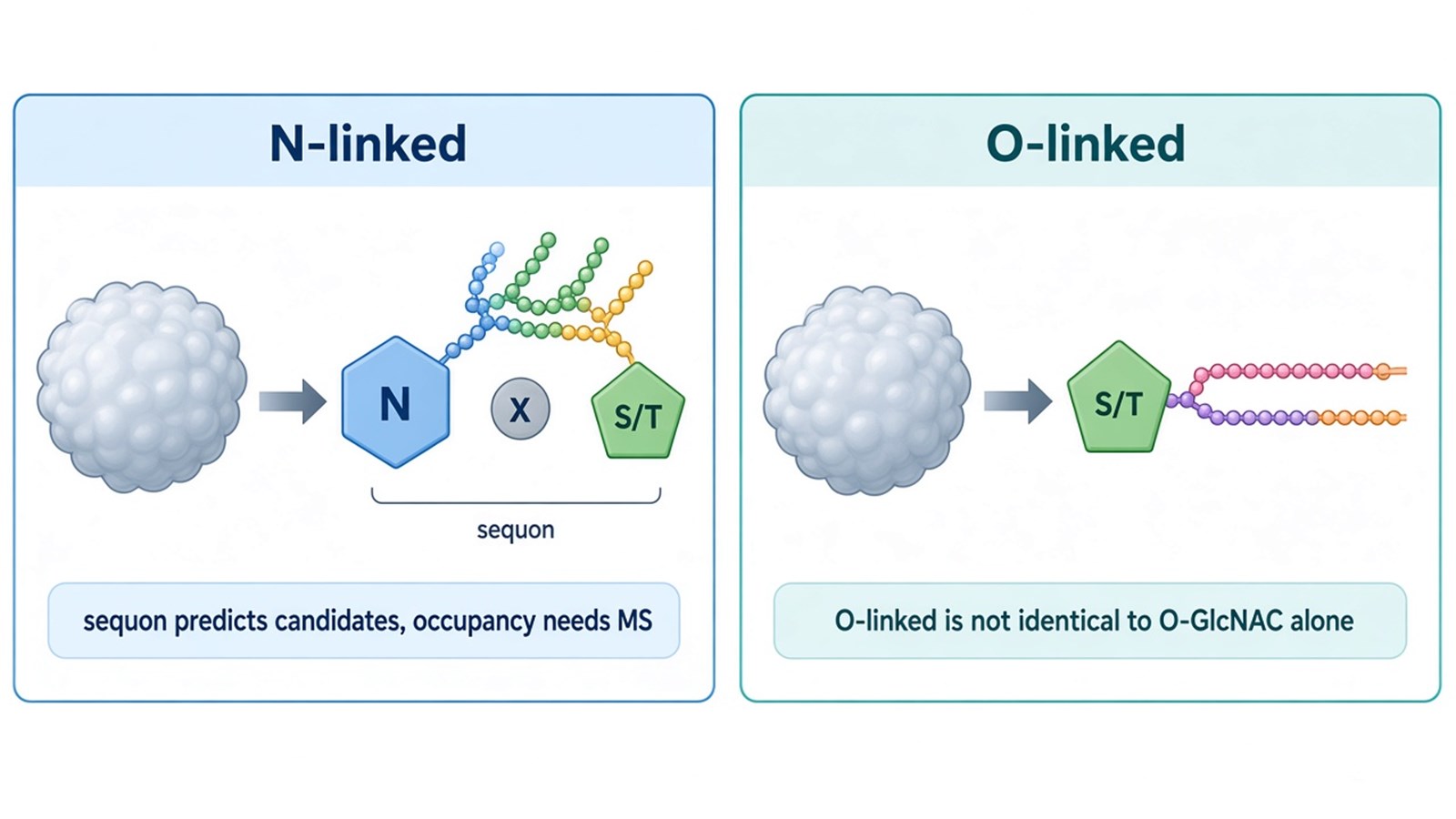
Figure 1. N-linked Asn glycosylation and O-linked Ser/Thr glycosylation create different site-prediction and localization problems for glycoproteomics.
Glycopeptide Preparation and Enrichment for LC-MS/MS
Protein Digestion and Glycopeptide Preparation
Proteins are digested into peptides so that glycopeptides are generated and can subsequently be enriched, separated, and fragmented. Enzyme choice determines whether a given site ends up on a peptide that ionizes and fragments efficiently.
Glycopeptide Enrichment Before Mass Spectrometry
Glycopeptides are enriched before LC-MS/MS because they are often outnumbered by non-glycosylated peptides. HILIC-based enrichment is a common route. Lectin enrichment can be applied when the specificity of the lectin matches the glycan class of interest. Enrichment choices for other PTM classes are summarized in How to Choose a PTM Enrichment Strategy for LC-MS/MS Analysis.
Intact Glycopeptide Analysis vs. Deglycosylation-Based Site Mapping
Intact glycopeptide analysis retains the glycan on the peptide, so that each entry can specify which glycan is present at which site. Enzymatic deglycosylation releases the glycan and can leave a defined mass signature at the previously occupied site. That signature supports mapping of occupied sites, while the glycoform list is derived from the intact glycopeptide data. Identification of these glycopeptides is described in the Glycopeptide Identification Service.
LC-MS/MS Identification of Glycosylation Sites and Glycoforms
Glycan-Derived Ions and Peptide Backbone Fragments
Oxonium ions and other glycan-derived fragments show that a precursor carries a glycan. Backbone fragments define the peptide sequence and provide the ions from which the attachment residue is assigned.
Glycosylation Site Localization in Peptide Sequences
When a glycopeptide contains more than one Asn, Ser, or Thr residue that could carry the glycan, the site is assigned from backbone fragments that differ between the candidate positions. Shared site-localization practice is outlined in How Are Post-Translational Modification Sites Identified and Localized?. Site-level glycoprotein analysis is offered through the Glycosylation Site Analysis Services.
Glycan Composition Assignment and Structural Characterization
Precursor mass and fragments usually define a monosaccharide composition: which sugars are present and how many of each. Isomers that share a composition remain unresolved until branching and linkage are determined by a method designed for that structural question.
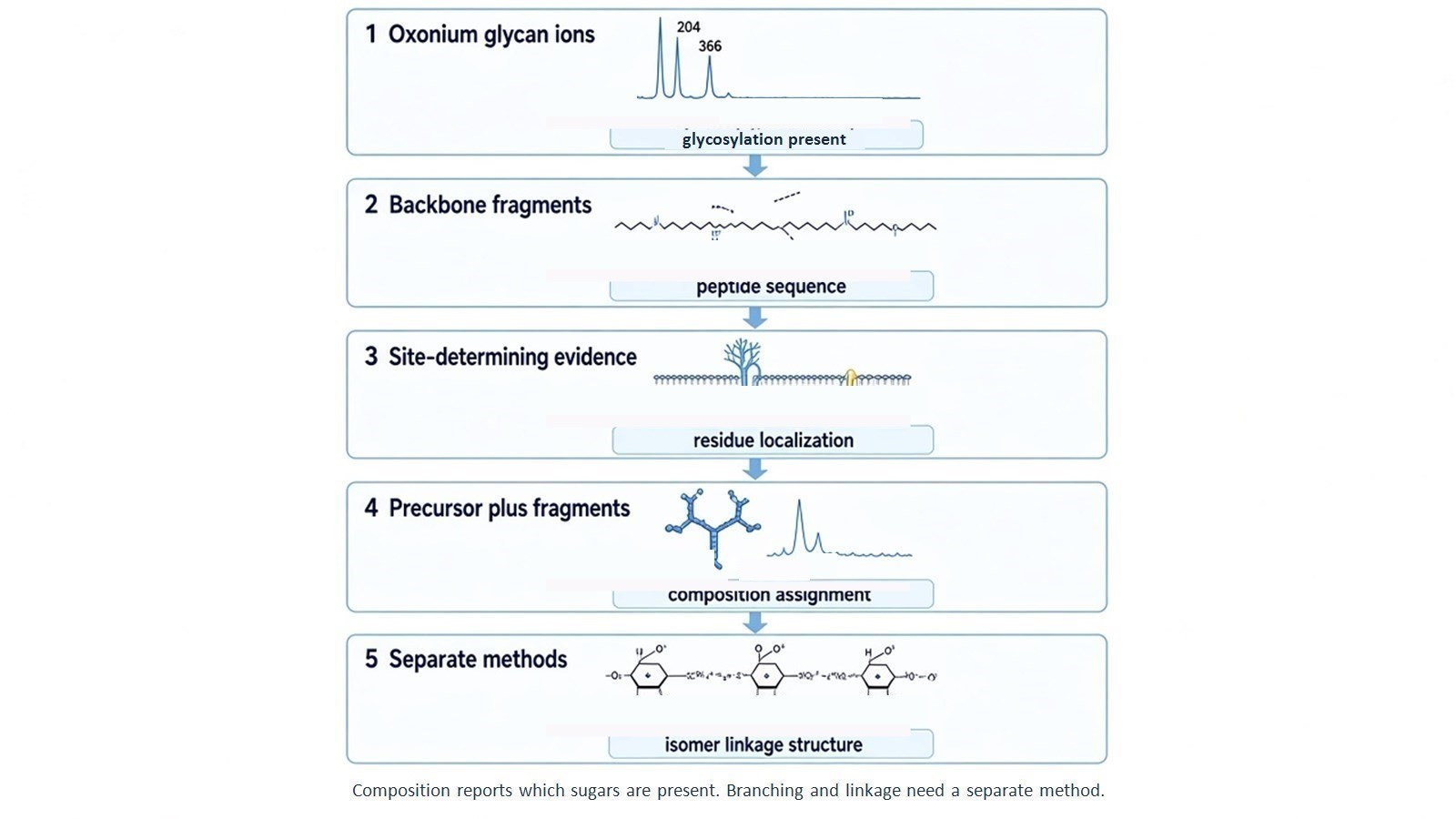
Figure 2. Oxonium ions show that a glycan is present, backbone fragments support the peptide sequence, site-determining fragments name the residue, and precursor mass supports the sugar composition.
Interpreting Glycoproteomics Results: Glycosylation Sites and Glycoform Profiles
Protein and Site-Level Identification Results
Typical tables list glycoproteins, glycopeptides, site positions, and assigned compositions or glycoform features. Coverage depends on enrichment, digestion, and acquisition depth.
Site-Specific Glycoforms and Glycosylation Heterogeneity
Microheterogeneity is the set of glycoforms found at one site. Macroheterogeneity is which candidate sites are occupied. The result table records those two findings separately.
Comparing Glycosylation Profiles Across Experimental Conditions
Across conditions, glycopeptide or glycoform signals are compared between groups. Such a comparison gives a relative difference between samples, whereas site occupancy — the fraction of protein molecules carrying the glycan at that site — requires a separate measurement. How relative PTM quantification should be interpreted is explained in How Is PTM Quantification Used to Compare Modification Changes Across Conditions?.
Frequently Asked Questions
Which fragments name the glycosylation site?
The site is named by backbone fragments that differ among the candidate residues. Oxonium ions indicate that the precursor carries a glycan.
What does a glycan composition include?
It lists the sugars present and how many of each, for example hexose and HexNAc. Branching and the glycosidic linkages between sugars require a method designed for structural questions.
How are O-GlcNAc and other O-linked glycans handled?
Mucin-type O-glycans and O-GlcNAc require different enrichment strategies. The glycan class must therefore be specified in advance, because both the enrichment approach and the site-assignment criteria depend on it.
Conclusion
Glycoproteomics connects proteins, sites, and the glycans on those sites. Intact glycopeptide data establish which glycan is present at which site, and deglycosylation supports mapping of occupied sites. Glycoprotein site and glycoform projects are supported through the MtoZ Biolabs Glycoproteomics Analysis Service.
Reference
- M. Thaysen-Andersen, N.H. Packer (2014). Advances in LC-MS/MS-based glycoproteomics: getting closer to system-wide site-specific mapping of the N- and O-glycoproteome. Biochim. Biophys. Acta, 1844, 1437-1452. https://doi.org/10.1016/j.bbapap.2014.05.002
How to order?