






How Is PTM Quantification Used to Compare Modification Changes Across Conditions?
Post-translational modification (PTM) quantification helps researchers compare changes in protein modifications across treatments, disease states, or other experimental conditions. By measuring the relative abundance of modified peptides, LC-MS/MS-based analysis can reveal which modification-associated signals increase or decrease between groups. However, changes in modified-peptide abundance do not always reflect changes in modification occupancy, as they may also result from differences in the abundance of the corresponding proteins or variations during sample preparation and enrichment. Understanding these factors is essential for interpreting quantitative PTM data and distinguishing modification-related changes from changes in protein expression.
For studies comparing PTM changes across defined experimental groups, MtoZ Biolabs provides PTM Quantitative Analysis Services using relative quantification approaches. The following sections explain how these measurements are obtained, interpreted, and selected according to different research objectives. For a broader introduction to protein modifications, see Post-Translational Modifications (PTMs) in Proteomics Research.
What Does PTM Quantification Measure?
Routine PTM quantification typically compares the relative abundance of modified peptides across samples. When modification sites are confidently localized, the corresponding peptide signals can be reported at the site level. These measurements indicate whether a modified peptide or localized site is more or less abundant between groups under a consistent analytical workflow.
Relative PTM quantification does not automatically measure site occupancy. PTM site occupancy estimates the fraction of protein molecules carrying a modification at a specific site and requires quantification of both modified and unmodified forms with appropriate calibration. Absolute PTM amounts likewise require suitable standards and a calibration strategy (Gerber et al. 2003). Protein-level summaries that combine multiple modified sites represent a different level of analysis and should not be treated as substitutes for site-specific quantitative results.
How Are PTM Levels Compared Across Experimental Groups?
Reliable PTM quantification begins with a clearly defined research objective and experimental design. Researchers should determine the conditions to be compared, including control and treatment groups or different time points, before selecting a quantitative strategy. Biological replication, normalization, and quality control are also important for obtaining comparable results.
Define the Research Objective and Experimental Design
The experimental design should reflect the biological question and the intended comparisons.
- Research Objective: Determine whether the study focuses on treatment-associated PTM changes, disease-related differences, or time-dependent modification patterns.
- Experimental Groups: Define control and treatment groups, relevant time points, and other comparison conditions.
- Comparison Strategy: Identify the required group comparisons and whether matched total proteome data are needed to interpret modification changes.
Biological replicates
Biological replicates capture biological variability across independently collected samples. Technical reinjections of the same digest assess analytical repeatability and instrument stability. They do not substitute for independent biological samples when evaluating differences between experimental groups.
Label-Free
Label-free designs quantify modified features from separate LC-MS/MS runs. They scale to flexible cohort sizes when retention-time alignment, missing values, and batch structure are controlled. Comparability depends on stable enrichment and acquisition across the cohort.
TMT
TMT and related isobaric labeling methods combine labeled sample channels into a multiplexed pool for LC-MS/MS analysis, enabling relative comparisons among samples within the same plex. Co-isolation of interfering precursor ions can contribute to reporter-ion ratio compression. Labeling suitability depends on the PTM chemistry, sample preparation, and compatibility with the labeling reaction.
For Label-Free versus TMT project routes, see the Label-Free PTM Quantitative Analysis Service and the iTRAQ/TMT-Based PTM Quantitative Analysis Service.
Normalization and quality control
Normalization helps reduce technical variation across samples and analytical batches while preserving biologically meaningful differences. Important considerations include:
- Consistent sample preparation and PTM enrichment.
- Comparable LC-MS/MS acquisition conditions.
- Monitoring labeling and enrichment batch effects.
- Evaluating missing values and data quality before differential analysis.
These checks help ensure that observed quantitative differences are less likely to result from technical variation.
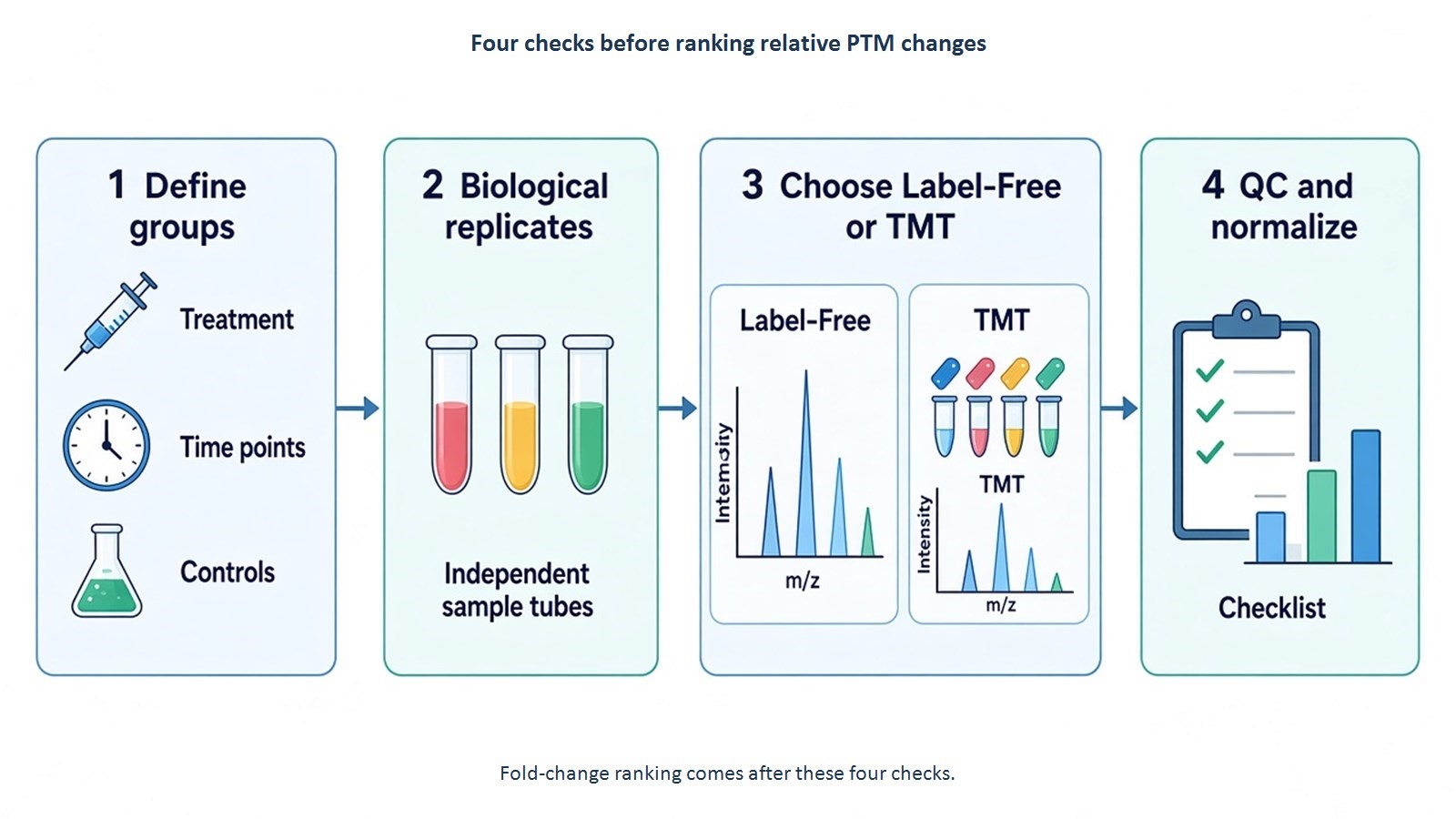
Figure 1. Relative PTM comparison needs defined groups, biological replicates, and QC before fold-change ranking.
Why Should PTM Changes Be Considered Alongside Total Protein Abundance?
Changes in modified-peptide abundance should be interpreted together with the abundance of the corresponding protein. An increase in a modified-peptide signal does not necessarily indicate an increase in the relative level of the modification, because the signal may also increase when the parent protein becomes more abundant.
Modified-peptide signals can be affected by several factors, including the abundance of the corresponding protein, the proportion of protein molecules carrying the modification, peptide recovery during sample preparation and PTM enrichment, and differences in analytical response and mass spectrometry detection. Therefore, modified-peptide abundance alone cannot determine whether the proportion of modified protein molecules has changed.
Matched proteome measurements provide additional information about changes in the abundance of the corresponding proteins across experimental groups. For example, if a parent protein increases in abundance, its modified-peptide signal may also increase even when the proportion of modified protein molecules remains unchanged. In contrast, if the corresponding protein abundance remains relatively stable while the modified-peptide signal changes, the result provides stronger support for a PTM-associated change, provided that sample processing, enrichment, and analytical performance are comparable across groups.
Comparing PTM measurements with matched protein abundance therefore helps distinguish changes related to protein expression from changes in modification-associated signals. However, this comparison alone does not directly establish PTM site occupancy, which requires quantitative assessment of both modified and unmodified forms of the target site.
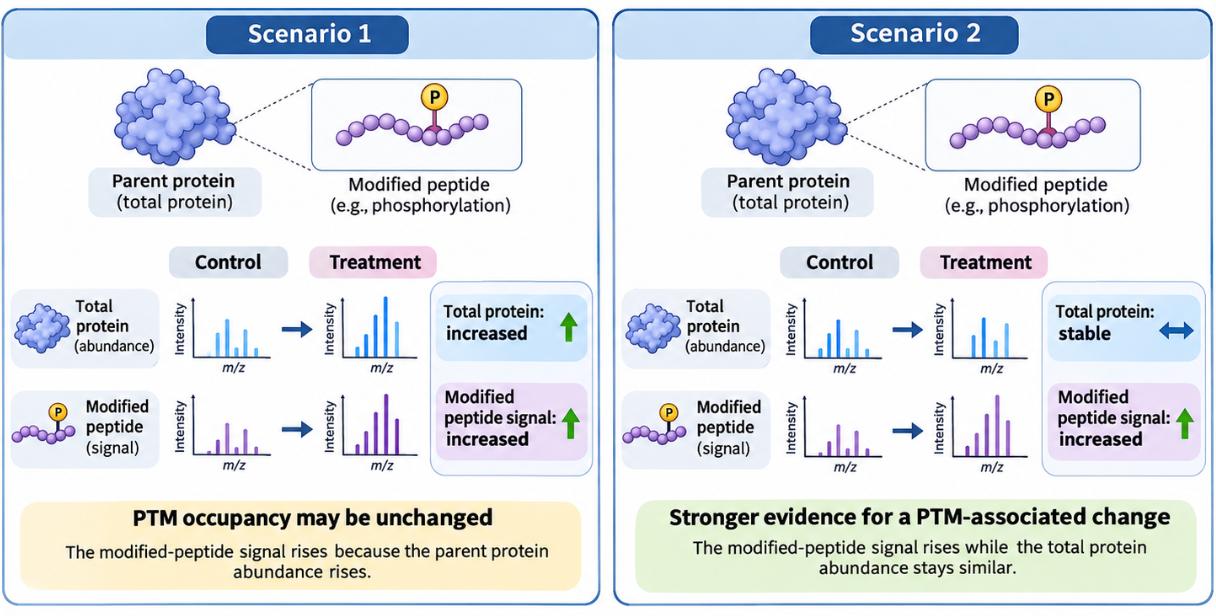
Figure 2. Interpreting PTM Changes by Comparing Modified-Peptide and Total Protein Abundance.
Differential PTM Analysis
Differential PTM analysis compares quantified PTM signals across experimental groups to identify modification-associated changes. The analysis considers the magnitude of change, variation among biological replicates, statistical significance, and multiple-testing correction rather than relying on fold change alone.
Fold Change and Biological Variation
Fold change describes the magnitude and direction of PTM abundance differences between experimental groups. A larger fold change indicates a greater change in the measured PTM signal, but it should be interpreted together with the consistency of the results across biological replicates.
Statistical Evaluation
Statistical testing evaluates whether observed differences are greater than expected from biological variation. The statistical approach should match the experimental design, including whether groups are paired or independent and how the quantitative data are structured. Statistical significance should be considered together with effect size and biological relevance.
Missing Values
Missing values are common in PTM-enriched datasets, particularly for low-abundance modified peptides that are not consistently detected across samples. Filtering and missing-value handling can affect which quantified features enter the differential analysis and should therefore be applied consistently according to the characteristics of the dataset.
Multiple Testing and FDR
Large-scale PTM studies typically involve simultaneous testing of many quantified PTM features. Multiple-testing correction is therefore used to control the false discovery rate (FDR) and reduce false-positive differential results. The FDR used for differential analysis is distinct from the FDR applied during peptide identification.
Differential PTM results should be based on appropriately identified and localized quantitative features. Detailed principles for PTM site identification and localization are discussed in How Are Post-Translational Modification Sites Identified and Localized?
When Is Absolute PTM Quantification or Site Occupancy Analysis Needed?
Absolute PTM quantification is appropriate when a study requires the amount or concentration of a specific modified peptide or protein. Site occupancy analysis addresses a different question: what proportion of protein molecules carry a modification at a particular residue. Absolute quantification generally requires suitable reference standards and calibration, while site occupancy estimation requires quantitative evidence for modified and unmodified forms that accounts for differences in analytical response and recovery (Gerber et al. 2003). In MtoZ Biolabs PTM quantitative projects, routine reporting focuses on relative changes. Site occupancy measurements require suitable synthetic standard peptides and separate feasibility assessment.
If the question only needs which sites respond to a treatment relative to controls, relative PTM quantification with protein context is usually enough. Absolute or occupancy work is a separate project decision, not an automatic upgrade of every fold-change table.
Frequently Asked Questions
Can TMT ratios be read as occupancy percentages?
No. Conventional TMT reporter-ion ratios measure relative abundance across labeled samples and cannot be directly interpreted as site occupancy percentages. Occupancy estimation requires an appropriate quantitative strategy that accounts for modified and unmodified forms of the same site or provides equivalent validated evidence.
How many biological replicates are enough?
For MtoZ Biolabs PTM quantitative projects, at least three independent biological replicates per group are required. Additional replicates may be needed depending on biological variability, expected effect size, and statistical power. Technical reinjections do not replace biological replicates.
Conclusion
PTM quantification provides information on changes in modified-peptide abundance across experimental conditions. Integrating corresponding total protein abundance helps distinguish protein-level changes from modification-associated responses, while site occupancy and absolute quantification require additional quantitative evidence. The appropriate strategy depends on the research question and the level of quantitative information required.
For studies comparing PTM changes across conditions, researchers can review the MtoZ Biolabs PTM Quantitative Analysis Service for project-specific analysis planning.
Reference
- S.A. Gerber, J. Rush, O. Stemman, M.W. Kirschner, S.P. Gygi (2003). Absolute quantification of proteins and phosphoproteins from cell lysates by tandem MS. Proc. Natl. Acad. Sci. U.S.A., 100, 6940-6945. https://doi.org/10.1073/pnas.0832254100
How to order?