






How Are Post-Translational Modification Sites Identified and Localized?
Post-translational modifications (PTMs) influence protein activity, stability, localization, and molecular interactions. PTM research often requires identifying not only which proteins are modified but also the specific amino acid residues carrying those modifications. Liquid chromatography–tandem mass spectrometry (LC-MS/MS) provides peptide-level evidence for PTM identification and, when sufficient fragment-ion information is available, residue-level site localization. Identifying a modified peptide does not necessarily establish its exact modification site, particularly when multiple residues within the peptide could carry the same PTM. Distinguishing peptide identification from site localization helps researchers interpret PTM results and select candidate residues for downstream functional studies.
For studies requiring PTM site identification and localization, MtoZ Biolabs provides a PTM Sites Identification Service. For a broader introduction to different PTM types and their roles in proteomics research, see Post-Translational Modifications (PTMs) in Proteomics Research.
PTM Site Identification and Localization: Key Concepts
Modified Peptides and Their Parent Proteins
In bottom-up proteomics, proteins are digested into peptides. A PTM that survives digestion stays on a peptide as a mass shift and, when fragmented, as modified fragment ions. The mass spectrometer measures the peptide directly. The parent protein is then inferred by matching that peptide to a sequence database entry.
Peptide Identification vs. Site Localization
Peptide identification asks whether a spectrum matches a peptide sequence carrying a specified modification mass. Site localization asks which residue on that peptide carries the modification when more than one acceptor residue is possible. A confident modified-peptide ID can still leave two serines unresolved if no fragment ion distinguishes them (Beausoleil et al. 2006).
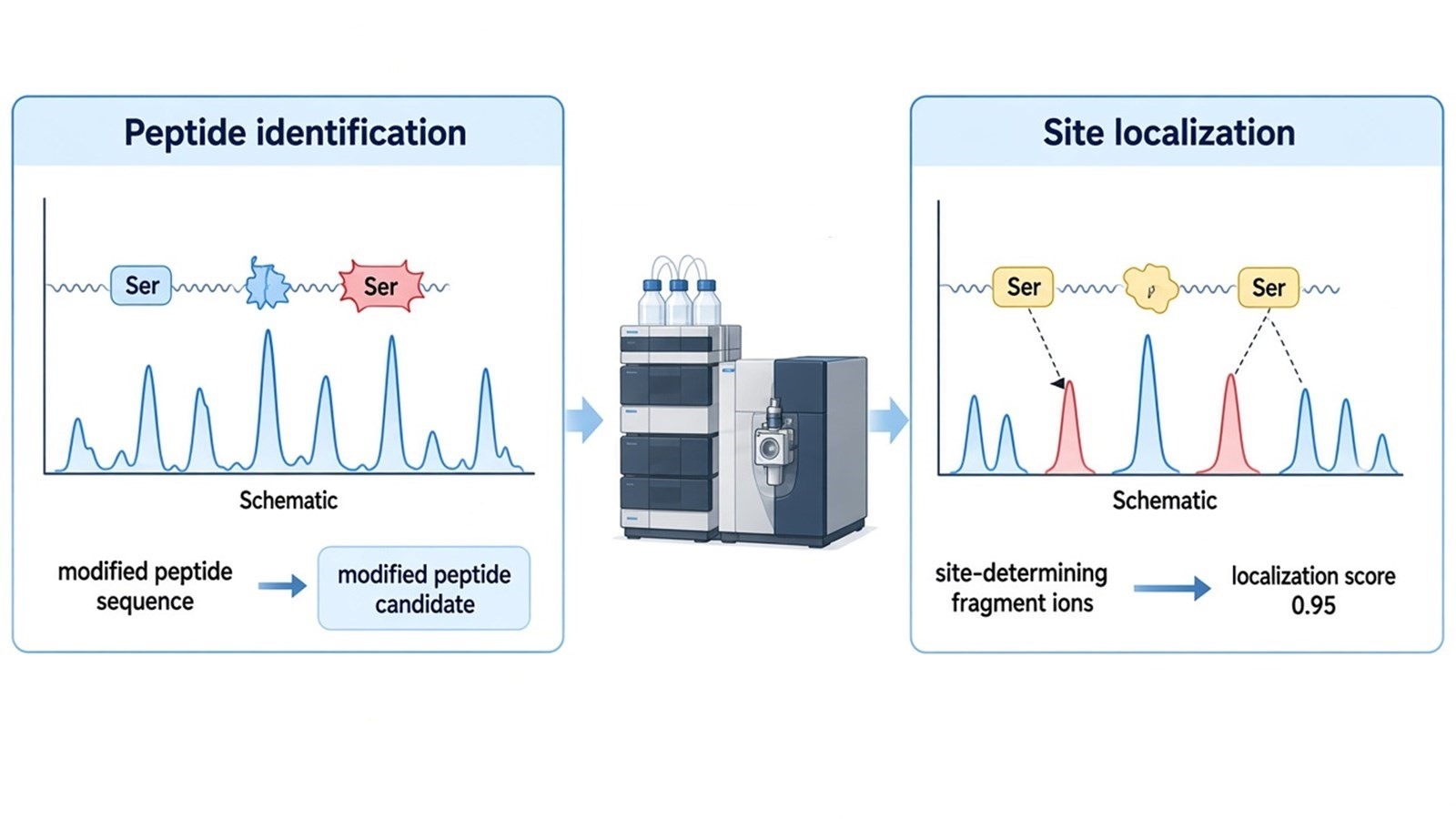
Figure 1. Finding a modified peptide and naming the modified residue answer different questions and need different fragment evidence.
LC-MS/MS Identification of PTM-Modified Peptides
Precursor Mass and Modification-Related Mass Shifts
Different PTMs and digestion-derived modification remnants produce characteristic mass shifts in peptide precursors. Phosphorylation and acetylation introduce defined mass additions, while diGly remnants can indicate lysine modification by ubiquitin or certain ubiquitin-like proteins after tryptic digestion. Glycosylated peptides exhibit mass shifts determined by their glycan compositions. Precursor mass accuracy on Orbitrap-series instruments helps narrow the candidate modification list, but precursor mass alone cannot determine which residue carries the modification.
Some modifications have similar nominal mass shifts but different exact masses. For example, acetylation (+42.0106 Da) and trimethylation (+42.0470 Da) can be distinguished by sufficiently accurate, high-resolution mass measurements. MS/MS fragmentation provides additional evidence for modification identity and site localization.
MS/MS Fragmentation and Peptide Sequence Matching
MS/MS fragment ion series provide peptide sequence information and support modification-site assignment. When multiple residues are potential modification sites, site-determining fragment ions are needed to distinguish between candidate positions. Database searching compares observed fragment ions with theoretical spectra generated from candidate peptide sequences and modification assignments.
Database Search Parameters for PTM Identification
Database search parameters define which modifications are considered during peptide identification. Fixed modifications account for predictable chemical changes introduced during sample preparation, such as cysteine carbamidomethylation after alkylation. Variable modifications specify the PTMs being investigated, such as phosphorylation or acetylation. Search settings should match the target modification and sample preparation workflow to avoid unnecessary search complexity and reduce the risk of incorrect peptide assignments.
How Are PTM Sites Localized to Specific Amino Acid Residues?
During MS/MS fragmentation, peptide bonds are broken to generate fragment ions that provide information about peptide sequences and modification positions. When a fragment contains a modified residue, its mass reflects the corresponding modification mass. Comparing b- and y-type fragment ions helps distinguish candidate modification sites. For example, a phosphopeptide may contain multiple serine, threonine, or tyrosine residues. Fragment ions that separate these candidate positions provide site-determining evidence for localizing the phosphorylation site. When the available MS/MS fragments cannot distinguish between candidate positions, the modification site should be reported as ambiguous rather than assigned to a single residue without sufficient evidence.
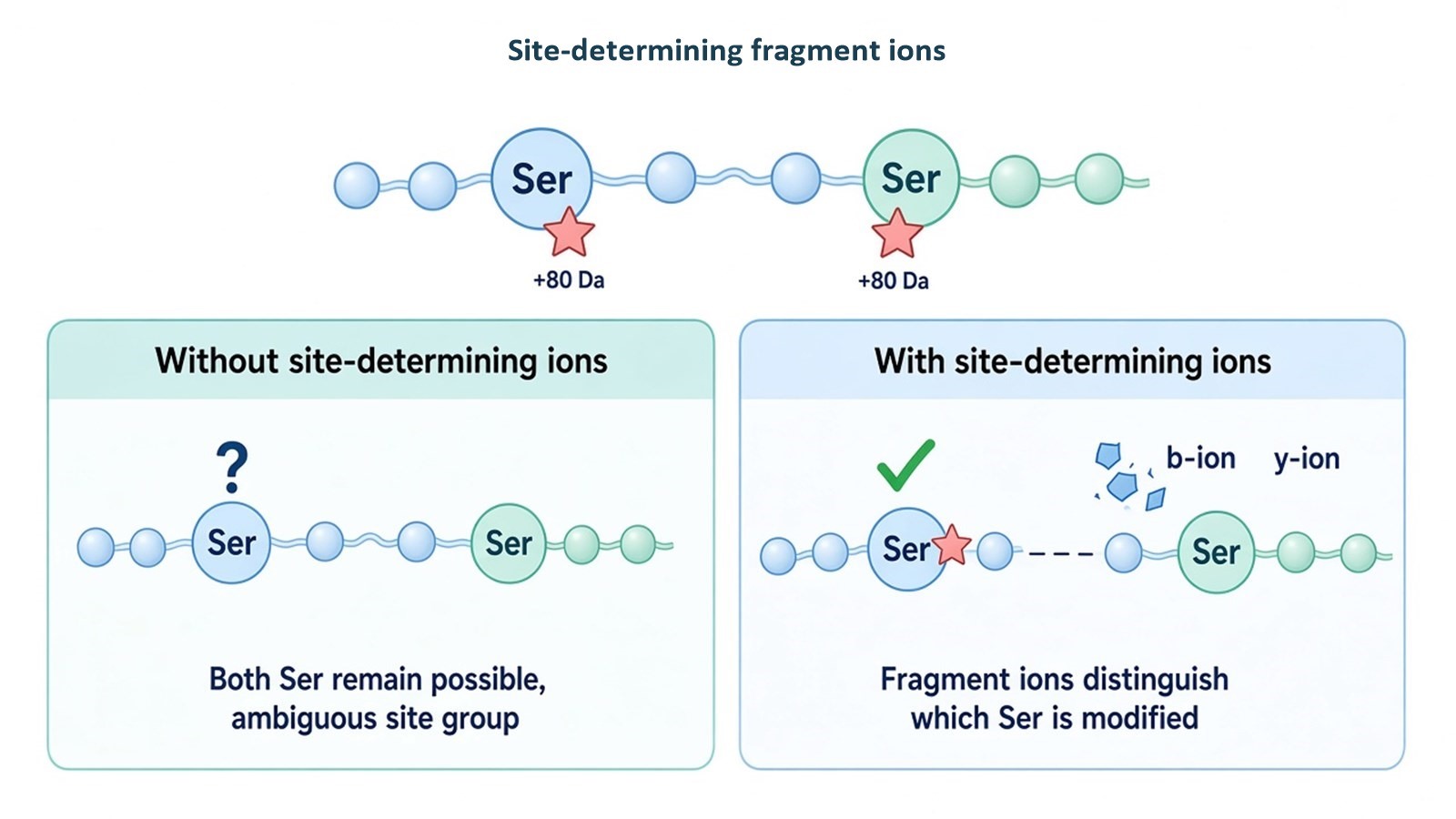
Figure 2. When two residues can accept the same modification mass, only site-determining fragment ions separate the candidates.
Factors Affecting PTM Site Localization Confidence
Fragment Ion Evidence and Spectrum Quality
Sparse fragmentation, low signal intensity, and precursor co-isolation can reduce the number or quality of informative fragment ions, limiting the evidence available to distinguish candidate modification sites. Reliable localization requires sufficient fragment-ion coverage and clear spectral evidence to support a specific residue assignment.
Peptide Identification FDR vs. Site Localization Confidence
Peptide identification FDR and PTM site-localization confidence assess different levels of evidence. Identification-level FDR estimates the proportion of incorrect identifications among accepted peptide-spectrum matches (PSMs), peptides, or proteins. In contrast, site-localization scores or probabilities evaluate how strongly the MS/MS spectrum supports a modification at a specific amino acid residue. Therefore, a modified peptide can meet identification-level FDR criteria even when its modification site remains unresolved.
Labile Modifications and Targeted Analysis
Some labile PTMs undergo neutral loss during fragmentation, reducing the number of modification-retaining fragment ions available for site localization. For selected modified peptides, targeted analysis such as parallel reaction monitoring (PRM) may provide complementary evidence when suitable site-determining fragment ions can be monitored. Learn more about the PRM-based Post-translational Modification Site Analysis Service.
Interpreting PTM Site Identification Results
Key Information in a PTM Site Report
A PTM site report typically includes the protein accession, peptide sequence, modification type, modified residue and its position within the peptide, corresponding position in the reference protein sequence, site-localization score or probability, and relevant peptide identification metrics. The exact information depends on the analytical workflow and reporting format.
Mapping Peptide Sites to the Full Protein Sequence
After a modification site is localized within a peptide, its position is mapped to a defined reference protein sequence. Site numbering may differ among protein isoforms or between precursor and mature protein forms. Peptides shared by multiple proteins or isoforms can map to more than one protein sequence, even when the modified residue is confidently localized within the peptide. Reports should specify the reference protein accession, sequence version, and any ambiguity in protein-level site assignment.
Reporting Uncertain Site Assignments
Confidently localized sites can be interpreted as residue-specific assignments supported by the reported localization scores and spectral evidence. For ambiguous assignments, the modified peptide may be identified, but two or more candidate residue positions remain possible. These results should be presented as ambiguous sites or site groups rather than separate confirmed modification sites. Distinguishing localized and ambiguous assignments is important when selecting residues for mutagenesis or modification-specific antibody development.
For cross-condition abundance questions after sites are assigned, continue with How Is PTM Quantification Used to Compare Modification Changes Across Conditions?.
Frequently Asked Questions
Can software localization probability replace manual spectrum checks for key sites?
For priority sites that drive mutation or antibody work, inspect site-determining ions even when the score is high. Scores summarize the evidence; they do not show the ions themselves.
What if two adjacent residues share similar localization scores?
When two adjacent residues have similar localization scores, the available MS/MS evidence may not clearly distinguish between them. Both positions should be reported as candidate sites rather than treating the slightly higher-scoring residue as confirmed. Additional targeted analysis may help clarify the modification position.
Does a localized site prove that the modification is functional?
No. Localization only tells you which residue carries the modification. Function still needs a perturbation experiment and a phenotype or activity readout matched to the biology.
Conclusion
Reliable PTM site identification depends on confident peptide identification, accurate modification assignment, and sufficient MS/MS evidence for site localization. Clearly distinguishing confidently localized sites from ambiguous assignments helps researchers interpret results and select candidate residues for further investigation. Additional validation can be performed when needed to investigate the biological significance of selected sites.
For projects requiring residue-level PTM identification, explore the MtoZ Biolabs PTM Sites Identification Service or contact our team for a free consultation about your research needs.
Reference
- S.A. Beausoleil, J. Villen, S.A. Gerber, J. Rush, S.P. Gygi (2006). A probability-based approach for high-throughput protein phosphorylation analysis and site localization. Nat. Biotechnol., 24, 1285-1292. https://doi.org/10.1038/nbt1240
How to order?