






How to Choose a PTM Enrichment Strategy for LC-MS/MS Analysis
Many modified peptides occur at low abundance relative to unmodified peptides in complex protein digests. Without appropriate enrichment, signals from low-abundance modified peptides may be obscured by more abundant unmodified peptides, reducing their detection and identification by LC-MS/MS. The enrichment strategy should be selected according to the target PTM chemistry, sample matrix, and analytical objective, such as modification profiling, site identification, or relative quantification.
For a broader introduction to protein modifications, see Post-Translational Modifications (PTMs) in Proteomics Research. For bottom-up LC-MS/MS studies involving modified-peptide enrichment and site analysis, researchers can review the MtoZ Biolabs Bottom-Up MS-Based PTM Analysis Service.
Why Does PTM Proteomics Often Require Enrichment?
PTM enrichment increases the representation of modified peptides during LC-MS/MS analysis, improving the detection of low-abundance modification features within complex protein digests (Larsen et al. 2005).
Because enrichment selectively retains peptides associated with the target PTM chemistry, the resulting profile represents a subset of the original peptide population. The identified modified peptides and sites depend on the selectivity and recovery characteristics of the enrichment method.
Which Enrichment Approaches Are Used for Different PTM Types?
Enrichment methods are selected according to the chemical characteristics of each modification. Common approaches include metal oxide affinity, antibody-based capture, hydrophilic interaction chromatography, and affinity capture using biotin-streptavidin interactions.
TiO2 for phosphopeptides
Titanium dioxide (TiO₂) enrichment selectively retains phosphopeptides through interactions between phosphate groups and the titanium dioxide surface. It is widely used in phosphoproteomics to enrich phosphorylated peptides from complex digests, improving their representation for subsequent LC-MS/MS identification. MtoZ Biolabs uses TiO₂ enrichment in its standard phosphoproteomics workflow. For studies specifically targeting tyrosine phosphorylation, phosphotyrosine-specific antibody enrichment may also be considered.
Antibody-based enrichment
Antibody-based enrichment is commonly used for acetylation, methylation, ubiquitination-related diGly remnants, lactylation, and other lysine modifications when suitable modification-specific antibodies are available. Antibody specificity, nonspecific binding, and batch variability can affect the recovered peptide population. Enrichment of lysine diGly remnants provides evidence of ubiquitin-related modification but does not independently distinguish ubiquitination from certain ubiquitin-like modifications that produce the same remnant.
Enrichment for glycopeptides
Hydrophilic interaction liquid chromatography (HILIC) separates peptides according to differences in hydrophilicity. Glycopeptides generally exhibit greater hydrophilicity than many unmodified peptides, allowing HILIC-based approaches to enrich glycosylated peptides before LC-MS/MS. Lectin-based enrichment is another approach that uses carbohydrate-binding proteins to capture glycans with specific structural features. The choice depends on the glycan class and the desired glycoproteomic information. Different enrichment approaches may recover different glycopeptide populations.
Streptavidin for biotinylated proteins
Streptavidin-based enrichment can capture naturally biotinylated proteins or proteins labeled with biotin through modification-specific chemical reactions. For PTMs such as S-palmitoylation and S-nitrosylation, appropriate chemical capture strategies can introduce biotin tags for subsequent affinity enrichment. The specificity and efficiency of the labeling and capture steps influence the recovered protein or peptide population.
For MtoZ Biolabs, proteome-wide analysis of certain less common modifications, including formylation, fumarylation, and glutarylation, requires customer-supplied chemical probes. Project feasibility depends on the suitability of the supplied reagents, enrichment chemistry, and intended LC-MS/MS analysis.
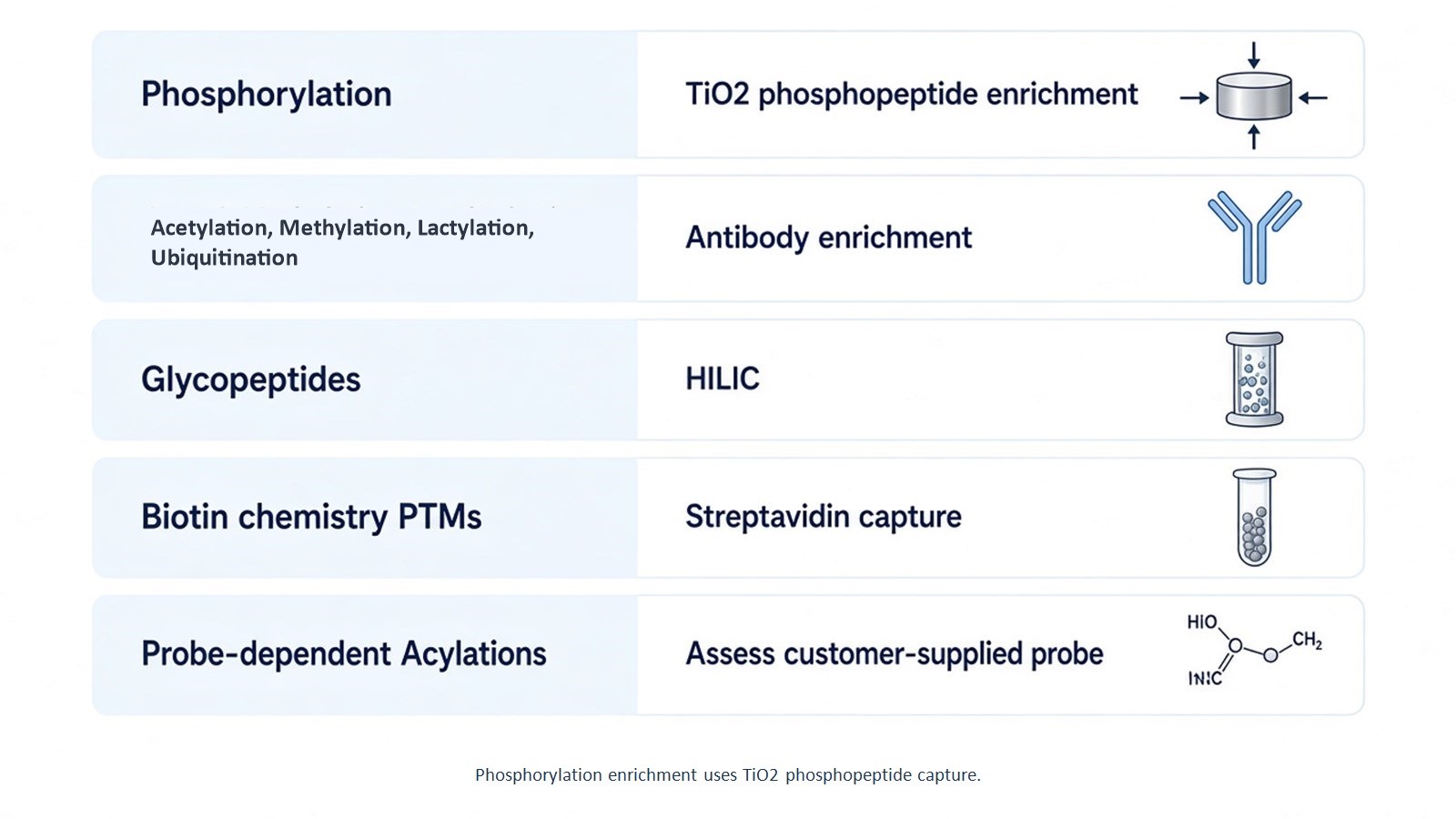
Figure 1. Enrichment chemistry follows the target PTM class: TiO2 for phosphopeptides, antibodies for several lysine marks, HILIC for glycopeptides, and streptavidin when biotin capture applies.
How Should Enrichment Be Matched to the Research Objective?
Global profiling
Global profiling aims to identify modified peptides across as much of the sample proteome as the analytical workflow can support. The enrichment method should recover a broad range of peptides carrying the target PTM rather than selectively focusing on a single protein.
Target protein
For studies focused on a specific protein, protein-first isolation, such as immunoprecipitation, can be performed before LC-MS/MS analysis of its modifications. If additional modification-specific enrichment is required, the enrichment method should be selected according to the target PTM chemistry.
Site-level identification
Site-level identification requires sufficient recovery of modified peptides and MS/MS spectra containing fragment ions that distinguish candidate modification positions. Sample preparation and enrichment conditions should preserve labile modifications, while reliable site localization depends on adequate site-determining fragment-ion evidence.
Quantitative comparison
Quantitative PTM studies compare modified-peptide abundance across different experimental conditions. To distinguish biological changes from technical variation, sample preparation and enrichment conditions should remain as consistent as possible across groups. Using the same enrichment chemistry, comparable reagent amounts, and consistent washing and elution conditions helps reduce technical variability. If different antibody or reagent batches must be used, experimental groups should be distributed appropriately across batches, with suitable quality-control samples included to assess batch effects.
For more detailed information on phosphorylation analysis, see Phosphoproteomics: How to Profile and Compare Protein Phosphorylation. For glycosylation-focused research, see Glycoproteomics: Analysis of Protein Glycosylation Sites and Glycoforms.
What Can Affect Enrichment Specificity and Recovery?
The performance of an enrichment workflow depends on more than the affinity between the target modification and the enrichment material. Antibody recognition, nonspecific interactions, sample composition, and peptide recovery during washing and elution can all influence the final results.
Antibody specificity
Modification-specific antibodies may also recognize peptides carrying related modifications or similar epitopes, introducing off-target enrichment. Antibody specificity for peptide enrichment should be evaluated using appropriate controls and LC-MS/MS evidence supporting the target modification. Western blot reactivity alone does not establish peptide-enrichment specificity.
Nonspecific binding
Beads and metal oxides bind abundant acidic or sticky peptides. Wash conditions trade specificity against recovery of weak binders.
Sample complexity
Tissue, plasma, and plant matrices carry different backgrounds. The same enrichment chemistry can need different cleanup depth.
Peptide loss
Over-washing, adsorption, and incomplete elution remove true modified peptides. Low recovery can look like biological absence. Batch-to-batch differences in wash or elution also change recovery and should stay matched when groups will be compared.
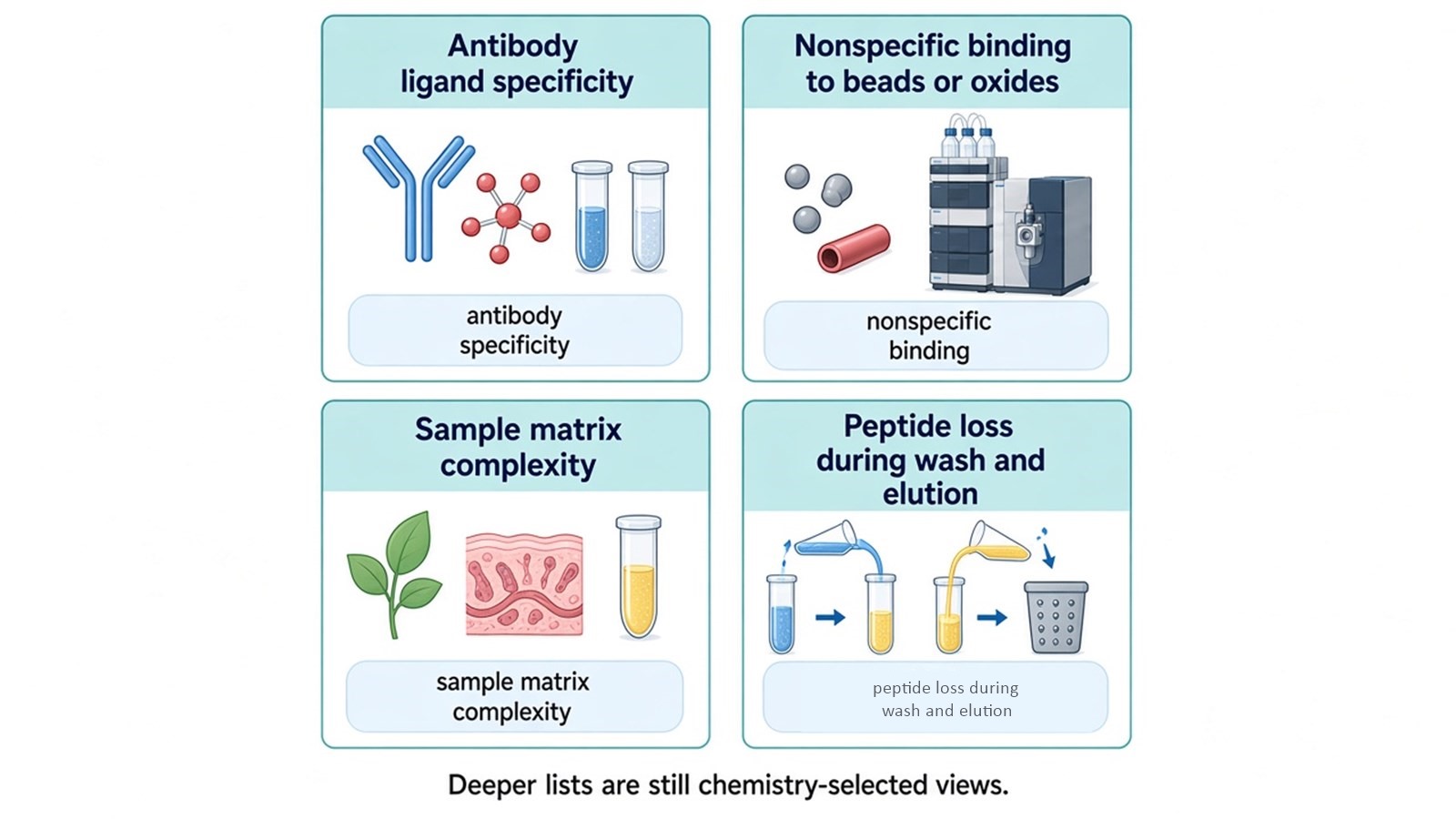
Figure 2. Enrichment outcomes move with antibody or ligand specificity, nonspecific binding, matrix complexity, and peptide loss during wash and elution.
Frequently Asked Questions
Can one enrichment method cover all PTM classes?
No single enrichment method is suitable for all PTM classes. TiO₂ enrichment for phosphopeptides, anti-acetyllysine antibodies, diGly-remnant antibodies, and HILIC-based glycopeptide enrichment target different modification characteristics. Studies involving multiple PTM types may require parallel or sequential enrichment strategies, depending on sample availability and analytical objectives.
Does a longer enriched list always mean better biology?
Longer lists can include more nonspecific peptides if stringency is too low. Match wash conditions to the research question and inspect modification-mass evidence.
Conclusion
PTM enrichment improves the detection of modified peptides in complex samples, with the appropriate method determined by the target modification and research objective. Enrichment specificity, peptide recovery, and consistency across experimental groups influence the reliability of subsequent identification and quantitative analysis.
For projects requiring modification-specific peptide enrichment and LC-MS/MS analysis, researchers can review the MtoZ Biolabs Bottom-Up MS-Based PTM Analysis Service for project-specific feasibility assessment.
Reference
- M.R. Larsen, T.E. Thingholm, O.N. Jensen, P. Roepstorff, T.J.D. Jorgensen (2005). Highly selective enrichment of phosphorylated peptides from peptide mixtures using titanium dioxide microcolumns. Mol. Cell. Proteomics, 4, 873-886. https://doi.org/10.1074/mcp.T500007-MCP200
How to order?