






Ubiquitination Proteomics: How to Identify Ubiquitinated Proteins and Modification Sites?
Ubiquitination is an important post-translational modification involved in regulating protein stability, degradation, and cellular signaling. Depending on the modification context, ubiquitination can influence protein turnover, promote protein degradation, or alter signaling interactions (Xu et al. 2010; Kim et al. 2011). Identifying ubiquitinated proteins and their modification sites, and comparing ubiquitination changes across experimental conditions, helps researchers investigate how ubiquitination contributes to cellular regulation.
What Is Ubiquitination Proteomics?
Ubiquitination proteomics uses mass spectrometry to identify proteins carrying ubiquitin-related modifications and characterize their modified lysine sites. By analyzing ubiquitin-modified peptides, researchers can investigate which proteins are modified, where the modifications occur, and how ubiquitination changes under different experimental conditions.
For studies investigating ubiquitination-related proteins, modified lysine sites, and their relative changes across conditions, researchers can review the MtoZ Biolabs Ubiquitination Proteomics Service.
What Can Ubiquitination Proteomics Reveal?
Ubiquitination proteomics provides several types of information for investigating protein ubiquitination:
- Ubiquitinated Proteins: Identify candidate substrate proteins carrying ubiquitin-related modifications.
- Modification Sites: Map modified lysine residues on substrate proteins to determine where ubiquitination occurs.
- Ubiquitination Changes: Compare the relative abundance of modified peptides across experimental conditions to identify changes associated with specific treatments or biological states.
These findings help researchers identify candidate ubiquitination targets, investigate modification patterns, and prioritize proteins and sites for further functional studies.
Substrate Ubiquitination Sites vs. Ubiquitin Chain Linkages
Substrate-site analysis identifies modified lysine residues on target proteins, whereas ubiquitin chain-linkage analysis examines modified residues within ubiquitin itself, such as Lys48 and Lys63. These measurements provide different types of information and may be obtained from the same LC-MS/MS dataset when suitable peptides are detected. Linkage-specific peptide signals indicate ubiquitin linkage types but do not independently establish which chains are attached to individual substrate proteins.
Histone ubiquitination can also be investigated within histone PTM studies. For histone-specific modification analysis, researchers can review the Histone Post-Translational Modification Analysis Service.
Sample Preparation and Peptide Enrichment for Ubiquitination Proteomics
Protein Digestion and Modified Peptide Generation
Following protein extraction, trypsin digestion generates peptides and cleaves ubiquitin near its C terminus, leaving a diglycine (K-ε-GG) remnant attached to modified lysine residues. This remnant produces a characteristic mass shift of +114.0429 Da, which can be detected by LC-MS/MS to support modified-peptide identification (Xu et al. 2010).
Antibody-Based Enrichment of Modified Peptides
Anti-K-ε-GG antibodies enrich peptides carrying the diglycine remnant from tryptic digests, improving the detection of low-abundance modified peptides by LC-MS/MS. This peptide-level enrichment facilitates subsequent modification-site identification and localization based on supporting MS/MS fragment-ion evidence.
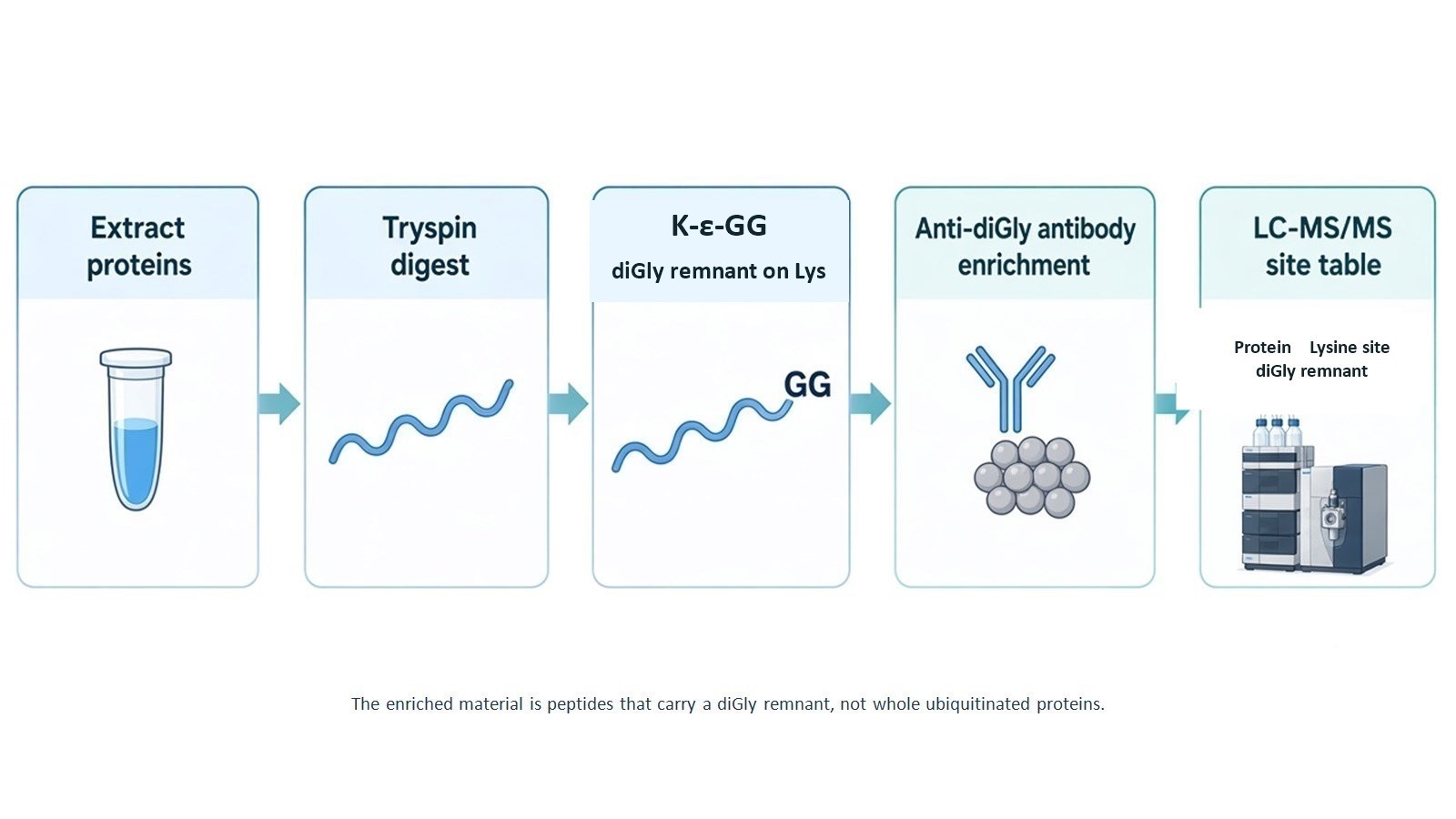
Figure 1. Trypsin leaves a diGly remnant on modified lysines, and antibody enrichment concentrates those peptides for an LC-MS/MS site list.
LC-MS/MS Identification of Ubiquitinated Proteins and Modification Sites
MS/MS Evidence for Modified Peptide Identification
LC-MS/MS measures the precursor mass of diGly-modified peptides and generates fragment-ion spectra for peptide sequence identification. High-resolution mass measurements support modified-peptide identification, while MS/MS fragment ions provide additional evidence for peptide sequence matching and modification-site localization.
Database Searching and Ubiquitination Site Localization
Database searching includes lysine diglycine modification as a variable modification to identify candidate K-ε-GG peptides. Modification sites are assigned to specific lysine residues when sufficient site-determining fragment ions are available. Ambiguous assignments are retained when the spectral evidence cannot distinguish between candidate positions. The principles of site localization are discussed in How Are Post-Translational Modification Sites Identified and Localized?. For ubiquitinated protein identification and site analysis, researchers can review the MtoZ Biolabs Protein Ubiquitination Identification Service.
One limitation of diGly-based identification is that NEDD8 and ISG15 can also leave the same K-ε-GG remnant after trypsin digestion. Therefore, the detected modification sites cannot always be assigned exclusively to ubiquitination based on the diGly signature alone. When modifier-specific identification is required, additional evidence, such as genetic perturbation of ubiquitin-like modification pathways or ubiquitin-specific enrichment and validation approaches, may be needed.
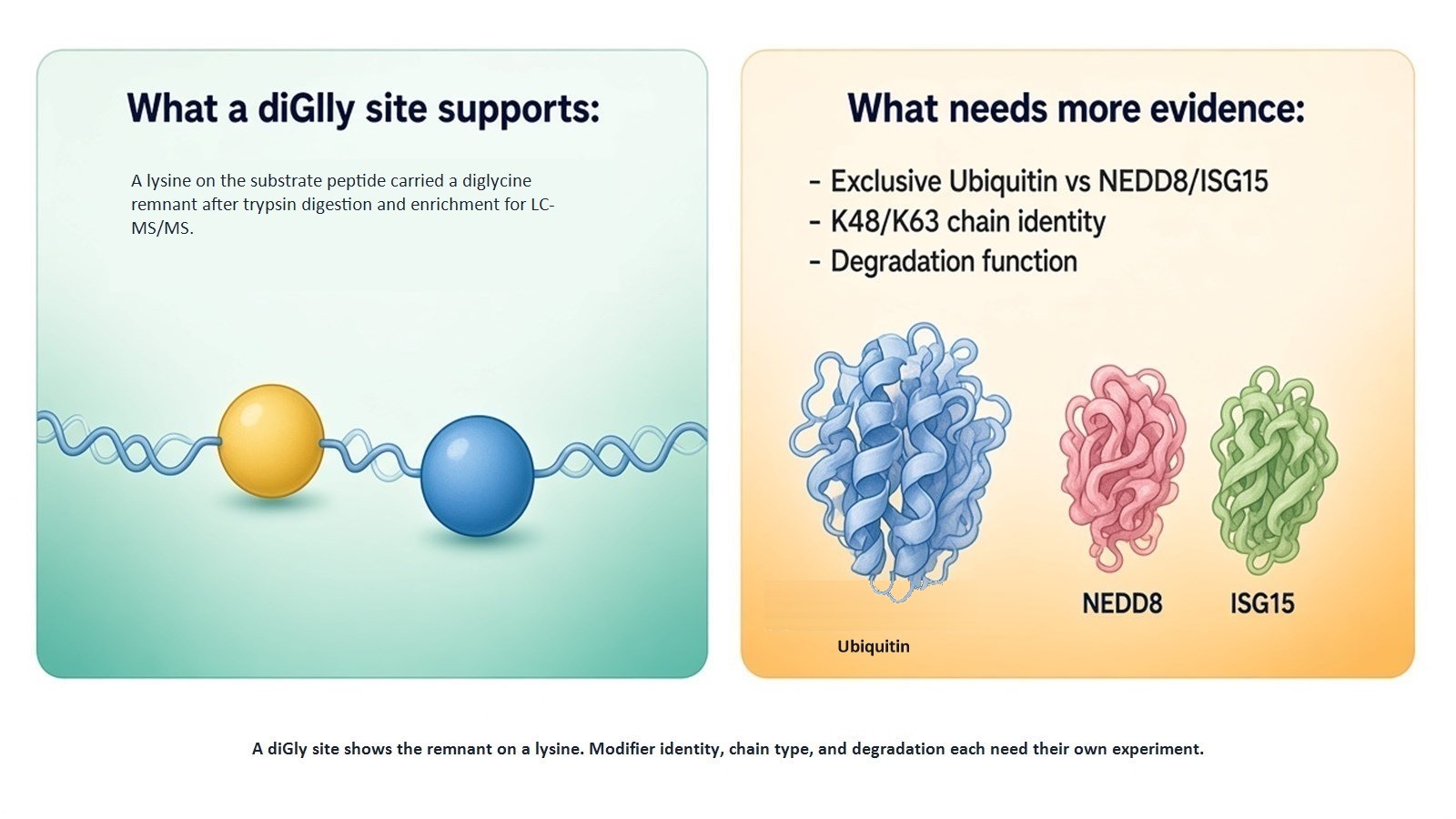
Figure 2. Left: the lysine that carried the diGly remnant. Right: ubiquitin, NEDD8, and ISG15, shown with chain linkage and degradation.
Interpreting Ubiquitination Proteomics Results
Protein- and Site-Level Identification Results
Ubiquitination proteomics reports typically include protein accessions, identified diGly-modified peptides, mapped lysine positions, and site-localization confidence scores. For quantitative studies, relative peptide intensities or fold changes between experimental groups may also be reported. Identification coverage varies with sample complexity, protein input, enrichment efficiency, and LC-MS/MS acquisition depth (Kim et al. 2011).
Identification Coverage and Site Localization Confidence
Failure to detect a modification site may reflect low modification abundance, insufficient peptide recovery, poor ionization, or limited MS/MS coverage. Site-localization scores evaluate the fragment-ion evidence supporting assignment to a specific lysine residue, while peptide identification confidence is assessed using appropriate database-search scores and false discovery rate (FDR) control. Confident peptide identification does not necessarily establish unambiguous site localization.
Ubiquitination Changes vs. Total Protein Abundance Changes
A change in diGly-peptide signal is a relative difference in that remnant peptide. Compare it with the abundance of the parent protein before attributing the difference to the modification itself. For relative quantification of ubiquitination-associated changes across experimental conditions, researchers can review the Quantitative Ubiquitinomics Service.
Frequently Asked Questions
Can one protein contain multiple ubiquitination sites?
Yes. A protein can contain multiple ubiquitination sites, and different lysine residues may show distinct modification patterns under different experimental conditions. Site-level analysis helps identify these modification sites and compare their relative changes, providing a more detailed view of ubiquitination regulation.
Does identifying a ubiquitinated protein confirm its E3 ligase?
No. Ubiquitination proteomics can identify candidate ubiquitinated proteins and their modification sites, but it does not directly establish which E3 ubiquitin ligase catalyzes the modification. Identifying the responsible E3 ligase requires additional experiments, such as E3 ligase perturbation, interaction analysis, or functional validation.
Does increased ubiquitination always lead to protein degradation?
No. Ubiquitination does not always result in protein degradation. Depending on the ubiquitin modification pattern and cellular context, ubiquitination can regulate protein stability, intracellular trafficking, protein interactions, and signaling pathways. Therefore, increased ubiquitination should not automatically be interpreted as increased protein degradation.
Can ubiquitination proteomics distinguish monoubiquitination from polyubiquitination?
Conventional diGly-based ubiquitination proteomics primarily identifies and quantifies ubiquitination sites but cannot directly distinguish monoubiquitination from polyubiquitination. Both modification types generate the same diGly remnant after trypsin digestion, while information about the original ubiquitin-chain structure is lost. Additional approaches, such as ubiquitin linkage-specific enrichment, TUBE-based enrichment, or specialized mass spectrometry analysis (such as middle-down or top-down mass spectrometry), may be required to characterize ubiquitin-chain formation and linkage types. The appropriate strategy depends on whether the research focuses on global ubiquitination changes or the ubiquitination pattern of a specific target protein.
Conclusion
Ubiquitination proteomics returns candidate substrates and diGly lysine sites after remnant enrichment and LC-MS/MS. For ubiquitination-related protein identification and modification-site analysis, researchers can review the MtoZ Biolabs Ubiquitination Proteomics Service for project-specific feasibility assessment.
Reference
- G. Xu, J.S. Paige, S.R. Jaffrey (2010). Global analysis of lysine ubiquitination by ubiquitin remnant immunoaffinity profiling. Nat. Biotechnol., 28, 868-873. https://doi.org/10.1038/nbt.1654
- W. Kim, E.J. Bennett, E.L. Huttlin, A. Guo, J. Li, A. Possemato, M.E. Sowa, R. Rad, J. Rush, M.J. Comb, J.W. Harper, S.P. Gygi (2011). Systematic and quantitative assessment of the ubiquitin-modified proteome. Mol. Cell, 44, 325-340. https://doi.org/10.1016/j.molcel.2011.08.025
How to order?