






Glycoconjugate Analysis Service
MtoZ Biolabs offers Glycoconjugate Analysis Service to provide comprehensive analysis of glycosylated biomolecules, including glycoproteins, glycolipids, and proteoglycans. Glycoconjugates are essential molecules in various biological processes, playing pivotal roles in signaling, immune modulation, cell adhesion, and pathogen recognition. Understanding their glycosylation patterns is crucial for advancing therapeutic development, biomarker discovery, and disease research.
Glycosylation is a key post-translational modification that affects the biological activity, stability, and immunogenicity of proteins and lipids. MtoZ Biolabs employs cutting-edge technologies to offer high-resolution glycan profiling, structural characterization, and site-specific glycosylation analysis. Our services are designed to meet the needs of both academic researchers and the biopharmaceutical industry, supporting applications from early-stage research to large-scale production.
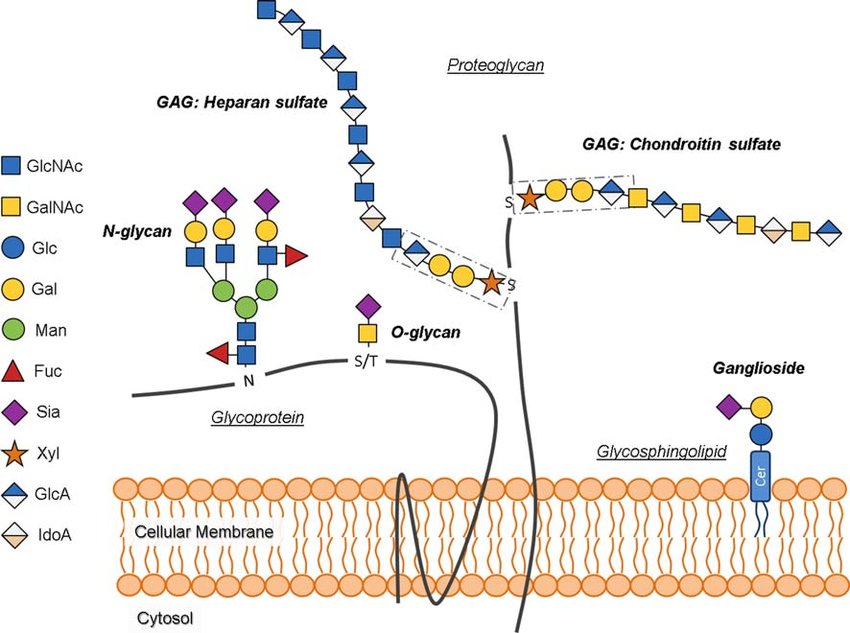
Severino, P. et al. Carbohydr Chem. 2012.
Figure 1. Glycoconjugates in Mammalian Cells
Services at MtoZ Biolabs
MtoZ Biolabs provides an extensive range of specialized services in glycoconjugate analysis. Below is a list of the different service types available:
|
|
MtoZ Biolabs uses a variety of advanced technologies to support glycoconjugate analysis, ensuring high precision, reproducibility, and sensitivity. Our technical platforms include:
● High-Performance Liquid Chromatography (HPLC)
Used for the separation and quantification of glycoproteins, glycolipids, and other glycoconjugates. HPLC provides robust glycan profiling and is ideal for routine analysis.
● Mass Spectrometry (MS)
Including LC-MS/MS and MALDI-TOF MS, which are critical for identifying glycan structures, mapping glycosylation sites, and quantifying glycosylated species in complex samples.
● Capillary Electrophoresis (CE)
For rapid, high-resolution separation of glycosylated molecules based on size and charge. CE is especially useful for analyzing complex samples with low-abundance glycoconjugates.
● Nuclear Magnetic Resonance (NMR) Spectroscopy
Used to determine the detailed structure of glycans and glycosylation sites, providing insights into the glycan composition and glycosidic linkages in glycoconjugates.
● Surface Plasmon Resonance (SPR)
For real-time monitoring of glycan-protein interactions, helping to study the dynamics and specificity of glycosylation-related molecular interactions.
● Glycan Array Technology
Facilitates high-throughput screening of glycan interactions, enabling rapid identification of glycan-binding proteins or receptors.
Each platform is designed to provide high-sensitivity, reproducible results, ensuring comprehensive analysis for both research and therapeutic applications.
Why Choose MtoZ Biolabs?
✅ Comprehensive Glycoconjugate Profiling
We offer a full spectrum of glycosylation analysis, including glycan profiling, glycosylation site mapping, and structural characterization, ensuring thorough insights into glycosylated molecules and their biological roles.
✅ Advanced Analytical Technologies
Our Glycoconjugate Analysis Service employs cutting-edge platforms like LC-MS/MS, NMR spectroscopy, and HPLC, providing high-resolution, reproducible data to support in-depth glycosylation studies for diverse glycoconjugates.
✅ Broad Sample Compatibility
Our service supports a wide range of biological samples, including serum, plasma, tissue homogenates, and cell culture supernatants, offering flexibility to address diverse research needs.
✅ Customizable Research Solutions
We tailor our glycosylation analysis to fit specific research objectives, whether optimizing glycosylation patterns in biopharmaceuticals or studying new glycosylated molecules for biomarker discovery.
✅ High-Quality Standards and Compliance
Our processes comply with global standards, ensuring accurate, reproducible results suitable for both research and clinical applications, meeting industry regulations for consistency and quality.
Sample Submission Suggestions
|
Sample Type |
Recommended Volume |
|
Purified Protein |
≥ 1 µg |
|
Cell Lysate |
≥ 106 cells |
|
Tissue Homogenate |
≥ 20 mg |
|
Serum / Plasma |
≥ 100 µL |
|
Cerebrospinal Fluid |
≥ 100 μL |
|
Urine |
≥ 1 mL |
|
Cell Culture Supernatant |
≥ 1 mL |
Note: Provide details on sample collection and handling. If you need further details, our technical support team is happy to assist and provide comprehensive guidance on sample submission.
MtoZ Biolabs Glycoconjugate Analysis Service provides essential insights into glycoconjugates, enabling researchers to better understand their biological roles and optimize their therapeutic applications. Our state-of-the-art analytical techniques ensure that we deliver high-quality, reproducible results to advance your research.
For more information or to request a customized study, please contact the MtoZ Biolabs team, your trusted partner for Glycoconjugate Analysis Service.
FAQ
Q1: What types of glycoconjugates can MtoZ Biolabs analyze?
We analyze a wide variety of glycoconjugates, including glycoproteins, glycolipids, proteoglycans, and glycosaminoglycans. Our services cover glycosylation analysis for antibodies, enzymes, lipids, and other biologically relevant molecules.
Q2: How does glycosylation affect the function of glycoproteins and glycolipids?
Glycosylation influences protein folding, stability, receptor binding, and immune system interactions. Changes in glycosylation can affect the biological activity of glycoproteins and glycolipids, which are critical for optimizing their therapeutic or functional properties.
Q3: Can you analyze glycosylation in complex biological samples?
Yes, our methods are optimized for extracting and analyzing glycoconjugates from complex biological samples such as serum, plasma, tissue homogenates, and cell culture supernatants.
Related Services
How to order?




