






Glycoglycerolipids Analysis Service
-
Avoid detergents or salts that may affect chromatographic or MS analysis.
-
Store samples at −80 °C and ship on dry ice.
-
Provide sample source, preparation details, and target objectives for method optimization.
MtoZ Biolabs offers professional Glycoglycerolipids Analysis Service that provides detailed structural, compositional, and quantitative characterization of glycoglycerolipids across various biological systems. By integrating LC-MS/MS, HPLC-UV/ELSD, and NMR spectroscopy, our analytical platform enables precise identification and quantification of these complex lipids in plants, algae, cyanobacteria, and microbial samples.
Overview
Glycoglycerolipids (GGLs) are a distinct class of membrane glycolipids composed of a glycerol backbone, one or two sugar residues (commonly galactose or sulfoquinovose), and two fatty acyl chains. They are predominant components of chloroplast membranes in plants and algae, where they play critical roles in thylakoid membrane stacking, photosynthetic efficiency, and stress adaptation. Beyond plant systems, GGLs also participate in immune modulation, apoptosis, and potential anti-inflammatory mechanisms, highlighting their emerging importance in biomedical and nutritional research.
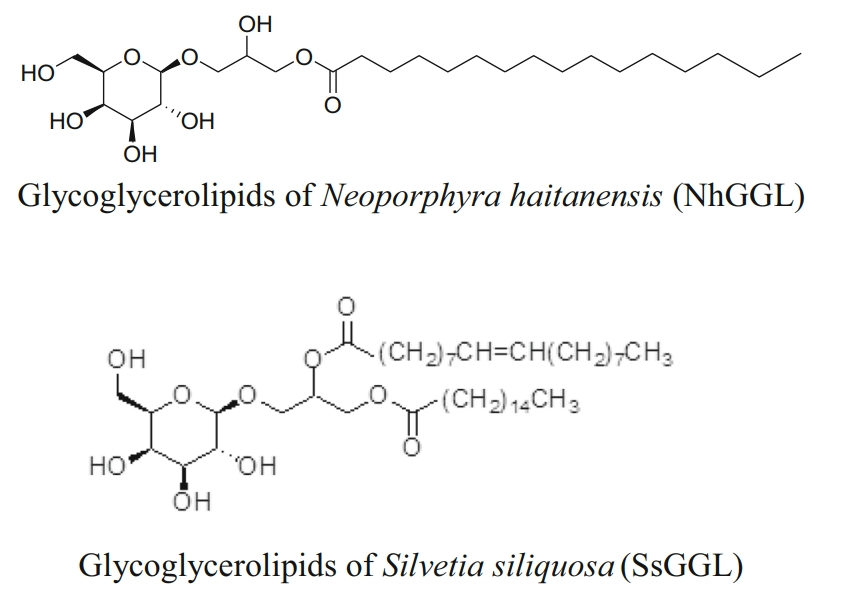
Sun, Y. Y. et al. J. Appl. Phycol. 2021.
Figure 1. Structures of Glycoglycerolipids from Neoporphyra Haitanensis
and Silvetia Siliquosa
Through advanced instrumentation and expert data interpretation, MtoZ Biolabs delivers reproducible and publication-ready data that support discoveries in lipidomics, biochemistry, and pharmaceutical research.
Services at MtoZ Biolabs
● Lipidomic Profiling
Comprehensive profiling of glycoglycerolipids within complex lipid mixtures to determine class distribution, composition, and relative abundance.
● Structural Identification and Elucidation
Determination of glycan head groups, fatty acid chains, and linkage positions using LC-MS/MS and NMR spectroscopy for accurate molecular characterization.
● Quantitative Analysis
Absolute and relative quantification of glycoglycerolipids by HPLC-UV/ELSD and LC-MS/MS, enabling comparative assessment under different biological or experimental conditions.
● Customized Method Development
Tailored analytical solutions designed for specific research objectives, such as chloroplast lipid analysis, microbial lipid screening, or functional lipid evaluation.
Analysis Workflow
Our Glycoglycerolipids Analysis Service offers flexible and comprehensive workflows for structural elucidation, quantification, and comparative lipid profiling.
1. Sample Preparation and Extraction: Lipids are extracted using optimized methyl tert-butyl ether or Bligh–Dyer protocols to ensure maximum glycolipid recovery.
2. Separation and Fractionation: Normal-phase or hydrophilic interaction chromatography (HILIC) separates glycoglycerolipids from phospholipids and neutral lipids.
3. Instrumental Analysis: LC-MS/MS and HPLC-UV/ELSD platforms are employed for high-sensitivity detection and quantification, complemented by NMR spectroscopy for structural elucidation.
4. Data Processing and Annotation: Comprehensive databases such as LIPID MAPS and HMDB are used for precise lipid identification and annotation.
5. Reporting and Interpretation: Each client receives a complete analytical report including chromatograms, spectra, quantitative tables, and biological interpretation.
Sample Submission Suggestions
For optimal results in Glycoglycerolipids Analysis Service, please follow these recommendations:
|
Sample Type |
Recommended Amount / Volume |
|
Fresh Plant or Algal Tissue |
≥ 200 mg (flash-frozen) |
|
Dried Plant Material |
≥ 20 mg |
|
Cyanobacterial or Algal Cultures |
≥ 100 mL |
|
Bacterial Pellet |
≥ 50 mg |
|
Purified Lipid Extract |
≥ 100 µg (in chloroform/methanol, 2:1 v/v) |
Notes:
If you need further details, our technical support team is happy to assist and provide comprehensive guidance on sample submission.
Why Choose MtoZ Biolabs?
✅ Comprehensive Analytical Expertise: Extensive experience in glycolipidomics, with validated protocols for plant, algal, and microbial samples.
✅ Advanced Analytical Platforms: Equipped with LC-MS/MS, HPLC-UV/ELSD, and NMR systems for complete molecular characterization and quantification.
✅ Minor Lipid Detection Capability: Proven ability to detect and characterize low-abundance GGL subclasses, including sulfoquinovosyl and mono-/digalactosyldiacylglycerols.
✅ Dedicated Expert Support: Our scientists provide personalized consultation throughout every project phase, from experimental design to data interpretation.
✅ One-Time-Charge: Our pricing is transparent, no hidden fees or additional costs.
With advanced LC-MS/MS, HPLC-UV/ELSD, and NMR-based analytical systems, MtoZ Biolabs delivers accurate, reproducible, and high-resolution Glycoglycerolipids Analysis Service. Our expert lipidomics team provides comprehensive insights into the composition, structure, and biological relevance of glycoglycerolipids, supporting innovation in life science, pharmaceutical, and environmental research.
FAQ
Q1: What glycoglycerolipid subclasses can MtoZ Biolabs analyze?
We can detect and characterize major subclasses such as monogalactosyldiacylglycerol (MGDG), digalactosyldiacylglycerol (DGDG), and sulfoquinovosyldiacylglycerol (SQDG), as well as other related glycoglycerolipids from plants, algae, and microbial samples.
Related Services
How to order?




