






GlycoNucleic Acids Analysis Service
MtoZ Biolabs provides comprehensive GlycoNucleic Acids Analysis Service that enables precise quantification and structural analysis of nucleic acids carrying glycan modifications. This service focuses on glycosylated RNA, an emerging biomolecular class recently identified in mammalian systems, while also offering customized exploratory workflows to investigate potential glycosylation in DNA.
Overview
Recent scientific discoveries have revealed that certain RNA molecules, known as glycoRNA, can carry covalently attached glycans that participate in cell communication, immune regulation, and extracellular signaling. This finding expands the traditional concept of glycosylation, which was once limited to proteins and lipids.
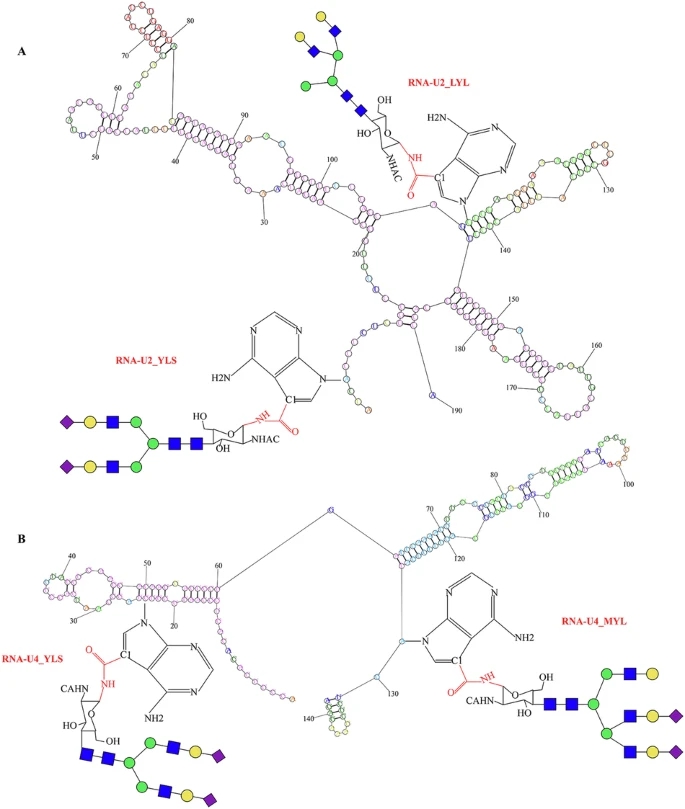
Xin, B. et al. Oncogenesis. 2025.
Figure 1. Structural Representation of GlycoNucleic Acids (RNA–Glycan Conjugates)
Although DNA glycosylation has not yet been experimentally confirmed, it remains an intriguing area of molecular exploration. Determining whether DNA can also carry glycan structures could reshape our understanding of nucleic acid biology. MtoZ Biolabs supports both validated glycoRNA research and hypothesis-driven investigations of DNA glycosylation using advanced multi-platform analysis for reliable quantitative and structural results.
Services at MtoZ Biolabs
To deliver high-quality and multidimensional results, MtoZ Biolabs integrates a suite of complementary analytical technologies that together support both routine glycoRNA quantification and exploratory glycoDNA studies.
1. Mass Spectrometry Platforms
High-resolution mass spectrometry systems, including MALDI-TOF, ESI-MS, and LC-MS, are applied for the detection, quantification, and structural elucidation of glycosylated RNA molecules. These platforms provide high sensitivity and mass accuracy, enabling confident characterization of glycan compositions and linkage positions.
2. Nuclear Magnetic Resonance (NMR) Spectroscopy
One-dimensional and two-dimensional NMR analyses provide detailed information on glycan linkage, configuration, and conformational structure. NMR validation is particularly valuable for confirming the three-dimensional features of glycoRNA and verifying structural models derived from MS-based analysis.
3. High-Performance Liquid Chromatography (HPLC)
HPLC with ultraviolet or fluorescence detection allows for efficient separation and quantification of glycoRNA species. This technique is ideal for profiling fluorescently labeled or purified glycoRNA and can also serve as a complementary front-end separation method before mass spectrometry.
4. Capillary Electrophoresis (CE)
Capillary electrophoresis provides an orthogonal analytical strategy to distinguish glycoRNA and nucleotide-conjugated glycans based on charge-to-size ratio. It enhances resolution and purity assessment, supporting precise molecular profiling.
5. Glycan Microarray Screening
Microarray technology enables large-scale screening of glycan–nucleic acid and glycan–protein interactions. This method supports identification of binding motifs and biological partners involved in glycoRNA-mediated processes.
6. Computational Bioinformatics and Structural Modeling
Specialized bioinformatics tools are employed for peak deconvolution, glycan annotation, and molecular modeling. These resources help predict linkage patterns, simulate glycoRNA conformations, and correlate structural findings with biological function.
By combining these complementary analytical approaches, the GlycoNucleic Acids Analysis Service at MtoZ Biolabs achieves comprehensive, quantitative, and reproducible insights into glycoRNA structure and abundance, while also providing a flexible framework for exploratory DNA glycosylation research.
Sample Submission Suggestions
|
Sample Type |
Recommended Amount |
|
Cell |
≥ 1 x 10⁶ cells |
|
Animal tissue |
≥ 50 mg |
|
Plant Tissue |
≥100 mg |
|
Saliva |
≥ 1 mL |
|
Serum/Plasma |
≥ 2 mL |
Note: Store samples at −80 °C immediately after collection. Use nuclease-free materials and avoid repeated freeze–thaw cycles. Ship samples on dry ice to ensure RNA and glycan stability. If you need further details, our technical support team is happy to assist and provide comprehensive guidance on sample submission.
Why Choose MtoZ Biolabs?
✅ Multi-Platform Analytical Integration: Our GlycoNucleic Acids Analysis Service combines LC-MS, NMR, HPLC, CE, and glycan array platforms, ensuring multidimensional analysis of glycosylated nucleic acids with comprehensive molecular insight.
✅ High-Resolution Quantitative Precision: With state-of-the-art Orbitrap Fusion Lumos and Q Exactive HF systems, we achieve high quantitative reproducibility and sub-femtomole sensitivity across various biological sample types.
✅ Broad Sample Compatibility: The service supports multiple sample types, including cultured cells, tissues, plasma, viral RNA, and DNA extracts, providing flexible solutions for diverse research goals.
✅ Expert Bioinformatics Support: Our computational tools integrate glycan composition, mass spectra, and quantitative data, producing fully annotated, publication-ready reports.
✅ One-Time-Charge: Our pricing is transparent, no hidden fees or additional costs.
MtoZ Biolabs GlycoNucleic Acids Analysis Service provides a scientifically validated platform for quantitative and structural characterization of glycoRNA and exploratory study of potential DNA glycosylation. By combining multiple analytical technologies, optimized extraction methods, and expert data interpretation, we help researchers explore this emerging area of nucleic acid biology with precision and reliability.
For project consultation or collaborative research inquiries, please contact MtoZ Biolab, your trusted partner in GlycoNucleic Acids Analysis Service.
Related Services
How to order?




