






Proteoglycans Analysis Service
- Samples should be free of detergents, salts, and preservatives.
- Store at –80°C and ship on dry ice.
- Provide metadata including species, sample source, and experimental conditions.
MtoZ Biolabs offers comprehensive Proteoglycans Analysis Service to support glycobiology research, disease mechanism elucidation, and therapeutic development. By integrating advanced chromatographic separation, high-resolution LC-MS/MS detection, and glycomic data analysis, the Proteoglycans Analysis Service provides precise identification, quantification, and structural mapping of proteoglycans and their glycosaminoglycan (GAG) chains. Our comprehensive workflow enables detailed exploration of proteoglycan architecture and biological function across multiple sample types and disease contexts.
What are Proteoglycans?
Proteoglycans are highly glycosylated macromolecules composed of a core protein covalently linked to one or more GAG chains such as heparan sulfate, chondroitin sulfate, or dermatan sulfate. These complex molecules are key structural and regulatory components of the extracellular matrix and cell surfaces, mediating cell adhesion, migration, growth factor binding, and signaling. Abnormal proteoglycan expression or modification is linked to diseases such as cancer, osteoarthritis, cardiovascular disorders, and neurodegenerative conditions.
Analyzing proteoglycans provides insights into molecular mechanisms underlying these processes, supports biomarker discovery, and enables the evaluation of therapeutic interventions targeting proteoglycan metabolism or signaling pathways.
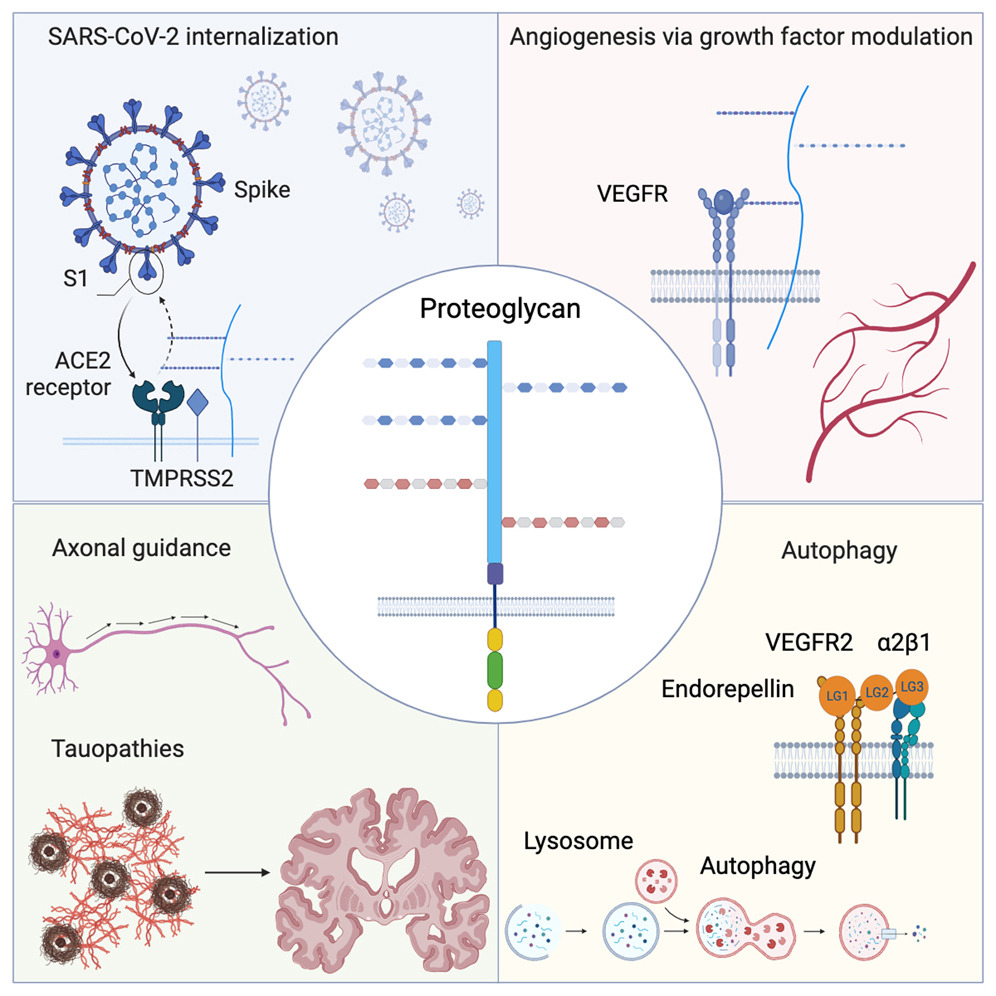
Xie, C. et al. iScience. 2023.
Figure 1. Biological Roles of Proteoglycans in Cellular and Disease Processes
Services at MtoZ Biolabs
MtoZ Biolabs provides end-to-end Proteoglycans Analysis Service that covers both the protein core and the GAG chains, ensuring complete molecular characterization. Using enzymatic digestion, chromatographic separation, and high-resolution mass spectrometry, our team delivers accurate, reproducible, and comprehensive analytical data.
Our main service offerings include:
1. Proteoglycan Profiling
Comprehensive identification and quantification of proteoglycans in complex biological samples using high-resolution LC-MS/MS and advanced bioinformatics workflows.
2. Glycosaminoglycan (GAG) Structure Analysis
Determination of disaccharide composition, sulfation pattern, and linkage type through UPLC coupled with Orbitrap or timsTOF mass spectrometry, following enzymatic digestion or depolymerization.
3. Core Protein Characterization
Analysis of proteoglycan core proteins by peptide mapping, sequence coverage, and post-translational modification identification.
4. Quantitative GAG Measurement
Absolute quantification using isotope-labeled internal standards and multiple reaction monitoring (MRM) for accurate comparison across biological conditions.
5. Interaction and Functional Studies
Evaluation of proteoglycan–protein and proteoglycan–ligand interactions, when applicable, through biophysical techniques such as surface plasmon resonance (SPR) and isothermal titration calorimetry (ITC).
Analysis Workflow
Each project follows a standardized and validated analytical workflow:
1. Sample Preparation: Proteoglycans are extracted from tissues, cells, or biological fluids using detergent-free methods that preserve molecular integrity.
2. Enzymatic or Chemical Digestion: Specific lyases and proteases are applied to release glycosaminoglycan chains and glycopeptides for downstream chromatographic and MS-based analysis.
3. Derivatization and Labeling: Chemical tagging enhances detection sensitivity and facilitates accurate quantification.
4. Chromatographic Separation: High-performance HPLC or UPLC systems separate proteoglycan components based on charge, size, and hydrophobicity.
5. Mass Spectrometry Detection: High-resolution instruments such as Orbitrap Fusion Lumos, Q Exactive HF, or timsTOF are used for structural elucidation and mass determination.
6. Bioinformatics Data Processing: Specialized software integrates peptide and glycan data, generating detailed structural annotations and quantitative reports.
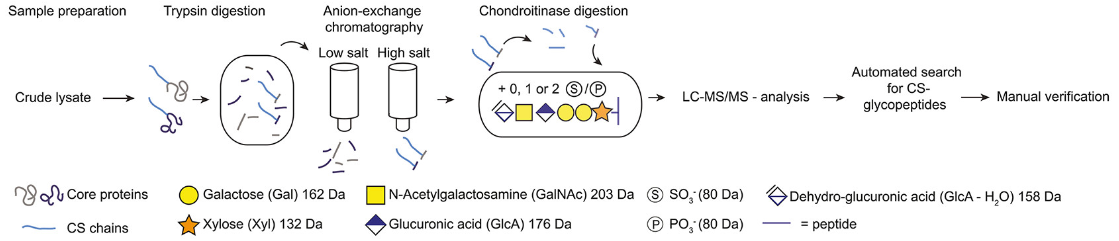
Takemura, M. et al. Mol Biol Cell. 2020.
Figure 2. LC–MS/MS Workflow for Chondroitin Sulfate (CS) Proteoglycan Analysis
Sample Submission Suggestions
To ensure high-quality analytical results, please prepare samples for Proteoglycans Analysis Service according to the following guidelines:
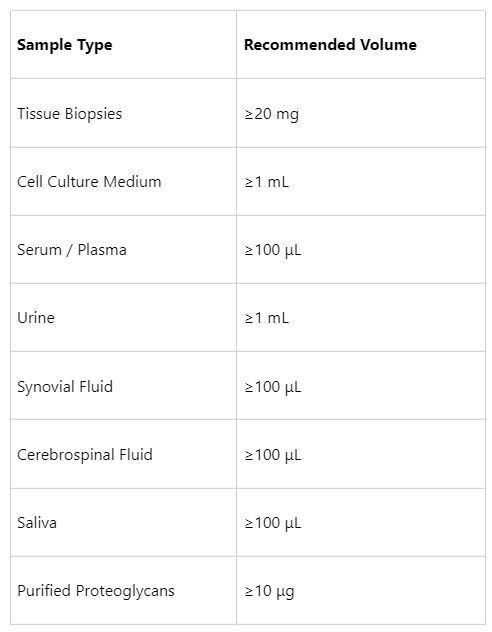
Additional Notes:
Our team can assist with sample preparation and confirm compatibility with LC-MS/MS and glycan analysis workflows.
Why Choose MtoZ Biolabs?
1. Advanced Analytical Platform
MtoZ Biolabs utilizes Orbitrap, timsTOF, and QTOF mass spectrometers integrated with automated HPLC, UPLC, and NMR systems, when applicable, for precise proteoglycan characterization.
2. Reliable Data Quality
All analyses follow standardized protocols and strict quality control for reproducible and publication-ready data.
3. Broad Sample Compatibility
Our platform supports diverse biological matrices, including tissues, cells, plasma, and extracellular matrix samples.
4. Customized Project Design
We tailor analytical strategies and data interpretation to meet specific research goals and experimental requirements.
5. Transparent Pricing
A one-time-charge model ensures clarity and cost-effectiveness, with no hidden fees.
MtoZ Biolabs provides reliable and comprehensive Proteoglycans Analysis Service that enables researchers to explore the structural complexity and biological relevance of proteoglycans in health and disease. Our expert team ensures each project is completed with precision and efficiency, delivering results that drive scientific discovery and innovation. Contact MtoZ Biolabs to learn how our expertise can advance your research in glycobiology and therapeutic development.
How to order?




