






Glycopeptide Sequence Analysis Service
MtoZ Biolabs provides comprehensive Glycopeptide Sequence Analysis Service that enables in-depth characterization of glycoproteins at the peptide level. By integrating state-of-the-art LC-MS/MS instrumentation, advanced glycopeptide enrichment techniques, and bioinformatics-driven data interpretation, we deliver high-confidence identification of glycosylation sites, glycan structures, and peptide backbones in complex biological samples.
Glycopeptides are peptides covalently modified by carbohydrate chains (glycans) through N- or O-linked glycosylation. These structural hybrids are central to cell communication, immune recognition, protein folding, and stability. Deciphering glycopeptide sequences provides direct insights into how specific glycosylation patterns influence protein function, disease progression, and therapeutic performance. With extensive experience in glycoproteomics, MtoZ Biolabs offers precise, reliable, and customizable analytical solutions for academic, clinical, and biopharmaceutical research.
Services at MtoZ Biolabs
1. Glycopeptide Identification and Sequencing
Using LC-MS/MS combined with HCD and ETD fragmentation, we identify glycopeptides and determine their peptide backbone sequences with site-specific resolution. This approach enables confident localization of glycosylation sites within complex protein samples.
2. Glycan Composition and Structural Analysis
Characterization of glycan structures attached to peptides using MS/MS spectra interpretation, retention time alignment, and glycan library matching. This service provides detailed information on monosaccharide composition, linkage type, and branching pattern.
3. Site-Specific Glycosylation Profiling
Mapping and quantifying N- and O-glycosylation sites across multiple proteins. This analysis supports functional studies and batch-to-batch consistency evaluation of therapeutic proteins.
4. Quantitative Glycopeptide Comparison
Employing label-free or TMT-based quantification, we assess glycopeptide abundance across biological conditions or production lots, facilitating differential glycoform analysis and biomarker validation.
Analysis Workflow
Every Glycopeptide Sequence Analysis Service project at MtoZ Biolabs follows a standardized workflow to ensure precision and traceability:
1. Sample Preparation: Proteins are denatured, reduced, and enzymatically digested (commonly with trypsin) to produce glycopeptides.
2. Enrichment: Glycopeptides are selectively captured using hydrophilic interaction chromatography (HILIC), lectin affinity, or graphitized carbon cartridges to improve detection sensitivity.
3. LC-MS/MS Analysis: High-resolution LC-MS/MS systems such as Orbitrap Fusion Lumos or timsTOF Pro are used for glycopeptide detection with dual fragmentation (HCD/ETD/EThcD).
4. Data Processing: MS/MS spectra are interpreted using proprietary glycoproteomics pipelines to identify both peptide sequences and attached glycans.
5. Data Validation and Reporting: Identified glycopeptides are cross-validated through glycan databases and manual verification, ensuring confident assignment and accurate quantification.
This end-to-end workflow enables simultaneous identification of peptide backbones and glycan moieties with exceptional sensitivity and precision.
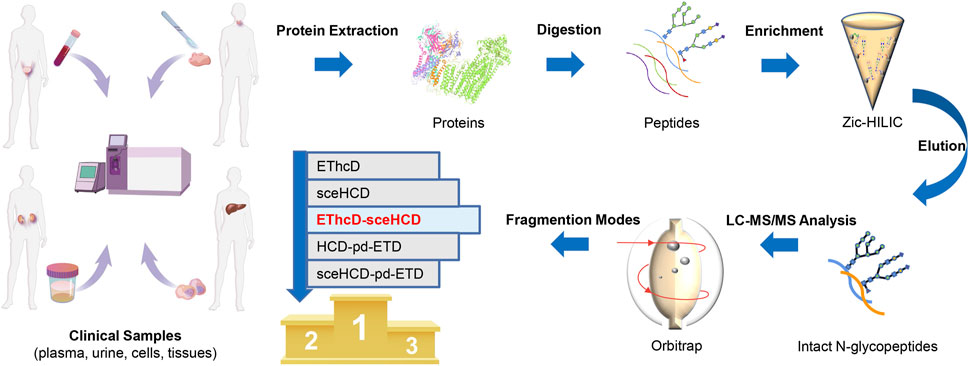
Zeng, W. et al. Front. Chem. 2022.
Figure 1. Workflow for Glycopeptide Sequencing using LC–MS/MS
Why Choose MtoZ Biolabs?
✅ Comprehensive Sequencing Coverage
Simultaneous analysis of peptide sequences and glycan structures within a single LC–MS/MS run.
✅ High-Resolution and High-Sensitivity Detection
Orbitrap Fusion Lumos and Q Exactive HF systems ensure sub-ppm mass accuracy and ultra-low detection limits.
✅ Multiple Fragmentation Modes
Combined use of HCD, CID, and ETD generates complementary fragment ions for unambiguous site identification.
✅ Advanced Glycopeptide Enrichment Strategies
Lectin, HILIC, and TiO₂-based methods effectively enrich glycopeptides and enhance low-abundance detection.
✅ Integrated Bioinformatics Pipeline
Automated database searching, glycan library matching, and quantitative statistical analysis for comprehensive interpretation.
Sample Submission Suggestions
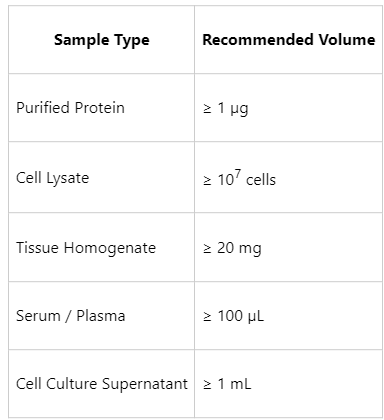
Note: Provide details on sample collection and handling. If you need further details, our technical support team is happy to assist and provide comprehensive guidance on sample submission.
FAQ
Q1: Can Quantitative Comparison of Glycopeptides Be Performed?
A1: Yes. We provide both label-free and isobaric labeling (TMT/iTRAQ) quantification options to assess changes in glycopeptide abundance across biological or experimental conditions.
Glycopeptide sequence analysis bridges proteomics and glycomics by revealing the structural intricacies of protein glycosylation at the site-specific level. With cutting-edge Orbitrap mass spectrometry, optimized enrichment strategies, and robust bioinformatics pipelines, MtoZ Biolabs provides accurate, reproducible, and insightful glycopeptide characterization.
Whether your goal is biomarker discovery, therapeutic protein validation, or mechanistic exploration of glycoprotein function, our Glycopeptide Sequence Analysis Service offers the precision and analytical depth your research demands.
Partner with MtoZ Biolabs to accelerate your glycoproteomics discoveries and ensure analytical excellence in every project.
How to order?




