






Basic Starch Analysis Service
- Raw data for each tested parameter.
- Summary tables of compositional and functional results.
- Graphical plots of viscosity, digestibility, or solubility where applicable.
- Methodological details and quality-control records.
- Professional interpretation outlining implications for performance, nutrition, or formulation optimization.
- Optional consultation for further research design or process adjustment.
Starch is one of the most abundant carbohydrates in nature and serves as a fundamental component in food, pharmaceutical, textile, and biomaterial industries. The structure and composition of starch vary significantly depending on botanical origin and processing conditions. Factors such as amylose-to-amylopectin ratio, granule size, and degree of modification influence water absorption, gelatinization, and nutritional value. Basic compositional analysis, covering water, ash, fat, and protein contents, forms the foundation for evaluating starch quality and predicting its performance in industrial applications.
Beyond simple composition, functional testing such as viscosity, solubility index, swelling power, phosphorylation level, and digestibility further characterizes starch behavior under thermal or enzymatic treatment. Understanding these parameters allows manufacturers to tailor starch properties for specific uses, from food thickening and controlled drug release to biodegradable packaging.
To meet the increasing analytical needs of the food and biopolymer industries, MtoZ Biolabs offers a professional Basic Starch Analysis Service. This comprehensive suite of assays provides accurate quantification of key starch parameters through standardized, validated methodologies. Combining advanced chromatographic and enzymatic platforms with expert scientific interpretation, our Basic Starch Analysis Service supports diverse research and quality-control objectives across the food, agricultural, and pharmaceutical sectors.
Service at MtoZ Biolabs
| Service | Method |
| Starch Water Content Determination Service | Measured using a rapid moisture analyzer by controlled heating and weight loss to evaluate sample stability and dryness. |
| Starch Ash Content Determination Service | Conducted in a muffle furnace at high temperature to determine inorganic residue and assess sample purity. |
| Starch Crude Fat Content Determination Service | Uses solvent extraction (Soxhlet or reflux) to separate and quantify lipid components affecting nutritional and physical properties. |
| Starch Crude Protein Content Determination Service | Applies Kjeldahl or Dumas nitrogen analysis, converting total nitrogen to protein equivalent to evaluate sample quality. |
| Starch Digestibility Testing Service | Simulates gastrointestinal digestion using α-amylase and amyloglucosidase, measuring glucose release. |
| Starch Phosphorylation Level Determination Service | Quantifies phosphate substitution at C-3 and C-6 hydroxyl groups using colorimetric or chromatographic detection to assess modification degree. |
| Starch Gel Consistency Determination Service | Evaluates the firmness and flow characteristics of gelatinized starch gels under standardized conditions, offering precise data on gel texture, retrogradation behavior, and the relationship between amylose content and final product quality. |
| Starch Water Solubility Index Testing Service | Determines dissolved solids after heating and centrifugation, reflecting starch solubility and molecular degradation. |
| Starch Swelling Power Measurement Service | Measures granule expansion by heating starch in water and calculating sediment weight ratio, indicating hydration capacity and structural integrity. |
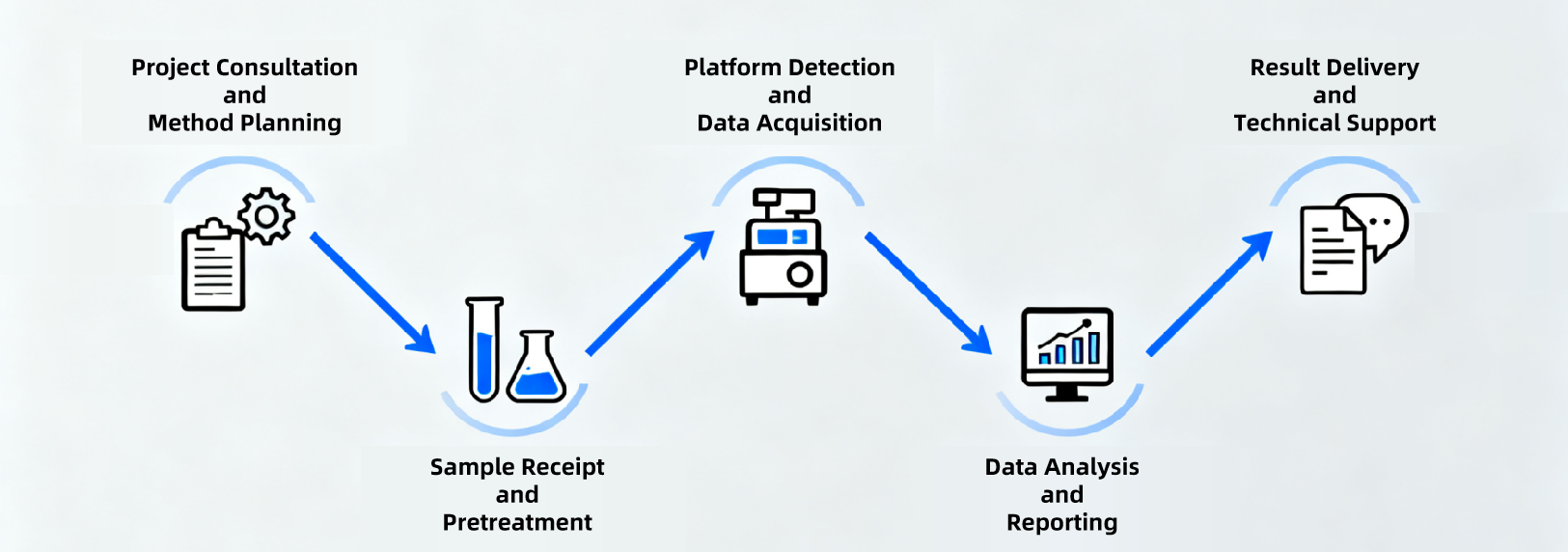
Analysis Workflow
Service Advantages
✔️Advanced Instrumentation
Utilization of high-precision moisture analyzers, muffle furnaces, viscometers, and LC/MS systems ensures accurate measurement.
✔️Standardized and Validated Methods
Each test follows international protocols, ensuring data reliability and regulatory compliance.
✔️Customizable Testing Packages
Clients may select individual analyses or tailored combinations to meet specific R&D or production requirements.
✔️Efficient Turnaround and Transparent Reporting
Streamlined workflows enable timely delivery of results with detailed, publication-ready documentation.
Applications
The Basic Starch Analysis Service provided by MtoZ Biolabs supports a wide range of research and industrial applications by linking starch composition and functionality to product performance.
1. Food Industry
Used for evaluating starch as a thickener, stabilizer, or gelling agent in processed foods. Helps optimize texture, water retention, and shelf stability while monitoring changes during processing or storage.
2. Pharmaceutical Industry
Applied to assess starch used as excipients in drug formulations. Determines parameters affecting disintegration time, compressibility, and controlled-release behavior of tablets and capsules.
3. Agricultural and Breeding Research
Supports crop selection and genetic improvement by characterizing starch quality across different plant sources, enabling better utilization of agricultural resources.
4. Biomaterial Development
Provides key physicochemical data for starch-based biodegradable films and packaging materials, correlating structure with mechanical strength and environmental stability.
5. Nutritional and Health Studies
Used to classify starch digestibility and evaluate glycemic response, supporting the design of functional foods and dietary formulations.
6. Quality Control and Product Certification
Ensures batch consistency and compliance with industry standards for starch-based materials across food, pharmaceutical, and biomaterial production.
Sample Submission Suggestions
1. Sample Types: Native or modified starches, starch-based products, and raw materials such as grains, tubers, or biopolymers.
2. Sample Quantity: At least 10 g of pure starch or 50 g of raw material for extraction.
3. Replicates: A minimum of three biological or technical replicates is recommended for reproducibility.
4. Packaging and Storage: Samples should be sealed in airtight containers, protected from moisture, and kept at ambient or refrigerated conditions as appropriate.
5. Shipping: Use dry ice or ice packs when necessary to maintain sample stability.
*Note: For samples with limited availability or specific handling requirements, please contact MtoZ Biolabs for customized submission instructions.
Deliverables
How to order?




