






Starch Swelling Power Measurement Service
Swelling power is a fundamental functional parameter for starch, reflecting how starch granules absorb water and expand under heating. When a starch sample is dispersed in excess water and heated, water molecules penetrate into the granule's amorphous and crystalline regions, causing expansion, disruption of internal structure, and mobility of polymer chains. The ability of granules to swell, and the degree to which they do so, influences viscosity, gel formation, digestibility, and mechanical behavior in biopolymers.
Starch swelling power varies widely among botanical sources, growing conditions, and post-processing treatments. For example, starches with high amylopectin content and low amylose content tend to show greater swelling, while those with higher crystalline order or stronger internal hydrogen bonding resist swelling. Swelling power is also sensitive to chemical modifications (crosslinking, phosphorylation) or physical treatments (heat, extrusion). Understanding swelling power helps researchers predict how starch behaves in food, pharmaceutical, and material systems. It can guide formulation of gels, adhesives, coatings, and encapsulants. Accurately measuring swelling power under standardized conditions is thus a key step in starch characterization.
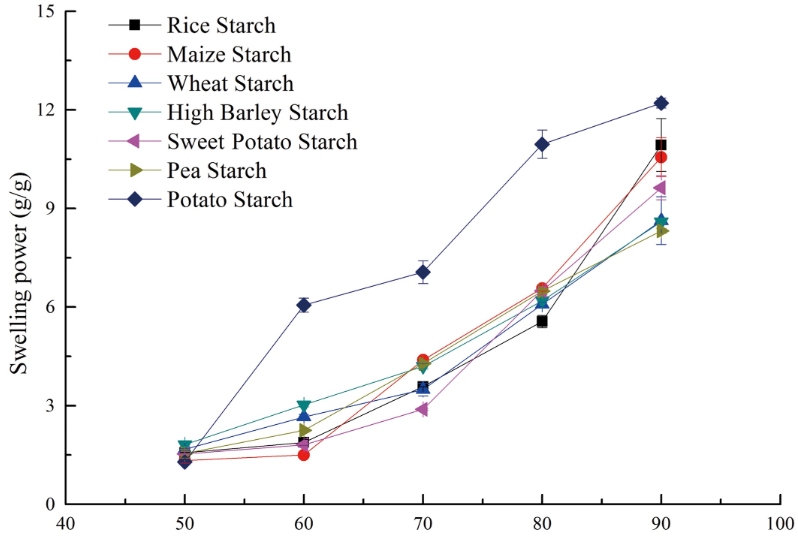
Li, Y. et al. Int J Food Sci Tech. 2022.
Figure 1. Swelling Power of Different Starches
MtoZ Biolabs offers a reliable Starch Swelling Power Measurement Service with well-validated protocols, high precision instrumentation, and expert interpretation. Our service quantifies the water uptake capacity and structural expansion behavior of starch granules, providing actionable data for R&D, quality control, and material design.
Technical Principles
The measurement of swelling power relies on quantifying how much water a starch granule can absorb relative to its dry mass when heated under defined conditions. Fundamentally:
1. A known mass of dry starch is hydrated in excess water and subjected to a defined heating and agitation program to induce maximum swelling.
2. After swelling, centrifugation isolates the swollen gel phase from the excess water.
3. The swollen mass (gel + bound water) is weighed, and swelling power is calculated as grams of swollen mass per gram of dry starch (or the water uptake per unit mass).
4. The formula often used is:

This ratio indicates how many grams of swollen paste form per gram of dry starch. A higher value suggests greater water absorption and expansion capability.
Swelling is governed by polymer-water interactions, disruption of internal hydrogen bonds, and granule architecture. The crystalline and amorphous domains, degree of branching in amylopectin, the presence of lipids or phosphates, and granule integrity all modulate behavior. Well-controlled swelling measurements hence reflect both the inherent structure and any modifications present.
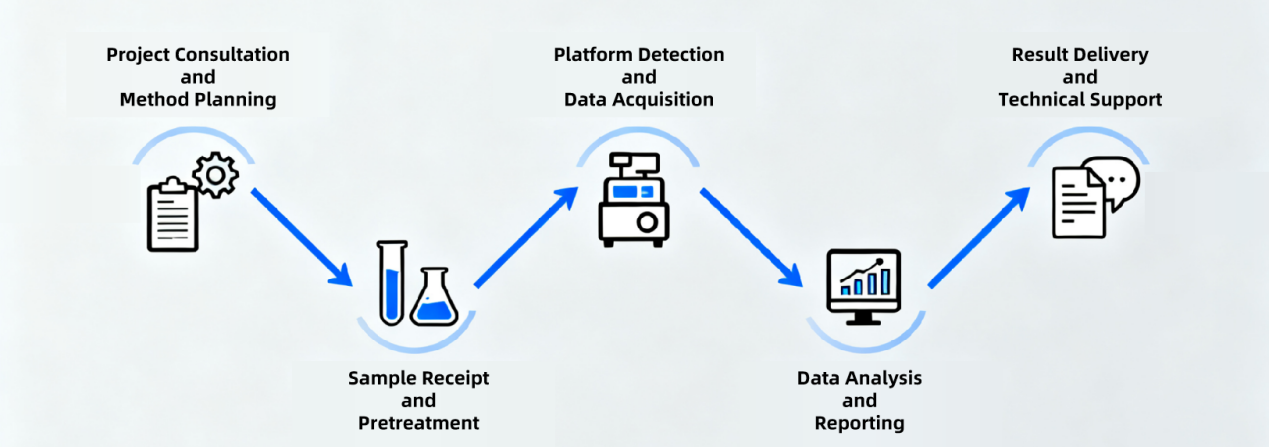
Analysis Workflow
Service Advantages
✔️High Analytical Accuracy
MtoZ Biolabs applies rigorously standardized procedures and precise thermal control to ensure reproducible and accurate swelling power measurements across diverse starch types.
✔️Flexible Experimental Design
Our testing protocols can be tailored for different temperature ranges, heating durations, and starch concentrations, providing flexibility for both research and industrial applications.
✔️Reliable Quality Assurance
Each experiment is conducted under controlled laboratory conditions with replicate measurements and strict data validation, ensuring high reliability and traceability of every report.
✔️End-to-End Professional Support
From sample handling to final reporting, MtoZ Biolabs provides comprehensive technical assistance, ensuring that clients receive clear, meaningful, and actionable results.
Applications
The Starch Swelling Power Measurement Service from MtoZ Biolabs supports multiple domains:
1. Food Science & Formulation: Assess swelling ability for applications such as thickening, bulking, or gel formation in sauces, puddings, and baked goods.
2. Pharmaceutical Excipients: Predict behavior of starch excipients under aqueous environments relevant to disintegration, release, and tablet swelling.
3. Biodegradable Materials & Films: Optimize starch-based composites or coatings by understanding water uptake and expansion that influence mechanical stability.
4. Starch Modification Research: Evaluate how chemical (e.g. crosslinking, phosphorylation) or physical treatments alter swelling behavior.
5. Quality Control & Standardization: Monitor lot-to-lot consistency of starch batches in terms of swelling response under standardized conditions.
Sample Submission Suggestions
1. Sample Type: Purified starch powders or raw materials containing starch from plant, microbial, or synthetic sources. If raw materials are provided, starch extraction will be performed by MtoZ Biolabs prior to analysis.
2. Sample Quantity: At least 10 g of starch or 60 g of fresh raw material; actual requirements depend on starch purity and experimental conditions.
3. Replicates: We recommend three or more biological replicates to ensure statistical reliability.
4. Packaging and Transport: Samples should be sealed in airtight containers, protected from moisture and contamination.
*Note: For samples with limited availability or specific handling requirements, please contact MtoZ Biolabs for customized submission instructions.
How to order?




