






Starch Physical And Chemical Properties Testing Service
- Viscosity: Reflects starch paste behavior and thickening properties.
- Gelatinization temperature: Indicates the temperature range where starch granules absorb water and lose crystallinity.
- Thermal stability: Evaluates starch resistance to heat-induced degradation.
- Molecular interactions: Assessed through infrared spectroscopy and rheology.
- Crystalline structure: Determined by X-ray diffraction.
MtoZ Biolabs provides comprehensive Starch Physical and Chemical Properties Testing Services designed to evaluate the structural, thermal, rheological, and morphological characteristics of starch from diverse biological and industrial sources. Using advanced analytical platforms such as X-ray diffraction (XRD), Fourier-transform infrared (FTIR) spectroscopy, differential scanning calorimetry (DSC), and rheometry, our services deliver high-precision, reproducible data for applications in food science, materials research, biotechnology, and pharmaceuticals.
Background
Starch is one of the most widely used polysaccharides in nature and industry. Its functionality depends strongly on its physical and chemical characteristics, which vary according to botanical origin, processing method, and modification treatment.
Starch physical and chemical properties testing refers to the systematic analysis of starch characteristics that determine its performance, functionality, and stability in different environments. These analyses assess how starch behaves under heat, pressure, enzymatic action, and mechanical stress, providing insight into its structural integrity, gelatinization, viscosity, and crystalline arrangement.
Key parameters typically include:
By accurately measuring starch properties, researchers and manufacturers can improve efficiency, enhance product quality, and develop innovative starch-based materials.
Services at MtoZ Biolabs
MtoZ Biolabs offers a complete suite of starch property testing services, allowing clients to select targeted or integrated analyses according to their research and production needs.
💠Starch Viscosity Determination Service
Measures paste viscosity and shear-thinning behavior using advanced rheometers, supporting food formulation and process optimization.
💠Starch Gelatinization Temperature Determination Service
Uses DSC to determine onset, peak, and conclusion temperatures of gelatinization, revealing energy requirements for starch transformation.
💠Starch Thermal Stability Determination Service
Assesses heat resistance and degradation thresholds of starch, critical for evaluating processing conditions and storage stability.
💠Starch Infrared Scanning Determination Service
Applies FTIR spectroscopy to detect molecular interactions, functional group modifications, and amylose–amylopectin ratios.
💠Starch Rheological Determination Service
Analyzes time- and temperature-dependent flow properties to study gel formation, elasticity, and retrogradation effects.
💠Starch Scanning Electron Microscopy Determination Service
Provides high-resolution imaging of granule morphology, particle size distribution, and surface characteristics before and after treatment.
💠X-ray Diffraction Based Starch Analysis Service
Determines crystalline type, crystallinity percentage, and structural order, aiding in the identification of processing-induced changes.
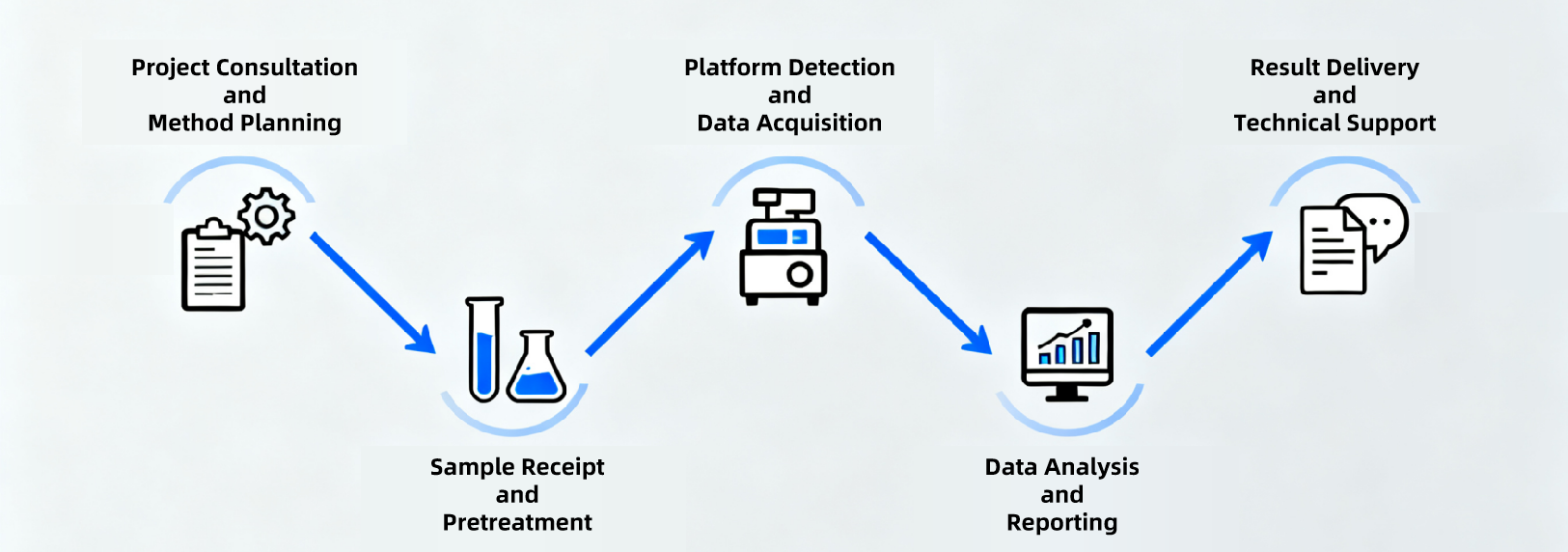
Analysis Workflow
1. Sample Preparation: Samples are homogenized, dried, or sieved as required. Starch granules may be isolated or chemically treated before testing.
2. Instrumental Measurement: Appropriate analytical techniques (DSC, FTIR, SEM, etc.) are applied based on the study objectives.
3. Data Acquisition: Raw data are collected from instruments with strict quality control measures.
4. Data Processing and Interpretation: Specialized software analyzes peak transitions, spectra, or diffraction patterns to extract quantitative parameters.
5. Reporting and Consultation: MtoZ Biolabs delivers a comprehensive report including methods, results, and expert interpretations with recommendations.
Service Advantages
✔️High Sensitivity and Accuracy: Utilizes advanced DSC, FTIR, XRD, and SEM platforms for precise quantification and imaging.
✔️Customized Solutions: Analytical plans tailored to specific research or industrial goals.
✔️Expert Interpretation: Experienced scientists provide professional evaluation and data interpretation.
✔️Reproducible and Reliable Data: Strict quality assurance protocols ensure consistent, publication-ready results.
Applications
1. Food and Beverage Industry: Texture, viscosity, and stability optimization in processed foods and starch-based thickeners.
2. Bioplastics and Packaging: Evaluating thermal behavior and crystallinity for starch-derived biodegradable polymers.
3. Pharmaceuticals: Studying starch excipients' flow and swelling behavior in tablets and capsules.
4. Agricultural Research: Characterizing starch variations across plant species or genetic modifications.
5. Material Science: Investigating starch composites and their physicochemical behavior under stress and temperature changes.
Sample Submission Suggestions
1. Sample Types: Native starch, modified starch, or raw materials for starch extraction.
2. Recommended Quantity: Minimum 10 g of dry starch or 60 g of raw material for extraction.
3. Replicates: At least three biological or technical replicates are recommended for statistical reliability.
4. Storage: Samples should be kept in sealed, dry containers and protected from moisture absorption.
*Note: For special sample types or low-yield materials, please contact MtoZ Biolabs for customized preparation guidance.
Deliverables
1. Detailed analytical report summarizing test methods, results, and conclusions
2. Raw data files
3. Instrumental spectra and images from DSC, FTIR, SEM, and XRD analyses
4. Thermal and rheological property curves with key parameter tables
5. Quantitative data on viscosity, crystallinity, and gelatinization temperature
6. Quality control and reproducibility assessment results
7. Expert interpretation with application-oriented recommendations
Partner with MtoZ Biolabs to achieve a comprehensive understanding of starch physical and chemical properties, supporting progress across food, pharmaceutical, agricultural, and material science industries. Free project evaluation, welcome to learn more details!
How to order?




