






Starch Infrared Scanning Determination Service
Infrared spectroscopy is one of the most powerful analytical techniques used to study the molecular structure, composition, and interactions of starch. By examining how starch absorbs infrared light at specific wavelengths, researchers can gain valuable insights into its chemical bonds, crystalline organization, and functional group distributions. The infrared spectrum of starch reflects the vibrational characteristics of its constituent molecules, particularly the O-H, C-O, and C-H stretching vibrations that define its molecular conformation. Infrared spectroscopy offers fast, non-destructive, and highly sensitive molecular characterization. It is particularly suitable for monitoring starch quality, detecting adulteration, studying reaction kinetics, and evaluating the impact of physical or chemical modifications on starch structure.
MtoZ Biolabs provides a precise and comprehensive Starch Infrared Scanning Determination Service to characterize the molecular and structural properties of native and modified starches. Using advanced Fourier Transform Infrared Spectroscopy (FTIR), we identify chemical bonds, detect functional group modifications, and evaluate crystalline–amorphous transitions that occur during starch processing. This analysis helps clients in food, pharmaceutical, material science, and agricultural industries optimize starch utilization, processing performance, and product functionality.
Technical Principles
The Fourier Transform Infrared (FTIR) spectroscopy technique operates by passing infrared light through a starch sample and detecting how much energy is absorbed at each wavelength. Each functional group within the starch molecule vibrates at characteristic frequencies, leading to distinct absorption bands in the infrared spectrum.
The resulting FTIR spectrum serves as a "molecular fingerprint" that reflects the chemical and physical state of the sample. For starch, key absorption regions typically include:
🔸O–H Stretching (3200–3600 cm-1): Related to hydrogen bonding and water content.
🔸C–H Stretching (2800–3000 cm-1): Represents aliphatic CH bonds in the glucose units.
🔸C–O and C–C Stretching (900–1200 cm-1): Associated with glycosidic linkages and ring vibrations.
🔸Hydroxyl Bending and Skeletal Vibrations (1400–1600 cm-1): Reflect changes in molecular conformation.
By comparing spectra before and after physical or chemical treatment, FTIR analysis can detect changes such as esterification, oxidation, phosphorylation, or gelatinization. MtoZ Biolabs’ optimized protocols ensure accurate and reproducible spectral acquisition, even for complex or composite samples.
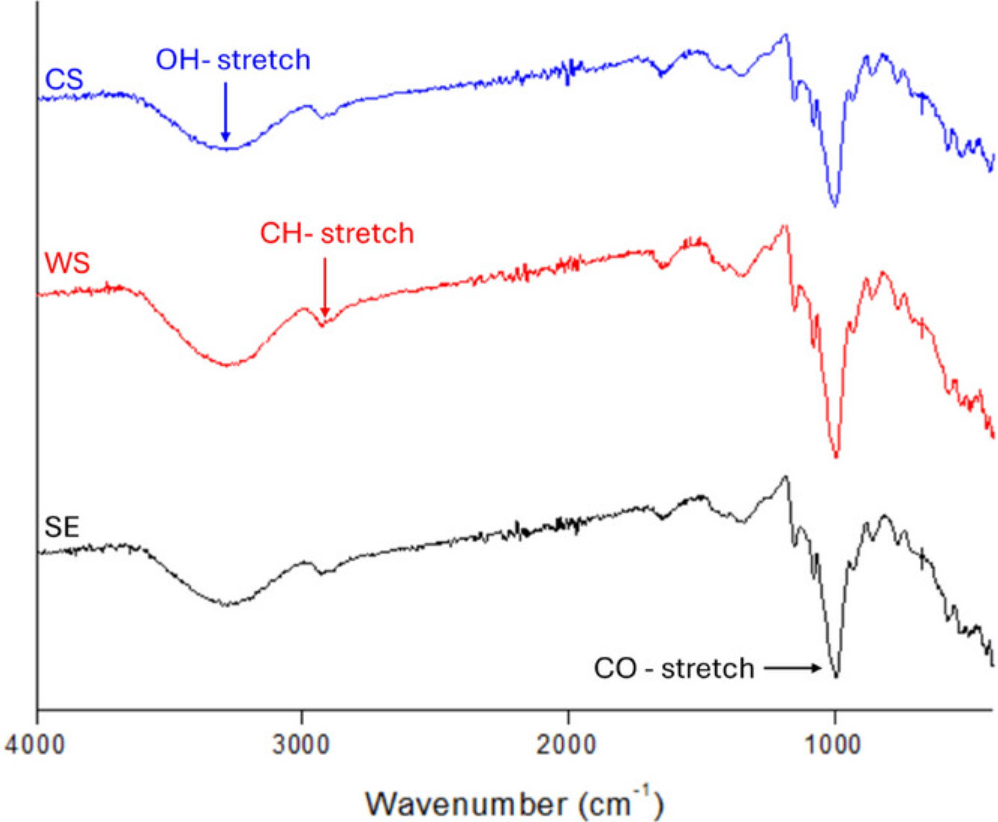
Akinwumi, F. E. et al. J Food Sci. 2025.
Figure 1. FTIR Spectra of Corn and Runner Bean Starches. CS: Corn Starch; SE: Runner Bean 'Scarlet Emperor'; WS: Runner Bean 'White Swan'.
Analysis Workflow

Service Advantages
✔️High Sensitivity and Accuracy
Our advanced FTIR systems capture fine structural details, enabling detection of even minor chemical modifications or crystallinity changes.
✔️Non-Destructive and Fast Analysis
Samples can be analyzed directly without complex preparation, preserving material integrity while delivering rapid results.
✔️Comprehensive Structural Interpretation
Our experts correlate infrared spectral data with starch functional properties, supporting research, quality assessment, and formulation design.
✔️Reproducible and Reliable Results
Rigorous calibration and data validation ensure high reproducibility and comparability across samples and projects.
Applications
1. Food Science and Processing
Infrared scanning helps evaluate starch behavior during heating, gelatinization, and retrogradation. It aids in quality control for products such as noodles, bread, and instant foods by monitoring structural changes affecting texture, digestibility, and shelf life.
2. Pharmaceutical Industry
FTIR analysis supports the characterization of starch excipients used as binders, disintegrants, or coating agents. It ensures chemical stability and detects modifications that influence drug release and formulation compatibility.
3. Biomaterials and Polymers
For biodegradable films and composites, infrared spectra provide insights into molecular interactions between starch and plasticizers or reinforcing agents. This aids in improving mechanical properties, water resistance, and biodegradability.
4. Agricultural and Crop Research
Infrared scanning is used to compare starches from different plant sources or genetically modified varieties. Differences in spectral features reflect variations in amylose content, crystallinity, and thermal behavior.
5. Chemical Modification Studies
FTIR spectra confirm successful chemical modifications such as acetylation, oxidation, and phosphorylation by identifying new absorption bands corresponding to functional groups introduced.
6. Quality Control and Authentication
Infrared spectroscopy offers a rapid and non-destructive means of detecting adulteration or contamination in starch-based materials, ensuring compliance with industry standards.
Sample Submission Suggestions
1. Sample Types: Native starch, modified starch, or raw materials for starch extraction.
2. Recommended Quantity: Minimum 1 g of dry starch or 50 g of raw material for extraction.
3. Replicates: At least three biological replicates are recommended for statistical reliability.
4. Storage: Samples should be kept in sealed, dry containers.
Note: For special sample types or low-yield materials, please contact MtoZ Biolabs for customized preparation guidance.
How to order?




