






Peptide Binding Assays Service
MtoZ Biolabs provides an advanced Peptide Binding Assays Service designed to evaluate the interactions between peptides and their protein targets. By offering both labeled and label-free assays, we utilize cutting-edge technologies such as fluorescence, radiolabeling, surface plasmon resonance (SPR), and structure-based analysis to determine binding affinity, kinetics, and specificity. Our service helps researchers gain a deeper understanding of peptide-protein interactions, supporting peptide optimization, drug design, and mechanism studies.
Background
Understanding how peptides bind to their target proteins is critical for optimizing peptide design and therapeutic efficacy. Peptides are often used as drugs or as part of drug conjugates, and their ability to bind specifically to biological targets plays a key role in their biological activity and therapeutic success. Peptide binding assays help identify and quantify these interactions, revealing key information about binding affinity, target specificity, and the mechanism of action.
Peptides interact with proteins via specific binding sites, which are influenced by factors such as protein conformation, electrostatic interactions, hydrophobicity, and steric complementarity. By evaluating these binding interactions, researchers can identify potential leads for drug development, predict pharmacodynamic outcomes, and optimize peptide stability and bioactivity.
Peptide Binding Assays Service at MtoZ Biolabs
1. Labeled Peptide Binding Assays
These assays use various labeling techniques to detect and quantify peptide binding to proteins, enabling high sensitivity and real-time monitoring.
💠Fluorescently Labeled Peptide Binding Assays
Peptides are labeled with fluorescent tags, and binding interactions are monitored through changes in fluorescence intensity. This method is widely used to assess binding affinity and kinetics.
💠Radiolabeled Peptide Binding Assay
Peptides are tagged with radioactive isotopes, enabling precise detection of binding events. This technique is ideal for studying low-affinity interactions or when high sensitivity is required.
💠Bioluminescent Binding Assays (Nanoluciferase)
Peptides are conjugated with nanoluciferase, a small, highly sensitive bioluminescent reporter. This assay allows for real-time, non-invasive monitoring of peptide binding to target proteins.
2. Label-Free Peptide Binding Assays
Label-free methods offer the advantage of measuring binding interactions in real time without modifying the peptide, providing a more natural interaction environment.
💠Surface Plasmon Resonance (SPR)
SPR measures the change in refractive index as peptides bind to immobilized proteins, providing real-time data on binding kinetics and affinity.
💠Nanofluidic Fluorescence Microscopy (NFM)
This advanced technique uses nanoscale fluidic channels to observe peptide binding, allowing for high-resolution imaging and real-time interaction monitoring.
💠Plasmon-Waveguide Resonance (PWR)
PWR is used for detecting binding events by measuring changes in the optical properties of a surface, providing sensitive, real-time data on peptide-protein interactions.
💠SPR Imaging for Affinity-Based Biosensors
This method uses SPR imaging to capture spatially resolved binding events, enabling the monitoring of multiple interactions simultaneously.
💠Whispering Gallery Microresonator (WGM)
WGM sensors detect shifts in light resonance caused by peptide binding, offering extremely high sensitivity and allowing for detection of even weak interactions.
💠Resonant Waveguide Grating (RWG)
RWG is used for label-free detection of peptide binding, offering high sensitivity and enabling the assessment of multiple binding events in parallel.
💠Biolayer Interferometry (BLI)
This biosensor technique measures the interference pattern of light as peptides bind to immobilized proteins, providing real-time data on binding affinity and kinetics.
3. Structure-Based Peptide Binding Assays
We use computational and structural biology techniques to predict and analyze peptide-protein binding regions, optimizing peptide design and interaction characterization.
4. Thermodynamic Binding Assays
Thermodynamic assays evaluate the enthalpic and entropic contributions to peptide binding, providing a deeper understanding of the binding process and the stability of peptide-protein complexes.
5. Whole-Cell Peptide Binding Assays
These assays assess peptide binding within living cells, providing a more physiologically relevant measurement of peptide-protein interactions in their native cellular context.
6. Computational Prediction
In addition to experimental assays, we also offer computational tools to predict potential peptide binding sites and protein-peptide interaction regions:
💠Peptide Binding Site Prediction
Using advanced computational algorithms, we predict the most likely binding sites on target proteins for a given peptide, facilitating the early stages of drug discovery.
💠Protein-Peptide Binding Regions Prediction
We analyze protein structures to predict the regions where peptides are most likely to bind, enhancing the understanding of the molecular mechanisms involved.
Why Choose MtoZ Biolabs
✔️Advanced Binding Assay Technologies
We use state-of-the-art technologies such as SPR, NFM, BLI, and molecular docking to provide accurate, high-resolution data.
✔️Flexible and Customizable Study Design
We offer tailored solutions to meet your specific research needs, including the use of both labeled and label-free methods.
✔️High Sensitivity and Precision
Our methods ensure the detection of even low-affinity interactions with high sensitivity and reproducibility.
✔️Expert Scientific Team
Our team of experienced scientists ensures high-quality data collection, analysis, and interpretation.
✔️Fast Turnaround and Excellent Support
We offer timely delivery of results and provide full client support throughout the study.
Applications of Peptide Binding Assays Service
1. Peptide optimization for drug development
Evaluate binding affinity and specificity to optimize peptide sequences.
2. Target identification and characterization
Identify potential binding sites and protein targets for new peptides.
3. Mechanism of action studies
Understand how peptides interact with biological targets at a molecular level.
4. High-throughput screening of peptide libraries
Screen multiple peptides for binding affinity and activity.
5. Peptide formulation development
Assess stability and bioactivity in formulation context.
FAQ
Q1: What types of samples are suitable?
For our Peptide Binding Assays Service, we accept a range of sample types, including:
In vitro Samples
- Recombinant proteins
- Purified peptides
- Protein complexes
- Membrane-bound receptors or targets
- Cell lysates or membrane fractions containing target proteins
In vivo Samples
- Tissue extracts (e.g., liver, brain, muscle)
- Plasma or serum from animal models
- Whole cells or cell-based systems expressing target proteins
Q2: How should I prepare my samples?
Please follow these preparation guidelines to ensure optimal assay performance:
Peptide and Protein Samples
- Ensure peptides are pure and at the required concentration for the assay.
- Store peptides and proteins at low temperatures (typically ≤ -20°C) to prevent degradation before use.
- If possible, provide samples in aliquots to avoid repeated freeze-thaw cycles.
Cell-Based Systems
- For whole-cell assays, provide cells expressing the target protein, preferably at a concentration suitable for binding studies (typically 1 x 10⁶ cells/mL).
- Use appropriate culture media and conditions to maintain cell viability.
- Provide relevant details such as cell line information and receptor expression levels.
Buffers and Reagents
- Ensure all buffers used for reconstitution or dilution are compatible with the assay system (e.g., pH, salt concentration).
- Avoid using detergents that may interfere with binding interactions, unless required for solubility.
If specific storage or handling conditions are required for your peptide or protein, please provide these details along with the sample submission.
For more information, please refer to Sample Submission Guidelines for Proteomics and Sample Submission Guidelines for Metabolomics.
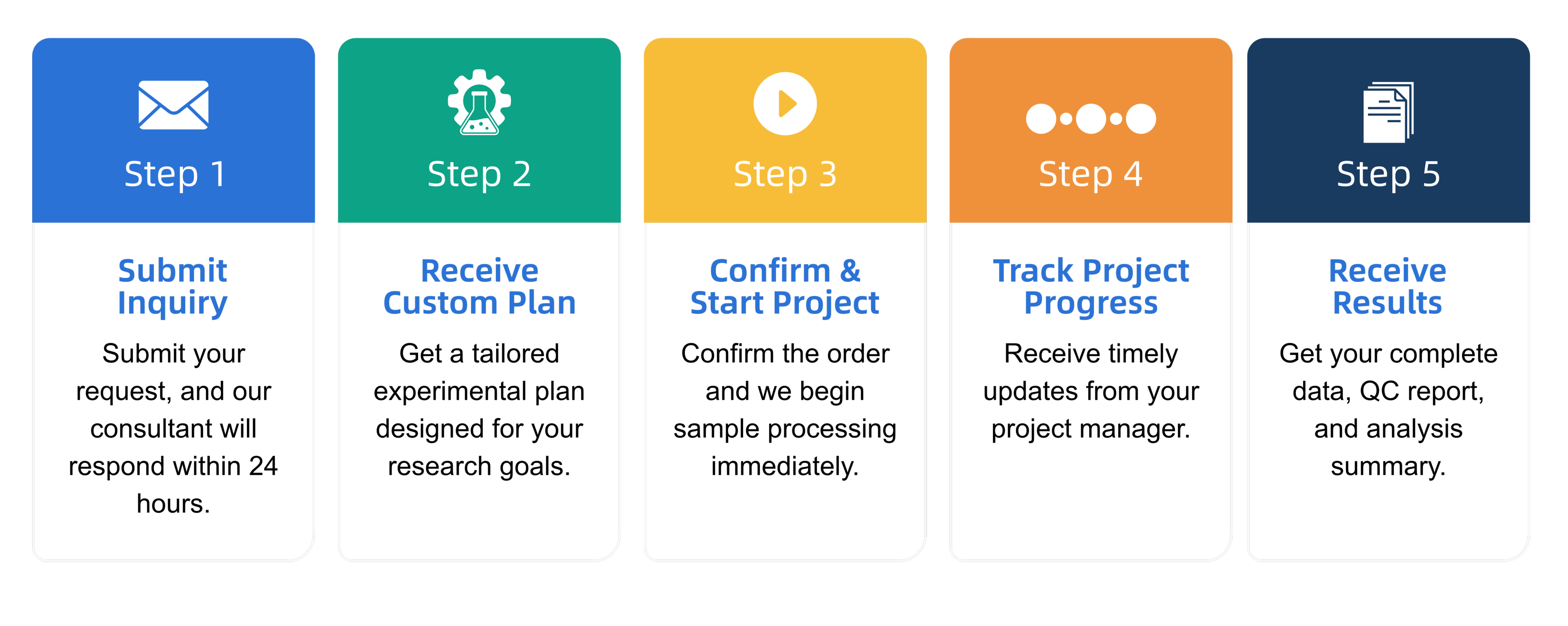
Q3: What is the service general workflow?
Q4: What data formats are provided?
We provide results in standard formats suitable for analysis, reporting, and publication:
- PDF report with assay workflow, binding results, and interpretation
- Excel or CSV files containing raw and processed binding data
- High-resolution PNG or TIFF images of binding curves and kinetic plots
- PDB or related structural files for computational binding predictions when applicable
- Additional formats can be supplied upon request.
Start Your Project with MtoZ Biolabs
MtoZ Biolabs provides an advanced and comprehensive Peptide Binding Assays Service to support peptide drug development and optimization.
Contact us today to learn how we can assist you in optimizing your peptide candidates and accelerating your drug development process.
How to order?




