






Label-Free Peptide Binding Assays Service
MtoZ Biolabs provides Label-Free Peptide Binding Assays Service using Surface Plasmon Resonance (SPR) technology to characterize peptide interactions with proteins, receptors, antibodies, nucleic acids, or other biomolecules. This service delivers real-time, quantitative kinetic and affinity data without the need for labeling or chemical modification, ensuring biological relevance and data accuracy. MtoZ Biolabs integrates advanced SPR platforms and optimized assay development workflows to accelerate peptide drug discovery, molecular recognition studies, and protein-peptide interaction analysis.
Background
Surface Plasmon Resonance (SPR) is an optical biosensing technology that measures molecular interactions in real time. When polarized light strikes a metal film at a specific angle, surface plasmons are excited, and the resulting changes in reflected light intensity correlate with mass variations on the sensor surface. By immobilizing one molecule (the ligand) and flowing another (the analyte) across the sensor surface, SPR detects binding events without the need for fluorescent or radioactive labels.
This approach enables accurate characterization of peptide-protein, peptide-antibody, or peptide-nucleic acid interactions while preserving native structure and activity. The method allows direct determination of kinetic constants (ka, kd) and affinity (KD), providing a full kinetic profile that surpasses traditional endpoint binding assays.
Principle of Label-Free Peptide Binding Assays
The core principle of SPR lies in detecting changes in the refractive index near the sensor surface as molecular binding occurs.
🔸Immobilization: The ligand (peptide or protein) is immobilized on a gold-coated sensor chip via covalent coupling, affinity capture, or non-covalent adsorption.
🔸Interaction Monitoring: Analytes (binding partners) are passed over the sensor surface under continuous flow. Binding and dissociation are recorded in real time as sensorgrams.
🔸Data Analysis: The sensorgrams are analyzed using kinetic and equilibrium models to calculate association (ka), dissociation (kd), and affinity constants (KD).
🔸Label-Free Detection: Because SPR measures mass changes directly, labeling steps that could alter molecular behavior are avoided, maintaining physiological accuracy.
This approach offers superior sensitivity and reproducibility for detecting weak, transient, or high-affinity interactions, making it ideal for peptide-target binding characterization.
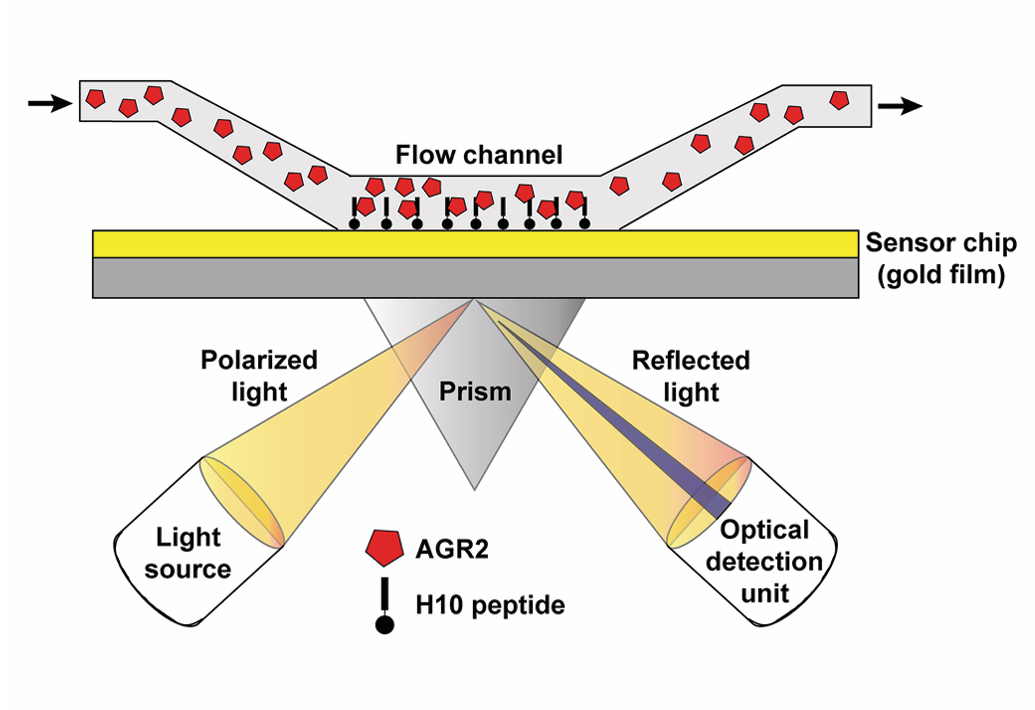
Garri, C. et al. Oncotarget. 2018.
Figure 1. Principle of SPR biosensor
Label-Free Peptide Binding Assays Service at MtoZ Biolabs
MtoZ Biolabs provides a comprehensive suite of SPR-based peptide binding assays to support discovery research and biopharmaceutical development.
Our services include, but are not limited to:
💠Kinetic and Affinity Analysis: Determination of real-time binding rates (ka, kd) and equilibrium constants (KD).
💠Epitope Mapping: Characterization of peptide binding sites on antibodies or receptors to support structure-function studies.
💠Competitive Binding Studies: Evaluation of multiple ligands or peptides for the same target to identify strongest binders.
💠Binding Specificity and Selectivity Testing: Differentiation of specific versus nonspecific binding using reference channels and controls.
💠Peptide-Protein and Peptide-Receptor Interaction Profiling: Systematic screening and ranking of peptide candidates for therapeutic or diagnostic applications.
💠Thermodynamic Analysis: Determination of enthalpy and entropy contributions to binding, revealing interaction mechanisms.
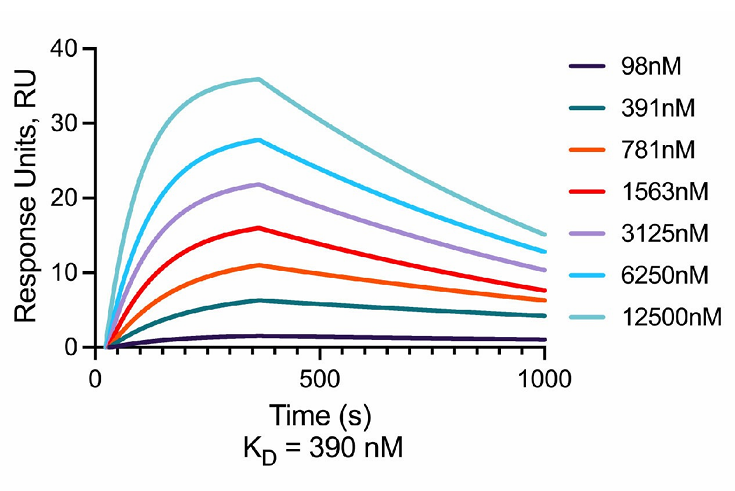
Boragine, D. M. et al. Chembiochem. 2022.
Figure 2. Surface Plasmon Resonance Traces for The Determination of Peptide Binding Affinity to β‐Lactamases
Service Advantages
☑️Real-Time and Label-Free: Direct measurement of binding kinetics without chemical labeling, preserving native interaction profiles.
☑️High Sensitivity and Accuracy: Detects picomolar to micromolar affinities with precise kinetic quantification.
☑️Comprehensive Data Output: Provides association/dissociation rates, equilibrium constants, and binding thermodynamics.
☑️Versatile Platform: Suitable for peptides interacting with proteins, antibodies, DNA, membranes, or small molecules.
☑️Customizable Solutions: Tailored assay design for client-specific peptides, receptors, and research objectives.
☑️Expert Analytical Support: Experienced scientists interpret kinetic profiles and recommend optimal experimental conditions.
Applications of Label-Free Peptide Binding Assays Service
- Characterization of peptide-receptor and peptide-antibody interactions
- Validation of peptide inhibitors or agonists in drug development
- Screening of peptide binding affinity for diagnostic or therapeutic targets
- Evaluation of peptide stability and binding strength in formulation studies
- Comparison of peptide variants for structure-activity relationship (SAR) analysis
- Confirmation of predicted peptide binding models through experimental validation
FAQ
Q1: What types of samples are suitable?
Our SPR-based assays accommodate purified peptides, purified proteins, peptide-protein complexes, antibodies, membrane protein preparations, as well as clarified biological samples such as tissue lysates, serum, or plasma, provided they can be introduced in an SPR-compatible buffer without particulates or interfering components.
Q2: How should I prepare my samples?
- Ensure samples are free of aggregates, particulates, and interfering additives such as detergents or high concentrations of glycerol or salts.
- Filter or centrifuge samples when necessary to remove debris.
- Provide accurate information on sample concentration, buffer composition, and storage history.
Detailed requirements and recommendations can be found in the Sample Submission Guidelines for Proteomics.
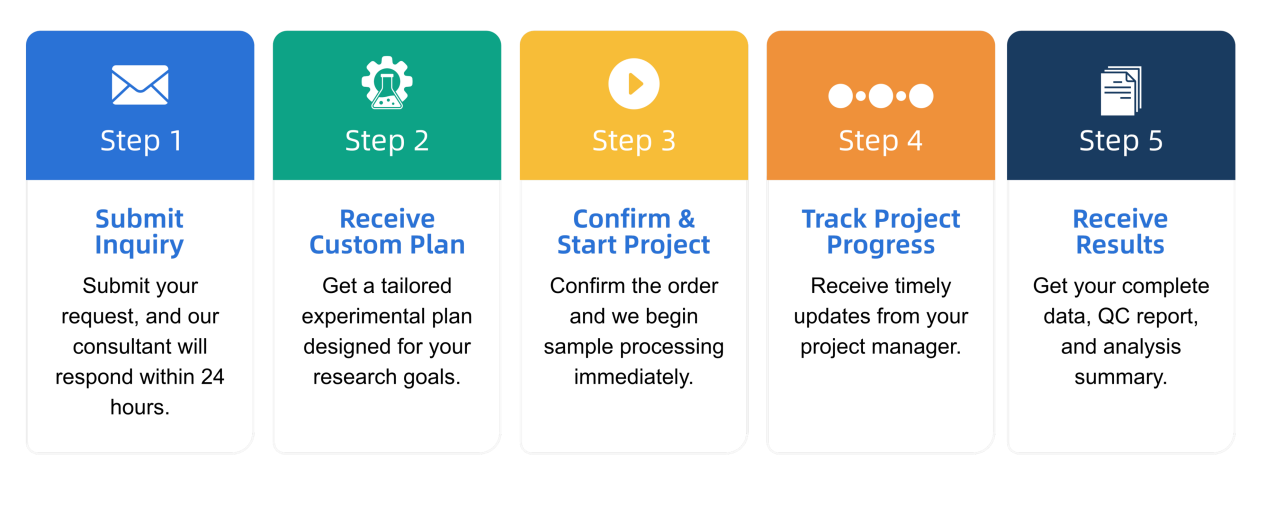
Q3: What is the service general workflow?
Q4: What data formats are provided?
We deliver a full report in PDF format, kinetic and affinity data in Excel or CSV files, and high-resolution sensorgrams and binding curves in PNG or TIFF formats. Additional formats can be supplied upon request.
Start Your Project with MtoZ Biolabs
MtoZ Biolabs integrates high-resolution SPR instrumentation, custom assay development, and expert bioinformatics analysis to deliver accurate, publication-ready results that advance peptide drug discovery and biophysical characterization.
Contact us today to discuss your project needs or request a detailed quotation.
How to order?




