






Plasma Proteomics: Workflow, Sample Requirements, and Research Applications
Plasma is the liquid component of blood and contains a wide range of proteins involved in transport, immune regulation, coagulation, cell communication, and metabolism. Because the circulatory system connects different tissues and organs, changes in plasma protein composition and abundance can reflect molecular differences associated with physiological states, experimental treatments, or study cohorts. Systematic analysis of plasma proteins can therefore help characterize changes in circulating proteins across samples.
Plasma Proteomics uses mass spectrometry-based proteomic approaches to identify and relatively quantify a broad range of plasma proteins and to compare protein abundance changes across samples or study groups. Differential protein analysis and functional analysis can further help prioritize proteins and biological processes for follow-up investigation. In practice, sample characteristics, sample preparation, analytical workflow, and result interpretation can all influence the proteomic information obtained and should be considered together with the specific research objective.
Plasma Sample Characteristics and Challenges
The protein composition of plasma differs from that of tissue or cellular samples. Highly abundant circulating proteins, such as albumin and immunoglobulins, coexist with lower-abundance secreted proteins, tissue-released proteins, and immune-related proteins. This creates a broad abundance range, and proteins do not have equal visibility during LC-MS/MS analysis. Proteome coverage therefore needs to be interpreted in the context of plasma composition.
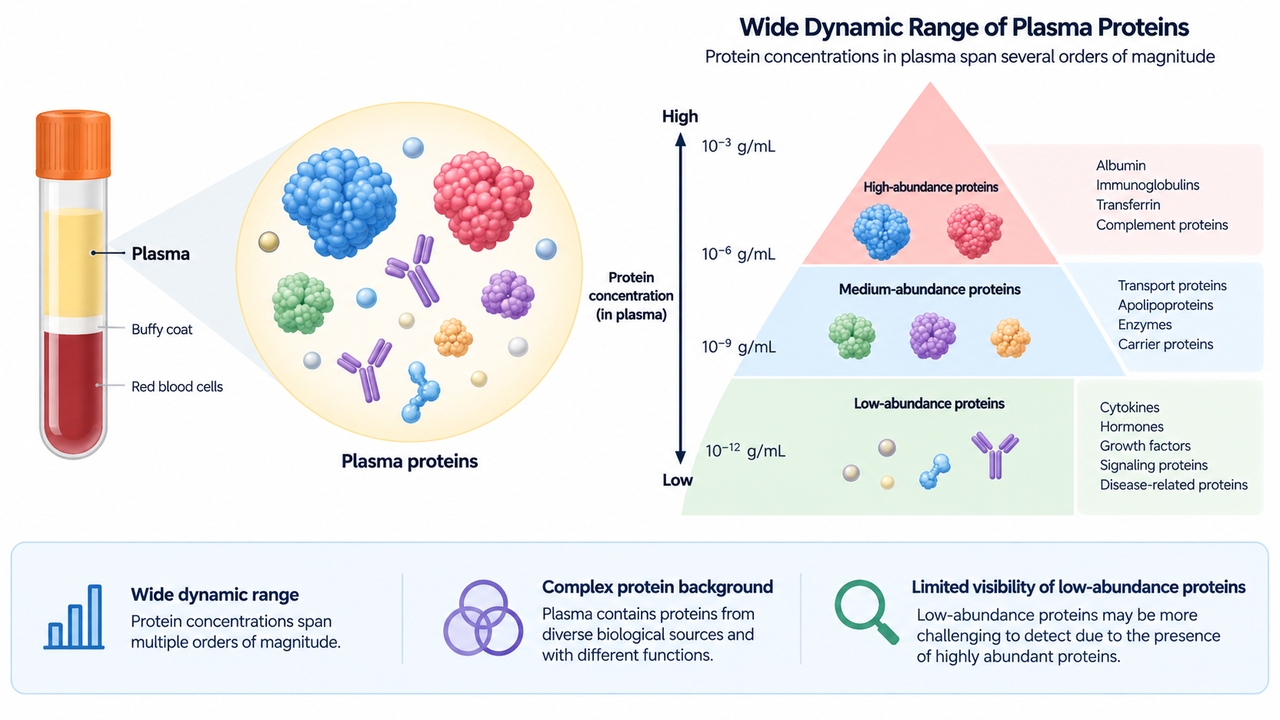
Plasma also shows substantial biological heterogeneity. Different individuals, study cohorts, disease states, experimental treatments, or sampling time points may have different circulating protein backgrounds. Comparative studies should distinguish genuine biological differences from sample-quality effects so that sample abnormalities are not interpreted directly as group-level biology.
Samples with low input, hemolysis, lipemia, repeated freeze-thaw exposure, clots, residual cellular material, or other matrix-related issues may still be usable, but these conditions may affect protein input, low-abundance protein detection, and quantitative consistency. More detailed guidance is available in Plasma Proteomics Challenges: Sample Quality and Analysis Considerations.
Plasma Sample Preparation and Requirements
Before a project begins, sample source, anticoagulant information, available volume, storage history, study grouping, and sample condition should be organized clearly. These records help determine whether the available material meets the analytical requirements and support the design of downstream comparisons.
| Item | Basic Requirement |
| Sample type | Human and animal plasma samples are supported; sample type and collection background should remain as consistent as possible within a comparison. |
| Submission volume | Minimum submission volume: 15 μL; recommended: 20–50 μL. |
| Anticoagulant and collection information | Record anticoagulant type, collection method, and sample ID to support assessment of between-group comparability. |
| Storage and freeze-thaw history | Provide storage conditions and freeze-thaw history; systematic differences between study groups should be minimized where possible. |
| Sample condition | Record visible hemolysis, lipemia, clots, contamination, residual cellular material, or other abnormalities when present. |
| Study design information | Provide experimental groups, time points, key comparisons, and sample numbers. |
For practical guidance on preparing or submitting plasma samples, see Plasma Sample Collection, Storage, and Shipping for Proteomics, which covers plasma type, anticoagulants, collection records, storage, shipping, and pre-submission checks.
Plasma Proteomics Analysis Workflow
The technical details may vary among projects, but the overall Plasma Proteomics pathway is consistent: define the study design and sample status, prepare proteins and peptides, acquire LC-MS/MS data, perform protein identification and relative quantification, and then generate bioinformatics results and an analysis report.
1. Study Design and Sample Evaluation
Confirm the research question, experimental groups, sample number, sample condition, and expected data type before selecting the analytical route.
2. Protein Processing and Peptide Preparation
Process and digest plasma proteins to generate peptide samples suitable for LC-MS/MS analysis.
3. LC-MS/MS Acquisition
Separate peptides by liquid chromatography and acquire mass spectrometry data for subsequent protein identification and quantification.
4. Protein Identification and Relative Quantification
Convert peptide-level evidence into protein identifications and a quantitative matrix for relative abundance comparison among samples or study groups.
5. Bioinformatics Analysis and Reporting
Perform differential protein analysis, functional annotation, pathway analysis, and related interpretation according to the predefined comparisons, and organize quality-control information and reporting outputs.
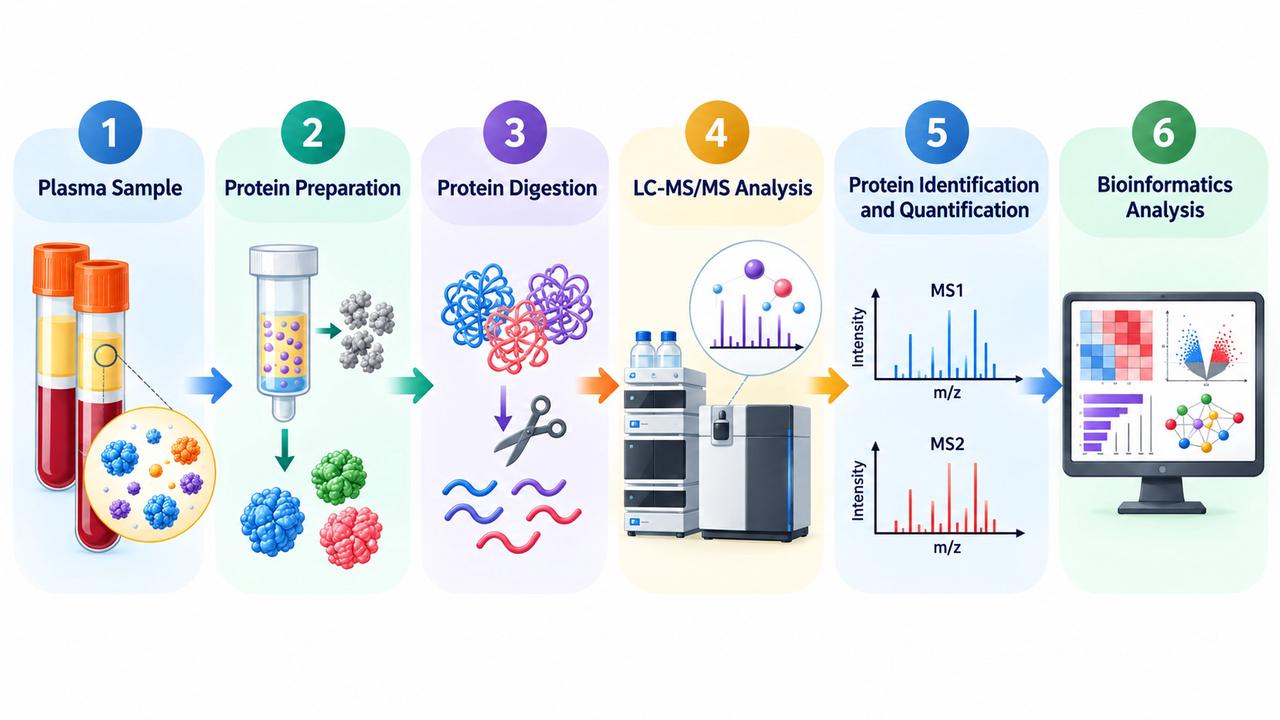
Detailed information on protein extraction, digestion, peptide preparation, acquisition mode, quantitative strategy, data processing, and experimental quality control is available in Plasma Proteomics Workflow: Sample Processing and LC-MS/MS Analysis.
Plasma Proteomics Data Analysis and Interpretation
Plasma Proteomics deliverables commonly include protein identification, relative quantification, differential analysis, bioinformatics results, quality-control information, raw data, and an analysis report. Each result type answers a different question, so no single plot or protein list should be treated as a complete interpretation of the study.
| Result Type | Main Question Answered |
| Protein identification results | Which proteins are supported by peptide evidence under the current analytical conditions? |
| Quantitative matrix | How does relative protein abundance vary among samples or study groups? |
| Differential protein results | Which proteins show statistically supported abundance differences in a predefined comparison? |
| Functional and pathway results | Which functional categories, pathways, or known network contexts are associated with the differential protein set? |
| QC, raw data, and report | How stable is the dataset, and which information can support review or reanalysis? |
For a stepwise approach to reviewing the quantitative matrix, within-group consistency, differential proteins, and functional analysis, see How to Interpret Plasma Proteomics Results.
Factors Affecting Plasma Proteomics Results
Different Plasma Proteomics projects may differ in protein coverage, missing-value patterns, quantitative stability, and between-group results. These differences should be separated into several sources rather than judged only by the total number of identified proteins.
- Sample-related factors: sample condition, source, storage history, and preanalytical background can alter the protein composition entering the analytical workflow.
- Experimental factors: consistency in protein processing, digestion, peptide preparation, and batch organization affects comparability among samples.
- Technical factors: chromatographic separation, mass spectrometry acquisition, signal stability, and long-batch performance affect protein detection and relative quantification.
- Data-processing factors: database choice, normalization, missing-value handling, and statistical methods affect how results are organized and how differential patterns appear.
- Biological variation: individual variation, study conditions, and true group-level biological differences are themselves part of the dataset.
For a more detailed discussion of how sample variation, batch effects, technical fluctuation, and data processing influence result reliability, see What Factors Affect Plasma Proteomics Results?.
Applications
Plasma Proteomics is suitable for studies that require systematic comparison of circulating proteins or tracking of molecular changes across defined research conditions. Common applications include:
- Group comparison: Compare protein profiles and relative abundance patterns across predefined experimental groups, cohorts, phenotypes, or time points.
- Treatment response: Track circulating protein changes before and after stimulation, drug treatment, or other interventions and prioritize response-associated proteins.
- Disease-related research: Describe circulating protein differences between disease-associated and comparison groups to provide candidates for further mechanistic investigation.
- Candidate protein / biomarker discovery: Prioritize proteins from discovery datasets for follow-up validation rather than treating discovery results as clinical diagnostic or predictive conclusions.
- Multi-omics integration:Combine protein-level changes with transcriptomic, metabolomic, or genetic information to interpret multiple molecular layers within the same research system.
Different applications require different grouping structures, time points, candidate-prioritization strategies, and validation plans. More detailed study designs, application boundaries, and candidate-use considerations are discussed in Research Applications of Plasma Proteomics.
Planning a Plasma Proteomics Project
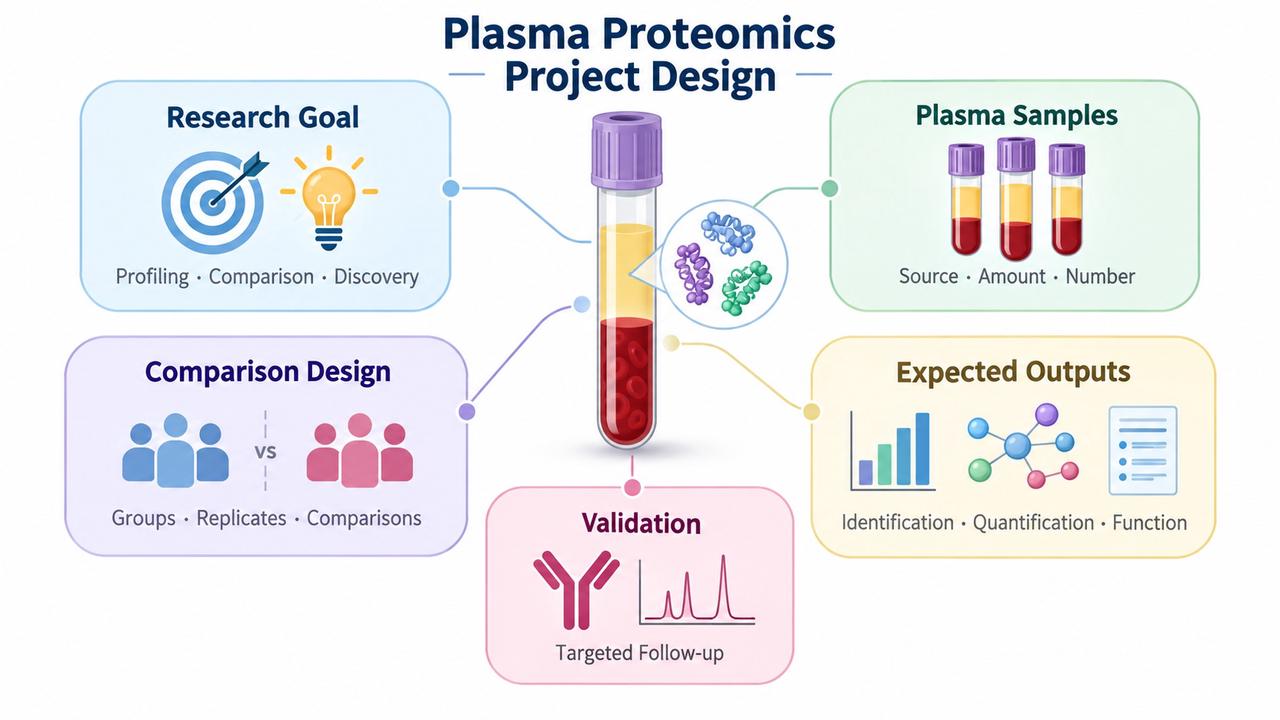
A Plasma Proteomics project should begin with the research question. Defining the question, available sample conditions, and expected outputs before selecting a specific acquisition or quantification strategy usually leads to a clearer study design than choosing a technical route first.
1. Define the Research Question
Determine whether the project focuses on broad protein profiling, predefined group comparison, treatment response, or discovery of candidate proteins for downstream validation. The research question determines the required sample structure and result level.
2. Review Sample and Cohort Structure
Confirm species, sample number, grouping, time points, available plasma volume, and sample background. Comparative studies should also check whether important non-target variables are strongly imbalanced across groups.
3. Define the Key Comparisons
Specify control groups, experimental groups, biological replicates, time structure, and primary comparisons before analysis rather than redefining the central question after data generation.
4. Define the Required Result Level
Distinguish protein identification, relative quantification, differential protein results, and functional interpretation, and identify which outputs will directly support the next research decision.
5. Match the Analytical Strategy
Sample number, available material, group structure, and quantitative requirements together shape the analytical plan. Acquisition mode and quantification strategy should support the study design rather than determine the project direction on their own.
6. Plan the Validation Path
If the study aims to confirm candidate proteins, consider independent samples, PRM/MRM, or other follow-up approaches early so that discovery data can connect efficiently with subsequent validation.
For projects with defined plasma samples, study groups, and research questions, Plasma Proteomics Service provides additional information on available analytical routes and project planning.
Frequently Asked Questions
1. How does Plasma Proteomics differ from single-protein testing?
Single-protein assays usually measure predefined targets. Plasma Proteomics is better suited to discovery-stage studies that compare broader protein patterns, identify group-level changes, and prioritize candidate proteins.
2. Can Plasma Proteomics replace tissue or cell proteomics?
Not directly. Plasma reflects proteins present in the circulating environment, whereas tissue or cell proteomics more directly describes a specific tissue or cellular system. The sample type should be selected according to the biological question.
3. If a target protein is not reported, does that mean it is absent from plasma?
No. A protein may be unreported because of low abundance, peptide detectability, sample complexity, or analytical coverage. Non-detection is not the same as biological absence.
4. Can Plasma Proteomics determine the tissue or cell of origin of a protein?
Not by itself. Plasma proteins may originate from multiple tissues, cell types, and physiological processes. Mass spectrometry data from plasma generally need to be combined with other experimental evidence or established biological knowledge to infer origin.
5. When should candidate proteins move to targeted validation?
Targeted methods such as PRM/MRM can be considered when a discovery study has narrowed the focus to a defined set of candidate proteins that need confirmation in independent samples or a more focused experimental design.
How to order?




