






Research Applications of Plasma Proteomics
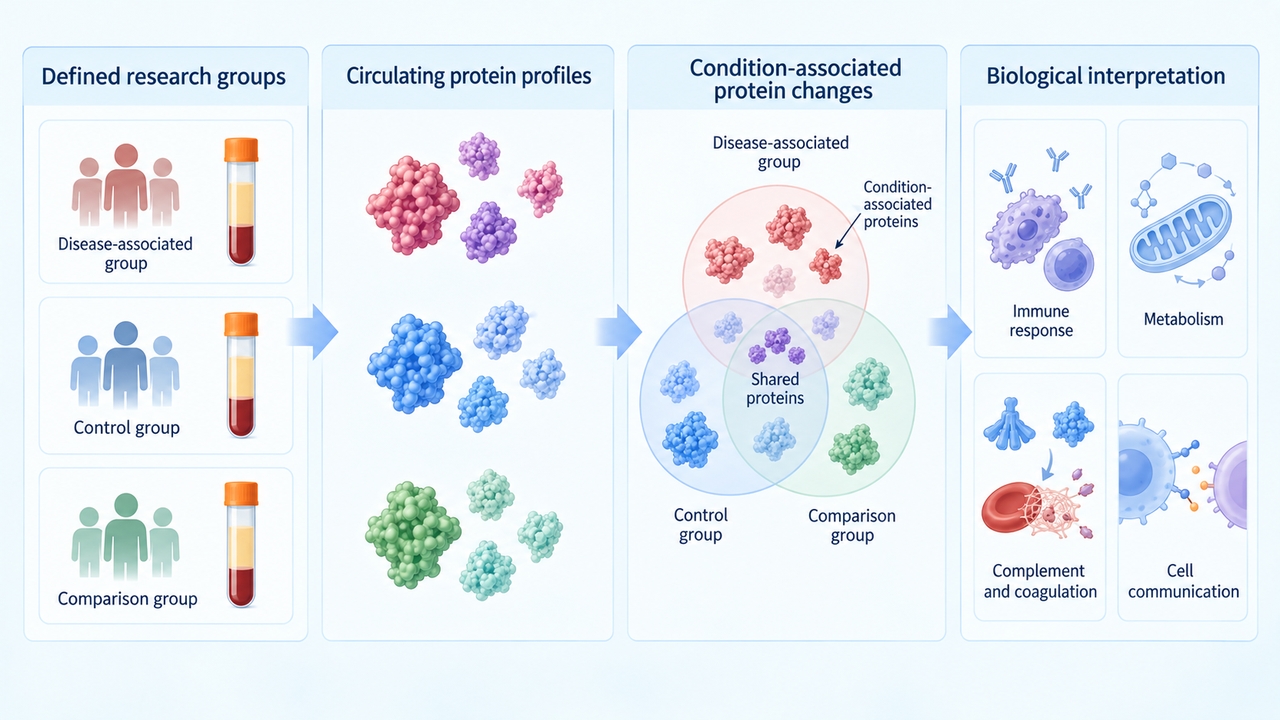
Plasma proteomics is used to examine changes in circulating proteins across defined biological states and experimental conditions. Study designs commonly involve comparisons between disease and control groups, pre- and post-intervention samples, distinct phenotypes, or different physiological states. Protein identification and relative quantification can define group-level protein profile differences and support the selection of proteins associated with a specific study condition.
Different application areas address different research objectives. Group comparison focuses on protein profile differences; intervention studies examine response-associated changes; disease-related studies characterize circulating protein patterns linked to a defined condition; candidate discovery prioritizes proteins for downstream validation; and multi-omics integration connects protein-level changes with RNA, metabolite, or genetic information. Application design should therefore be aligned with the research question, grouping strategy, sampling time points, and expected analytical output.
Group Comparison Studies
Group comparison studies assess whether defined research groups show reproducible differences in circulating protein profiles. Typical designs include disease versus control groups, distinct phenotypes, different physiological states, or other research-defined categories. The analysis examines whether proteins are consistently detected, whether abundance patterns are stable within groups, and whether defined between-group differences are observed.
Group definitions should correspond to the biological question. If age, sample source, collection conditions, or other non-target variables are unevenly distributed between groups, the observed differences may contain both biological and non-target variation. Group composition and comparison structure should therefore be specified during study planning.
Further interpretation of plasma proteomics findings, including protein identification, quantitative results, and biological interpretation, is discussed in How to Interpret Plasma Proteomics Result.
Treatment Response Studies
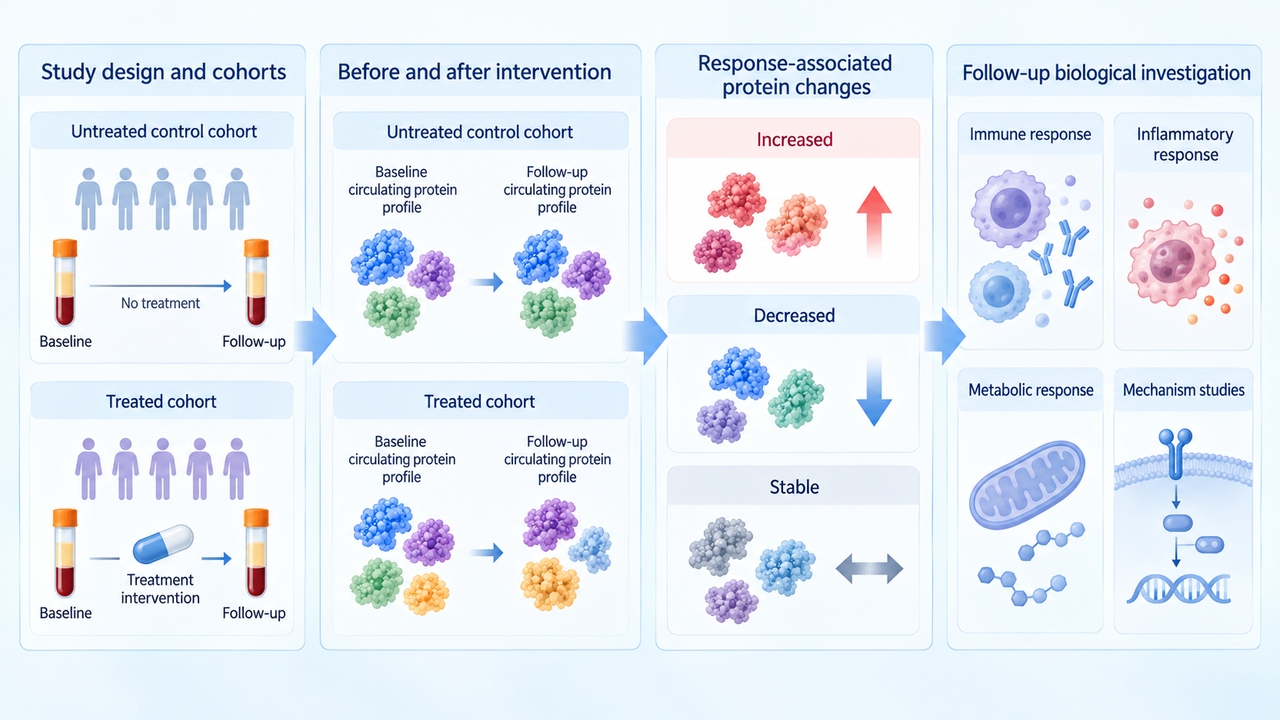
Plasma proteomics can be applied to investigate circulating protein changes associated with experimental treatments, biological stimulation, or other intervention conditions. By comparing plasma protein profiles before and after an intervention, or between treated and untreated groups, researchers can explore molecular responses associated with specific experimental conditions.
The analysis focuses on protein response patterns that are consistent with intervention. Protein abundance can be compared across time points or treatment conditions to identify proteins with sustained increases, sustained decreases, or stage-specific changes. Response-associated proteins can then be prioritized for further investigation according to the study context.
Sampling time points, grouping strategy, batch allocation, and quantitative stability can influence treatment-response comparisons. Sample-, experimental-, and technical factors that affect comparability are discussed in What Factors Affect Plasma Proteomics Results?
Disease-Related Research
Disease-related studies generally compare plasma protein profiles between a disease-associated group and a comparison group to characterize circulating protein changes linked to a defined condition. The resulting protein patterns can support condition-associated protein lists, direction-of-change analysis, and prioritization for downstream functional or validation studies.
1. Cancer and Tumor Research
In cancer and tumor research, plasma proteomics is used to study circulating protein alterations associated with tumor-related biological changes. Changes in plasma protein profiles may reflect differences in tumor-associated responses, immune interactions, metabolism, and systemic regulation. By comparing plasma protein patterns between cancer-associated groups and control groups, researchers can identify proteins showing condition-related abundance changes and explore their potential relevance to tumor biology. These findings can provide molecular evidence for further investigation of tumor-associated mechanisms and candidate proteins.
2. Inflammatory and Immune-Related Disease Research
In inflammatory and immune-related disease studies, plasma proteomics helps researchers examine circulating protein changes associated with immune regulation and inflammatory responses. Alterations in plasma protein profiles may reflect changes in immune activity, inflammatory signaling, and interactions between different biological systems. Comparative plasma proteomics studies can reveal protein patterns associated with inflammatory conditions and provide candidate molecules for investigating disease-related immune processes.
3. Metabolic and Other Disease-Associated Research
Plasma proteomics is also applied in metabolic, cardiovascular, neurological, and other disease-related research areas to explore circulating protein changes under different biological conditions. These studies may focus on how plasma protein profiles differ between disease-associated groups and comparison groups, helping researchers investigate molecular characteristics associated with specific conditions. Identified proteins can serve as candidates for further biological evaluation and hypothesis-driven studies.
Candidate Biomarker Discovery
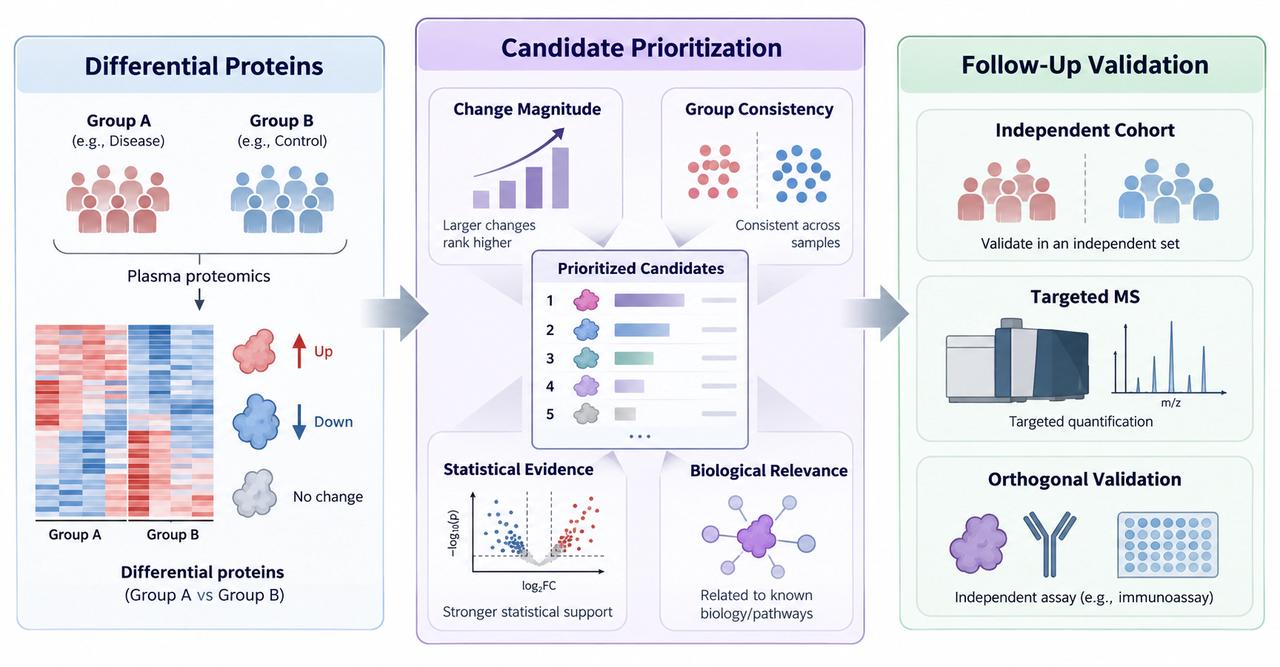
Plasma proteomics is applied in biomarker discovery research to explore circulating proteins associated with specific biological conditions. By comparing plasma protein profiles between defined research groups, researchers can identify proteins showing condition-associated abundance changes and evaluate their potential relevance to disease processes, biological responses, or other research questions. These findings provide candidate molecules for subsequent biological investigation rather than confirmed biomarkers.
1. Candidate Protein Prioritization
Candidate prioritization can consider the direction and magnitude of between-group change, within-group consistency, statistical evidence, and known biological information. This process produces a focused set of proteins with different levels of priority rather than treating all differential proteins as equivalent candidates.
2. Follow-Up Evaluation of Candidate Proteins
Candidate proteins can be assessed in independent samples or additional study conditions to determine whether the observed pattern is reproducible. When more focused quantification is required, targeted mass spectrometry or other independent experimental methods can be selected according to the study design, together with biological evidence relevant to the research question.
Multi-Omics Integration
Plasma proteomics data can be integrated with transcriptomic, metabolomic, genomic, and other omics datasets. The purpose of integration is to compare relationships across molecular layers within the same research question and determine whether protein changes are concordant, complementary, or distinct from RNA, metabolite, or genetic changes.
1. Integration with Transcriptomics
Joint analysis of plasma proteomics and transcriptomics can compare gene-expression changes with protein-abundance changes. The analysis can identify genes and proteins that change in the same direction within a biological process, as well as RNA-protein discordance that may support further investigation of post-transcriptional regulation, protein stability, or tissue origin.
2. Integration with Metabolomics
Joint analysis of plasma proteomics and metabolomics can connect protein changes with metabolic-state changes. When differential proteins and metabolites converge on the same pathway or related biological process, the combined evidence can support a shared research direction and define candidate protein-metabolite relationships for further study.
3. Integration with Genomics and Other Omics
Plasma proteomics integrated with genomic data can be used to examine associations between genetic variation and protein abundance. The same principle applies to epigenomic, lipidomic, or other molecular datasets: each omics layer is first analyzed according to the same comparison question, followed by integration based on shared pathways, related molecules, or statistical associations.
4. Study Design for Multi-Omics Integration
Multi-omics studies benefit from matched sample sources, grouping strategies, and sampling time points across datasets. When omics data are generated from different sample sets or time points, comparability should be established before integration. Defining the integration objective during study planning also reduces the risk of simply combining multiple result lists without a clear analytical question.
Frequently Asked Questions
1. Can plasma proteomics be used in longitudinal studies?
Yes. Longitudinal studies can compare plasma protein profiles from the same subjects at multiple time points, such as before and after an intervention, during treatment, or across disease progression. Sampling intervals and pairing relationships should be defined in the study design.
2. Is a paired design or a parallel-group design more suitable for treatment-response studies?
Both designs can be used. Paired designs are suitable when the same subjects are sampled before and after intervention, while parallel-group designs compare an intervention group with an independent control group. The appropriate design depends on the study population, sampling conditions, and primary comparison question.
3. When should candidate proteins move to follow-up validation?
Candidate proteins can move to follow-up evaluation when they show a defined direction of change in the target comparison, reasonable within-group consistency, and relevance to the research question.
4. Do all omics layers need to use the same samples for multi-omics integration?
Matched samples facilitate direct comparison across molecular layers. When different omics datasets come from different sample sets, the grouping structure, sampling time points, and sample background should be reviewed before integration.
Conclusion
The application of plasma proteomics should be aligned with the research question, group design, and downstream validation plan. Group comparison characterizes circulating protein differences across biological states; intervention studies examine treatment-associated dynamics; disease studies define condition-associated protein patterns; candidate discovery focuses on prioritization and validation; and multi-omics integration connects protein-level changes with other molecular layers.
For a broader understanding of plasma proteomics applications, workflow, and project planning, refer to Plasma Proteomics: Workflow, Sample Requirements, and Research Applications. For researchers planning plasma proteomics projects involving group comparison, treatment response, disease-related research, or candidate protein discovery, MtoZ Biolabs provides Plasma Proteomics Analysis Service to support project evaluation and study design. Researchers can contact us to discuss specific research objectives and analytical requirements.
How to order?




