






What Factors Affect Plasma Proteomics Results?
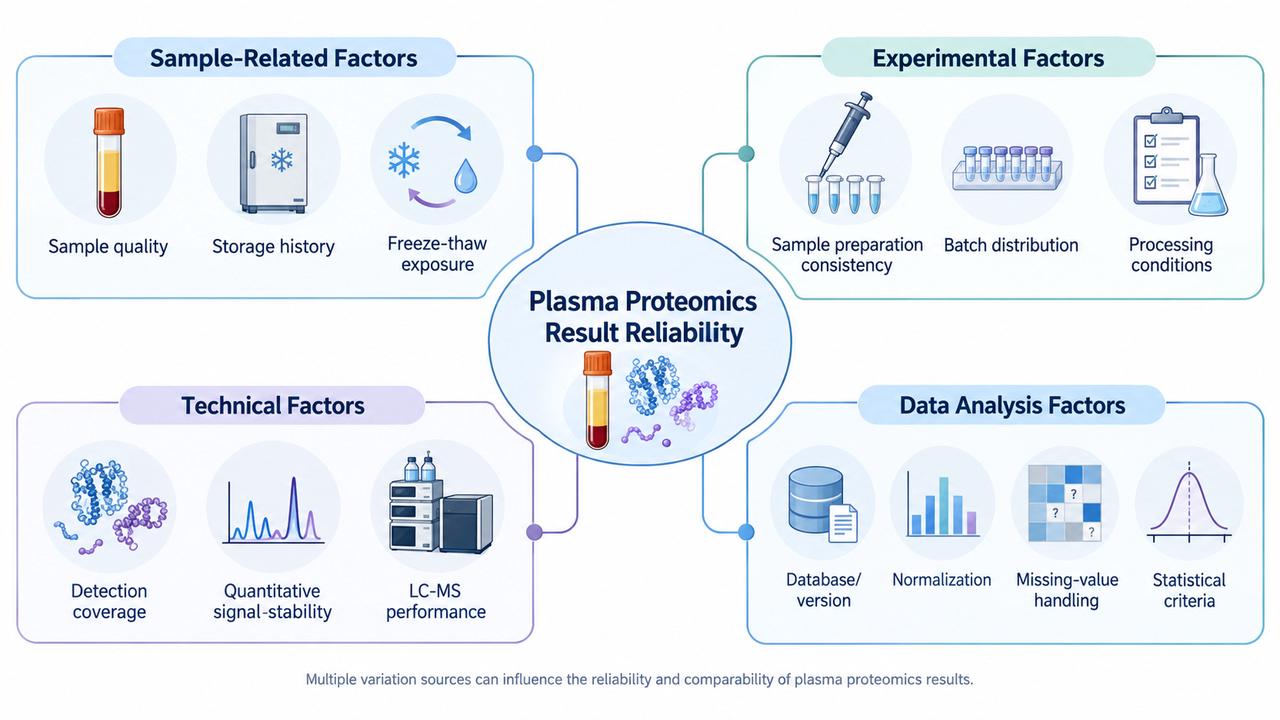
Sample-Related Factors Affecting Plasma Proteomics Results
Comparability between groups depends partly on whether plasma samples have similar pre-analytical histories. Differences in sample quality, storage history, or freeze-thaw exposure can alter the detection behavior of some proteins or peptides. When those differences are unevenly distributed across experimental groups, the resulting group comparison may contain both biological effects and sample-related variation.
| Sample-Related Factor | Possible Data Pattern | Point to Review During Interpretation |
| Differences in sample condition | Differences in detected protein composition or relative abundance profiles | Check whether abnormal samples are concentrated in one group before attributing the pattern to biology. |
| Differences in storage history | Changes in signal stability and between-sample consistency for some proteins | Compare storage temperature, duration, and long-term storage conditions across groups. |
| Differences in freeze-thaw exposure | Greater variation in protein or peptide signals in selected samples | Check whether freeze-thaw counts differ systematically between groups. |
| Individual sample variation | Greater dispersion of protein abundance values within a group | Distinguish genuine biological heterogeneity from shifts driven by a small number of atypical samples. |
In comparative plasma proteomics studies, sample-related variation should be considered when interpreting differences between groups. A detected protein change may reflect biological differences, sample-related variation, or a combination of both factors. Evaluating sample consistency helps distinguish meaningful biological signals from variation introduced by sample characteristics.
For detailed discussion of plasma sample characteristics and related analytical considerations, refer to Plasma Proteomics Challenges: Sample Quality and Analysis Considerations.
Experimental Factors Affecting Proteomics Data Quality
Experimental factors determine whether samples are processed under sufficiently comparable conditions. Differences in protein handling, digestion, peptide preparation, or injection conditions can change peptide recovery and detection behavior, creating variation that is unrelated to the biological group itself.
1. Sample Preparation Consistency
Samples within the same comparison should follow consistent protein processing, digestion, peptide preparation, and injection arrangements. Differences in preparation conditions can alter peptide recovery and detection performance and may affect both protein identification and relative quantification. For multi-group studies, consistency across samples is generally more important than maximizing detection depth for one individual sample.
2. Experimental Batches and Group Balance
Batch effects should be evaluated together with group allocation. If all samples from one biological group are processed in one batch and all samples from another group are processed in a separate batch, group identity and batch identity become confounded. Multi-batch studies should distribute groups across batches as evenly as practical and use the same processing principles and documentation across runs.
Technical Factors Influencing Protein Detection and Quantification
Technical variation is reflected in whether proteins are detected consistently, whether quantitative signals remain stable, and whether LC-MS/MS performance is comparable across samples and batches. A technical shift may affect several data characteristics at the same time, including identification coverage, missing values, and quantitative dispersion.
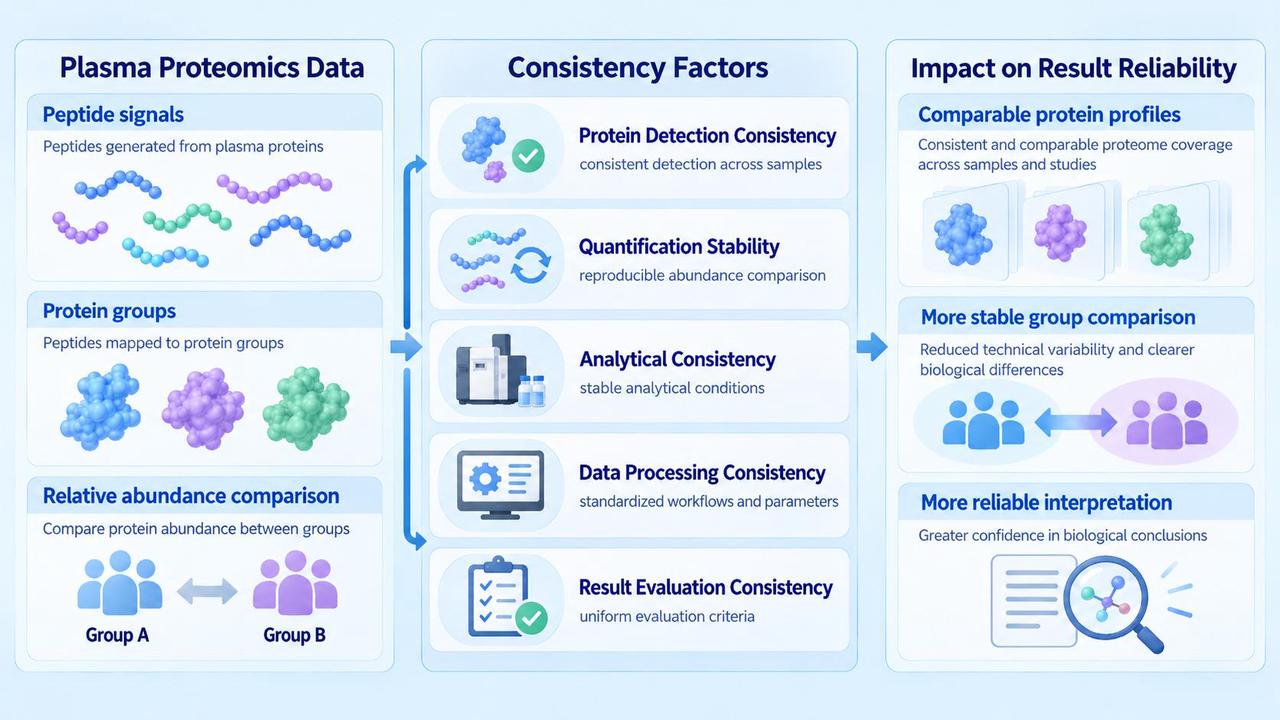
1. Protein Detection Coverage and Missing Values
Proteins close to the detection limit are more likely to be observed inconsistently across samples. When a protein is detected in only part of a dataset, the missing pattern should be reviewed before group comparison. Missing values that occur mainly in one experimental group or one batch can change the apparent set of differential proteins and complicate biological interpretation.
2. Quantitative Signal Stability
Relative quantification depends on comparable peptide signals across samples. Unstable representative-peptide detection, signal-intensity fluctuation, or missing quantitative values increase uncertainty in group-level abundance estimates. Protein-level differences should therefore be reviewed together with within-group distributions and the consistency of the underlying quantitative values.
3. Chromatographic and Mass Spectrometric Stability
Stable retention time, peak shape, mass accuracy, sensitivity, and overall instrument response help maintain comparable measurement conditions during long analytical batches. Pronounced drift may appear as lower identification counts in later samples, changes in signal distributions, or greater quantitative variation. Instrument status is best reviewed together with batch QC information and injection order.
| Technical Factor | Common Data Pattern | Potentially Affected Result |
| Variation in detection coverage | Different protein identification counts or missing-value rates across samples | Protein identification coverage and between-sample comparability |
| Variation in quantitative signals | Greater dispersion of abundance values for the same protein across replicate samples | Relative quantification stability and differential analysis |
| Run-performance drift | Changes in overall signal, retention behavior, or identification level across the analytical sequence | Batch stability and cross-sample comparison |
Data Processing and Analysis Considerations
The same raw data can produce different identification counts, quantitative matrices, or differential results when processing rules change. Comparative studies should therefore use consistent data-processing and evaluation principles, especially when multiple groups or analytical batches are combined.
1. Data Processing Consistency
Protein database version, identification criteria, normalization method, and missing-value handling can all change the structure of the final dataset. Samples belonging to the same project should be processed with the same parameters and standards so that analytical-rule changes do not become an additional source of variation.
2. Result Evaluation Consistency
Group comparisons should use consistent statistical and filtering criteria. When different comparisons use different thresholds or evaluation rules, differential-protein counts and result ranges are not directly comparable. Interpretation should return to the specific comparison design and research question rather than relying on the number of differential proteins alone.
Further information on plasma proteomics result interpretation can be found in How to Interpret Plasma Proteomics Result.
Improving Reliability in Plasma Proteomics Studies
Improving reliability in plasma proteomics studies requires consistency between the biological question, experimental design, and result evaluation strategy. Clear definition of comparison groups and consideration of potential variation sources help determine whether observed protein changes are consistent with the intended research objective.
1. Study Design and Experimental Planning
Project design should define comparison groups, control groups, and biological replicates before analysis. Sample source, storage history, and experimental batch should also be checked for strong overlap with group identity. In multi-batch projects, distributing samples from different groups across batches reduces the risk that a batch-specific shift will be interpreted as a group effect.
2. Quality Control and Data Reliability
Quality control should cover sample comparability, technical performance, and batch-related changes. Sample correlation, batch distribution, identification coverage, and quantitative stability can be reviewed together to identify atypical samples or systematic shifts before group-level conclusions are made.
The application of plasma proteomics in comparative studies, treatment response research, and biomarker-related investigations is discussed in Research Applications of Plasma Proteomics.
Frequently Asked Questions
1. Can data from different experimental batches be compared directly?
They can be compared when sample processing, instrument performance, and data-processing rules are sufficiently consistent and when experimental groups are distributed across batches in a balanced way.
2. Why can repeated plasma proteomics studies produce different numbers of identified proteins?
Protein identification counts can vary with sample composition, sample condition, analytical performance, and data-processing criteria. Identification numbers are best interpreted within the context of the specific sample set and analytical conditions rather than as a standalone performance metric.
3. How can biological variation be distinguished from technical variation?
First review within-group consistency, batch allocation, sample condition, and technical QC. A pattern that follows the experimental groups while remaining stable within groups is more consistent with a biological effect. A pattern that tracks batch identity or a small number of atypical samples requires additional review for non-biological variation.
4. When should batch effects receive particular attention?
Batch effects become more important when sample numbers are large, processing is divided across several batches, or LC-MS/MS acquisition spans multiple analytical sequences. The risk is highest when one experimental group is concentrated in a single batch.
5. What should be reviewed when a group difference is driven by only a few samples?
Review the condition, storage record, technical QC, and within-group position of those samples before interpreting the difference. Group-level results should be considered together with the full sample distribution rather than the group mean alone.
Conclusion
The central issue in evaluating plasma proteomics reliability is separating the biological difference defined by the study from non-biological variation introduced by samples, experimental batches, technical performance, or analytical rules. Balanced study design, consistent sample handling, stable LC-MS/MS performance, and uniform data-processing criteria make group comparisons easier to interpret and reproduce.
For a broader overview of plasma proteomics workflow, sample requirements, and research applications, refer to Plasma Proteomics: Workflow, Sample Requirements, and Research Applications. Researchers planning specific plasma proteomics projects can refer to Plasma Proteomics Analysis Service provided by MtoZ Biolabs.
How to order?




