






Monoclonal Antibody Sequencing: Principles, Workflow, and Service Planning Basics
Where teams usually get stuck
The planning issue often begins with a useful antibody and poor documentation. A team may inherit a legacy monoclonal antibody after staff turnover, receive transferred material with conflicting records, or discover that archived sequence notes do not match current analytical observations. In each case, the bottleneck is similar: downstream work pauses until the heavy chain and light chain sequence question is narrowed.
That uncertainty affects practical project choices. A redevelopment team may need the variable region for recombinant recovery. A comparability review may need to tell whether a difference comes from glycosylation or from a true sequence mismatch. An engineering group may only need to settle a disputed complementarity-determining region (CDR), especially CDR3, rather than rebuild both chains from end to end.
Without a clear planning framework, teams often ask for “full sequencing” before deciding which part of the sequence matters most. That can consume limited sample and still leave the most important positions unresolved.
Why projects succeed or stall
Most early decisions fall into four practical categories.
-
The sequencing objective is too broad. Full chain recovery, variable region reconstruction, and sequence cross-checking need different evidence thresholds and reporting formats.
-
The sample is not a good fit for peptide mapping. Low purity, excipients, aggregation, or limited amount can reduce sequence coverage and weaken de novo read quality.
-
Database matching is expected to solve an unknown-sequence problem. A database search reaches its limit when the true sequence is absent, proprietary, engineered, or only partly documented.
-
Confidence boundaries are not defined up front. PTMs, glycosylation, clipping / truncation, disulfide bond complexity, and isobaric residue assignment can all affect interpretation and should be reported clearly.
A project-planning workflow for monoclonal antibody sequencing
1. Define the decision the sequence must support
Start with the downstream use case. If the goal is recombinant redevelopment, the report should support heavy chain and light chain reconstruction with strong variable region evidence. If the goal is archive verification, the project may focus on a disputed framework region, terminal processing, or a suspected mismatch between lots.
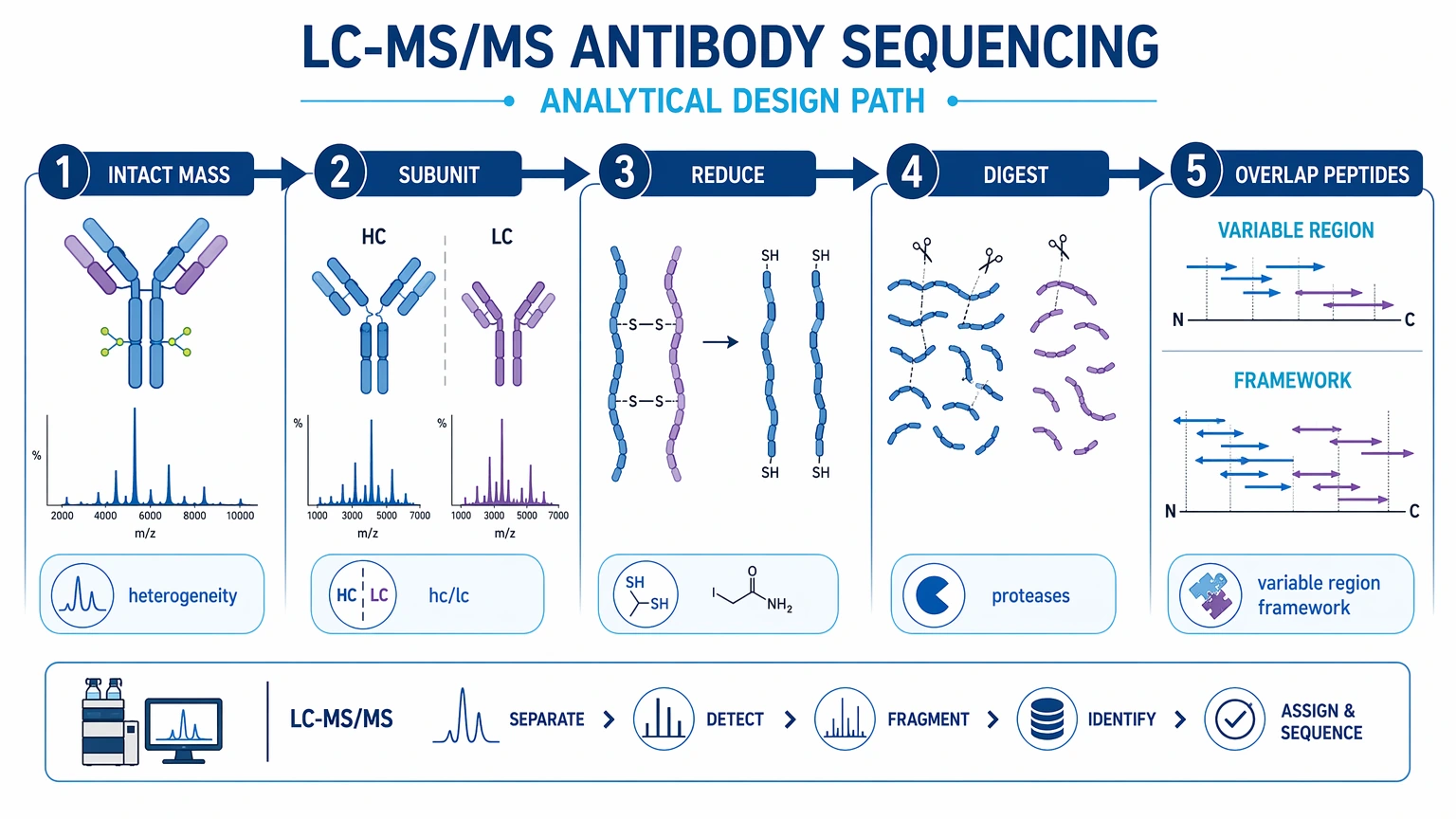
That first choice sets the scope. A broad recovery project often calls for intact mass analysis, subunit analysis, reduction / alkylation, enzymatic digestion, and overlapping peptides to support chain assembly. A narrower clarification project may only need targeted coverage in selected regions.
| Scenario | Recommended workflow focus | Main limitation | Likely follow-up |
|---|---|---|---|
| Missing full sequence record | Chain-level reconstruction from LC-MS/MS with de novo read support | Some residues may remain qualified | Recombinant expression confirmation |
| Variable region recovery | CDR and CDR3 coverage with overlapping peptides | Framework-supported gaps may remain | Targeted confirmation of high-value sites |
| Sequence cross-check | Peptide mapping plus review of mismatched peptides | Archive record may be inaccurate | Site-specific validation |
| PTM-heavy antibody | Intact and subunit review with PTM-aware interpretation | PTMs can obscure sequence reads | Follow-up PTM characterization |
Use the table as a screening guide, then confirm the fit against the available sample, spectra, and validation goal.
Service Routes to Consider
For this project scenario, readers usually compare these service routes before requesting a quote or submitting samples.
2. Check sample fit before committing scope
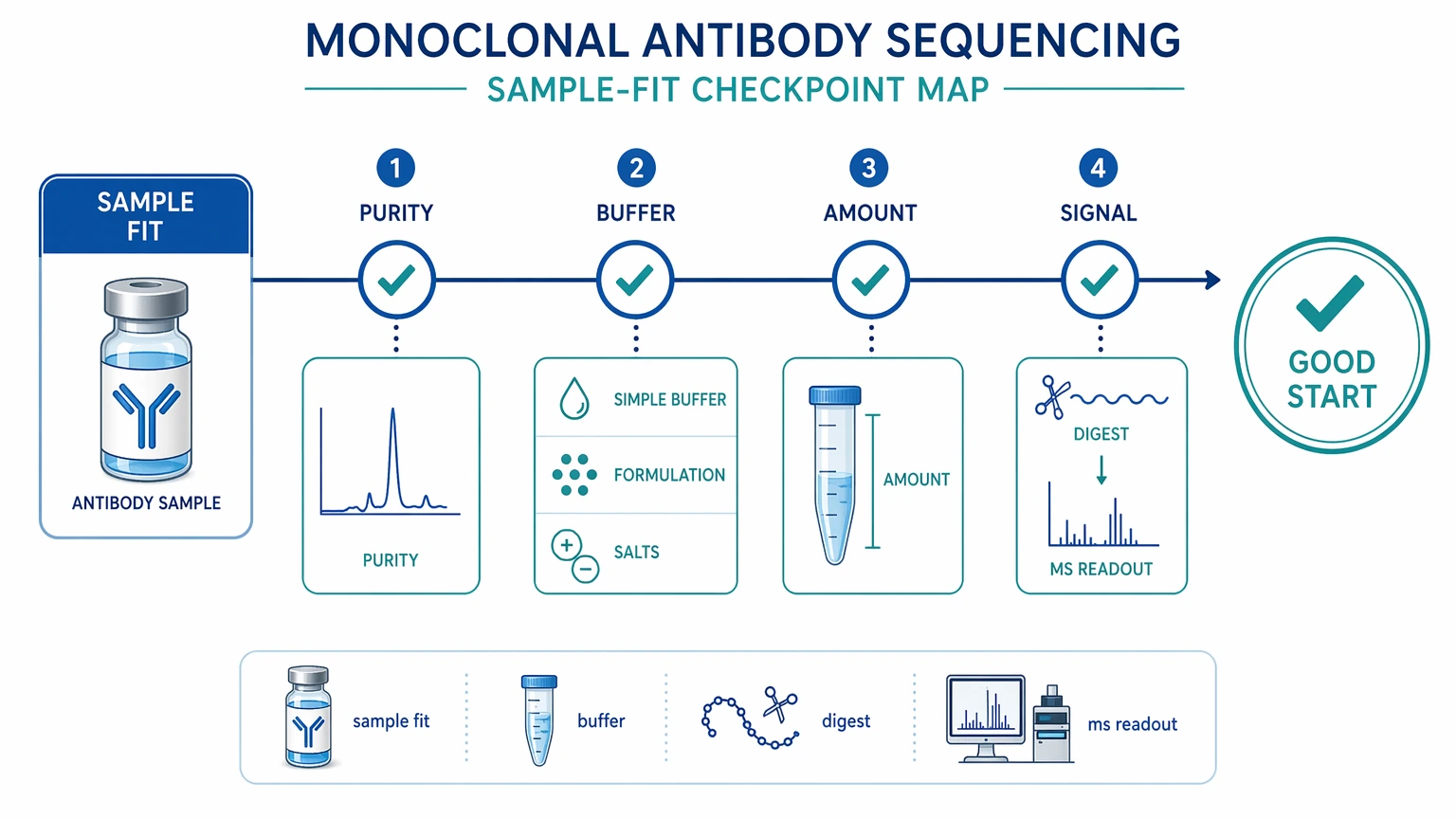
Monoclonal antibody sequencing depends on interpretable peptide and subunit evidence, so sample condition matters from the beginning. Purified intact IgG in a simple buffer is often the cleanest starting point. Formulated samples may still be workable, but salts, stabilizers, surfactants, and other excipients can interfere with reduction / alkylation, enzymatic digestion, or LC-MS/MS signal quality.
Useful background information includes species or isotype if known, SDS-PAGE, SEC, intact mass analysis, prior peptide mapping, partial sequence notes, and handling history. Even incomplete records can improve homology-assisted assembly and help separate expected heterogeneity from true sequence ambiguity.
When your team is deciding between full recovery and a narrower clarification study, submit your requirements to MtoZ Biolabs so the sequencing workflow can be evaluated against sample amount, formulation, and the exact region that needs to be resolved.
3. Match the analytical design to the antibody and its risks
A practical sequencing plan usually moves from broad characterization to peptide-level reconstruction. Intact mass analysis gives an overview of mass consistency and heterogeneity. Subunit analysis, often after reduction, separates heavy chain and light chain context. Reduction / alkylation prepares the sample for enzymatic digestion, and multiple proteases are often used to generate overlapping peptides across variable region and framework region segments.
This staged design is especially useful when interpretation risks are already suspected. Heavy-chain glycosylation can change peptide behavior near modified motifs. Oxidation, deamidation, pyroglutamate formation, clipping / truncation, and disulfide bond-related features can split evidence across several peptide forms. These effects do not automatically prevent sequencing, but they can lower certainty in specific regions and should shape the validation plan.
4. Understand how sequence proposals are built
LC-MS/MS does not read a monoclonal antibody as one uninterrupted chain. Instead, fragment ions from each peptide are interpreted to generate de novo peptide sequencing reads, which are then assembled into chain-level proposals through overlap, heavy chain or light chain context, and framework region continuity. When appropriate, homology-assisted assembly can strengthen regions that align with known antibody patterns.
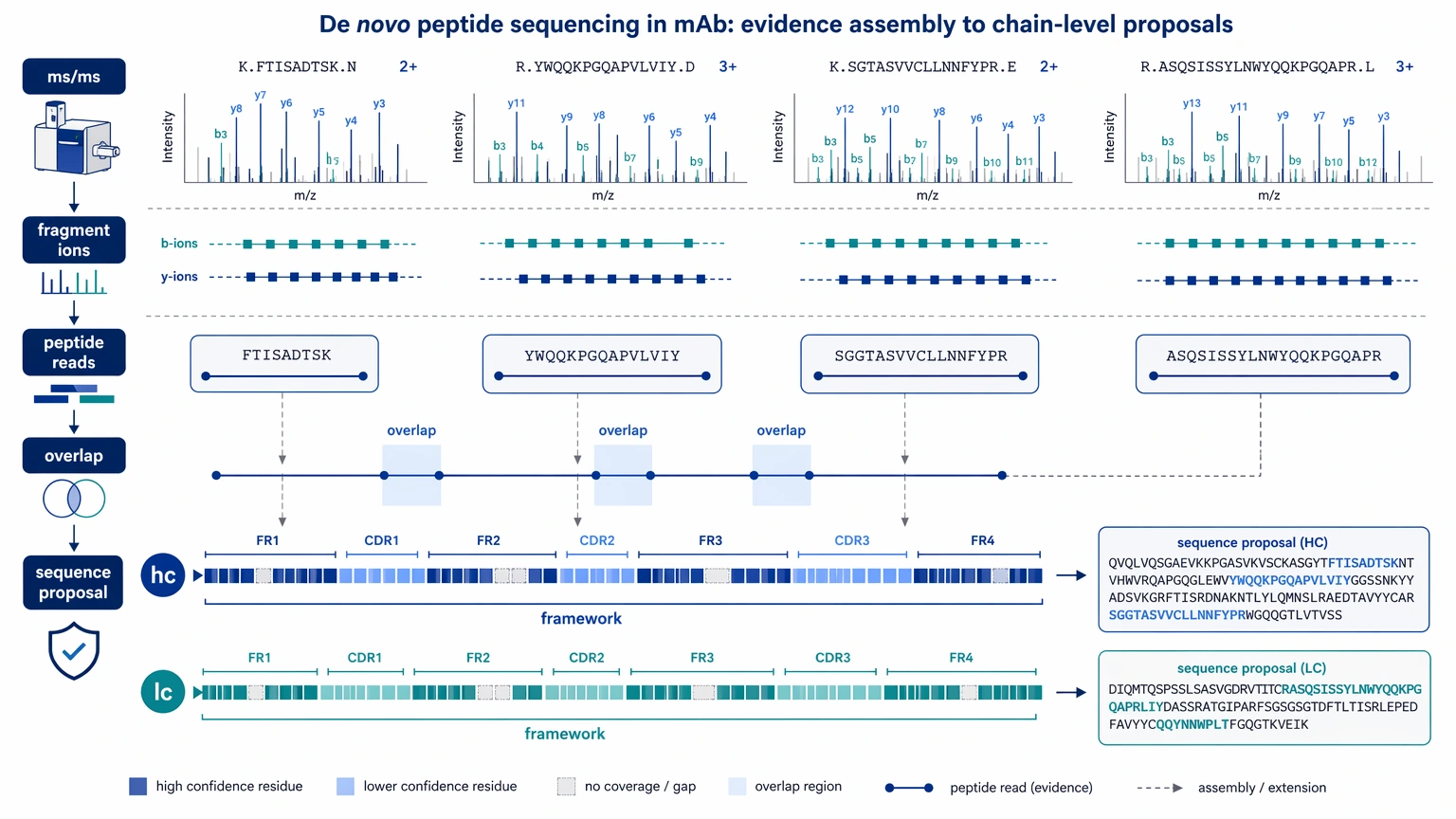
This is also where the database search limitation matters. Database matching can support identification when a close sequence already exists, but it does not replace true reconstruction when the antibody sequence is unknown or unreliable. A useful report should separate positions supported directly by de novo reads from positions inferred through framework or homology support.
An explicit limitation belongs here: MS/MS-based interpretation may not resolve every amino acid with equal confidence, especially in PTM-rich regions or at isobaric residues such as leucine and isoleucine. For that reason, sequence confidence should be expressed with confidence annotation and unresolved-position reporting rather than as a single unqualified consensus string.
5. Ask for deliverables that support the next decision
A planning-level sequencing project is only useful if the output can guide the next technical step. For first-time outsourcing stakeholders, the most practical deliverables usually include proposed heavy chain and light chain sequences, sequence coverage by chain, CDR-focused evidence, peptide evidence tables, annotated spectra for critical assignments, PTM notes, sequence ambiguity flags, and a validation plan.
If redevelopment is the next milestone, contact us to discuss whether the report should be structured for sequence recovery only or for later recombinant expression confirmation and targeted follow-up testing.
Expected results and validation methods
The immediate deliverable from monoclonal antibody sequencing is not just a sequence string. It is a documented sequence proposal with supporting evidence. In a well-scoped project, immediate outputs may include chain-specific sequence coverage, CDR and CDR3 support, annotated peptide-level evidence, confidence annotation for uncertain positions, and a summary of where de novo reads versus homology-assisted assembly were used.
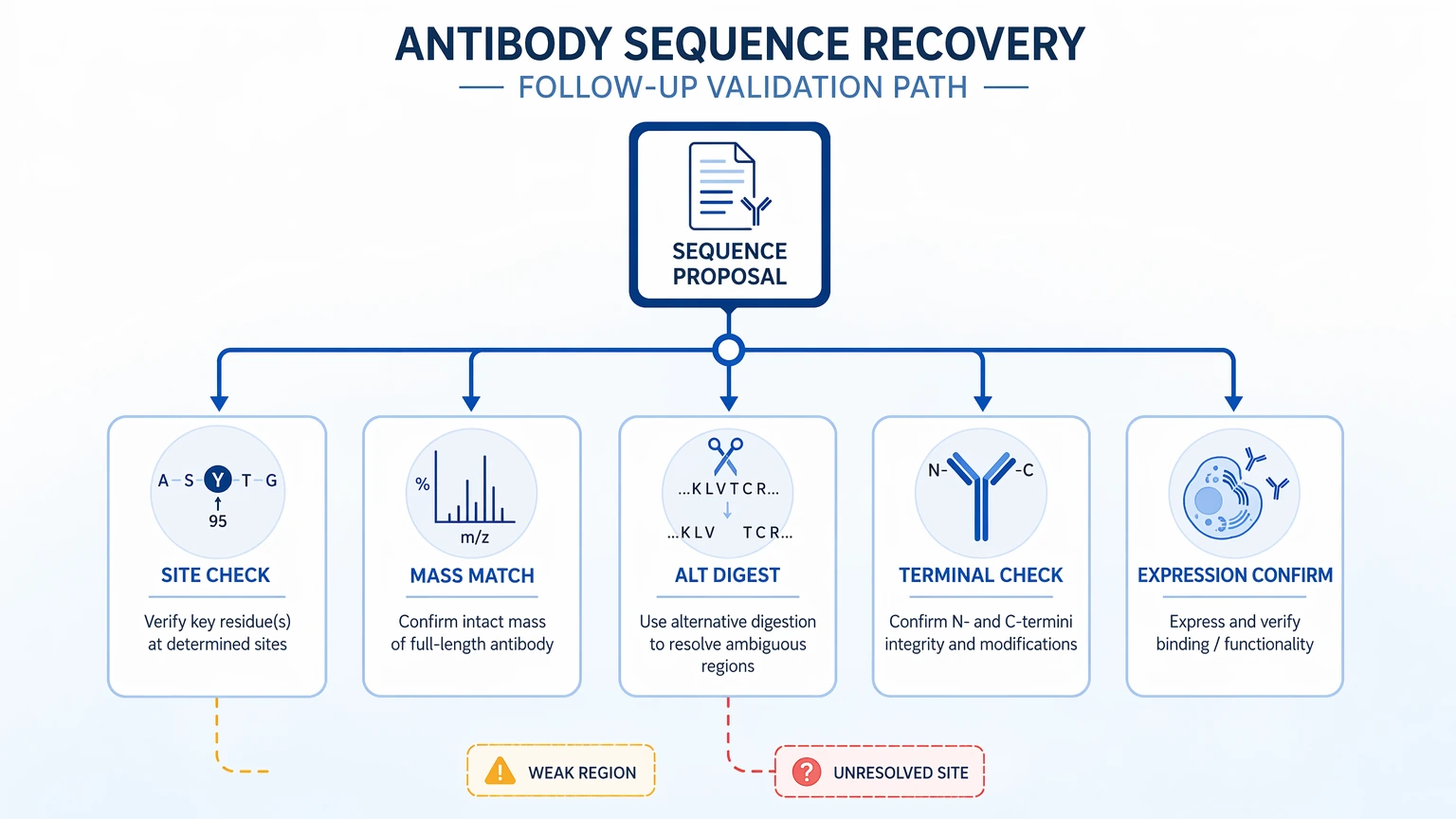
Follow-up confirmation is a separate step. If a project moves toward redevelopment, validation may include targeted checks for unresolved residues, comparison of intact or subunit mass against the assembled sequence, alternative protease digestion for weakly covered regions, terminal confirmation where needed, or recombinant expression confirmation to test whether the proposed sequence behaves as expected in downstream characterization.
That distinction matters for planning. Immediate deliverables answer whether the sample produced actionable sequence evidence. Follow-up confirmation answers whether the proposed reconstruction is sufficient for the next development step.
Key cautions and practical limits
Sample quality and sample amount set the first boundary. Low-input or partially impure material may still support region-specific work, but repeat capacity becomes limited and full sequence coverage may not be realistic.
Controls and repeat expectations should be discussed early. If multiple lots or reference materials exist, decide which sample is the primary sequencing target and which materials are only for comparison. Otherwise, reporting can become diffuse.
Batch effects and contamination risk also deserve attention. Co-purified proteins, formulation components, keratin background, or handling-related degradation can complicate peptide mapping and chain assembly. Cleanup may help, but it also consumes material.
Interpretation has clear boundaries. Monoclonal antibody sequencing supports sequence reconstruction and redevelopment planning; it does not by itself establish biological activity, therapeutic equivalence, or regulatory suitability.
Another method may be the better next step when the antibody is highly heterogeneous, heavily modified, or too limited for broad digestion-based coverage. In such cases, targeted site validation, terminal sequencing, PTM-focused analysis, or a narrower region-specific objective may be more informative than attempting full reconstruction.
Conclusion
Monoclonal antibody sequencing is most useful when the project question is defined before the sample is consumed. The practical path is to decide whether the goal is full recovery, variable region reconstruction, or sequence cross-checking; review whether the available antibody can support peptide mapping and LC-MS/MS; and request deliverables that clearly show sequence coverage, sequence ambiguity, and validation options. For legacy antibody rescue, redevelopment assessment, or record verification, prepare your sample details and prior data, then contact MtoZ Biolabs to evaluate your project and discuss a sequencing scope that fits the next technical decision.
FAQ
What minimum background information should I prepare before a feasibility discussion?
Prepare the sample type, concentration, buffer or formulation details, total amount available, any known species or isotype information, and any prior QC records such as SDS-PAGE, SEC, or intact mass analysis. Also state whether the goal is full recovery, variable region reconstruction, or sequence cross-checking.
Why is CDR3 often emphasized in antibody recovery projects?
CDR3 often carries strong identity value for the antibody and is frequently a priority for redevelopment decisions. If sample is limited, stakeholders may choose to prioritize CDR3-containing coverage before asking for broader chain reconstruction.
Can a sequencing report be useful even if a few positions remain unresolved?
Yes. Some projects move forward with qualified positions if the unresolved residues are outside the main decision region or can be addressed in follow-up confirmation. The key is that the report identifies those positions explicitly.
When should I request a targeted study instead of full heavy-chain and light-chain reconstruction?
A targeted study is often more practical when sample amount is low, only one region is disputed, or prior records already cover most of the framework region. It can also be a better choice when redevelopment planning depends on a specific variable region question rather than complete chain recovery.
Does sequencing alone confirm that the recovered antibody will perform the same after re-expression?
No. Sequencing can support reconstruction and planning, but comparable behavior after re-expression usually requires separate confirmation through recombinant production and downstream characterization.
How to order?




