






Common Failure Points in Monoclonal Antibody Sequencing Projects and How to Prevent Rework
A monoclonal antibody sequencing project often heads into rework before anyone looks at the first spectrum. The usual reason is not an unusual instrument problem. More often, the project starts with a sample that is only partly suitable for LC-MS/MS, missing clone documentation, unrecognized chain-assignment risk, or assumptions about what a first-pass sequence report can actually confirm.
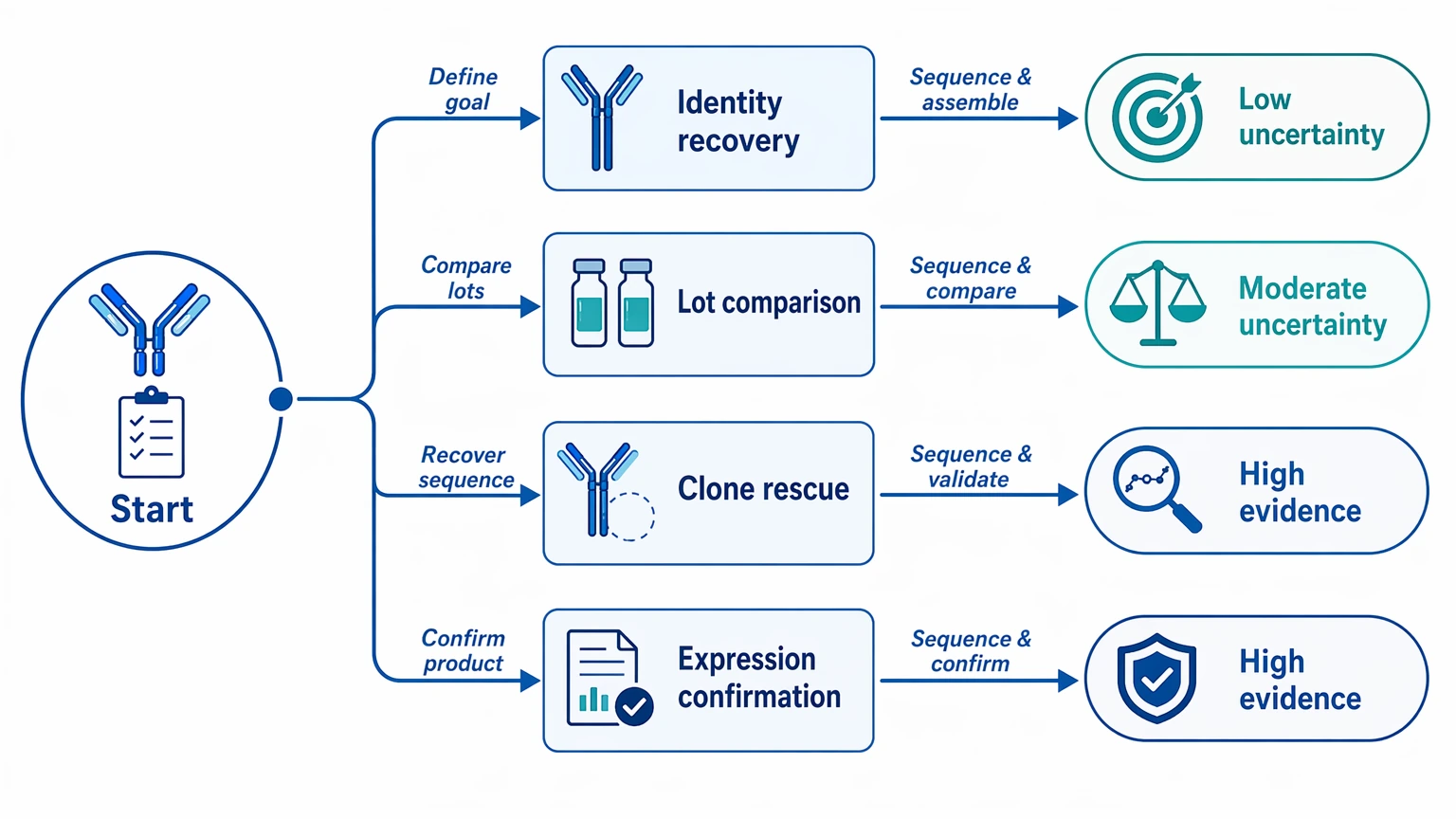
Quick decision block
Before kickoff, confirm four points:
- The purified antibody sample has enough usable amount and an MS-compatible formulation.
- Heavy chain and light chain interpretation will not be confounded by mixed material or weak chain-origin evidence.
- Likely PTM burden, including glycosylation heterogeneity, is disclosed and considered in planning.
- The team agrees on the required deliverable: a proposed sequence, a confidence-annotated report, or a package that supports downstream recombinant work.
If one of those checks is weak, the first pass often comes back with uneven sequence coverage, chain misassignment, unresolved residues, or follow-up validation requests. For teams working with legacy hybridoma-derived reagents, rescued lots, or partly documented purified IgG, that delay can disrupt cloning plans, lot comparison, or redevelopment timelines.
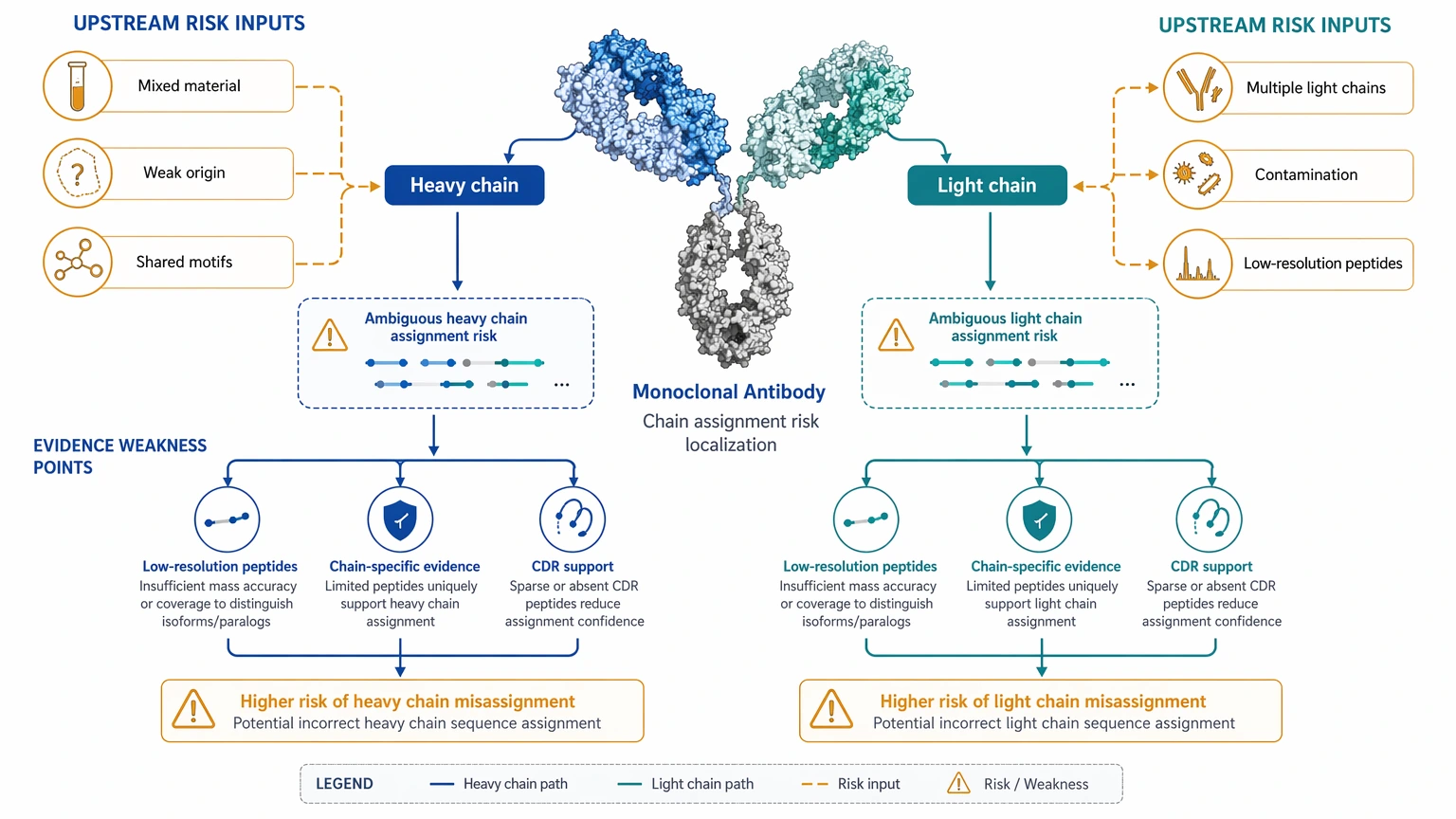
Where Monoclonal Antibody Sequencing Projects Usually Break Down
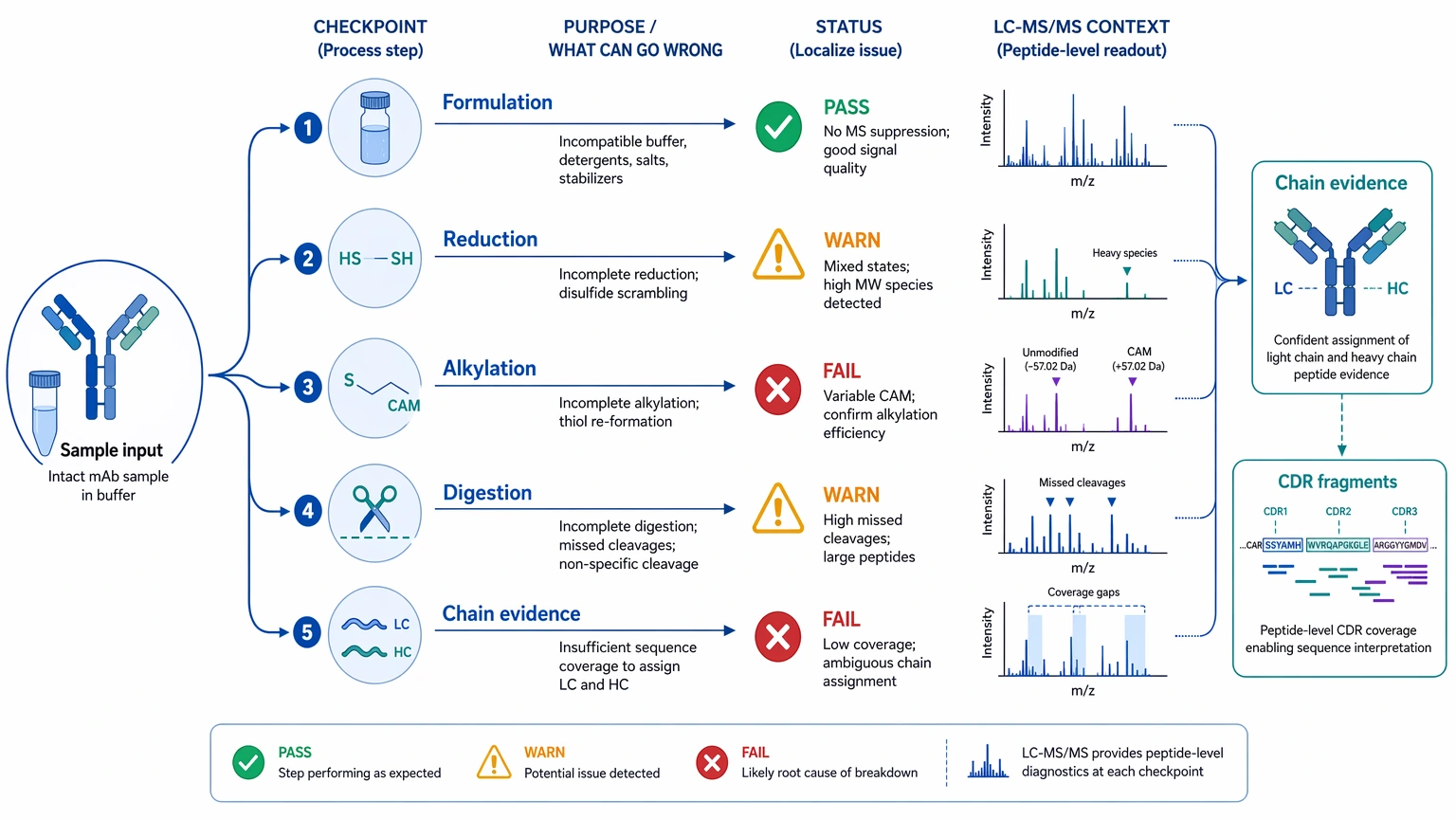
One common mistake is treating acceptable SDS-PAGE purity as proof that the sample is ready for de novo sequencing. In practice, monoclonal antibody sequencing depends on more than visible purity. LC-MS/MS interpretation is affected by formulation components, reduction and alkylation behavior, proteolytic digestion performance, chain-specific peptide evidence, and local fragmentation quality in CDR and framework region peptides.
The antibody context adds extra complexity. A useful report needs to separate heavy chain from light chain, track sequence coverage by chain, and show whether decision-critical regions such as CDR-H3 are directly supported or only inferred. Database search limitation becomes more serious when the antibody is novel, engineered, legacy, or poorly documented. In those situations, peptide-spectrum match limitation and de novo sequencing uncertainty can leave local sequence confidence lower than expected.
That does not mean the workflow is unreliable. It means the team should define the project as a sequence-recovery exercise with evidence boundaries, not as a guaranteed one-run answer.
The Five Failure Categories That Cause Most Rework
1. Incomplete sample suitability checks
The most common issue is a sample that is technically purified but still difficult to analyze. Low concentration, small total mass, salts, detergents, glycerol, carrier proteins, preservatives, or prior handling damage can suppress signal or complicate peptide mapping. A freeze-thawed sample may also contain clipping, oxidation, or aggregation that did not show up in routine QC.
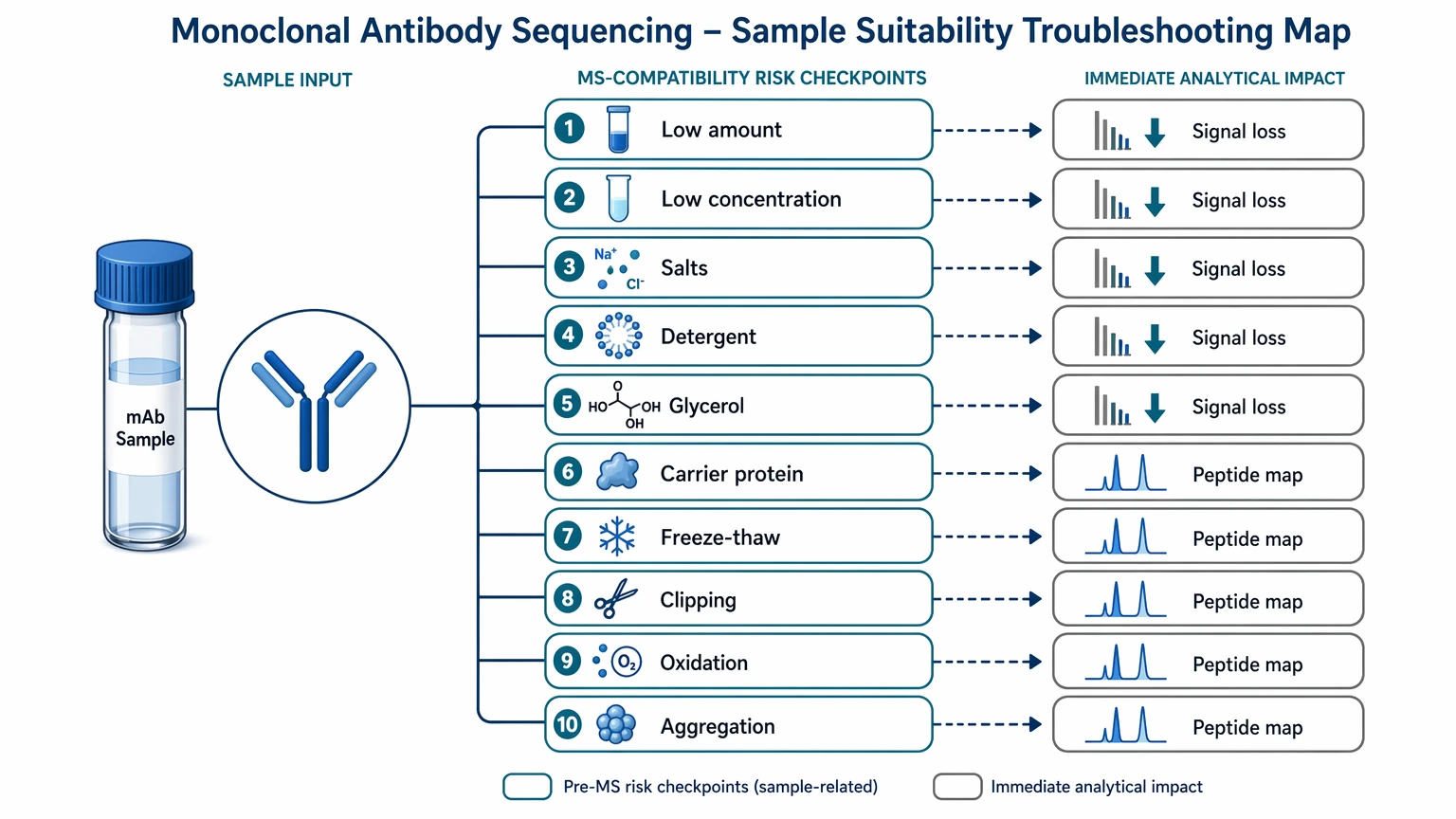
For monoclonal antibody sequencing, sample purity should be judged alongside sample amount and formulation. If the project includes intact mass, subunit mass, replicate digestion, or targeted follow-up, usable amount matters more than label concentration alone.
2. Weak clone documentation
Clone documentation shapes interpretation strategy, not just intake paperwork. Missing records on host species, isotype, purification route, storage buffer, prior reduction, digestion history, or possible sample mixing can push the analysis toward the wrong assumptions.
For example, an undocumented isotype assumption may change expectations about glycosylation or heavy-chain mass behavior. Unclear purification history can mask co-purified proteins. A legacy reagent from older stock may carry unknown processing, terminal clipping, or multiple preparation lots. Each of those gaps adds interpretation uncertainty before the first LC-MS/MS run is finished.
3. Heavy chain and light chain assignment risk
Chain misassignment is one of the most antibody-specific failure points. It can happen when mixed immunoglobulin material is present, when chain-origin evidence is weak, or when peptide assembly leans too heavily on shared framework motifs. The risk becomes more serious if multiple light chains, contamination, or poorly resolved chain-specific peptides are possible.
A report with strong total coverage can still be weak where it matters most if heavy chain and light chain coverage are not reviewed separately. Teams should look closely at CDR support, chain-discriminating peptides, and whether uncertain regions are labeled as inferred rather than directly observed.
4. Underestimating PTM and glycan complexity
Post-translational modification burden often explains why a clean-looking sample still produces fragmented sequence evidence. Glycosylation heterogeneity, oxidation, deamidation, pyroglutamate formation, C-terminal lysine processing, blocked termini, and clipping can all shift mass and fragment behavior. Modified peptides may be undercalled, split into competing assignments, or reported with lower sequence confidence.
This matters most near functional or redevelopment-sensitive regions. If CDR-H3 support is weak, or if terminal evidence is reduced by blocking or clipping, the sequence may not yet be ready for cloning decisions. A key limitation is that LC-MS/MS-based de novo sequencing may still leave local ambiguity when PTMs, database-search limits, or isobaric residue ambiguity reduce direct MS/MS evidence.
5. Misaligned deliverable expectations
Many projects stall because the team asks for “the sequence” without defining what that means. A proposed amino acid sequence, a confidence-annotated analytical report, and a package suitable for recombinant expression confirmation are not interchangeable outputs.
If the team needs an expression-ready construct path, the report should show chain-specific sequence coverage, unresolved positions, CDR evidence, intact mass or subunit mass consistency, and recommended orthogonal validation. Without that agreement at kickoff, the first deliverable may answer the wrong question.
Step-by-Step Prevention Plan Before Kickoff
1. Define the actual project decision
Start by deciding what the sequence result needs to support. Is the goal identity recovery, lot comparison, clone rescue, or preparation for recombinant expression confirmation? That choice determines how much uncertainty is acceptable.
A short internal checklist helps:
- Do both heavy chain and light chain need reconstruction?
- Is CDR-H3 sequence confidence a release criterion?
- Are unresolved residues acceptable if follow-up confirmation is planned?
- Must intact mass or subunit mass agree before downstream cloning begins?
2. Screen for MS compatibility, not just visible purity
Review the sample as a sequencing input, not simply as a general protein prep. Confirm usable amount, concentration, storage buffer, additives, and any cleanup already performed. Ask whether detergents, glycerol, salts, stabilizers, or carrier proteins may still be present.
If the sample is limited, set expectations for repeats and validation before submission. If the material may be mixed, enrich or clarify it first instead of expecting the sequencing report to resolve that ambiguity after acquisition.
Service Routes to Consider
For this project scenario, readers usually compare these service routes before requesting a quote or submitting samples.
3. Submit the documentation that changes interpretation
Provide clone documentation that can affect de novo sequencing logic:
- clone origin and project history
- expected species and isotype
- purification method
- storage and freeze-thaw history
- any prior reduction, alkylation, digestion, or labeling
- suspicion of mixed clones, multiple light chains, or co-purified proteins
When the available material is legacy, low-mass, or formulation-heavy, submit your requirements to MtoZ Biolabs for a project-fit review tied to antibody sequencing workflow scope, cleanup needs, and likely validation steps.
4. Plan for chain assignment, not just peptide identification
Ask how heavy chain and light chain assignment will be supported. Chain-aware reduction, alkylation, proteolytic digestion, and peptide mapping are more informative than total peptide count alone. Review whether chain-specific sequence coverage, CDR support, and uncertain local assignments will be reported separately.
This is also the stage to flag unusual intact or subunit mass patterns, since unresolved mass discrepancies can point to clipping, glycoform complexity, or sample heterogeneity that might otherwise appear only late in the project.
5. Anticipate modification-driven ambiguity
Do not wait for the report to reveal expected PTMs. If glycosylation heterogeneity, oxidation, deamidation, pyroglutamate formation, or terminal processing are plausible, include that context at intake. Planning for those features early reduces the chance that modified peptides will be mistaken for missing sequence.
Expected Results and Validation Methods
A well-prepared project should produce a cleaner first-pass result, but validation still needs to be staged.
Immediate deliverables from the sequencing workflow should include:
- a proposed heavy-chain and light-chain sequence
- chain-specific sequence coverage
- CDR and framework region support
- a list of unresolved positions or isobaric residue ambiguity
- notes on PTM-related interpretation limits
- intact mass or subunit mass consistency, if included in scope
Follow-up confirmation is different. It may involve:
- targeted review of uncertain peptides
- subunit mass reconciliation
- terminal confirmation
- site-focused LC-MS/MS checks
- recombinant expression confirmation when the sequence will drive redevelopment
The practical question is not whether a sequence string exists, but whether the evidence is strong enough for the next project decision.
Key Cautions and Practical Limits
Reserve material for repeat work. Low-amount submissions leave little room for repeat digestion, targeted confirmation, or orthogonal validation.
Use controls and repeat logic when the antibody identity is decision-critical. One dataset may not settle chain-origin questions if mixed material or contamination is suspected.
Track batch history carefully. Different lots, cleanup steps, or storage conditions can create differences that look like sequence issues but actually reflect heterogeneity or handling artifacts.
Interpret within evidence boundaries. Sequence confidence is local, not uniform across every residue. Database search limitation, peptide-spectrum match limitation, PTM burden, and isobaric residue ambiguity can leave some assignments conditional.
Know when another method is the better next step. Persistent unexplained mass mismatch, weak terminal evidence, unstable CDR-H3 support, or mixed-chain signals may justify intact mass review, glycosylation-focused analysis, targeted validation, or additional outside support before the team treats the sequence as expression-ready.
Final Project Guidance
Preventable rework in monoclonal antibody sequencing usually starts in project setup, not instrument output. Teams get better first-pass results when they verify sample purity and amount in MS terms, provide clone documentation that affects interpretation, reduce chain misassignment risk, anticipate PTM burden, and define whether the needed output is a proposed sequence or a validation-ready package. This approach is especially suitable for legacy antibodies, rescued lots, and partly documented purified IgG samples where heavy chain, light chain, and CDR confidence will affect downstream redevelopment. If your current material or records still leave open questions, contact us to evaluate your project with MtoZ Biolabs in the context of antibody sequencing, orthogonal validation, and report-readiness for the next decision.
FAQ
Can one monoclonal antibody sequencing report support both lot comparison and recombinant recovery?
Sometimes, but not automatically. Lot comparison may tolerate a small number of unresolved positions if the main question is similarity. Recombinant recovery usually needs tighter review of CDR support, chain-specific evidence, terminal assignments, and any inferred residues.
What is the most common reason teams have to send more sample after kickoff?
Insufficient usable mass is a common trigger, especially when the original plan expands to include subunit mass checks, targeted follow-up, or repeat digestion after ambiguous regions appear.
Why is CDR-H3 often reviewed separately from overall sequence coverage?
CDR-H3 can be harder to reconstruct confidently because it is hypervariable and may yield less informative fragmentation. A report with strong overall sequence coverage can still be weak at CDR-H3.
How should mixed-material risk be communicated if the team is not sure?
State the uncertainty directly at intake. Even a suspicion of mixed clones, co-purified proteins, or multiple light chains can change digestion planning, chain-assignment review, and expectations for sequence confidence.
Is an unresolved leucine/isoleucine position always a project failure?
No. Isobaric residue ambiguity is a known limitation in MS/MS interpretation. The key question is whether the unresolved position affects the intended use of the sequence and whether targeted follow-up is justified.
How to order?




