






LC-MS/MS Analytical Service
Liquid chromatography-tandem mass spectrometry (LC-MS/MS) analysis combines two core processes: separation and detection. First, liquid chromatography (LC) separates the components of complex biological samples according to polarity, hydrophobicity, or molecular size, based on the interactions between the stationary phase and the mobile phase. This allows the target analytes to gradually enter the mass spectrometry system. Next, mass spectrometry (MS) converts molecules into charged ions using ionization techniques such as electrospray ionization (ESI) or matrix-assisted laser desorption ionization (MALDI). In the first stage of mass spectrometry (MS1), the mass-to-charge ratio (m/z) of precursor ions is obtained. Selected precursor ions are then subjected to collision-induced dissociation (CID) or higher-energy collisional dissociation (HCD), generating a series of fragment ions that are precisely detected in the second stage of mass spectrometry (MS2). By comparing precursor ions with their corresponding fragment ions, structural information, amino acid sequences, or modification types can be deduced, enabling both qualitative and quantitative analysis. With its high resolution, wide dynamic range, and high sensitivity, LC-MS/MS has become a core methodology in protein identification, post-translational modification analysis, metabolite detection, and drug analysis.
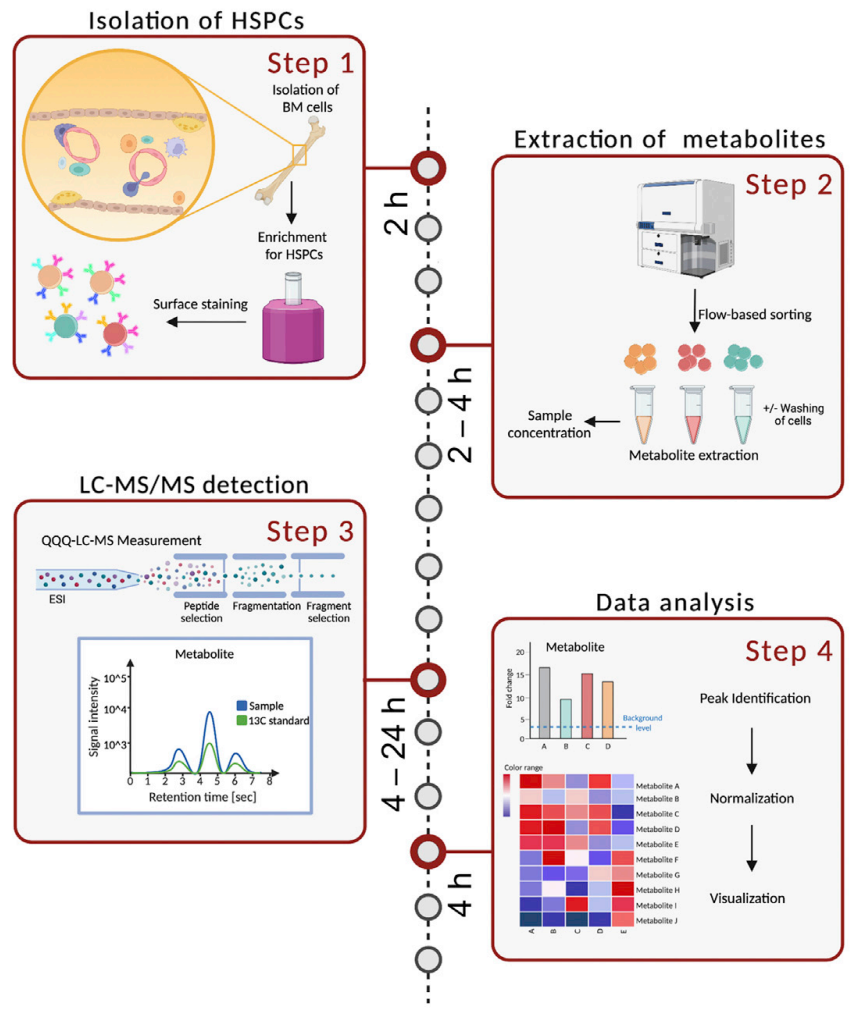
Schönberger, K. et al. STAR Protoc. 2022.
Figure 1. Targeted Metabolomics and Lipidomics Based on LC-MS/MS
Services at MtoZ Biolabs
MtoZ Biolabs provides end-to-end LC-MS/MS Analytical Service for proteomics, peptidomics, metabolomics, and biopharmaceutical characterization, covering the entire workflow from separation and preparation to data interpretation. We integrate multi-brand platforms, including Vanquish Neo-Orbitrap Exploris 480, Orbitrap Fusion Lumos, Orbitrap Astral, and IMS TOF Pro2, combined with UHPLC and nano-LC for high-resolution separation and HRMS for accurate detection. This setup accommodates highly polar or thermally unstable molecules, as well as large-scale, high-throughput projects requiring deep proteome coverage with 3D and 4D enhancements. We offer customized acquisition strategies, including DDA, DIA, and PRM, combined with CID, HCD, and ETD fragmentation, enabling continuous solutions from large-scale relative quantification to targeted protein or peptide sequence confirmation and absolute quantification. Our LC-MS/MS Analytical Service can be applied in:
1. Proteomics Analysis Service
2. Protein Identification Service
4. Protein Mass Spectrometry Sequencing Service
5. PTM Mass Spectrometry Analysis Service
6. Peptidomics Analysis Service
7. Biopharmaceutical Research Services
8. Metabolomics Analysis Service
9. Lipidomics Analysis Service
10. Preclinical Drug Development
11. Biomarker Discovery Service
LC gradients, ionization modes, and fragmentation parameters can be tailored to meet project objectives. Contact MtoZ Biolabs to receive a customized solution that fits your research and submission requirements.
Service Advantages
1. Multi-platform Integration
MtoZ Biolabs integrates Vanquish Neo-Orbitrap Exploris 480, Orbitrap Fusion Lumos, Orbitrap Astral, and IMS TOF Pro2 platforms. Combined with UHPLC and HRMS, this ensures flexible adaptation to molecules with different physicochemical properties, enabling both high-polarity or thermally unstable molecules and large-scale, high-throughput detection.
2. Flexible Acquisition Strategies and Fragmentation Modes
Our LC-MS/MS analytical service supports DDA, DIA, and PRM strategies, along with CID, HCD, and ETD fragmentation. This enables both large-scale relative quantification at the omics level and precise confirmation or absolute quantification of specific peptides and proteins, covering research needs from basic studies to translational applications.
3. High Sensitivity
3D and 4D separation and acquisition strategies increase proteome coverage, enabling reliable detection of low-abundance proteins, modified peptides, and metabolites. This makes the platform suitable for disease mechanism studies, biomarker discovery, and drug development.
4. Proven Expertise and Broad Sample Compatibility
With extensive experience in proteomics, peptidomics, metabolomics, and biopharmaceutical characterization, our team supports diverse sample types, including gel bands, protein solutions, and tissue samples, serving both academic research and industrial R&D.
5. One-Time Charge
Our pricing is transparent, with no hidden fees or additional costs.
Sample Submission Suggestions
1. Sample types
- Protein samples: gel bands, protein solutions, cell lysates, tissue homogenates, serum, plasma.
- Peptide samples: synthetic peptides or digested peptide mixtures.
- Small molecules or metabolites: please provide structural information or expected mass range.
2. Protein or peptide samples
- Concentration: recommended ≥1 µg/µL, total amount ≥50 µg.
- Buffers: avoid high salt, glycerol, or SDS that may suppress ionization.
- Storage and shipping: store at -80 °C and ship on dry ice.
3. Cell and tissue samples
- Cells: ≥1×10⁶ cells, frozen in PBS or suitable buffer.
- Tissues: ≥50 mg, homogenized under cold conditions and snap-frozen.
4. Metabolite or small molecule samples
- Quantity: ≥100 µL (liquid) or ≥5 mg (solid).
- Solvents: use LC-MS compatible solvents such as methanol, water, or acetonitrile, and avoid strong acids, bases, or contaminants.
5. General notes
- Label all samples with detailed information (name, concentration, buffer, storage conditions).
- Provide background information such as expected targets, databases, or known modifications to facilitate optimized analysis.
MtoZ Biolabs also provides a detailed sample submission guide including buffer recommendations, digestion options, and shipping instructions. For special requirements, please consult our technical support team.
Deliverables
1. Raw data files: original mass spectrometry data in RAW, mzML, or mzXML format.
2. TIC and QC results: chromatograms and quality control data for workflow validation.
3. Method parameter files: including LC gradients, ionization settings, fragmentation modes, and acquisition strategies.
4. Database search outputs: protein and peptide identification lists with sequence information, modification sites, and confidence scores.
5. Quantitative analysis reports (if applicable): relative or absolute quantification with statistical evaluation.
6. Bioinformatics analyses: functional annotation, pathway enrichment, and network analysis tailored to research objectives.
7. Comprehensive experimental report: including study design, workflow description, data interpretation, and visualized figures.
With advanced mass spectrometry platforms, flexible analytical strategies, and extensive project experience, MtoZ Biolabs delivers high-quality LC-MS/MS analytical service for researchers and pharmaceutical developers. From protein identification and post-translational modification analysis to metabolite profiling, we provide reliable solutions to accelerate your research.
Contact us today to receive a tailored solution that meets your project and submission requirements.
Related Services
How to order?




