






Western Blot Housekeeping Protein: Principles, Applications, and Method Considerations
Short Answer
To choose a housekeeping protein for Western blot normalization, use a control that stays stable under your experimental conditions, is detectable in your sample matrix, remains within the linear detection range at your planned loading amount, and does not interfere with the target by molecular weight or detection format. Teams should not assume that GAPDH, β-actin, or α/β-tubulin is valid by default. Instead, test at least two candidate controls in representative samples, confirm single-band antibody specificity at the expected molecular weight, evaluate signal linearity by densitometry across the intended loading range, and ask whether the biology of the experiment could alter the control itself. If the candidate control changes with treatment or saturates easily, total protein normalization may be a better internal reference strategy than a single loading control.
What Is a Housekeeping Protein in Western Blot?
A housekeeping protein in a Western blot, or immunoblot, is a constitutively expressed protein used as a loading control or internal reference for normalization. Its purpose is not to show that every lane is identical. Its purpose is to provide a reference signal that helps account for lane-to-lane differences in sample loading, transfer, and detection when comparing a target protein across samples.
In practice, a western blot housekeeping protein should show relatively consistent abundance across the groups being compared. After imaging, researchers often divide the target band intensity by the housekeeping protein band intensity to generate a normalized value. That value is then compared across biological replicate groups.
This logic holds only when the control itself is stable and measured within a valid analytical range. If the control changes with treatment, differs across cell states, or reaches exposure saturation, normalization can add bias instead of reducing it.
Why Housekeeping Proteins Are Used for Normalization
Normalization is intended to reduce technical variation. In a blot-based workflow, common sources of variation include:
- Small differences in protein loading between lanes.
- Uneven transfer efficiency from gel to membrane.
- Imaging nonlinearity or exposure saturation.
- Membrane handling effects during stripping and reprobing.
- Antibody-related variation, including cross-reactivity or lot-to-lot changes.
A housekeeping protein can partially correct for some of these issues when its own behavior is stable. For example, if two lanes contain slightly different total protein amounts, a loading control may help place the target signal on a common reference scale. That is why housekeeping protein normalization remains common in semi-quantitative Western blot workflows.
Still, a housekeeping protein does not repair every upstream problem. Poor transfer of high-molecular-weight targets, membrane edge effects, nonlinear chemiluminescent exposure, or weak antibody specificity can still distort the result even when the control band looks clean.
Common Housekeeping Proteins and Their Typical Use Cases
The most familiar controls are GAPDH, β-actin, and α/β-tubulin. Each can be useful, but none is universally stable.
GAPDH
GAPDH is abundant and often produces a strong, easy-to-detect band. It is frequently used in whole-cell lysates when the target protein is well separated by molecular weight. However, GAPDH is a metabolic enzyme, so its expression may change under hypoxia, serum starvation, mitochondrial stress, metabolic rewiring, or drug treatment that alters glycolysis.
β-Actin
β-actin is a common cytoskeletal loading control. It often performs reasonably well in cultured cell lysates when actin biology is not under direct perturbation. It can become unsuitable in migration studies, morphology-driven models, differentiation systems, or treatments that alter cytoskeletal organization.
α-Tubulin / β-Tubulin
Tubulin controls are often chosen when a strong cytoskeletal marker is needed and the target protein is clearly separated by molecular weight. They are less suitable in experiments involving microtubule inhibitors, mitotic arrest, structural remodeling, or neuronal differentiation, where tubulin abundance or accessibility may shift.
Compartment-Specific Controls
Whole-cell standards are often inappropriate for membrane fractions, nuclear extracts, mitochondrial preparations, or secreted protein studies. In those settings, the internal reference should match the sample matrix and the compartment under study. A familiar housekeeping protein may still be biologically mismatched to the fraction being analyzed.
When Housekeeping Proteins Can Mislead Western Blot Interpretation
A housekeeping protein fails as a reference when the model changes the control, when the assay measures the control poorly, or when the control is technically incompatible with the target.
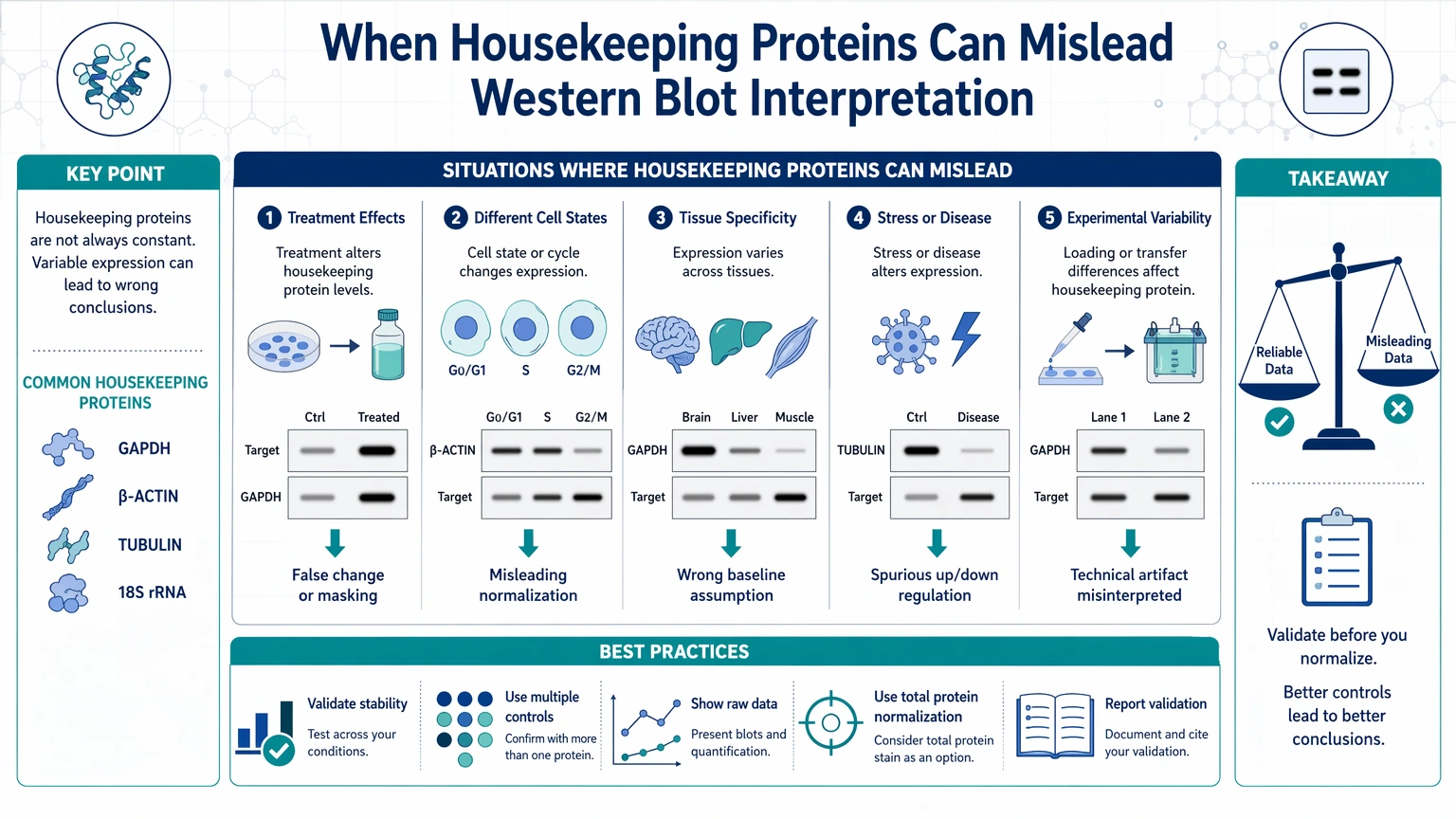
Common failure modes include:
- Treatment-induced expression changes: A drug may alter metabolism, stress signaling, cytoskeletal remodeling, or differentiation status, causing GAPDH, β-actin, or tubulin to drift.
- Signal saturation: Highly abundant controls often exceed signal linearity before the target does. A saturated housekeeping band makes densitometry normalization unreliable.
- Molecular weight overlap: If the target and control migrate close together, multiplexing or stripping and reprobing becomes harder, and residual signal can affect interpretation.
- Poor antibody specificity: Multiple bands, unexpected bands, or cross-reactivity can invalidate the control even if the expected band is present.
- Sample matrix mismatch: A control that works in whole-cell lysate may fail in membrane, nuclear, or low-input samples.
- Transfer bias: Large targets and small controls can transfer with different efficiencies, so a normal-looking control band does not prove that the target transferred properly.
A common example is a comparison between treated and untreated cells using GAPDH by habit. If the treatment affects metabolic pathways, GAPDH may shift in the same direction as the target or in the opposite direction. Either case can compress or exaggerate the normalized result.
Service Routes for Study Planning
For teams moving from method selection into execution, these service paths connect assay design, validation, and interpretation needs.
How to Validate a Western Blot Housekeeping Protein for Your Workflow
Validation should be performed in the actual sample set rather than inferred from prior literature alone. A practical workflow is:
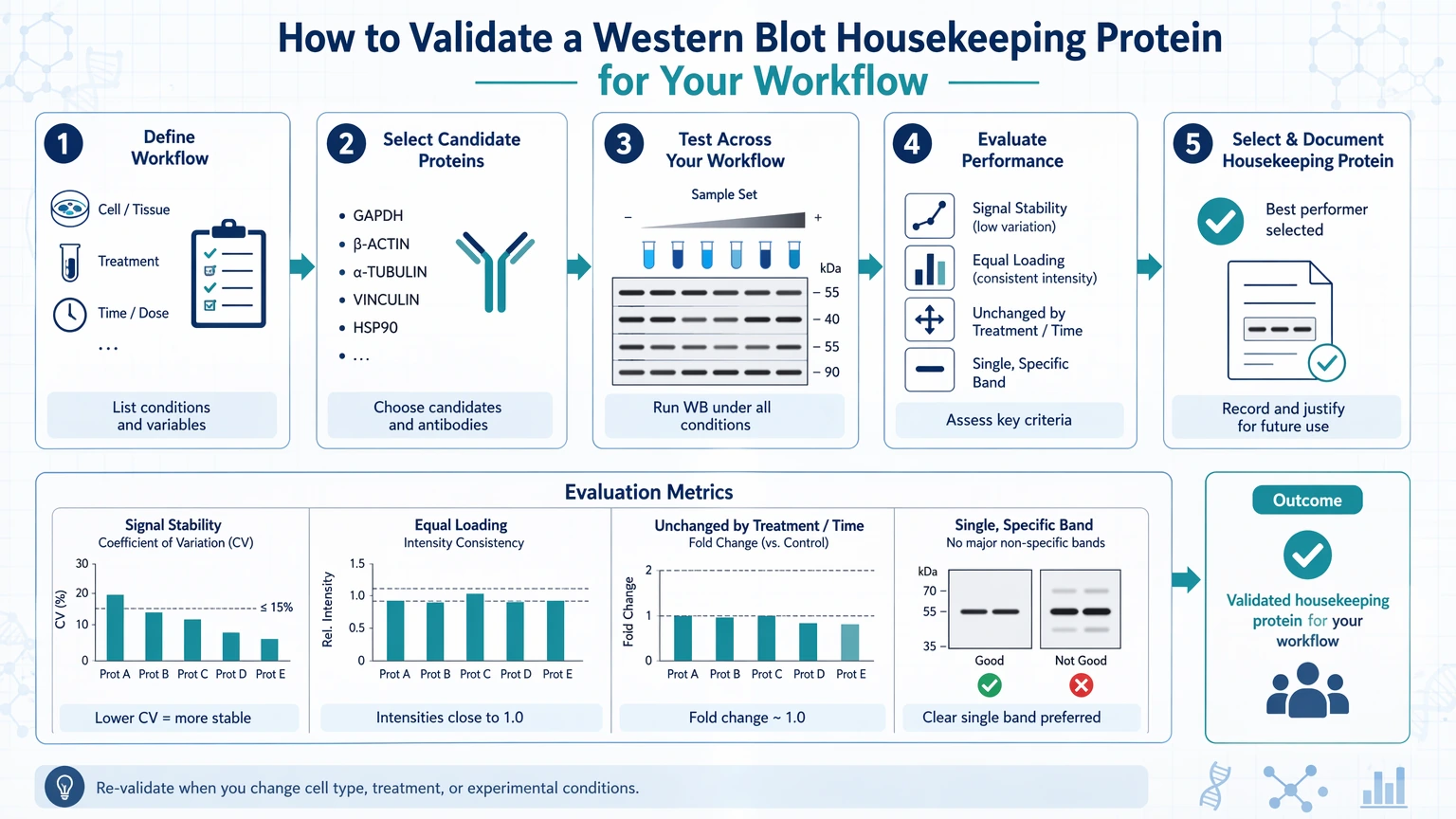
- Choose two or more candidate controls.
Start with proteins that fit the biology and molecular weight constraints of the experiment. In a metabolism-sensitive system, do not rely on GAPDH alone. In a cytoskeletal perturbation model, do not rely only on β-actin or tubulin.
- Test representative conditions.
Include treated and untreated samples, or all major groups in the study. Validation on control samples alone is not enough.
- Confirm antibody specificity.
The antibody should produce a dominant single band at the expected molecular weight with minimal background or cross-reactivity. If multiple bands appear, the internal reference becomes harder to defend.
- Measure signal linearity.
Load a dilution series across the intended protein input range and compare densitometry with loaded amount. A usable control should remain proportional within the working range.
- Check for exposure saturation.
Capture images that preserve unsaturated signal for both target and control. A flat-topped housekeeping band is not quantitative, even when it looks strong.
- Compare variability after normalization.
Determine whether normalization reduces lane-to-lane variation across technical replicate runs without masking plausible differences across biological replicate groups.
- Assess target-control compatibility.
Review molecular weight separation, stripping risk, fluorophore compatibility, and whether transfer efficiency is comparable enough for the pair to support interpretation.
This process is usually more informative than asking which housekeeping protein is “best.” The better question is whether a given internal reference behaves predictably in this assay.
Housekeeping Protein vs Total Protein Normalization
Total protein normalization uses the cumulative lane signal rather than a single reference band. This reduces dependence on one housekeeping protein, which can be useful when all obvious control candidates are likely to change under the treatment.
Total protein normalization is often attractive when:
- the treatment may alter classic housekeeping proteins,
- the control band saturates at the loading amount required for the target,
- the sample matrix is heterogeneous,
- stripping and reprobing would be risky, or
- the target occupies a molecular weight region that conflicts with common controls.
However, total protein normalization also requires validation. Uneven staining, inconsistent transfer efficiency, poor membrane handling, or strong lane artifacts can still bias the result. It is not automatically superior; it is simply a different reference model that may fit some experimental designs better.
A practical rule is straightforward: if no single housekeeping protein remains stable, specific, and linear across the relevant conditions, total protein normalization deserves serious consideration.
Antibody and Detection Considerations in Housekeeping Protein Analysis
Antibody performance is often the hidden variable in loading control selection. Even a biologically appropriate control can fail analytically if the antibody introduces ambiguity.
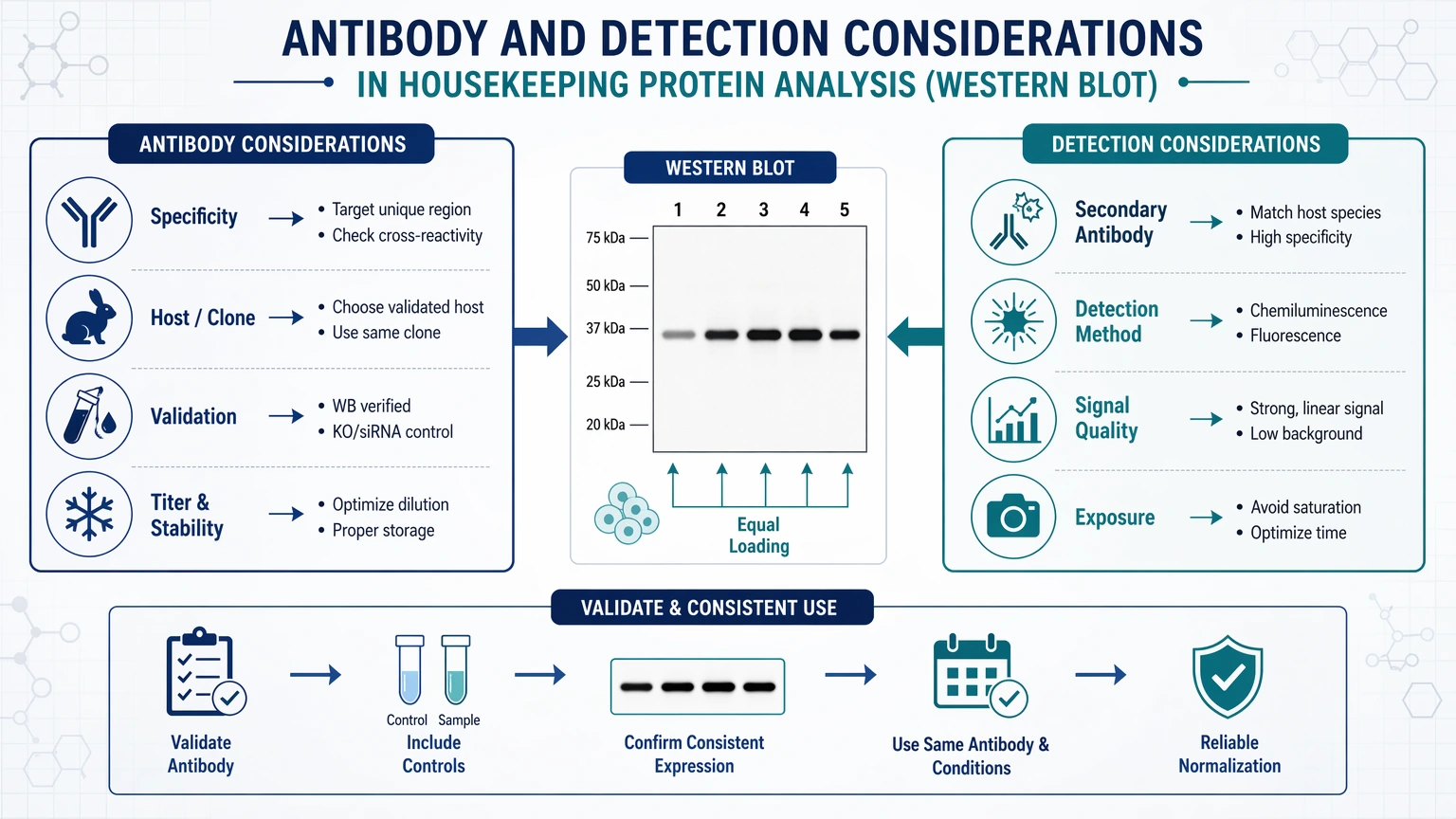
Antibody Specificity and Cross-Reactivity
A control antibody should produce a clean band at the expected molecular weight. Extra bands may reflect isoforms, degradation products, nonspecific binding, or sample-dependent cross-reactivity. If the banding pattern changes across treatments, that ambiguity can affect normalization.
Signal Linearity
A control signal must stay within the linear range of the detection system. This problem is common with abundant proteins and chemiluminescent readouts. Reducing sample load or antibody concentration may improve linearity, but the adjustment must still preserve measurable target signal.
Lot Consistency and Epitope Accessibility
Different antibody lots may behave differently, and denaturation, reduction, extraction conditions, or sample composition can alter epitope accessibility. These issues matter in projects that span multiple batches or reuse archived lysates.
Stripping and Reprobing Strategy
If the target and control are measured sequentially on the same membrane, stripping efficiency and residual signal should be considered. Reprobing is convenient, but it can alter membrane performance and complicate interpretation when target and control are close in molecular weight.
Practical Method Considerations for Data Interpretation
Even after selecting a control, interpretation should remain tied to assay design.
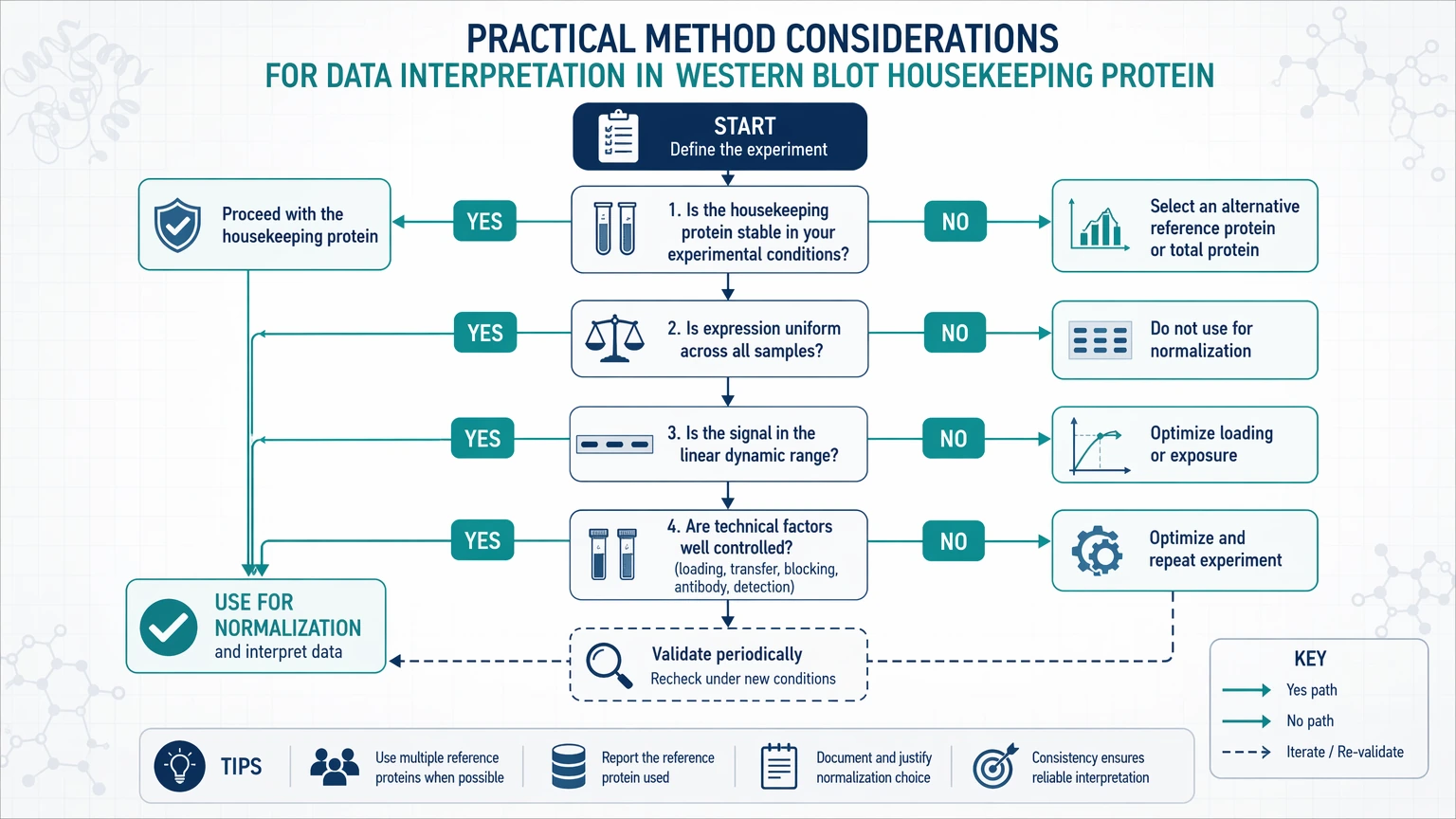
- Match the reference to the sample matrix. Nuclear extracts, membrane fractions, and secreted samples should not be normalized as though they were whole-cell lysates.
- Use appropriate loading amounts. More protein is not always better. Overloaded lanes can distort both target and control signals.
- Review replicate structure. A strong blot from one run does not replace reproducibility across biological replicate and technical replicate datasets.
- Document imaging settings. Exposure time, detector settings, and background subtraction influence densitometry and should be standardized.
- Watch the target-control size relationship. Large targets paired with small controls may reflect different transfer behavior.
- Avoid single-band overconfidence. A sharp housekeeping band is reassuring, but it does not validate normalization by itself.
If uncertainty remains after pilot testing, a focused review can save time. For example, if a team is unsure whether the real bottleneck is antibody specificity, linear range, or choice of normalization model, they can submit your requirements to MtoZ Biolabs for assay-path discussion before expanding a weak strategy across a larger replicate set.
When External Analytical Support May Help
External analytical support becomes useful when the question shifts from basic principle to troubleshooting a specific workflow.
Typical scenarios include:
- a candidate control changes after treatment,
- housekeeping bands are too intense for linear detection,
- target and control overlap in molecular weight,
- different antibody lots produce different band patterns,
- the sample matrix is unusual, such as membrane-enriched or nuclear fractions, or
- the team needs a clearer quantification plan before scaling biological replicates.
At that stage, the service path should follow the actual bottleneck. For direct blot readout and densitometry questions, a Western Blot Protein Quantification Service or Western Blot Quantification Service is the most natural follow-up. For antibody-centered questions such as reagent characterization or epitope coverage, supporting options such as AAE-2D Antibody Coverage Analysis Service, AAE-nanoLC-MS/MS Antibody Coverage Analysis Service, or 2D-DIGE Antibody Coverage Analysis Service may be more appropriate. The listed main service, Antibody Drug Developability/Druglikeness Assessment Service, fits best when the blot reagent question sits inside a broader antibody development or characterization program rather than a standalone normalization problem.
If your team is comparing antibody validation needs with quantitative immunoblot follow-up, you can evaluate your project with MtoZ Biolabs and decide whether the immediate need is reagent characterization, densitometry support, or a revised normalization strategy.
Conclusion
A western blot housekeeping protein should be selected by evidence rather than habit. The control should remain stable under the tested biology, fit the sample matrix, show acceptable antibody specificity, and stay within the planned loading and exposure range. GAPDH, β-actin, and α/β-tubulin remain useful options, but each can fail under predictable experimental conditions. When those risks are substantial, total protein normalization may provide a better reference model, provided transfer and staining consistency are also verified.
The most defensible next step is to validate candidate controls in representative samples before scaling the study. If unresolved issues remain around antibody specificity, signal linearity, or quantification workflow, contact us to discuss a targeted support path instead of building conclusions on an unstable internal reference.
FAQ
Can one housekeeping protein be used across every Western blot project?
Usually not. A control that behaves well in one cell line, tissue, or perturbation may fail in another. The choice should follow the biology of the experiment, the sample matrix, and the detection range of the assay.
How many candidate controls should I test before committing to one?
For a new workflow, testing at least two candidates is a reasonable minimum. If both show instability, saturation, or weak antibody specificity, reassess the design and compare that approach with total protein normalization.
Does a stronger housekeeping band improve densitometry?
Not necessarily. Very intense bands often indicate abundance beyond the linear range, especially with chemiluminescent detection. A weaker but linear band is more useful than a saturated one.
What should I do if the target protein and housekeeping protein have similar molecular weights?
That can complicate multiplex detection and stripping and reprobing. In that case, use a different control, modify the membrane workflow, or consider total protein normalization to avoid overlapping or residual signals.
Are technical replicates enough to validate a normalization strategy?
No. Technical replicates help assess assay consistency, but they do not capture biological variability. A normalization strategy should remain interpretable across biological replicate samples as well as repeated runs.
How to order?




