






Targeted Proteomics vs Discovery Proteomics
-
Label-free quantitation, which compares peptide ion signals across samples without isobaric tags
-
Isobaric labeling workflows, such as TMT or iTRAQ, which support multiplexed group comparison
-
DIA-based quantitation, which acquires broad fragment ion maps and supports retrospective peptide measurement
-
Run discovery proteomics to identify condition-associated proteins or generate a candidate list.
-
Narrow the list to proteotypic peptides with matrix-compatible performance.
-
Develop a targeted MRM or PRM assay on project-relevant samples.
-
Expand quantitation across the validation cohort with predefined QC rules.
-
Is the protein list still open, or is it already predefined?
-
Does the project need proteome-wide screening or validation-scale panel measurement?
-
Must results support candidate discovery, cohort comparison, or fixed monitoring?
-
Is repeat quantitation across many samples a core requirement?
-
Has matrix-specific peptide performance already been reviewed?
-
Will the project stop at screening, or continue into targeted validation?
Introduction
Proteomics projects often reach a point where the laboratory must decide between two different measurement strategies. A biomarker team may need to screen a complex matrix for candidate proteins, then quantify the same candidates across a larger cohort. A pharmacology group may first explore treatment-induced proteome changes, then narrow measurement to a predefined signaling panel. A biopharmaceutical group may need broad product characterization in one phase and selective peptide monitoring in another.
Discovery proteomics surveys many proteins in an open-ended way, often through label-free quantitation, isobaric labeling, or data-independent acquisition (DIA). Targeted proteomics measures predefined proteotypic peptides with selective LC-MS acquisition, commonly through multiple reaction monitoring (MRM) or parallel reaction monitoring (PRM). Both approaches use mass spectrometry, but they answer different questions and fit different project stages.
Choosing the wrong route can waste sample, delay decisions, and produce data that do not match the reporting goal. Discovery proteomics is poorly suited to fixed-panel validation when repeat quantitation and matrix control matter most. Targeted proteomics cannot replace an unbiased screen when the protein list is still unknown. The more suitable workflow is the one that matches study stage, quantitation goal, and whether the target list is open or predefined.
Related Services
Researchers comparing targeted proteomics and discovery proteomics can consult MtoZ Biolabs to review study stage, target list status, and reporting goals before selecting a workflow.
When Researchers Face This Decision
This comparison usually appears when a project moves from exploratory protein measurement toward a narrower quantitative question. Common scenarios include biomarker screening followed by cohort validation, pathway exploration followed by panel tracking, or biopharmaceutical characterization followed by selective peptide monitoring.
In each case, the practical question is whether the next experiment should remain open-ended or shift to predefined peptide quantitation. Answering that question before sample submission reduces method mismatch and repeat analysis.
Typical decision scenarios include:
1. The protein list is still unknown. Discovery proteomics is usually the first route to evaluate.
2. Candidates already exist from a prior screen. Targeted proteomics is often the next step for validation-scale measurement.
3. A fixed panel must be tracked across many samples. Targeted proteomics is usually the more direct quantitative route.
4. The project needs both screening and later validation. A staged discovery-to-targeted plan may be required rather than a single-method choice.
Four Comparison Dimensions That Matter Most
A useful comparison should focus on decision variables rather than generic platform preference.
Scientific question. Discovery proteomics asks which proteins are detected or changed across conditions. Targeted proteomics asks how abundantly predefined targets change across samples.
Acquisition strategy. Discovery proteomics allocates instrument time across a broad m/z range or broad DIA window. Targeted proteomics monitors selected precursors or transitions for a predefined peptide panel.
Coverage versus selectivity. Discovery proteomics prioritizes proteome breadth. Targeted proteomics prioritizes sensitivity, specificity, and reproducibility for a chosen panel.
Study stage. Discovery proteomics fits hypothesis generation and candidate identification. Targeted proteomics fits validation, panel monitoring, and repeat quantitation across larger cohorts.
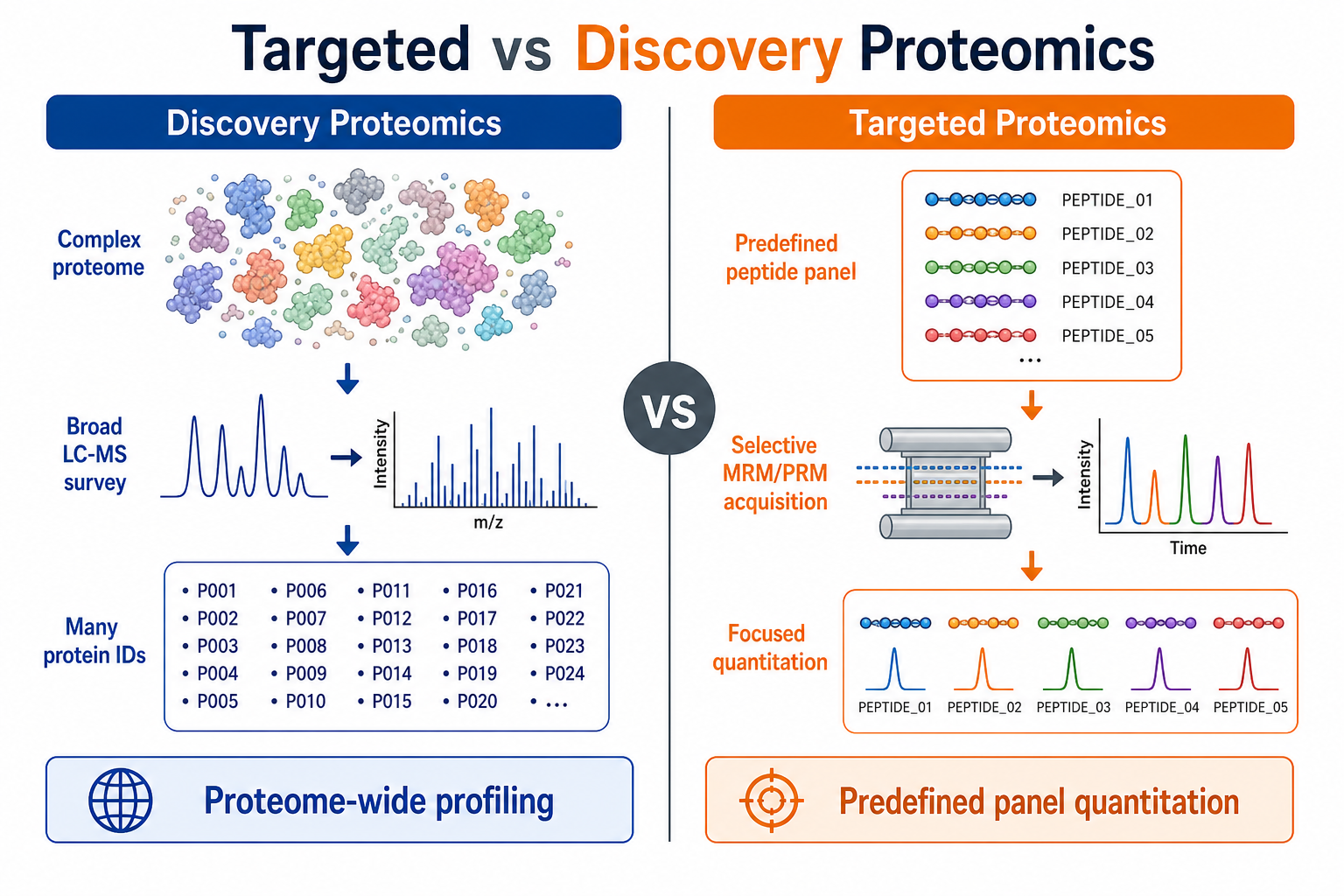
Figure 1. Discovery proteomics surveys many proteins in an open-ended way, while targeted proteomics quantifies a predefined peptide panel with selective acquisition.
How Discovery Proteomics Works
Discovery proteomics begins with complex protein mixtures and uses LC-MS/MS to identify and quantify large numbers of proteins without pre-specifying acquisition targets for each analyte.
Common discovery routes include:
Discovery proteomics is valuable when the project needs proteome-wide coverage, unbiased comparison across conditions, or candidate generation before a narrower panel is defined. The main limitation is that broad profiling is less efficient for fixed-panel validation when repeat measurement, matrix control, and assay-level performance become the priority.
How Targeted Proteomics Works
Targeted proteomics begins with a predefined list of proteins and converts each target into one or more proteotypic peptides for selective measurement.
The workflow typically includes peptide selection, assay development, matrix testing, and cohort-level quantitation using MRM, PRM, or related selective acquisition modes. Instrument time is spent on the chosen panel rather than on surveying unrelated peptides across the full proteome.
Targeted proteomics is valuable when the protein list is stable, validation-scale quantitation is required, and reproducible panel measurement matters more than open-ended identification. The main limitation is upfront planning: unknown proteins cannot be quantified reliably without peptide selection and assay development.
Side-by-Side Comparison
The principles above explain why study stage should come before platform preference. The table below adds practical differences in output type, planning needs, and reporting focus.
|
Dimension |
Discovery Proteomics |
Targeted Proteomics |
|---|---|---|
|
Primary question |
Which proteins are present or changed? |
How much do predefined targets change? |
|
Target list |
Open-ended |
Predefined before analysis |
|
Acquisition mode |
Broad survey, DIA, or multiplexed discovery |
Selective MRM, PRM, or related targeted modes |
|
Proteome coverage |
Broad |
Limited to chosen panel |
|
Quantitation focus |
Comparative profiling across many proteins |
Reproducible panel measurement |
|
Upfront planning |
Lower for initial screening |
Higher due to peptide and assay design |
|
Typical study stage |
Screening, exploration, candidate generation |
Validation, monitoring, expanded cohort analysis |
|
Main strength |
Unbiased proteome insight |
Selective, efficient panel quantitation |
|
Main limitation |
Less efficient for fixed-panel validation |
Requires prior target definition |
|
Repeat measurement |
Useful but not assay-optimized for a fixed panel |
Designed for repeat cohort analysis |
This comparison shows why neither workflow is universally more suitable. The appropriate route follows whether the target list is open or predefined and whether the project needs breadth or panel-level reproducibility.
Which Approach Fits Different Study Goals
Choose discovery proteomics when the protein list is still open, the goal is unbiased comparison across conditions, or candidate proteins must first be identified from a complex matrix.
Choose targeted proteomics when the protein panel is already defined, validation-scale quantitation is required, and repeat measurement with selective acquisition is the priority.
Consider a staged discovery-to-targeted plan when screening must be followed by cohort validation without losing analytical continuity. DIA-PRM or similar workflows can help bridge candidate identification and predefined panel measurement.
Use targeted proteomics alone when the panel is fixed from the start, such as pathway monitoring, release-related peptide tracking, or assay transfer support for a known target list.
Researchers should also define whether the reporting goal requires relative abundance comparison, normalized panel values, or absolute quantitation with labeled standards. That decision affects whether discovery output alone is sufficient or targeted assay development is required.
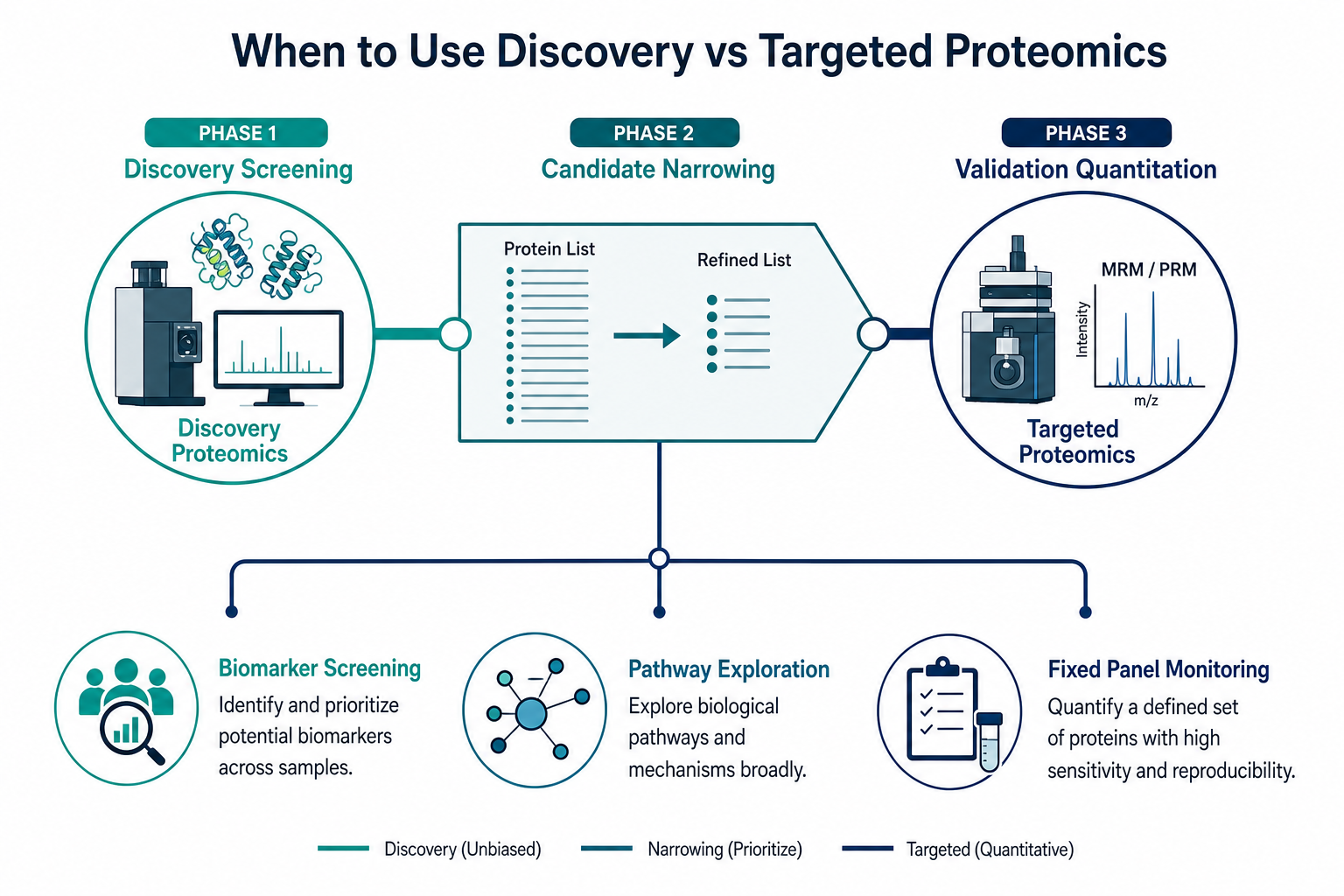
Figure 2. Many projects begin with discovery screening and move to targeted quantitation once the protein panel is defined.
Decision Recommendations by Project Type
The decision flow above provides a quick route-selection logic. The table below adds project-specific guidance for teams that already know their primary goal.
|
Project Situation |
More Suitable Approach |
Suggested Service Direction |
|---|---|---|
|
Open-ended biomarker screening in a new matrix |
Discovery proteomics |
Label-free or DIA-based quantitative profiling |
|
Validation of candidates from a prior screen |
Targeted proteomics |
MRM or PRM panel quantitation |
|
Pathway panel tracking across treatment arms |
Targeted proteomics |
Predefined peptide panel assay |
|
First proteome-wide comparison in a new model |
Discovery proteomics |
Broad LC-MS/MS or DIA quantitation |
|
Fixed peptide monitoring in biopharmaceutical matrix |
Targeted proteomics |
Selective MRM or PRM assay |
|
Screening plus later cohort validation in one program |
Staged discovery-to-targeted workflow |
DIA or label-free screening followed by targeted panel |
These recommendations are starting points. Matrix complexity, sample number, quantitation goal, and reporting depth can shift the final plan.
Combined Workflows and Continuity Planning
A strict either-or decision is not always necessary. Many proteomics programs plan continuity before the first sample is analyzed.
A practical staged plan may look like this:
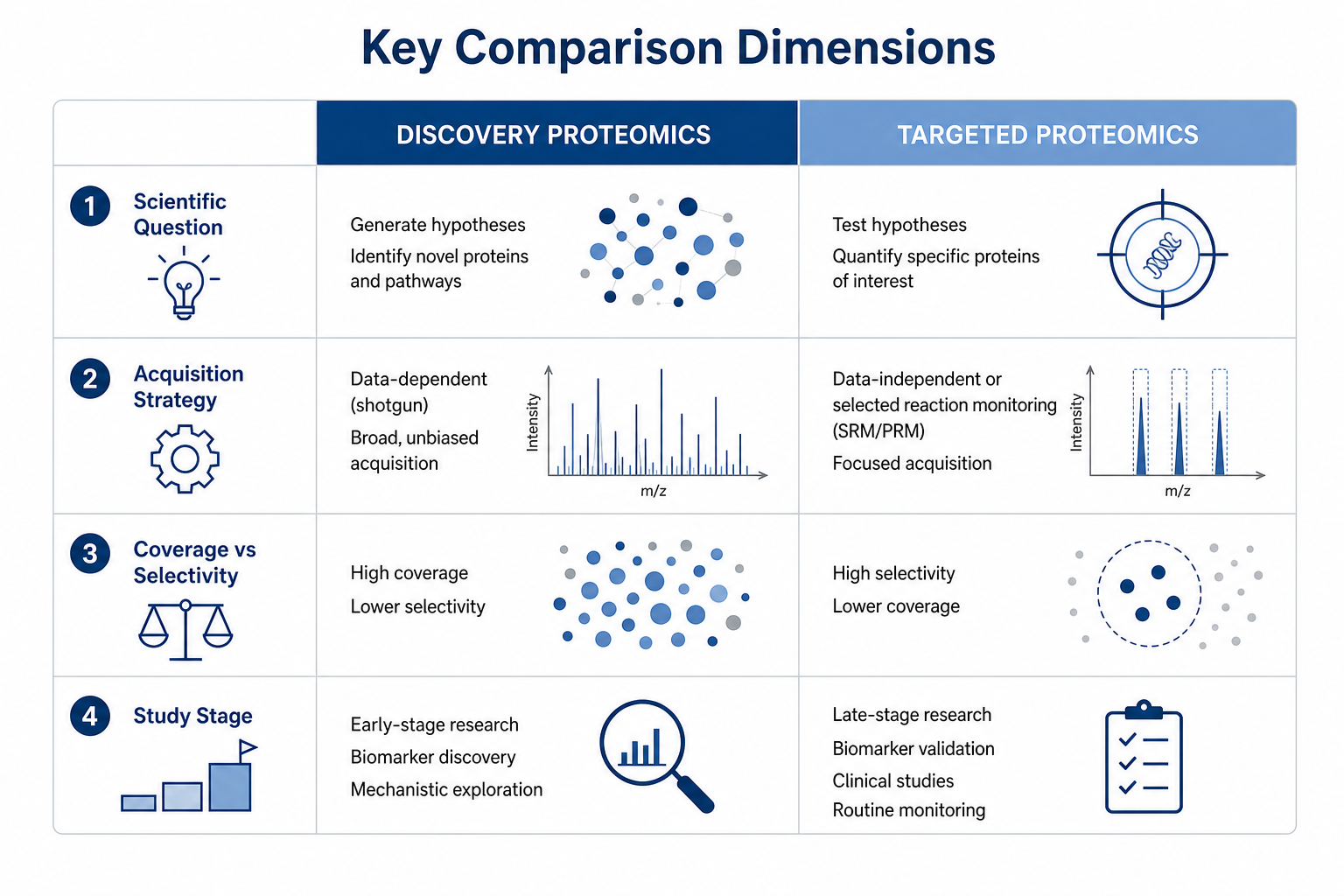
Figure 3. Scientific question, acquisition strategy, coverage focus, and study stage are the main dimensions for comparing the two workflows.
Some projects also combine both routes within one study design. Discovery proteomics can generate candidates, while targeted proteomics quantifies a reduced panel across a larger sample set. The appropriate design depends on whether the project needs open-ended insight, predefined validation, or both in sequence.
Technical Value and Practical Limits
1. Discovery Proteomics
Discovery proteomics provides broad proteome coverage and supports unbiased comparison when the target list is still forming. Label-free, TMT, and DIA workflows each offer different trade-offs in multiplexing, depth, and retrospective measurement flexibility.
The main practical limits include lower efficiency for fixed-panel validation, greater data complexity at reporting time, and the need for follow-up assay development when candidates move into validation-scale measurement.
2. Targeted Proteomics
Targeted proteomics provides selective instrument use, reproducible panel quantitation, and efficient cohort analysis once the peptide assay is developed. MRM and PRM can be matched to matrix complexity and confirmation needs.
The main practical limits include upfront assay investment, dependence on proteotypic peptide choice, and inability to quantify unknown proteins without prior panel design.
Researchers should avoid comparing the two workflows only by protein count. A broad discovery list is not more valuable than a validated targeted panel when the project decision depends on reproducible quantitation of predefined targets.
Practical Selection Checklist
Before choosing between targeted proteomics and discovery proteomics, answer these questions:
If the target list is open and the goal is unbiased exploration, discovery proteomics is usually the more suitable first step. If the panel is fixed and repeat quantitation matters most, targeted proteomics should be planned from the start.
Frequently Asked Questions
1. Is discovery proteomics the same as label-free proteomics?
No. Label-free quantitation is one common discovery route. Discovery proteomics can also use isobaric labeling or DIA-based measurement depending on project design.
2. When should a project move from discovery to targeted proteomics?
A project usually moves after candidate proteins are identified and a smaller panel must be quantified reproducibly across more samples or conditions.
3. Can targeted proteomics identify unknown proteins?
Not in the same open-ended way as discovery proteomics. Targeted proteomics quantifies predefined peptides and requires prior assay design.
4. Is DIA a discovery or targeted method?
DIA is often used for discovery-scale profiling, but DIA-PRM and related workflows can support continuity between screening and predefined panel validation.
5. How can teams avoid wasting sample on the wrong workflow?
Define the target list status, reporting goal, and study stage first, then request a feasibility review before sample submission.
Conclusion
Targeted proteomics and discovery proteomics address different stages of the same broad research need. Discovery proteomics is usually more suitable when the protein list is open and the goal is unbiased screening or candidate generation. Targeted proteomics is more suitable when the panel is predefined and validation-scale quantitation with selective acquisition is required. More reliable outcomes come from matching workflow to study stage, defining reporting goals early, and planning a discovery-to-targeted continuity path when both screening and validation are needed. Researchers comparing these routes for biomarker work, pathway analysis, or biopharmaceutical monitoring can contact MtoZ Biolabs to select the workflow aligned with target list status, sample matrix, and quantitation goals.
How to order?




