



Mass spectrometry projects fail route selection when the analytical goal is still open. A closed peptide panel that must be remeasured across many samples needs targeted acquisition. An unnamed proteome that must generate candidates needs discovery profiling. Parallel reaction monitoring (PRM) sits inside targeted mass spectrometry as the high-resolution option that isolates scheduled precursors and records product-ion spectra for fragment review (Peterson et al. 2012). Multiple reaction monitoring (MRM) or selected reaction monitoring (SRM) records predefined transitions on a triple quadrupole (Lange et al. 2008). Discovery data-dependent acquisition (DDA) or data-independent acquisition (DIA) profiles an open or semi-open proteome before any panel is frozen. The guide below matches PRM, MRM, and discovery LC-MS/MS routes to analytical goals with workflow, locked parameters, limits, and project fit.
Relative change is the common claim for discovery tables and for light-only targeted panels. Amount on named peptides needs stable isotope-labeled internal standard (SIS) peptides and a calibration model in the study matrix (Gerber et al. 2003). Route choice does not create a diagnostic cutoff by itself (Bantscheff et al. 2012).
In MtoZ Biolabs offerings, PRM, MRM/SRM, and discovery profiling are scoped after list status, matrix notes, and claim unit are declared. Targeted intake appears in Parallel Reaction Monitoring (PRM) Service and Targeted Proteomics Service.
What the Targeted-Versus-Discovery Decision Covers
Four decision layers belong in the brief and stay separated.
Goal layer states whether the study needs candidate finding, panel confirmation, or amount on named peptides.
List layer records whether proteins or peptides are already named and versioned, or still open.
Acquisition layer chooses discovery DDA or DIA for open profiling, MRM for stable transitions, or PRM when post-acquisition fragment review is required.
Claim layer states relative change or SIS-calibrated amount. Clinical diagnosis or treatment-selection language needs separate validation beyond the LC-MS/MS table.
The route decision starts from list status and claim unit. Instrument preference alone does not define the assay.
How PRM, MRM, and Discovery Profiling Differ
Scan mode and study stage should be chosen separately from the disease theme.
Discovery DDA selects precursors for MS/MS as they appear and builds an open protein inventory for relative profiling. DIA samples fragment ions across windows and can reduce stochastic missingness in some cohorts. Both discovery routes start before a panel is frozen.
MRM locks precursor-to-product transitions before acquisition and fits focused panels when matrix-matched ratios stay stable. PRM locks precursors and stores high-resolution product-ion spectra so fragments can be reviewed after acquisition when unit-resolution transitions remain unstable (Gallien et al. 2012). PRM versus MRM route detail appears in Parallel Reaction Monitoring vs MRM: Which Fits?.
Discovery nominates candidates. Targeted PRM or MRM remeasures a closed shortlist. A peptide seen in discovery is a lead, not proof that either targeted route will quantify it in the study matrix. Shared targeted routing appears on the Targeted Proteomics Service page. MRM/SRM intake appears in SRM-MRM Quantitative Proteomics Services.
End-to-End Workflow From Analytical Goal to Route Lock
A practical decision spine usually runs as follows.
- Freeze the analytical goal: open profiling, closed-panel confirmation, or amount claim.
- Record list status: unnamed proteome, short candidate list, or versioned peptide panel.
- Declare sample matrix, cohort size, and whether enrollment will stay open.
- Choose discovery DDA or DIA when the list is open and breadth is the bottleneck.
- Move surviving candidates into a closed panel only when repeat measurement is required.
- Run a matrix-matched pilot for MRM transitions or PRM fragment review on priority peptides.
- Lock MRM when transitions are stable; lock PRM when fragment confirmation is required.
- Declare relative versus SIS amount rules, quality control (QC) plan, and deliverables before cohort acquisition.
- Archive route choice, panel version, instrument method, and software with the project record.
Steps 1 through 3 protect the study question. Steps 4 through 9 are the route, pilot, and acquisition record. PRM operating detail appears in Workflow of Parallel Reaction Monitoring.
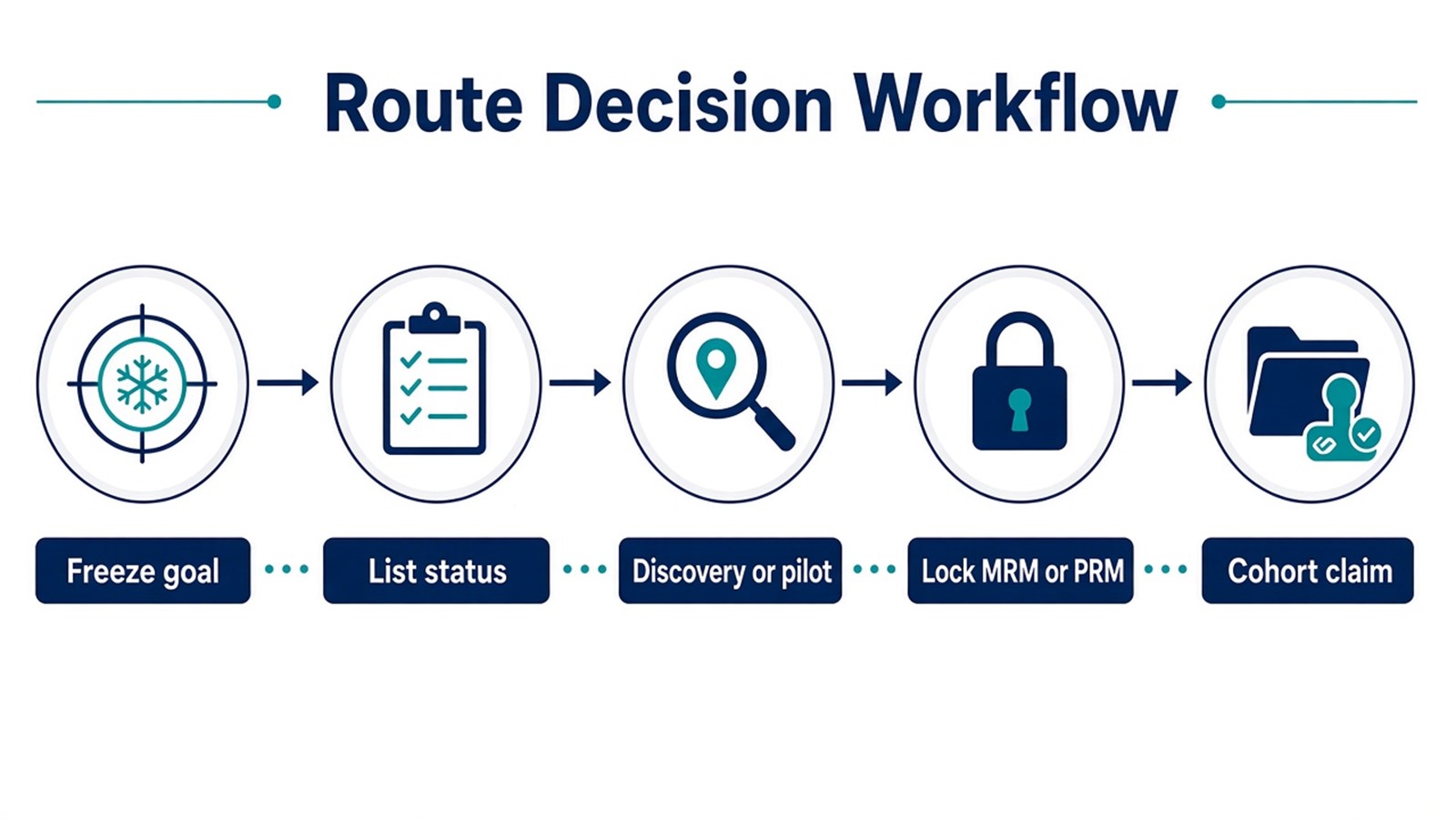
Figure 1. Route selection depends on list status and claim unit before discovery profiling or targeted PRM/MRM acquisition is locked.
Parameters That Must Be Locked Before Choosing a Route
Layer |
Parameter that must be declared |
Failure mode if ignored |
|---|---|---|
Goal |
Profiling, confirmation, or amount claim |
Platform chosen without a measurable endpoint |
List status |
Open proteome versus closed peptide panel |
PRM or MRM on unnamed proteins |
Matrix |
Sample type and interference expectations |
Clean-matrix transitions fail in plasma or tissue |
Cohort |
Sample count and enrollment flexibility |
Forced TMT-like freeze or underpowered targeted panel |
Discovery mode |
DDA or DIA rule when list is open |
Stochastic missingness misread as biology |
Targeted mode |
MRM transitions or PRM fragment rules |
Interference discovered after full cohort |
Pilot |
Matrix-matched test on priority peptides |
Full run committed to the wrong route |
SIS |
Spike step aligned to amount claim |
Relative peaks read as concentration |
QC |
Pools, blanks, and bracket pattern |
Undetected batch drift |
Deliverable |
Table, method file, panel or search version |
Report rebuilt after acquisition |
Limits follow the same table. Hybrid program language does not remove the need for a closed panel before targeted cohort work. Discovery depth does not prove targeted detectability. PRM fragment review does not remove matrix suppression.
What Each Route Result Can Support
A discovery DDA or DIA table supports relative candidate finding across detected proteins when pretreatment and acquisition stay matched. It does not freeze a validation panel by itself.
A reviewed MRM transition set supports same-peptide comparison across samples in one locked assay when transitions survive matrix review. A reviewed PRM fragment set supports the same claim with post-acquisition fragment selection when interference requires it. Amount claims still need SIS and a calibration model.
Staged programs can move from discovery to PRM or MRM after candidates are named. The discovery fold-change does not transfer automatically into the targeted table, because digestion, chromatography, and the quantitative signal can differ.
Discovery supports open candidate finding. PRM and MRM support closed-panel confirmation. Neither route invents clinical cutoffs.
How to Choose Among PRM, MRM, and Discovery LC-MS/MS
Use list status, matrix pilot outcome, claim unit, and study stage together.
Project need |
Route that often fits |
Recheck before committing |
|---|---|---|
Open proteome, candidate finding |
Discovery DDA or DIA |
PRM or MRM on unnamed proteins |
Closed peptides, stable transitions |
MRM or SRM |
Whole-panel PRM without interference evidence |
Closed peptides, need fragment review |
PRM |
Force MRM after unstable matrix ratios |
Discovery fold-change recheck in a new digest |
Closed PRM or MRM confirmation design |
Transfer discovery fold-change unchanged |
Amount on named peptides |
PRM or MRM with SIS and curve |
Relative peaks as concentration |
Large routine panel after clean transitions |
Mature MRM schedule |
PRM for every large panel by default |
Clinical cutoff or treatment selection |
Separate validation design beyond LC-MS/MS |
Any route table as diagnostic claim |
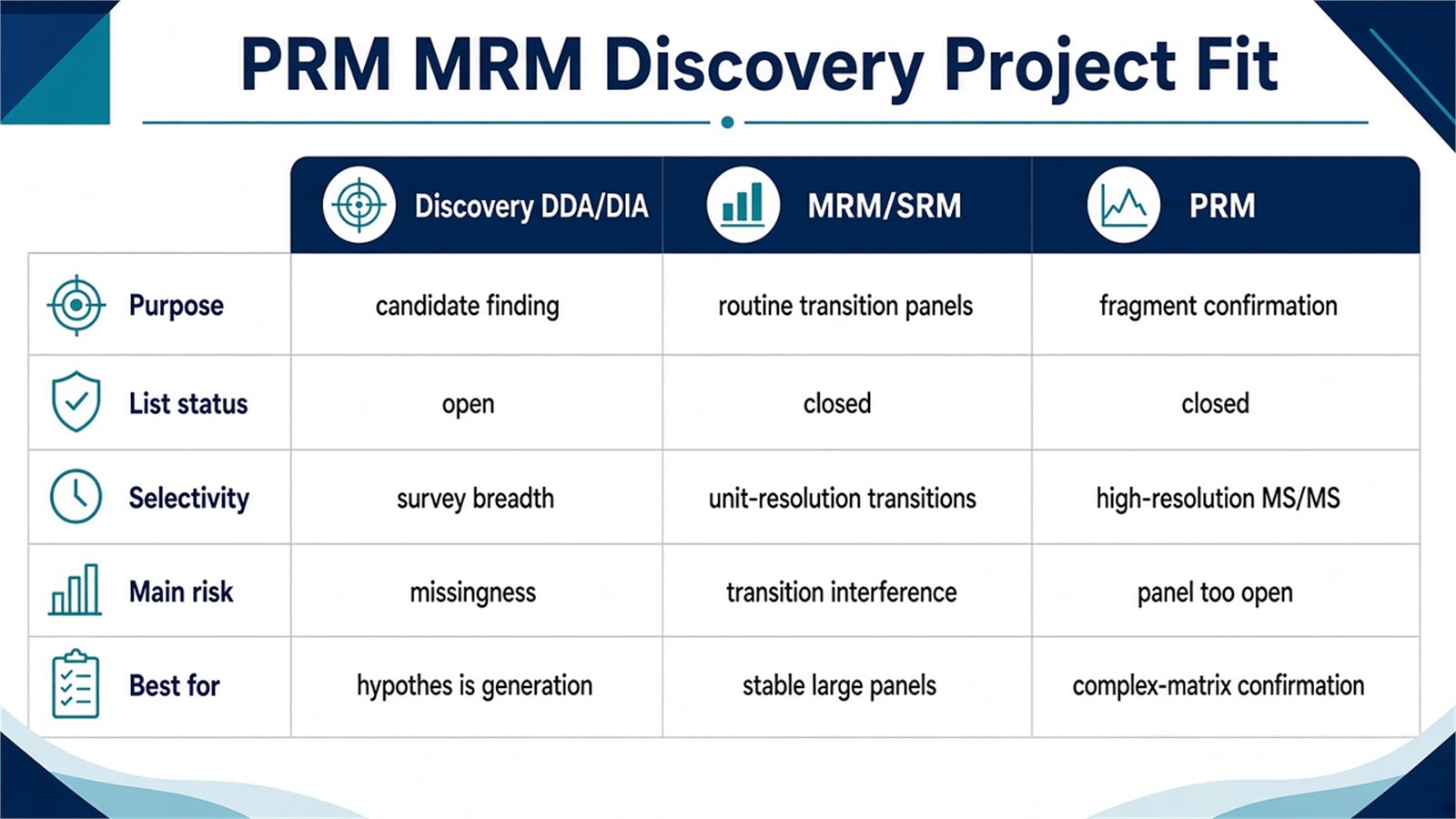
Figure 2. Choose discovery when the list is open; choose MRM or PRM when a closed panel needs repeat measurement, with PRM preferred for fragment confirmation.
Teams with list status notes, matrix pilots, and claim maps can review MtoZ Biolabs Parallel Reaction Monitoring (PRM) Service when PRM is declared, or SRM-MRM Quantitative Proteomics Services when transitions already fit.
Frequently Asked Questions
1. Is targeted mass spectrometry the same as MRM?
No. MRM is one targeted route. Targeted mass spectrometry also includes PRM and related selective assays on a closed analyte list.
2. Should every discovery project move to PRM or MRM?
No. Only candidates that need large-scale repeat measurement usually justify targeted method development.
3. Can one program combine discovery and targeted routes?
Yes. Many programs profile with DDA or DIA, then confirm a closed panel with PRM or MRM after matrix pilots.
4. When should PRM replace MRM inside a targeted panel?
When matrix-matched pilots still show unstable transition ratios after cleanup and collision-energy work, and fragment confirmation is required.
5. What project fields are needed before scoping the route?
Analytical goal, list status, sample matrix, cohort size, relative versus amount claim, and any prior discovery peptide evidence help evaluate feasibility before acquisition lock.
MtoZ Biolabs can provide parallel reaction monitoring, multiple reaction monitoring, and discovery LC-MS/MS profiling for projects that need route matching across open proteomes and closed peptide panels, including relative quantification and isotope-assisted absolute quantification when matched internal standards are required.
If further evaluation of list status, matrix interference, or PRM versus MRM versus discovery acquisition choice is needed, project details can be submitted for a feasibility review.
Reference
- A.C. Peterson, J.D. Russell, A.A. Klammer, P.F. Doubleday, H. Liu, J.N. Anderson, M.J. MacCoss (2012). Parallel reaction monitoring for high resolution and high mass accuracy quantitative, targeted proteomics. Mol. Cell. Proteomics, 11, 1475-1488. https://doi.org/10.1074/mcp.O112.020271
- S. Gallien, E. Duriez, A. Crone, M. Kellmann, T. Moehring, T. Domon (2012). Targeted proteomic quantification on quadrupole-orbitrap mass spectrometers. Mol. Cell. Proteomics, 11, 1709-1723. https://doi.org/10.1074/mcp.O112.019232
- V. Lange, P. Picotti, B. Domon, R. Aebersold (2008). Selected reaction monitoring for quantitative proteomics: a tutorial. Mol. Syst. Biol., 4, 222. https://doi.org/10.1038/msb.2008.61
- S.A. Gerber, J. Rush, O. Stemman, M.W. Kirschner, S.P. Gygi (2003). Absolute quantification of proteins and phosphoproteins from cell lysates by tandem MS. Proc. Natl. Acad. Sci. U.S.A., 100, 6940-6945. https://doi.org/10.1073/pnas.0832254100
- M. Bantscheff, S. Lemeer, H.U. Haab, B. Kuster (2012). Quantitative mass spectrometry in proteomics: a critical review. Anal. Bioanal. Chem., 404, 939-965. https://doi.org/10.1007/s00216-012-5892-4
