






PhIP-Seq vs Protein Microarray and ELISA: Which Fits Large-Scale Epitope Profiling?
Choose PhIP-Seq when the project starts with broad discovery across a large peptide space and needs cohort-scale screening with linear epitope resolution. Choose a protein microarray when the main question is better answered with broader antigen-format representation, including recombinant proteins or larger fragments that may keep some conformational context. Choose ELISA when the target list is already short and the goal is targeted validation or routine follow-up measurement rather than broad discovery.
These methods are not interchangeable because they capture different forms of antibody reactivity. PhIP-Seq, short for phage immunoprecipitation sequencing, measures sequencing-based enrichment from a phage-displayed peptide library after immunoprecipitation and next-generation sequencing. A protein microarray reports signal intensity from antibody binding to an immobilized antigen panel. ELISA starts with predefined antigen questions. For large-scale epitope profiling, the better choice comes from the biological signal the study can interpret with confidence, not from which assay feels more familiar.
Why the Choice Matters Early
Platform selection usually matters before sample allocation, budget, and validation planning are locked. In a study with dozens to hundreds of serum or plasma samples, the first assay determines which antibody signals can be discovered and which hits will need follow-up work. It also shapes how much material must be held back for orthogonal validation.
A translational team, for example, may want to compare serological profiling patterns across a large cohort without knowing the main targets in advance. If the goal is peptide-level reactivity mapping across many possible regions, PhIP-Seq often fits that discovery phase well. If the study instead asks whether antibodies recognize more intact antigen formats, a protein microarray may provide a better first readout. If the project already has a short candidate list, ELISA usually belongs later in the workflow.
Compare the Biological Question Before the Platform
Discovery Breadth and Content Design
The first practical difference is content scope. PhIP-Seq uses a peptide library, often arranged as overlapping peptides or custom panels, so it can probe a very large sequence space in one antibody profiling experiment. That makes it useful for exploratory serological profiling and for studies where the team wants to search beyond a fixed target list.
A protein microarray can also cover many antigens, but the breadth depends on what is printed on the array. The panel may contain recombinant proteins, domains, fragments, or selected antigen sets rather than proteome-scale peptide tiling. ELISA has the narrowest scope because each assay is tied to one or a small number of coated antigens. That makes ELISA a poor substitute for broad cohort-scale screening when the target space is still open.
Epitope Resolution Versus Antigen Context
For epitope profiling, resolution and context do not always move together. PhIP-Seq is especially useful for linear epitope discovery because enriched peptide sequences can point to specific reactive regions. When the library uses overlapping peptides, the method can support fine mapping of peptide-level reactivity across many samples.
Protein microarray usually offers less mapping precision, but it can preserve more antigen context because antibodies bind to immobilized antigen content rather than short displayed peptides alone. That matters when conformational epitope contribution is part of the hypothesis. Even then, protein microarray data still need cautious interpretation because printed proteins do not always keep native structure.
ELISA sits at the targeted end of the range. It can confirm antibody binding to a chosen antigen format, but it does not offer the same discovery breadth or peptide-level localization that PhIP-Seq can.
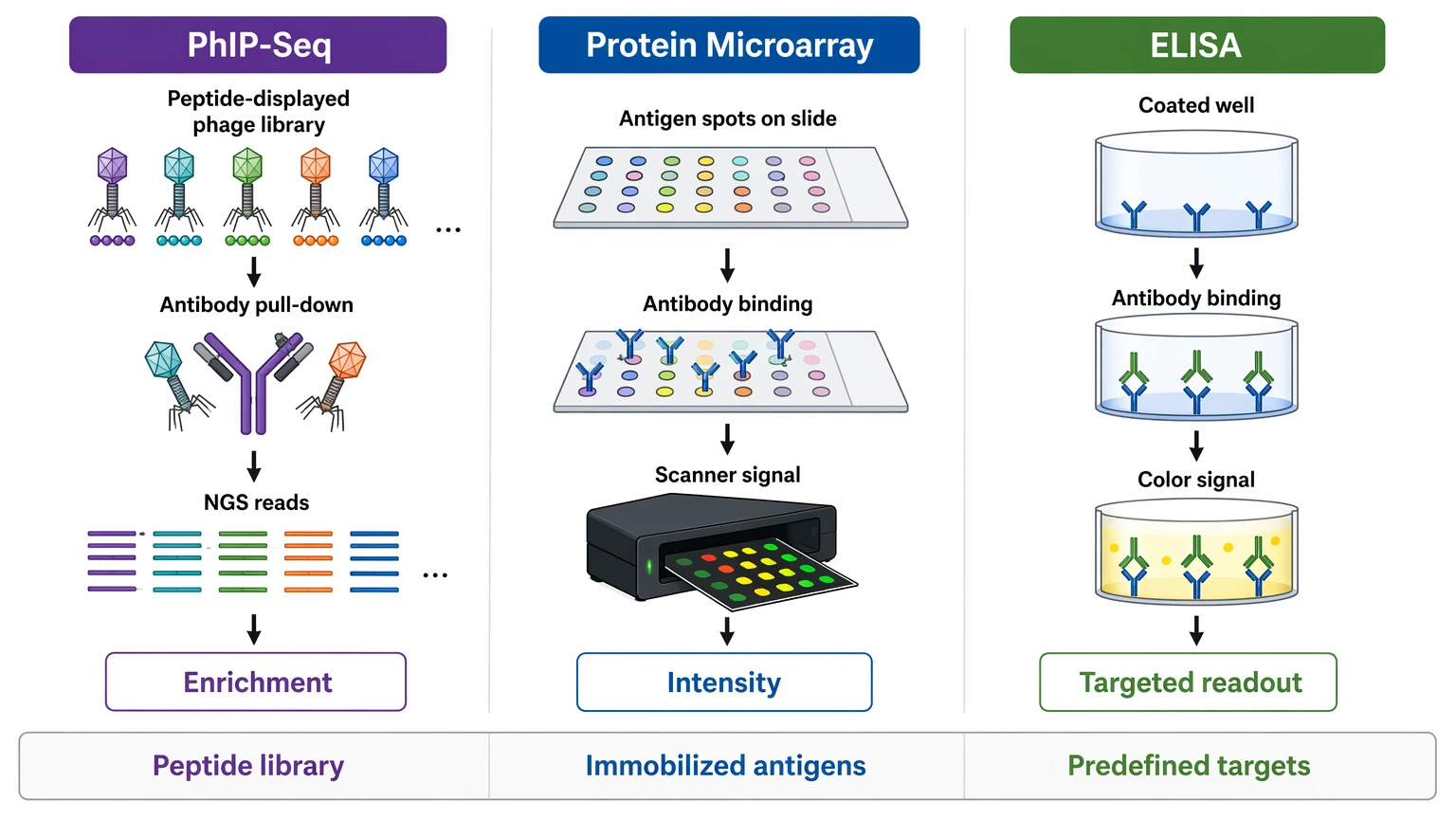
Readout and Quantitation Are Not the Same Thing
PhIP-Seq output is built on enrichment analysis after next-generation sequencing. The signal reflects which peptide library members are preferentially recovered after immunoprecipitation. That is powerful for ranking candidate reactivities, but it is not the same as calibrated absolute quantitation.
Protein microarray produces signal intensity values that are useful for comparing relative binding across a defined antigen panel. ELISA usually gives the most familiar targeted readout, often as optical density or another assay-specific quantitative format. Teams should not project ELISA-style quantitation expectations onto PhIP-Seq data, because sequencing enrichment and calibrated targeted measurement answer different questions.
Related Services
Main Service |
Supporting Service |
Validation Service |
Alternative Service |
Side-by-Side Comparison
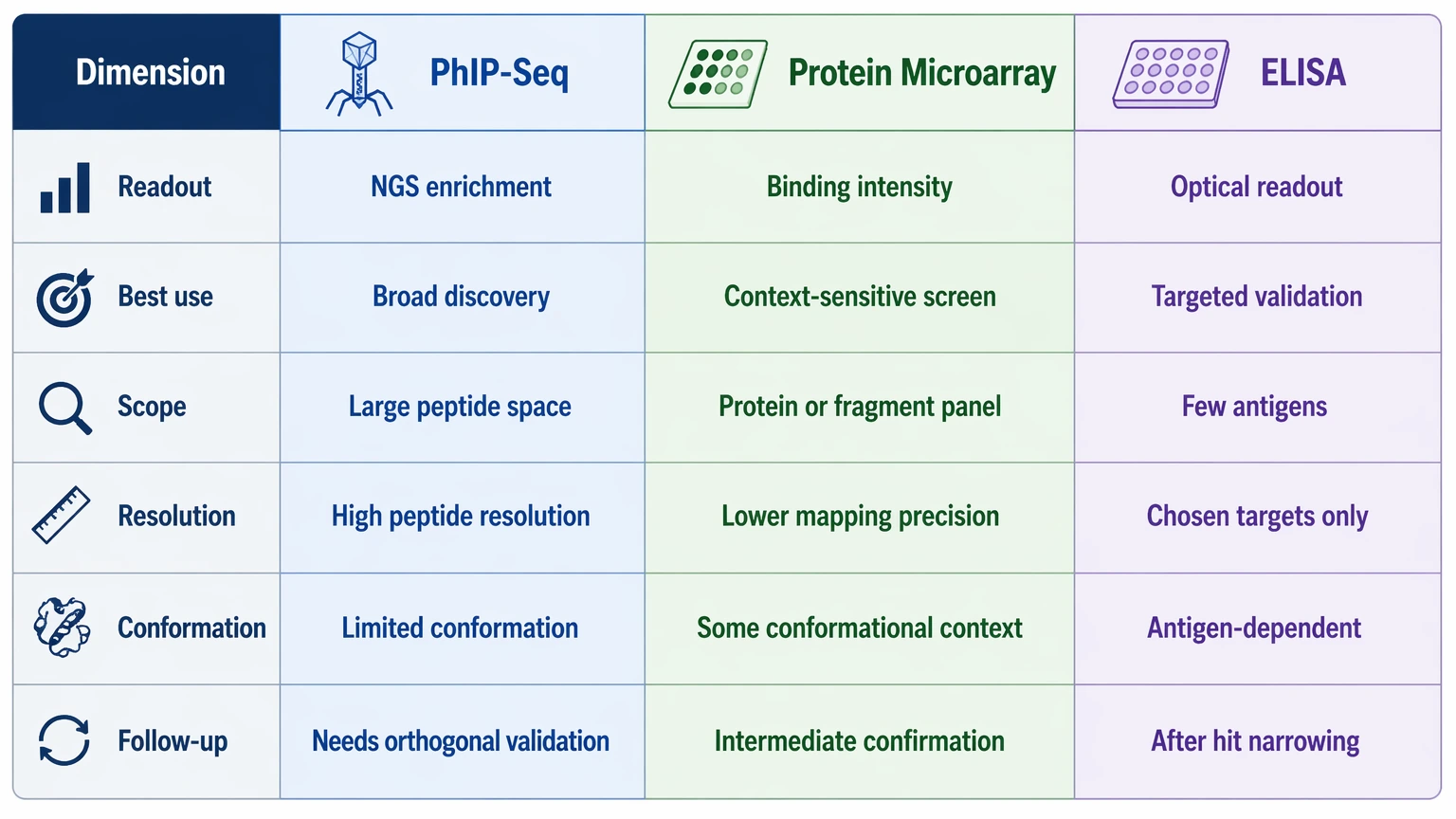
| Dimension | PhIP-Seq | Protein Microarray | ELISA |
|---|---|---|---|
| Core readout | Enrichment analysis after immunoprecipitation plus next-generation sequencing | Signal intensity from antibody binding to immobilized antigen content | Optical or assay-specific readout for predefined antigens |
| Best use | Broad serological profiling and linear epitope discovery | Antigen-format-sensitive screening with broader protein context | Focused targeted validation |
| Content scope | Large phage-displayed peptide library or custom peptide panels | Defined panels of recombinant proteins or fragments | One or a few selected antigens |
| Epitope interpretation | High peptide resolution | Better antigen context, lower mapping precision | Confirms chosen targets rather than discovering new ones |
| Conformational epitope coverage | Limited by peptide display format | May capture some conformational features, depending on content design | Depends on antigen design but remains targeted |
| Follow-up need | Commonly requires orthogonal validation | Often useful as an intermediate confirmation layer | Usually used after hit narrowing |
Throughput, Sample Use, and Data Burden
All three methods can support organized study execution, but their operational demands differ. PhIP-Seq is well suited to cohort-scale screening, especially when the study needs broad peptide content. The tradeoff is analytical complexity. Teams need a plan for background normalization, replicate concordance, enrichment analysis, and hit prioritization before they start interpreting candidate signals.
Protein microarray can also handle medium to large cohorts, but printed content quality, batch comparability, and normalization strategy strongly influence downstream confidence. ELISA is easier to standardize for small target panels, yet it becomes inefficient if teams try to stretch it into broad discovery across many antigens.
Sample budgeting should follow the study sequence. A discovery assay that consumes most of the available serum can leave too little material for protein-format follow-up or targeted confirmation. If your study still needs platform selection support, contact MtoZ Biolabs to evaluate your project and align sample allocation with the discovery-to-validation plan.
Interpretation Limits That Shape Follow-Up
A positive result does not mean the same thing across these platforms. In PhIP-Seq, enrichment points to peptide sequences that were selectively recovered from the peptide library. That can reveal strong linear epitope candidates, but it does not by itself prove persistent binding to the intact protein or to a native-like antigen format.
Protein microarray shifts the question. A positive array signal may support binding in a broader antigen context, but it is still shaped by immobilization chemistry and antigen preparation. ELISA provides the narrowest but often most direct confirmation for a predefined target. Those differences matter because they determine what kind of orthogonal validation is needed before the study makes stronger biological claims.
A Practical Selection Framework
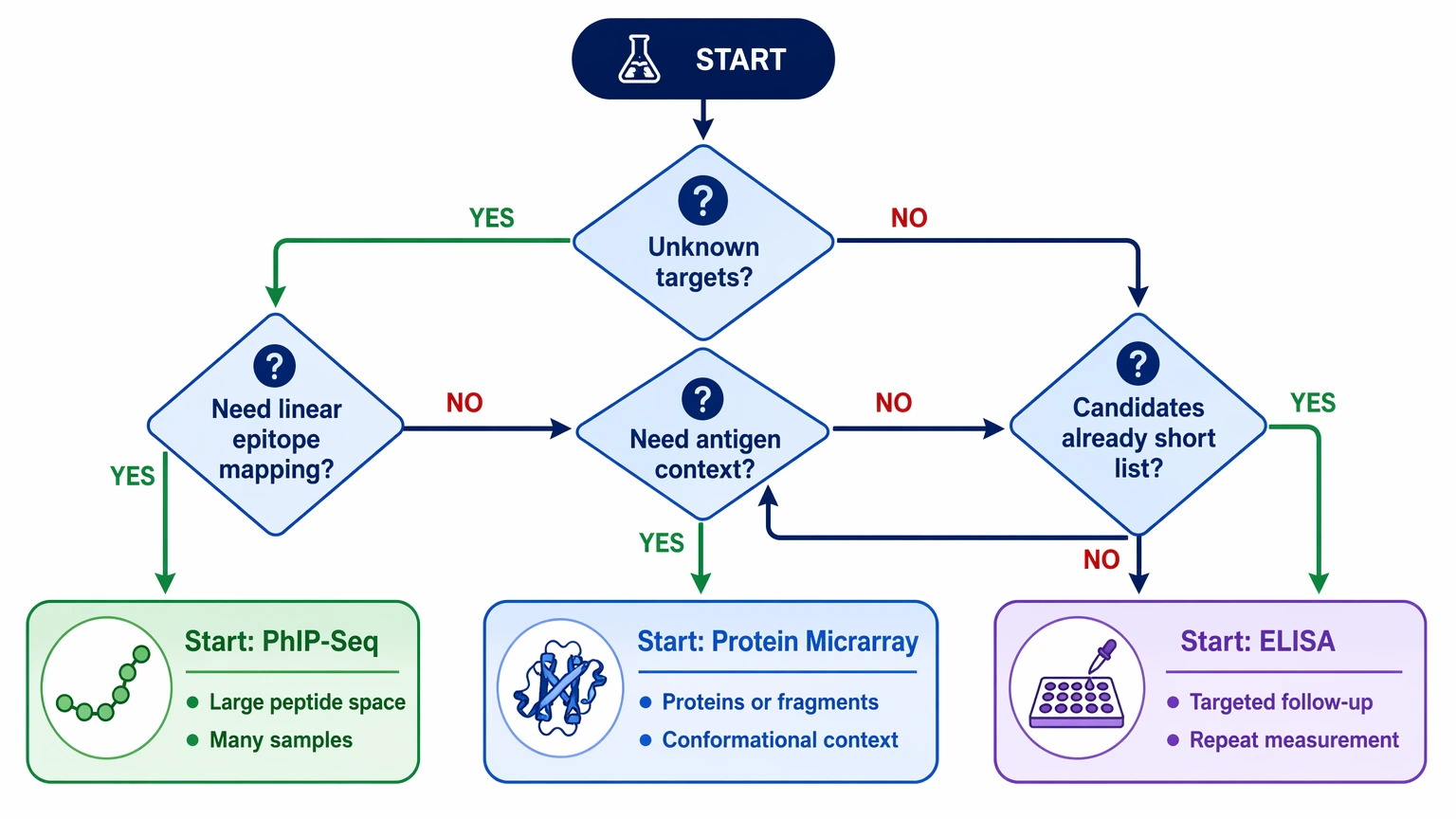
Start with PhIP-Seq for broad linear epitope discovery
Use PhIP-Seq first when the study begins with uncertainty about relevant antibody targets and needs large-content discovery across many samples. It is especially useful when linear epitope mapping, custom peptide coverage, or peptide-level reactivity ranking is central to the decision.
Start with protein microarray when antigen format is part of the hypothesis
Choose protein microarray first when the project needs earlier visibility into binding against recombinant proteins or larger antigen fragments. This is often the better entry point when conformational epitope questions are likely to shape interpretation.
Start with ELISA only after candidates are defined
Use ELISA as the primary assay only when discovery has already narrowed the target set. It fits repeat follow-up measurements, cross-batch confirmation, and focused targeted validation. It does not fit open-ended screening across a large antigen space.
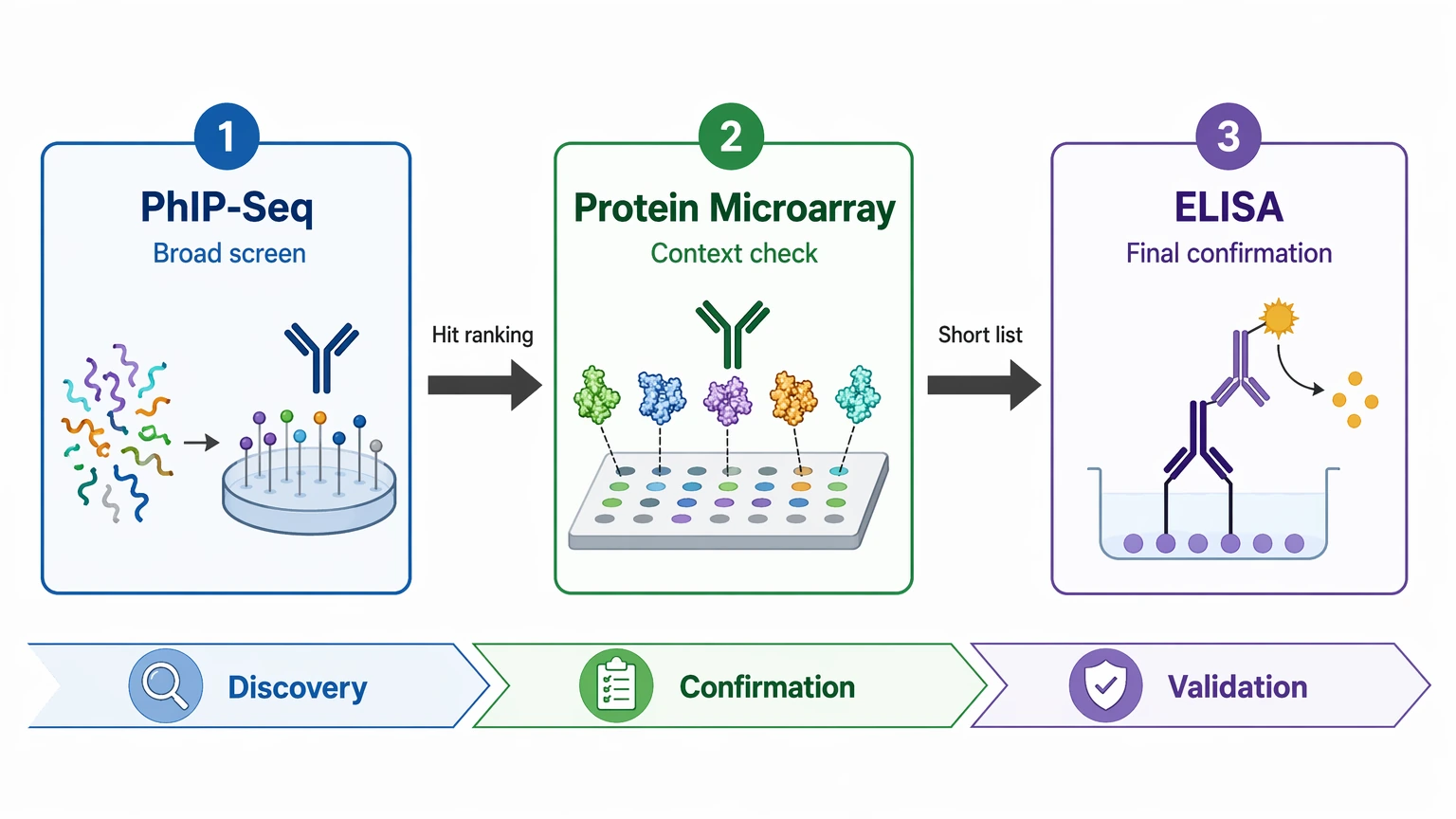
Combine platforms when discovery and confirmation are both required
Many studies work better as a staged design than as a single-method commitment. PhIP-Seq can screen broadly, protein microarray can test whether hits persist in a broader antigen context, and ELISA can support final confirmation on a short list. If your team is planning that transition, submit your requirements to MtoZ Biolabs to evaluate your project, review orthogonal validation options, and align the assay order before samples are committed.
Technical Summary and Consultation Guidance
For large-scale epitope profiling, PhIP-Seq is usually the strongest opening choice for broad peptide-space discovery, protein microarray is often more informative when antigen context matters earlier, and ELISA is best suited to focused follow-up after hit prioritization. The most practical workflow usually follows study phase: discovery first, context-aware confirmation second when needed, and targeted validation last. This sequence fits translational cohort studies, autoantibody discovery programs, and serological profiling projects that must balance breadth, interpretation limits, and sample use. When comparing options, prepare your cohort size, sample type, target scope, and follow-up goals in advance so the assay plan matches the actual decision point.
FAQ
Is PhIP-Seq a discovery tool, a validation tool, or both?
It is mainly a discovery tool for large-content antibody profiling. It can support internal hit ranking, but most studies still need orthogonal validation before peptide enrichment is treated as antigen-level confirmation.
When is a custom peptide library more useful than a protein microarray panel?
A custom peptide library makes more sense when the study asks sequence-centered questions, such as tiling across pathogens, isoforms, mutations, or candidate linear epitope regions that are not well represented by standard protein panels.
Can a negative ELISA result rule out a PhIP-Seq hit?
Not necessarily. A negative ELISA may reflect antigen format differences, coating effects, or loss of the specific peptide context that drove the original PhIP-Seq enrichment.
What planning detail is most often missed in large PhIP-Seq studies?
Teams often underestimate the time needed for hit prioritization rules, replicate concordance checks, and follow-up assay design. Those analysis choices should be set before the cohort screen begins.
When should a project skip protein microarray and go directly from PhIP-Seq to ELISA?
That shortcut can work when the biological question is clearly peptide-centered and the team only needs targeted confirmation for a small set of linear epitope candidates.
How many platform phases should a study budget for?
Most large discovery studies should budget for at least two phases: broad screening and targeted confirmation. A third phase becomes useful when peptide hits must be tested in a broader protein context before final follow-up.
How to order?




