






Peptide Epitope Substitution Scans Service
MtoZ Biolabs employs high-throughput peptide array and site-specific amino acid substitution platforms to offer the peptide epitope substitution scans service enabling systematic evaluation of how each amino acid residue within a peptide sequence affects epitope recognition and binding capacity. This service is widely applied in antibody binding mechanism analysis, key residue identification, and peptide drug optimization, providing reliable data to accurately define functional core sites and support rational molecular design.
What Is Epitope Substitution Scan?
Epitope substitution scan is a fine-mapping strategy that assesses the impact of substituting individual amino acid residues within a peptide sequence on epitope recognition. This approach commonly uses point mutations or one-by-one replacement methods (such as alanine scanning) to generate a series of peptides altered at only a single position, comparing their binding differences with antibodies or receptors to identify critical residues and evaluate their functional importance. This method facilitates rapid localization of core amino acids, elucidates structure-function relationships within peptide epitopes, and provides experimental evidence for peptide drug design and optimization.
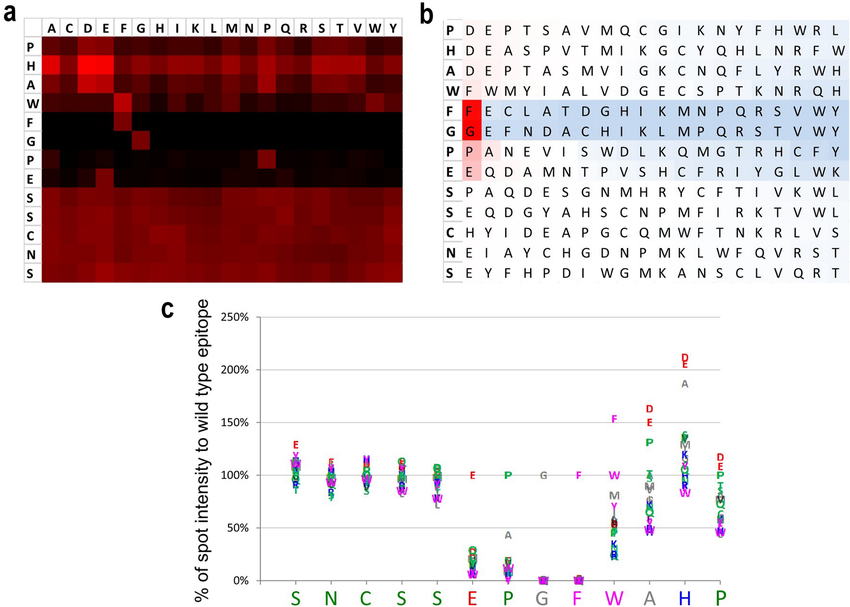
Wei, S H. et al. Scientific Reports, 2022.
Figure 1. Epitope Substitution Assay.
Peptide Epitope Substitution Scans Service at MtoZ Biolabs
1. Single-Residue Epitope Substitution Scan
MtoZ Biolabs performs systematic single-position amino acid substitutions within epitope peptide sequences, such as alanine scanning, to evaluate how each residue affects antibody or receptor binding. This approach enables precise identification of essential functional residues and core interaction sites, clarifying which amino acids are critical for epitope recognition.
2. Double-Residue Epitope Substitution Scan
Building on single-site analysis, MtoZ Biolabs conducts paired amino acid substitution testing to examine synergistic or compensatory effects between two residues. By comparing binding changes across different double-substituted peptides, this analysis provides a more comprehensive understanding of conformational dependencies and fine-scale regulatory features within the epitope.
Workflow of Peptide Epitope Substitution Scans Service
1. Peptide Sequence Design and Substitution Strategy Development
Design systematic single-substitution or double-substitution peptide libraries based on the target epitope sequence, defining the types of amino acid replacements and the scanning range.
2. Peptide Synthesis and Array Construction
Prepare substituted peptides in batches through solid-phase synthesis or array platforms, and immobilize them in a high-density format on chips or membranes for subsequent screening.
3. Binding Reaction Detection
Incubate antibodies or receptors with the substituted peptide array and detect changes in binding capacity of different peptides through fluorescence, chemiluminescence, or enzyme-linked signal readouts.
4. Data Analysis and Key Residue Identification
Calculate binding differences between substituted peptides and the original peptide, identify key residues, synergistic positions, or sensitive regions, and generate substitution-scan heatmaps and epitope mode
Why Choose MtoZ Biolabs?
✅ High-precision localization: Systematic substitution strategies can accurately identify key residues and sensitive positions.
✅ High-throughput efficiency: A large number of substituted peptides can be evaluated simultaneously, greatly accelerating the analysis process.
✅ Methodological stability: A standardized array-based screening system ensures stable and reproducible signal output.
✅ Flexible substitution design: Supports single substitution, double substitution, and multiple types of amino acid replacements across different dimensions.
✅ One-stop service: Covers the entire process from peptide design, substitution array construction, detection, data analysis, to result interpretation.
Applications of Peptide Epitope Substitution Scans Service
1. Antibody Recognition Research
Used to systematically evaluate how antibodies respond to different amino acid substitutions, helping to understand their recognition preferences and binding range.
2. Immune Recognition Feature Analysis
Supports researchers in analyzing sequence sensitivity of antigenic peptides in immune recognition and assessing the impact of sequence variations on response signals.
3. Protein Key Residue Evaluation
Used to identify core residues that affect binding signals, providing foundational data for studying functional regions of proteins.
4. Molecular Interaction Exploration
By observing signal changes during substitution scans, provides sequence-level reference for peptide-mediated antibody-antigen and other molecular interactions.
5. Sequence Variation Impact Assessment
Used to simulate natural or engineered sequence variations and analyze their fundamental impact on binding capacity or recognition signals.
Deliverables
1. Comprehensive Experimental Details
2. Materials, Instruments, and Methods
3. Amino acid Substitution Scan Result table
4. Substitution Scan Heatmaps, Signal Distribution Plots, and Other Visualization Files
5. Bioinformatics Analysis
6. Comprehensive Analysis Report
7. Raw Data Files
FAQ
Q1: What types of samples are suitable?
A1: This service is suitable for multiple sample types, including antibodies, purified proteins, recombinant proteins, and cell-derived antigen materials. To ensure the accuracy of substitution scan results, high-purity samples free of salt, detergents, and other interfering substances, and with stable structural integrity, are recommended.
Q2: What is the service general workflow?
A2:

Q3: What data formats are provided?
A3: The deliverables include several standardized formats, including:
-
Substitution scan result table (Excel format)
-
Heatmaps, signal distribution plots, and other visualization images (TIFF or PNG format)
-
Raw array or signal files (depending on the experimental platform)
-
Comprehensive analysis report (PDF), including experimental workflow, data interpretation, and conclusions
If special analytical requirements exist, data formats can be customized according to project specifications.
Q4: How should I prepare my samples?
A4: To ensure experimental quality, the following preparation guidelines are recommended:
(1) Sample purity: avoid interference from high salt, strong buffers, detergents, or precipitates
(2) Storage conditions: for short-term storage use -20℃, and for long-term storage use -80℃
(3) Shipping method: transport on cold chain or dry ice, keep sealed, and avoid repeated freeze-thaw cycles
(4) Additional information: provide sample concentration, source, antibody or antigen type, and research objectives to support optimization of the substitution scan design
For more information, please refer to Sample Submission Guidelines for Proteomics, Sample Submission Guidelines for Metabolomics.
Start Your Project with MtoZ Biolabs
Contact us to discuss your experimental design or request a quote. Whether you are exploring the sensitivity changes of critical epitopes or investigating how specific residue substitutions affect binding characteristics, MtoZ Biolabs can provide you with precise and reliable substitution scan analysis support.
How to order?




