






Peptide Drug-Drug Interaction Study Service
MtoZ Biolabs provides Peptide Drug-Drug Interaction Study Service to support the safe and effective development of peptide therapeutics. This service focuses on evaluating how peptide drug candidates interact with major metabolic enzymes and transporters that influence pharmacokinetics and clinical performance.
Background
Peptide Drug-Drug Interaction assessment is an essential component of modern peptide drug development. As peptide-based therapeutics grow in complexity and clinical relevance, the potential for metabolic or transporter-mediated interactions must be thoroughly characterized during early and late development stages. Regulatory authorities expect clear evidence demonstrating whether a peptide candidate inhibits or induces key enzymes, competes with other drugs for metabolic clearance, or alters transporter-mediated movement across biological barriers. These evaluations help predict clinical exposure changes, guide dose optimization, improve study design, and reduce development risk.
Peptide-based drugs differ from small molecules in structure, stability, and biotransformation behavior, yet many still interact with cytochrome P450 enzymes, UDP-glucuronosyltransferases, esterases, oxidases, and transporters. Understanding these interactions allows researchers to identify safety liabilities, prioritize candidate molecules, and avoid failures in downstream development.
Principle of Peptide Drug-Drug Interaction
The scientific basis of drug-drug interaction evaluation lies in understanding how drugs influence each other’s absorption, distribution, metabolism, and excretion. For peptide therapeutics, this includes interactions driven by metabolic enzymes, conjugation pathways, peptide-modifying activities, and transporter-mediated mechanisms.
1. Enzyme-Mediated Interactions
Metabolism-based drug-drug interactions occur when a peptide inhibits or induces enzymes responsible for the clearance of co-administered compounds. Relevant enzyme families include:
- Cytochrome P450 enzymes (CYP)
- UDP-glucuronosyltransferases (UGT)
- Flavin monooxygenases (FMO)
- Monoamine oxidases (MAO)
- Carboxylesterases (CES)
- Aldehyde oxidases (AOX)
- N-acetyltransferases (NAT)
These enzymes contribute to peptide modification, degradation, or clearance. If the investigational peptide inhibits a specific isoform, it may delay the metabolism of another drug, increasing clinical exposure. Conversely, enzyme induction may reduce exposure, lowering therapeutic efficacy.
2. Transporter-Mediated Interactions
Transporters regulate the movement of peptides and metabolites across cell membranes. Understanding whether a peptide is a substrate, inhibitor, or inducer of transporters allows prediction of absorption, tissue distribution, and elimination outcomes. Transporter classes include:
- Efflux transporters
- Uptake transporters
- Membrane vesicle transporters
- Solute carrier transporters
If a peptide drug blocks a transporter used by another therapeutic agent, accumulation or inadequate clearance may occur. These interactions are particularly important for kidney clearance, hepatic uptake, and blood brain barrier passage.
Peptide Drug-Drug Interaction Study Service at MtoZ Biolabs
💠CYP Inhibition Assessment Service
This service evaluates whether a peptide drug inhibits specific cytochrome P450 isoforms. We employ recombinant CYPs, human liver microsomes, and hepatocyte systems to determine IC50 values, Ki parameters, and mechanistic inhibition profiles. These studies identify potential risks for elevated exposure of co-administered drugs.
💠UGT Inhibition Assays Service
UGT inhibition testing assesses how peptide drugs influence conjugation pathways involved in detoxification, metabolism, and clearance. These assays help determine whether the peptide disrupts glucuronidation processes that regulate drug or metabolite elimination.
💠Enzymes Inhibition Determination Service
This broad category covers inhibition testing for metabolic enzymes beyond CYP and UGT, including: FMO, MAO, CES, AOX, and NAT. These enzymes are often involved in peptide degradation or structural modification. Understanding their inhibition profiles prevents unexpected metabolic interactions during clinical use.
💠CYP Induction Assessment Service
Induction assays identify whether peptide drugs upregulate CYP isoforms and accelerate the metabolism of other therapies. We evaluate mRNA expression, enzyme activity, and stability changes in primary hepatocyte systems.
This service uncovers induction-driven changes in glucuronidation capacity. These results help predict reduced exposure to co-administered drugs and support dosage refinement.
Why Choose MtoZ Biolabs
✔️Extensive Experience
Our team has extensive experience with peptide biotransformation pathways, including proteolysis, conjugation, and transporter-dependent clearance.
✔️High Sensitivity Analytical Systems
Advanced LC-MS/MS instruments ensure accurate detection of metabolites and reaction products.
✔️Flexible Study Designs
Customizable workflows allow evaluation of peptides of varying size, structure, and clinical relevance.
✔️One-Time-Charge
Our pricing is transparent, no hidden fees or additional costs.
Applications of Peptide Drug-Drug Interaction Study Service
Peptide drug-drug interaction evaluation is relevant across multiple development stages and research objectives.
- Prediction of metabolic liabilities
- Optimization of peptide drug dosing regimens
- Identification of transporter-mediated absorption barriers
- Evaluation of clinical drug combination strategies
- Regulatory submission preparation
- Pharmacokinetics and safety correlation
FAQ
Q1: What types of samples are suitable?
Suitable sample types include:
- Purified peptide drug candidates in solution or powder form
- Formulated peptide products intended for interaction testing
- Peptide reference standards when available
Q2: How should I prepare my samples?
Please follow these preparation guidelines:
- Ensure samples are dissolved in a compatible solvent such as water, buffer, or approved organic solvents
- Filter or centrifuge samples to remove particulates before shipping
- Provide concentration information and solubility data
- Avoid freeze-thaw cycles to maintain sample integrity
- Package samples in leak-proof, clearly labeled containers
For sensitive peptides:
- Store and ship samples on dry ice
- Include any available stability data or recommended handling instructions
For more information, please refer to Sample Submission Guidelines for Proteomics and Sample Submission Guidelines for Metabolomics.
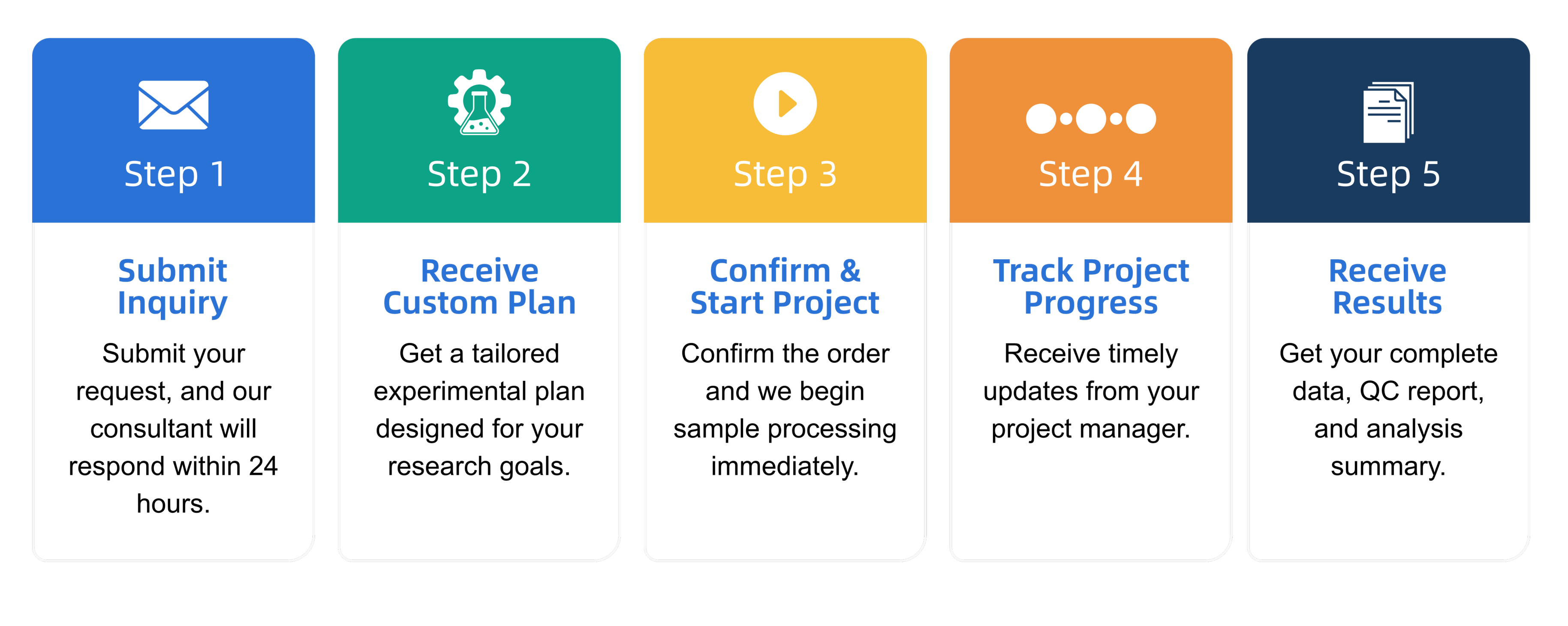
Q3: What is the service general workflow?
Q4: What data formats are provided?
1. PDF reports summarizing experimental design, kinetic findings, and interaction interpretation
2. Raw and processed LC-MS/MS data in formats such as RAW, mzML, or mzXML
3. Quantitative results and kinetic parameters including IC50 and Ki values in Excel or CSV format
4. Chromatograms and spectra in high-resolution PNG or TIFF formats
5. Additional data formats can be provided upon request to support specific analysis or publication requirements.
Start Your Project with MtoZ Biolabs
Peptide drug-drug interaction studies are essential for predicting clinical risks, designing safe dosing strategies, and supporting regulatory approval. MtoZ Biolabs offers a complete range of enzyme and transporter interaction assays specifically tailored for peptide therapeutics.
If you are interested in our service, please feel free to contact us.
Supporting Antibody Products for Protein Interaction Studies
MtoZ Biolabs offers antibody products for IP, Co-IP, IP-MS, and related protein interaction workflows, complementing protein interaction analysis services and supporting target enrichment and downstream mass spectrometry analysis.
IP-MS Validated Antibodies
Explore antibodies evaluated for target enrichment and downstream mass spectrometry applications, with product information available to support antibody selection.
View IP-MS Validated AntibodiesOther Supporting Products
How to order?




