






Monoclonal Antibody Sequencing for Legacy Antibody Redevelopment and Biosimilar Reference Work
When original records are missing, inconsistent, or were never transferred, monoclonal antibody sequencing by de novo protein sequencing with LC-MS/MS can recover interpretable heavy chain and light chain information directly from the protein. For redevelopment teams, the practical question is not simply whether some peptides are detectable, but whether the available material can support a defensible variable region sequence hypothesis, especially across each complementarity-determining region (CDR).
Decision snapshot
- Choose de novo monoclonal antibody sequencing when the exact antibody sequence is unknown and database search cannot confirm the variable region.
- A project is a better fit when the sample can support multi-enzyme digestion, replicate LC-MS/MS runs, and follow-up review of uncertain positions.
- The outputs that usually matter most for decision-making are sequence coverage by chain, direct evidence in CDR-containing peptides, intact mass analysis or subunit analysis consistency, and a clear list of unresolved sites.
- Sequence reconstruction can support legacy antibody redevelopment and biosimilar reference work, but it does not by itself prove function, sameness, or regulatory comparability.
Where legacy and externally sourced antibody projects get stuck
This issue often shows up after licensing, portfolio transfer, publication follow-up, old hybridoma recovery, or purchase of a commercial reference antibody. A team may receive a purified vial, a formulated product, or aged material with only partial documentation. The records may list an isotype, target, or clone name, but not a verified heavy-chain and light-chain sequence.
That missing information quickly becomes a planning problem. Moving straight into recombinant re-expression without sequence recovery can lead to the wrong construct. Relying only on historical notes can carry earlier annotation errors forward. Waiting for perfect documentation is rarely a workable option when the original cell line, notebooks, or archived sequence files are no longer available.
For biosimilar reference work, the threshold is different but still centered on sequence. The goal is often not to recreate the reference antibody, but to understand what can reasonably be inferred about framework usage, CDR composition, isotype context, glycosylation, and molecular heterogeneity before broader benchmark interpretation starts.
Why records and database search often do not answer the sequence question
Three issues usually drive the decision.
First, legacy records are often incomplete or difficult to transfer. Clone identifiers and species information do not define the exact amino acid sequence needed for redevelopment.
Second, database-search limitation is a real constraint for unknown antibodies. A database search works best when the target sequence is already present in a trusted reference set. When the antibody is unpublished, proprietary, or inconsistently documented, germline similarity can guide interpretation, but it cannot replace de novo peptide interpretation.
Third, sample state directly affects sequence confidence. Formulation components, oxidation, deamidation, clipping, and other post-translational modifications (PTMs) can change peptide observability or complicate assignment of an MS/MS spectrum. In addition, leucine/isoleucine ambiguity remains a known limitation in conventional mass spectrometry, so some residue calls may still need orthogonal confirmation when they matter to redevelopment decisions.
When de novo monoclonal antibody sequencing is the right next step
De novo work becomes the right path when the project needs direct evidence from the antibody protein rather than indirect inference from paperwork or partial matches. Common fit-for-purpose scenarios include:
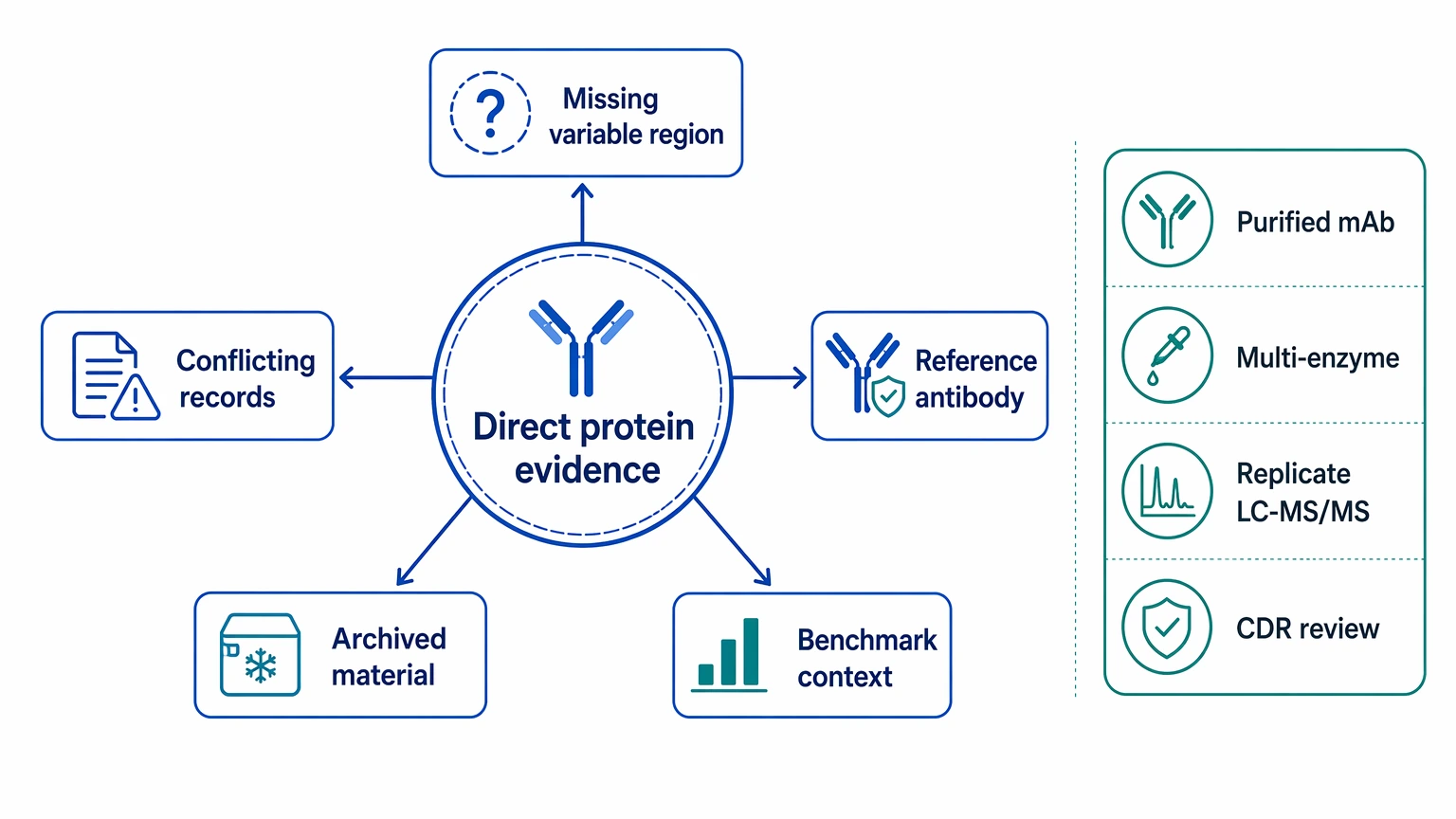
- a legacy antibody with missing variable region records
- an externally transferred monoclonal antibody with conflicting historical annotations
- a purchased reference antibody used for benchmark characterization
- an archived material set that must be evaluated before recombinant re-expression
- a benchmarking study where sequence-informed context is needed, but manufacturing claims are out of scope
The best starting material is a purified intact monoclonal antibody with known concentration, formulation details, and storage history. Reduced chain preparations can also be useful, especially when chain-resolved interpretation is needed. Partially degraded or heavily formulated samples may still be workable, but the likely outcome should be framed more conservatively at the outset.
How to plan the project around redevelopment or reference goals
For a problem-solution article in this setting, the most useful structure is a planning sequence rather than a generic method list.
Step 1: Define the decision the sequence must support
Separate three milestones that are often blurred together:
- sequence reconstruction
- readiness for recombinant re-expression
- bounded interpretation for biosimilar reference work
If the goal is redevelopment, the sequence must be solid enough to support candidate construct design with documented residual uncertainty. If the goal is benchmark use, the output may instead be a sequence-informed characterization package that clarifies what the reference material can and cannot represent.
Service Routes to Consider
For this project scenario, readers usually compare these service routes before requesting a quote or submitting samples.
Step 2: Check sample suitability before committing material
The sample amount should match the evidence goal. Deep antibody reconstruction often benefits from disulfide reduction, enzymatic digestion with more than one protease, repeat LC-MS/MS acquisition, and targeted follow-up. A very limited vial may support triage, but not full reconstruction plus confirmation.
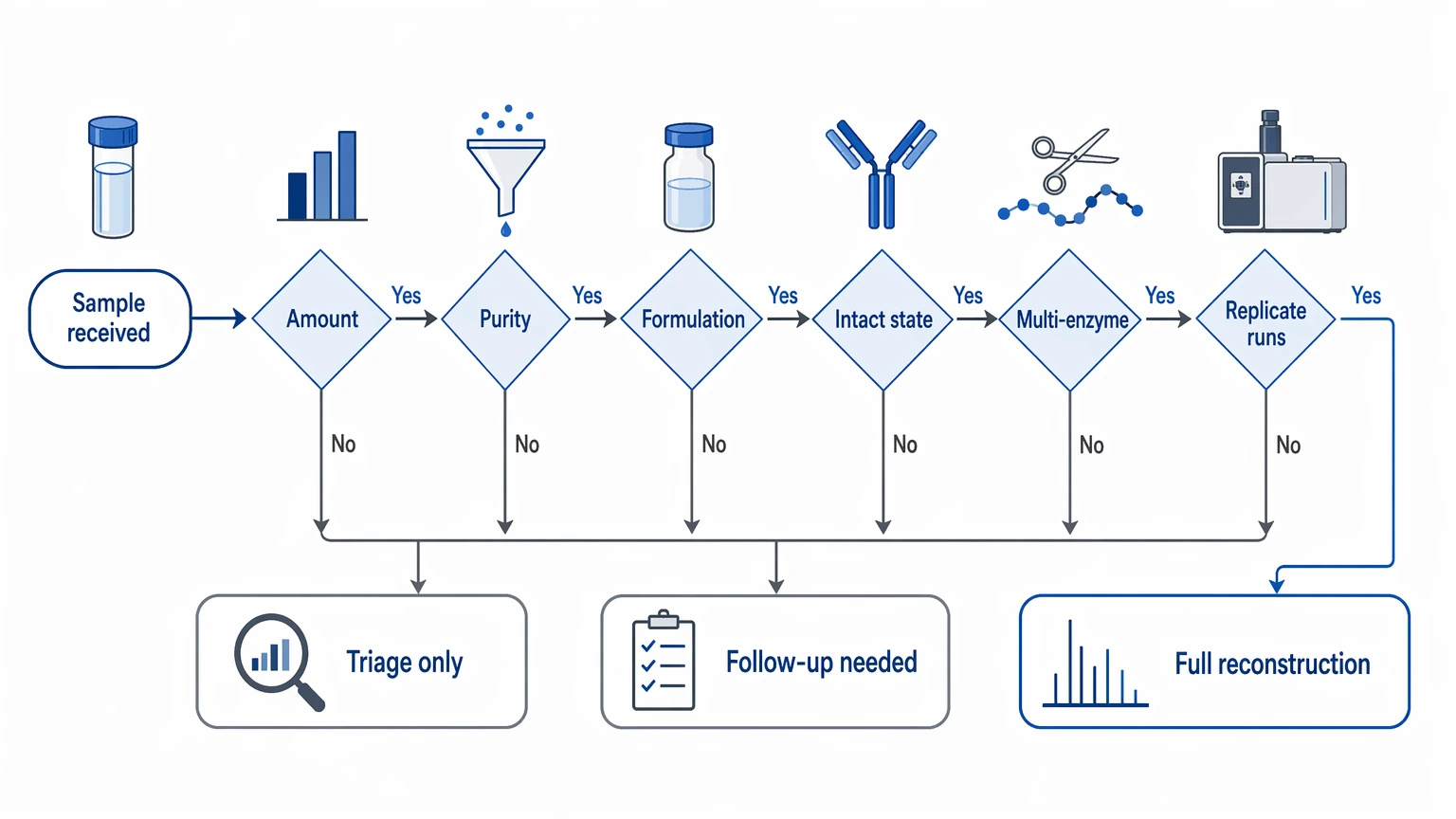
A practical screening review should ask:
- Is the antibody purified or heavily formulated?
- Is enough material available for multi-enzyme digestion?
- Is the sample intact enough for intact mass analysis or subunit analysis?
- Is the project focused on redevelopment, reference interpretation, or both?
If your team is unsure whether a limited sample can support chain reconstruction and CDR-focused review, you can submit your requirements to MtoZ Biolabs to evaluate your project against sample form, amount, formulation history, and intended use.
Step 3: Prioritize evidence in the variable region
A headline sequence coverage percentage is not enough. What matters is where that evidence sits. The key questions are whether the framework region and each CDR are directly observed, how dense the supporting peptide evidence is, and whether the heavy chain and light chain assemblies agree with chain-level mass measurements.
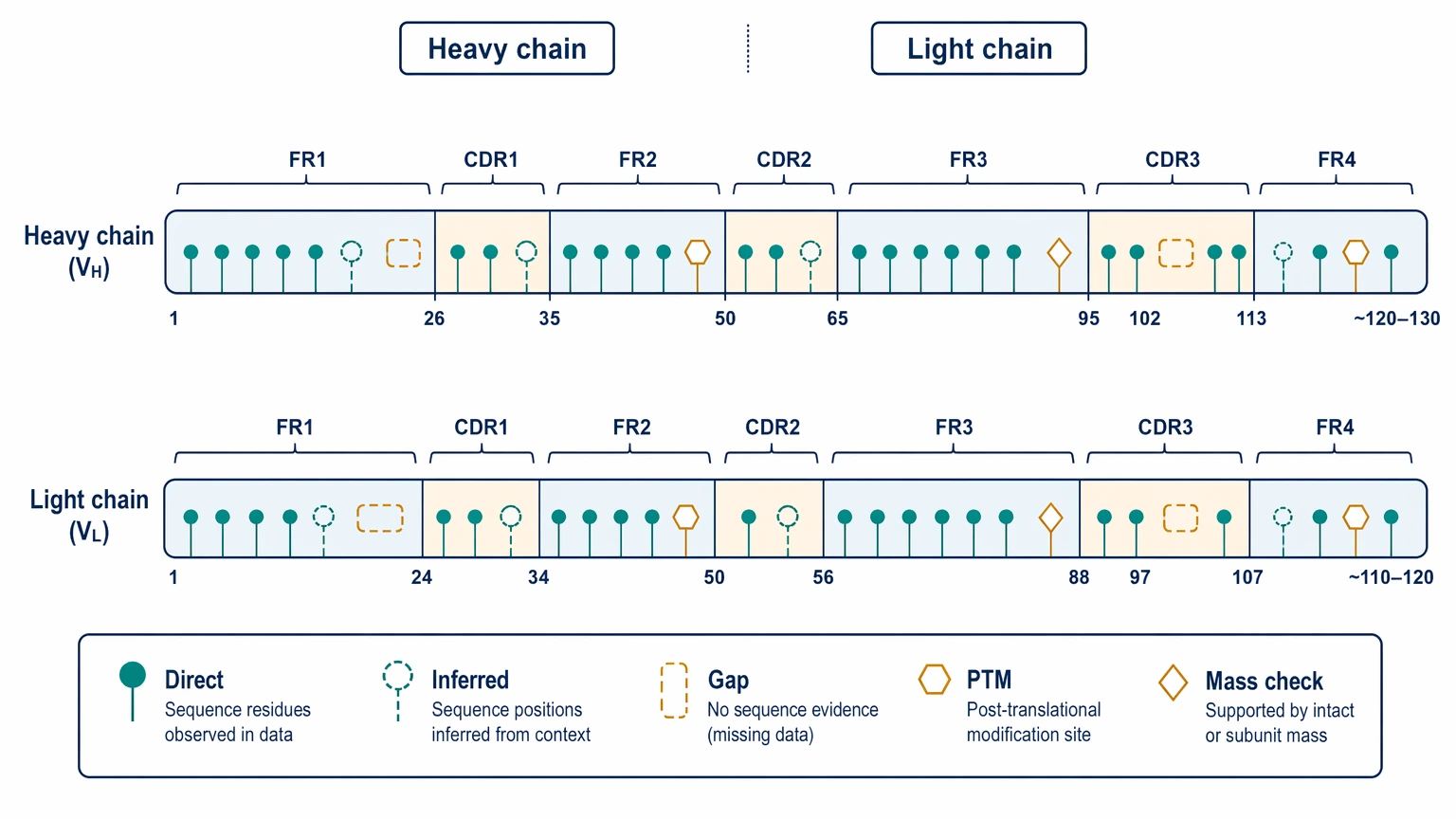
Useful metrics include:
- sequence coverage by heavy chain and light chain
- distribution of high-confidence peptide-spectrum match evidence
- direct versus inferred sequence assignment in CDR1, CDR2, and CDR3
- agreement between proposed sequence, intact mass analysis, and subunit analysis
- PTM-rich regions that affect interpretation
- unresolved leucine/isoleucine ambiguity positions
Step 4: Match the output to project risk
For redevelopment, uncertain CDR residues or unpaired sequence hypotheses can block confident construct design. For reference work, the same uncertainty may still allow a useful benchmark interpretation if the report clearly marks what is observed, what is inferred, and what remains unresolved.
Expected results and validation methods
The immediate deliverables from a successful monoclonal antibody sequencing project should include a chain-resolved sequence hypothesis, region-by-region evidence summaries, and explicit confidence notes for each uncertain position. A useful report should also separate observed peptide support from assembly-level inference and identify where PTM burden, low signal, or peptide gaps limited interpretation.
Follow-up confirmation is a separate stage. It may include targeted review of uncertain residues, confirmation of N- or C-terminal assignments when relevant, and comparison of the proposed sequence against chain-level mass behavior. For redevelopment programs, the next milestone is whether the recovered sequence is strong enough to justify a candidate recombinant re-expression design. For reference workflows, the next milestone is whether the sequence supports bounded benchmark characterization without overstating identity.
One limitation should stay in view: even with strong LC-MS/MS evidence, some antibody regions may remain uncertain because of isobaric residues, incomplete CDR coverage, modification-rich peptides, or the fact that database search cannot verify an unknown sequence on its own.
Key cautions and practical limits
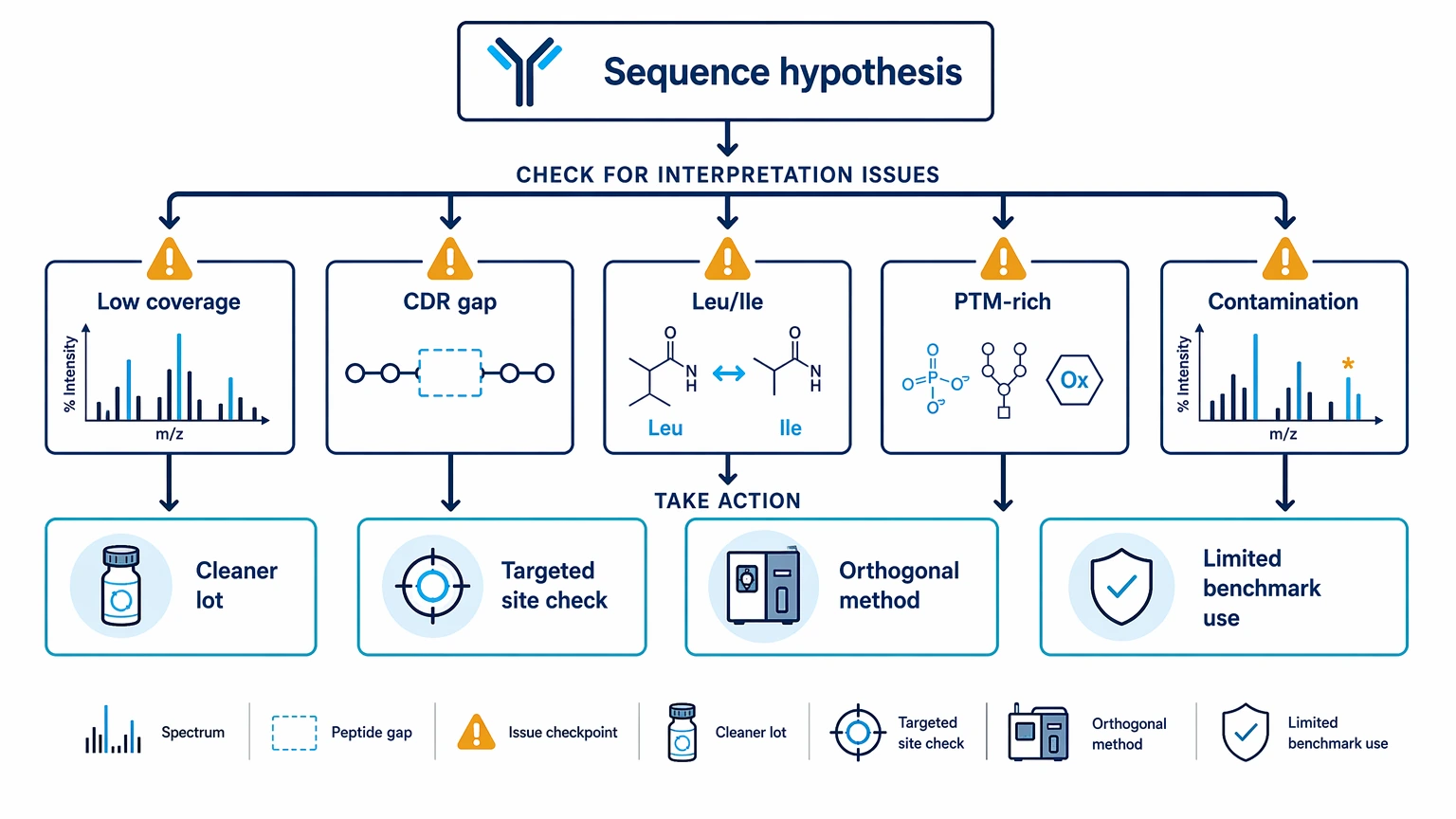
Sample quality and amount set the upper boundary for interpretation. Low-input material can force tradeoffs between broad discovery and targeted confirmation. Heavily stressed, clipped, or formulated antibodies may yield partial results rather than redevelopment-grade reconstruction.
Controls and repeat expectations also matter. Replicate runs help distinguish reproducible peptide evidence from isolated weak reads. When more than one lot is available, lot comparison can show whether a difference reflects true sequence variation or degradation.
Batch effects and contamination risk should be addressed early. Carryover, host-cell background, and formulation-derived interference can distort peptide mapping and de novo interpretation, especially in low-abundance regions.
Interpretation boundaries also need to stay explicit. Sequence reconstruction is not proof of retained binding, developability, or biosimilar comparability. In some projects, another next step makes more sense: obtain a cleaner lot, narrow the question to targeted site confirmation, or use an orthogonal method when a small set of residues is decision-critical.
For late-stage planning, contact us at MtoZ Biolabs to discuss the study if you need help deciding between full monoclonal antibody sequencing, targeted validation of uncertain sites, or a limited feasibility review for degraded or low-amount material.
Final decision guidance
For legacy antibody redevelopment and biosimilar reference work, monoclonal antibody sequencing is most useful when the real barrier is missing or untrusted sequence information rather than lack of general characterization. The decision should rest on whether the submitted material can support interpretable heavy-chain and light-chain reconstruction, meaningful CDR evidence, and a transparent accounting of uncertainty. In practical settings such as inherited antibody assets, purchased reference materials, and archived development samples, the strongest path is to pair sequence reconstruction with orthogonal validation and then decide whether the result is sufficient for re-expression planning, limited benchmark use, or a request for cleaner replacement material.
FAQ
What sample information is most helpful before a feasibility review?
Provide sample amount, concentration, formulation or buffer composition, storage history, known isotype, prior intact mass or peptide mapping data, and the intended decision point such as re-expression planning or benchmark characterization.
Can constant-region identification be strong even when the variable region is still uncertain?
Yes. Constant region assignment is often easier because those sequences are more conserved and better represented in references. That does not mean the variable region has been reconstructed with the same confidence.
How should leucine/isoleucine ambiguity affect redevelopment planning?
Treat those positions as explicit risk items. If an unresolved leucine/isoleucine call falls in a CDR or another design-critical site, orthogonal validation should be planned before construct finalization.
Does glycosylation prevent monoclonal antibody sequencing?
Not necessarily. Glycosylation can reduce peptide observability or complicate spectral interpretation in some regions, especially in Fc-containing peptides, but other parts of the sequence may still be recoverable with useful confidence.
When is a benchmark-focused project enough without full redevelopment-grade certainty?
A benchmark-focused project may be sufficient when the objective is to describe sequence-informed context, framework usage, proteoform heterogeneity, or likely CDR composition limits rather than to produce a final expression construct.
What is a sign that a new sample may be better than pushing further on the current one?
Severe degradation, weak variable-region peptide evidence, strong contamination background, or sample quantity too low for repeat analysis are common signs that replacing or supplementing the material may be more productive than extending interpretation.
How to order?




