






Lysosomal Proteomics vs Whole-Cell Proteomics
Introduction
Many lysosome-related studies begin with a methods fork. A team may already see lysosome pathway terms in whole-cell data and ask whether that is enough. Another team may plan organelle biology around storage disorders, autophagy, or membrane trafficking and need to decide whether bulk lysates can resolve the claim. The choice is not which platform is more advanced. The choice is which proteome best matches the biological question.
Lysosomal proteomics vs whole-cell proteomics is a decision about compartment focus. Bulk cellular analysis surveys proteins across the cellular mixture. Organelle-enriched analysis measures proteins recovered after lysosome enrichment and therefore emphasizes compartment-centered changes. This article compares the two approaches across practical dimensions and explains when each route fits.
What Each Approach Is Designed to Answer
Whole-cell analysis asks which proteins change in the overall cellular or tissue proteome under a defined condition. It is useful for broad pathway discovery, treatment-response mapping, and projects where lysosome biology is only one part of a larger cellular phenotype.
Lysosome-enriched analysis asks which proteins are recovered and changed in lysosome fractions. It is used when the claim depends on organelle cargo, lysosome-associated remodeling, or disease processes that are poorly resolved in bulk lysates.
Neither method proves organelle purity by protein identification alone. Enrichment improves organelle focus, while bulk data preserve a broader cellular context. The correct method is the one whose primary output matches the claim. Teams should also plan matched controls and consistent enrichment documentation when organelle comparisons are part of the study design.
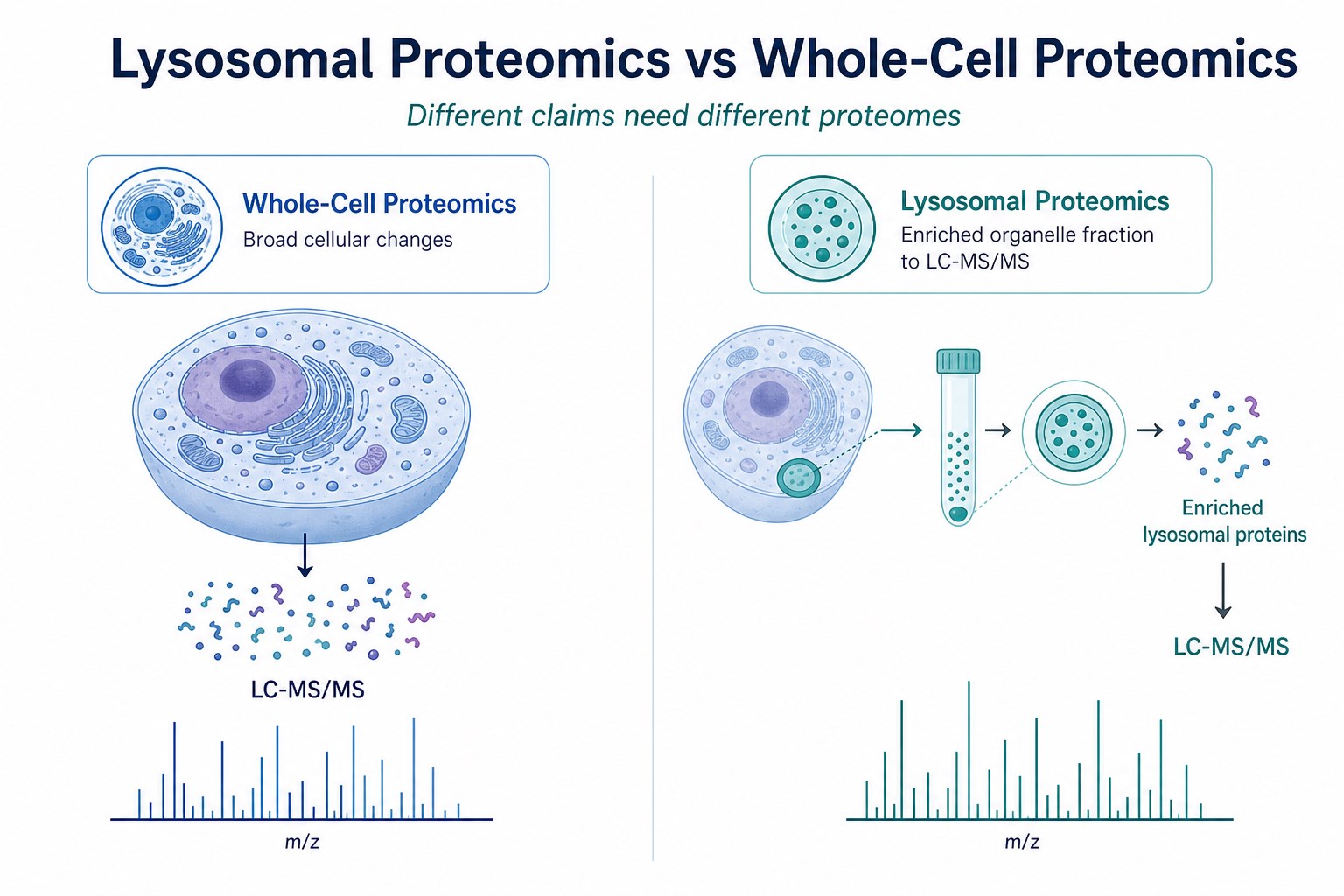
Figure 1. Bulk cellular proteomics captures broad changes, while lysosome-enriched proteomics focuses on proteins recovered from organelle fractions.
Core Comparison Dimensions
Biological claim
Choose bulk cellular proteomics when the primary question is global response. Choose lysosome-enriched proteomics when the primary question is organelle-centered composition or remodeling.
Compartment resolution
Whole-cell datasets mix compartments. Lysosome-associated proteins may appear, but their changes can be diluted or masked. Enrichment increases organelle focus, though residual contaminants can still remain.
Sample preparation burden
Bulk analysis usually needs standard protein extraction from cells or tissues. The enriched route adds isolation or requires submission of an already enriched fraction, which increases planning for input amount, buffer compatibility, and enrichment QC.
Sensitivity to low-abundance organelle proteins
Bulk analysis can miss or under-interpret low-abundance lysosomal proteins. Enrichment improves the chance of detecting those proteins when input and QC are adequate.
Interpretation limits
Whole-cell hits annotated to lysosome pathways are not the same as proteins measured in lysosome fractions. Enriched profiles remain enrichment profiles. Standard analysis does not by itself separate membrane and luminal lysosomal protein classes.
Method-by-Method Analysis
Bulk cellular analysis
This route fits discovery of broad abundance changes, screening for pathway-level effects, and projects that need cellular context before organelle follow-up. It is faster to initiate when enrichment is unnecessary for the claim.
It is less suitable when the study conclusion depends on lysosome-fraction composition. Pathway annotation of bulk proteins should not be treated as direct organelle evidence.
Organelle-enriched analysis
This route fits organelle cargo studies, lysosome-centered disease models, and matched comparisons of enriched fractions across genotypes or treatments. Laboratory isolation can start from cell lines, primary cells, and fresh or frozen tissues. Customer-enriched fractions can also be analyzed when protein amount and documentation are sufficient. Typical planning inputs are at least 1 x 10^7 cells or 20 to 50 mg tissue when isolation starts from those materials, or 20 to 50 ug protein for customer-enriched fractions.
It is less suitable as a first assay when only a broad cellular phenotype is needed, or when starting materials cannot support enrichment. Unfractionated serum, plasma, CSF, urine, and some special matrices are not used for laboratory lysosome isolation under the current service boundary. Those matrices require customer-side enrichment before proteomics.
Comparison Table for Study Design
|
Decision factor |
Whole-cell analysis |
Lysosome-enriched analysis |
|---|---|---|
|
Primary question |
Global cellular or tissue changes |
Lysosome-enriched protein changes |
|
Compartment focus |
Mixed compartments |
Organelle-enriched fraction |
|
Typical starting material |
Cells or tissues |
Cells or tissues for isolation, or enriched fractions |
|
Extra preparation |
Standard protein extraction |
Lysosome isolation or customer enrichment |
|
Best for |
Broad discovery and pathway screening |
Organelle-centered cargo and remodeling |
|
Main limitation |
Dilution of organelle signals |
Enrichment burden and residual contaminants |
No single route is universally preferred. The fit depends on whether the project prioritizes breadth or organelle resolution.
Related Services
Subcellular Proteomics Service
Subcellular Structure and Organelle Proteomics Service
Organelle Isolation and Protein Purification Service
Protein Subcellular Localization Service
Label-Free Quantitative Proteomics Service, MS Based
Quantitative Proteomics Service
iTRAQ/TMT/MultiNotch Quantitative Proteomics Service
Researchers comparing compartment strategies can consult MtoZ Biolabs to match the biological claim to bulk or lysosome-enriched analysis before sample preparation begins.
Decision Guide by Project Goal
If the goal is broad cellular phenotyping
Start with bulk analysis. Revisit organelle enrichment later if compartment-specific candidates need fraction-level confirmation.
If the goal is lysosome cargo or remodeling
Start with the enriched route. Plan enrichment QC and matched isolation across arms from the beginning.
If bulk data already point to lysosome pathways
Use those results as a hypothesis filter, not as final organelle evidence. Enrichment-based follow-up is the stronger route for compartment claims.
If both breadth and organelle focus are required
Sequence the methods. Bulk analysis can map global responses. Enriched-fraction analysis can then test whether priority changes are recovered in lysosome preparations.
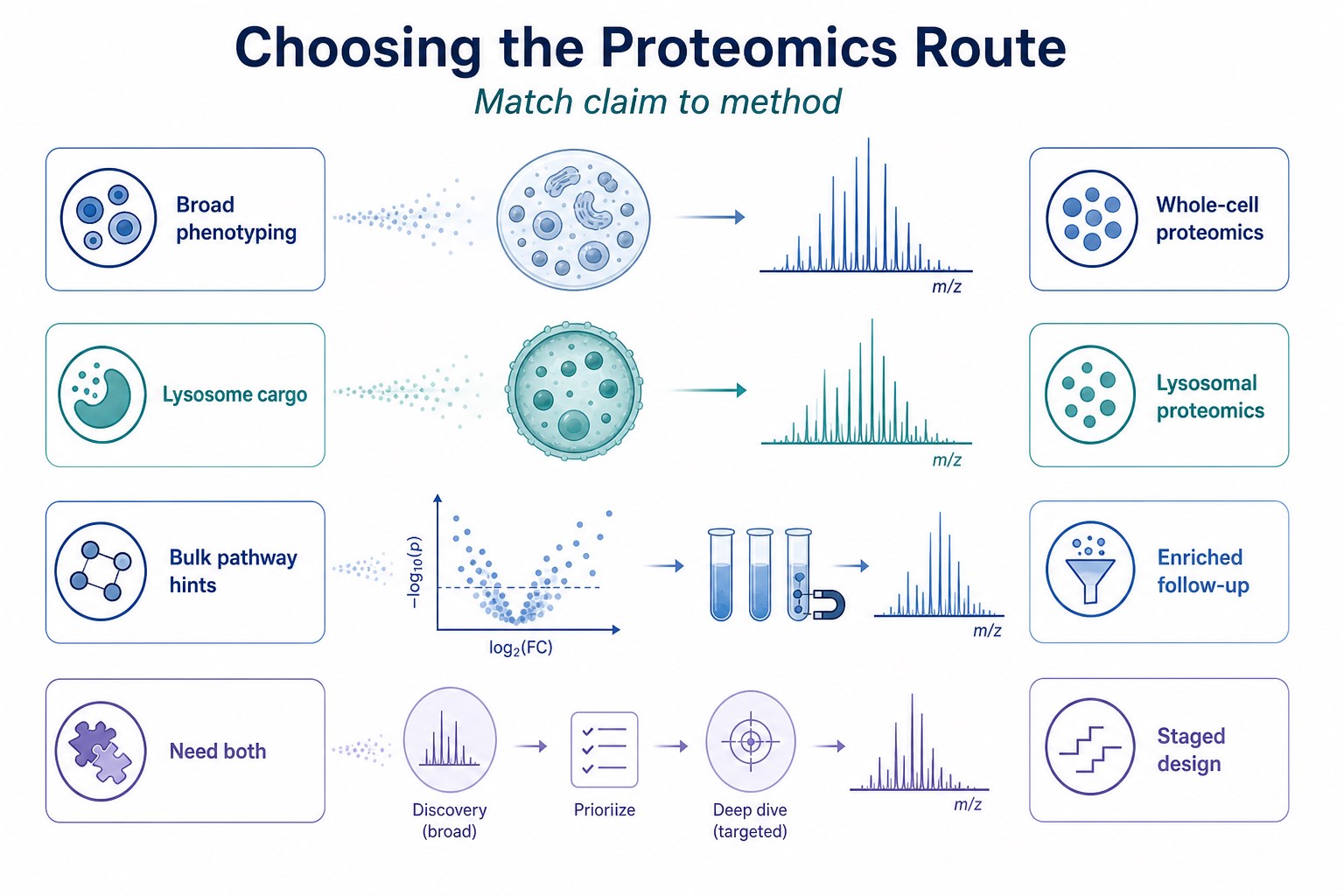
Figure 2. Match the claim first: broad phenotyping favors bulk analysis, while organelle-centered claims favor lysosome-enriched proteomics.
When the Two Approaches Should Be Combined
Combination is useful when a project needs both cellular context and organelle resolution. Bulk data can prioritize pathways and treatments. Enriched-fraction data can test whether selected proteins remain informative in lysosome preparations.
Combination also helps when enrichment input is limited. Whole-cell screening can narrow conditions before larger-scale isolation. In that staged design, lysosomal proteomics vs whole-cell proteomics is not an either-or choice. It becomes a sequence that protects both breadth and compartment focus.
For projects that need help sequencing these assays, MtoZ Biolabs can review whether bulk analysis, enrichment-based analysis, or a staged package fits the current study phase.
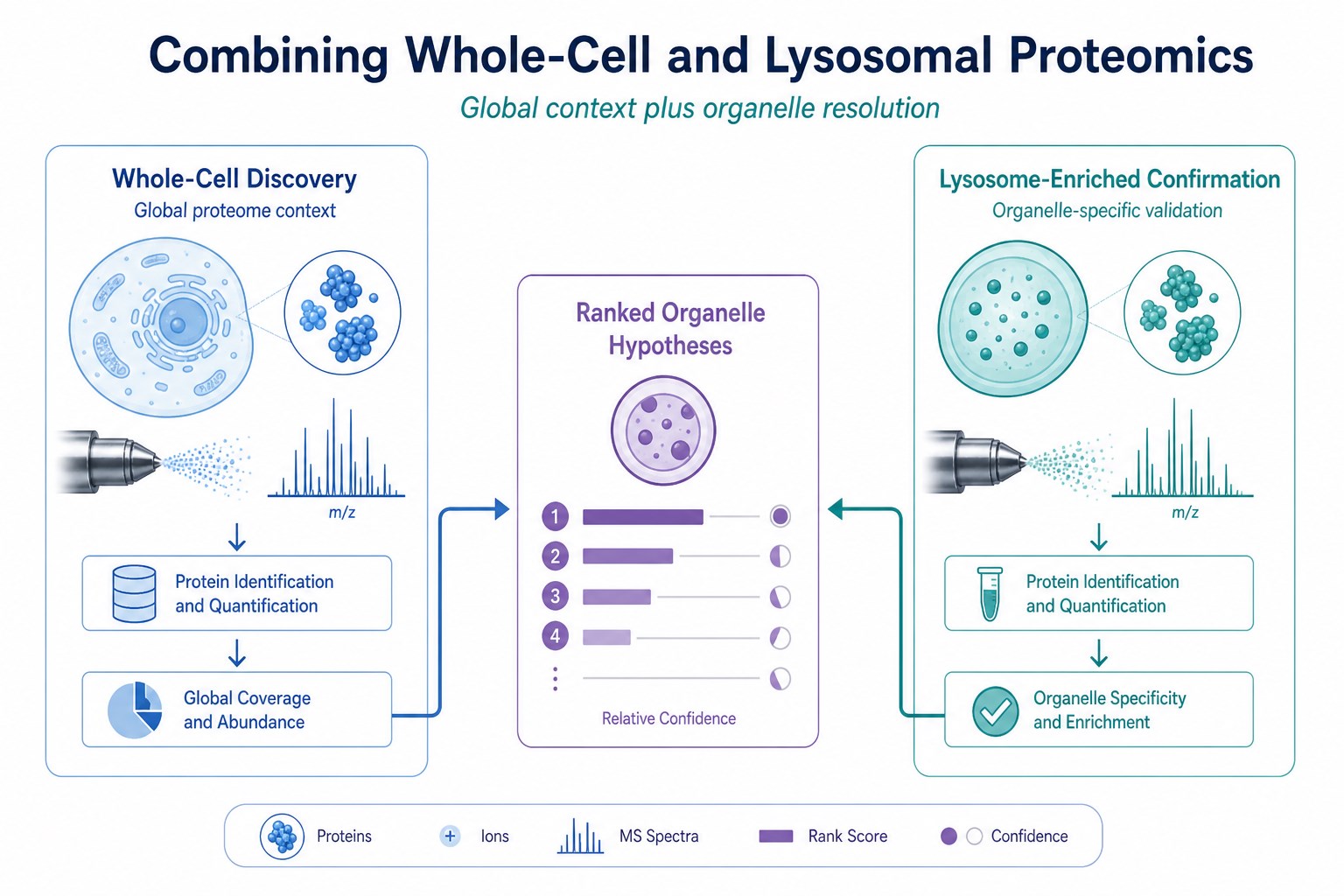
Figure 3. Bulk and lysosome-enriched proteomics are often combined when both global context and organelle resolution are required.
Frequently Asked Questions
1. What is the key difference in lysosomal proteomics vs whole-cell proteomics?
Bulk analysis measures mixed cellular proteins. Lysosome-enriched analysis measures proteins from organelle fractions and is better aligned to compartment-centered claims.
2. Can whole-cell data confirm lysosome biology on its own?
It can generate lysosome-related hypotheses through pathway annotation, but it does not replace enriched-fraction evidence for organelle composition claims.
3. When should the enriched route be chosen first?
Choose it first when the main conclusion depends on proteins recovered from lysosome-enriched material.
4. Does enrichment make the lysosomal proteome completely pure?
No. Enrichment improves organelle focus, but residual contaminants can remain. Marker checks support readiness for analysis.
5. Can the two methods be used in one project?
Yes. Many programs use bulk discovery first and lysosome-enriched follow-up for priority organelle questions. That is one practical reading of lysosomal proteomics vs whole-cell proteomics in real study design.
Conclusion
Lysosomal proteomics vs whole-cell proteomics is a claim-matching decision. Bulk analysis is the practical route for broad cellular changes. The enriched route is the practical route when organelle enrichment is required to resolve lysosome-centered protein questions. Enrichment adds preparation burden, but it also reduces dilution of organelle signals that bulk lysates often cannot resolve.
The most reliable rule is to define the biological claim first, then choose the proteome that can support that claim without overinterpretation. A short routing review before collection usually prevents mismatched bulk or enriched requests. Teams preparing lysosome-related studies can contact MtoZ Biolabs to review whether whole-cell analysis, lysosome-enriched analysis, or a combined design fits the current project.
How to order?




