






IP-MS Protocol: From Antibody Capture to LC-MS/MS
Introduction
An IP mass spec protocol is often copied from a Western blot immunoprecipitation method and then connected to LC-MS/MS at the end. That shortcut is a common reason IP-MS datasets become hard to interpret. Wash conditions that look clean on a blot can still leave resin binders that dominate mass spectrometry. An antibody that works for blotting may recover little bait under IP conditions. A protocol without matched IgG or bead controls can turn every co-purifying protein into an apparent interactor.
A usable IP-MS protocol is therefore a complete enrichment-to-MS design. It starts with antibody qualification, continues through lysis, capture, washing, elution, digestion, and acquisition, and ends with control-based filtering before candidate ranking. This article outlines a practical IP mass spec protocol framework, the decision points that most affect data quality, and the information needed before locking a method for discovery or confirmation work.
What an IP Mass Spec Protocol Must Achieve
An IP mass spec protocol has three linked goals.
First, it must enrich the intended bait protein with enough recovery for LC-MS/MS detection. Second, it must keep background low enough that co-enriched candidates can be ranked against controls. Third, it must preserve enough associated partners to answer the biological question without claiming that every identified protein is a validated interactor.
If the project only needs bait confirmation, classical IP with targeted detection may be enough. If the project needs unknown partner discovery from an endogenous bait, the protocol should be built for IP-MS from the start, ideally with an antibody validated for IP-MS in the relevant sample type.
Protocol Framework from Antibody Capture to LC-MS/MS
1. Antibody Qualification Before Scale-Up
The protocol begins with antibody selection and qualification. Confirm that the antibody recognizes the intended bait and can immunoprecipitate it under the planned lysis chemistry. An IP-MS validated antibody provides stronger evidence than Western-only application claims because it links capture performance to MS-compatible enrichment.
At this stage, define:
- antibody clonality and host species
- recommended IP conditions from available evidence
- isotype or bead-only control strategy
- whether genetic bait reduction is available for specificity checks
Do not scale lysate input or MS acquisition until bait recovery is demonstrated in a pilot IP.
2. Sample Input and Lysis Optimization
Sample amount should be sufficient for bait recovery and replicate structure, but not so high that nonspecific binders overwhelm the eluate. Lysis buffer composition is a major protocol variable. Detergent type and concentration, salt level, and inhibitor panels affect both complex stability and background.
Pilot different lysis conditions when the bait is membrane-associated, chromatin-linked, or known to participate in labile complexes. The best lysis condition for IP-MS is the one that recovers the bait with acceptable partner preservation and manageable background, not simply the harshest buffer that produces a clean blot.
3. Preclearing and Immunoprecipitation
Preclearing with beads can reduce some sticky binders before antibody capture, but it is not a substitute for proper controls. Antibody-bead conjugation or antibody incubation with lysate should be standardized for time, temperature, and mixing.
Capture efficiency depends on epitope accessibility under native or near-native lysis conditions. If recovery is weak, adjust antibody amount, incubation time, or lysis chemistry before increasing wash harshness.
4. Wash Stringency and Elution
Wash steps define the sensitivity-specificity trade-off in an IP mass spec protocol. Gentle washes retain weak or transient partners and raise background. Stringent washes reduce contaminants and may strip biologically relevant associations.
Elution should release bait and retained partners in a form compatible with downstream digestion. Harsh elution that denatures everything is acceptable for many discovery protocols, provided the same elution chemistry is applied to controls.
5. Digestion, LC-MS/MS, and Control Filtering
After elution, proteins are digested and analyzed by LC-MS/MS. Acquisition depth should match the expected complexity of the eluate. Identification tables from bait IP and control IP are then compared using enrichment metrics rather than presence-or-absence calling alone.
Candidate ranking should occur only after control filtering. Common contaminant awareness is useful, but experimental controls remain the primary filter for protocol-specific background.
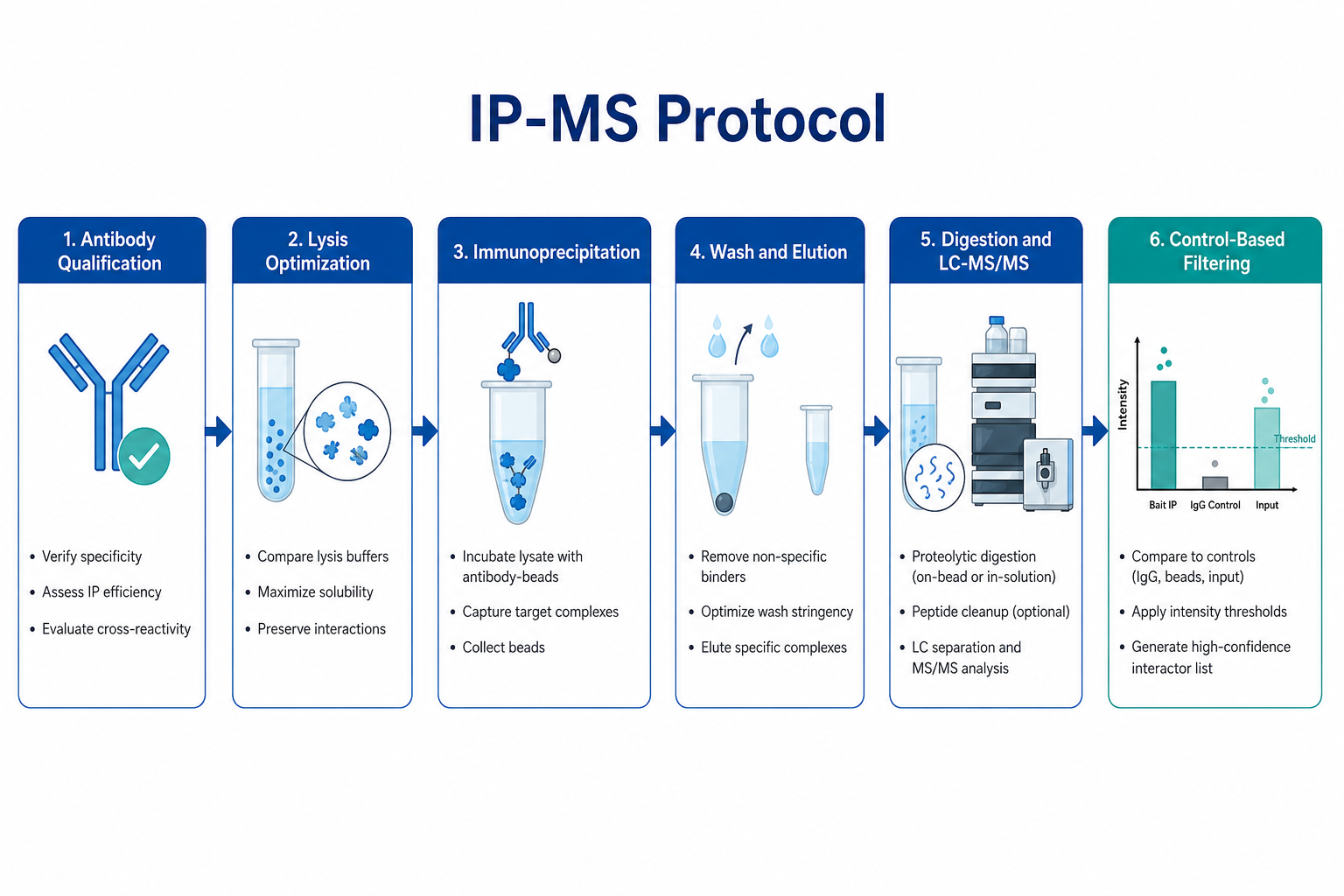
Figure 1. A complete IP mass spec protocol links antibody qualification, immunoprecipitation, LC-MS/MS, and control-based filtering.
Critical Checkpoints Before Calling Interactors
An IP-MS protocol should include go or no-go checkpoints.
Before IP scale-up, confirm that the antibody recovers the bait under the chosen lysis conditions.
During IP, confirm that bead handling, wash volumes, and incubation times are reproducible across replicates and controls.
Before biological interpretation, confirm that bait enrichment is observed relative to IgG or bead controls and that candidate lists are filtered with predefined criteria.
Skipping these checkpoints turns the protocol into a protein identification exercise rather than an interaction discovery method.
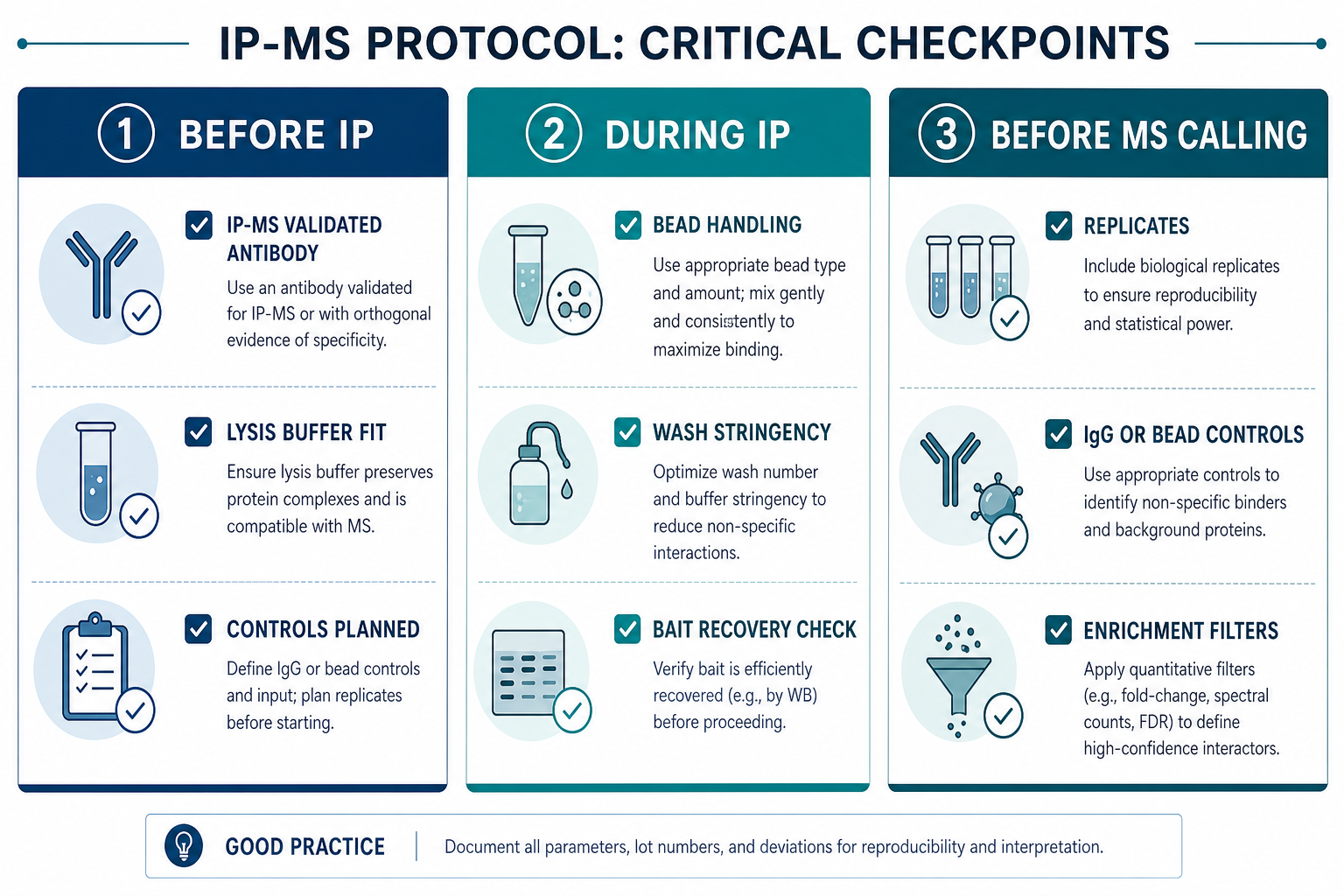
Figure 2. Protocol checkpoints reduce false interactome calls by confirming bait recovery, matched controls, and enrichment filters before candidate ranking.
Protocol Variables That Most Affect IP-MS Outcomes
|
Protocol Variable |
If Too Mild |
If Too Harsh |
Practical Aim |
|---|---|---|---|
|
Lysis detergent and salt |
High background, incomplete solubilization |
Loss of complexes or bait |
Recover bait with usable partner retention |
|
Antibody amount |
Weak bait recovery |
Higher off-target capture risk |
Lowest amount that yields stable bait enrichment |
|
Wash stringency |
Contaminant-dominated MS lists |
Loss of weak partners |
Matched stringency for bait and controls |
|
Input protein amount |
Low signal and unstable IDs |
Elevated sticky background |
Enough for replicates without overloading beads |
|
Control design |
Inflated candidate lists |
Overfiltering true partners |
Isotype or bead controls processed identically |
These variables should be recorded in the final method summary so later replicate batches remain comparable.
Controls That Belong in the Protocol, Not in the Appendix
A credible IP mass spec protocol includes controls at the same handling depth as the bait IP.
Isotype-matched IgG controls help identify antibody-driven background.
Bead-only controls help identify resin binders under the chosen lysis and wash chemistry.
Where feasible, bait knockdown or knockout samples help confirm that enrichment depends on the intended target.
Biological replicates allow enrichment metrics to stabilize candidate ranking. Single unreplicated IPs are weak support for interaction claims.
Co Immunoprecipitation (Co-IP) Service
When to Adjust the Protocol or Change Methods
Modify the IP-MS protocol when bait recovery is weak, background is consistently high, or known positive partners are lost under current washes.
Consider switching to AP-MS when no antibody validated for IP-MS is available and tagging is acceptable.
Consider pull-down-MS when the question is direct or reconstituted binding with a recombinant bait rather than endogenous complex discovery.
Consider classical Co-IP with targeted detection when only a few known partners need confirmation and discovery MS is unnecessary.
Affinity Purification-Mass Spectrometry Service
Pull Down based Protein Analysis Service with Mass Spectrometry
Related Services
Protein-Protein Interaction Analysis Service
MS-Based Protein-Protein Interaction Analysis Service
SILAC Based Co-IP-MS for Protein Interaction Analysis Service
Immunoprecipitation Analysis Service
Information to Lock Before Running the Protocol
Define the following before sample-intensive IP-MS work:
- bait identity and primary question: discovery, confirmation, or antibody qualification
- antibody status: untested, IP-only, or antibody validated for IP-MS
- sample type, approximate input amount, and replicate number
- lysis and wash priorities
- control plan: IgG, bead-only, and optional genetic controls
- expected deliverables: bait confirmation, filtered candidate list, or condition contrast
- orthogonal validation plan for priority candidates
MtoZ Biolabs supports IP-MS, Co-IP-MS, and related protein interaction analysis for teams building endogenous bait enrichment protocols. The technical team can review antibody evidence, lysis and control design, and whether an IP mass spec protocol or an alternative enrichment route is the better fit.
To discuss an IP-MS protocol, contact MtoZ Biolabs with your bait protein, antibody status, sample type, planned controls, and the interaction output required for the study.
Frequently Asked Questions
What is the difference between an IP protocol and an IP mass spec protocol?
A classical IP protocol is often optimized for Western blot readout of the bait or known partners. An IP mass spec protocol must also manage MS-detectable background, matched controls, and enrichment filtering for candidate interactors.
Do I need an IP-MS validated antibody to run this protocol?
For discovery-oriented IP-MS, an antibody validated for IP-MS is strongly preferred. Without demonstrated IP recovery and acceptable background, LC-MS/MS mainly reports protocol noise.
How many washes should an IP-MS protocol use?
There is no universal wash number. The correct stringency is the lowest level that keeps control background interpretable while retaining bait and relevant partners. That balance should be tested empirically for each bait and sample type.
Should I preclear lysates in every IP-MS protocol?
Preclearing can reduce some sticky binders, but it does not replace IgG or bead controls. Use it when background is high and verify that bait recovery remains adequate.
Can one protocol fit every bait?
No. Membrane proteins, nuclear complexes, and labile signaling assemblies often need different lysis and wash settings. Protocol transfer between baits should be treated as a starting point, not a finished method.
Conclusion
An IP mass spec protocol succeeds when antibody capture, lysis chemistry, wash stringency, controls, and LC-MS/MS filtering are designed as one system. The highest-yield sequence is to qualify an antibody validated for IP-MS, optimize lysis and washes around bait recovery, process matched controls identically, and rank candidates only after enrichment filtering.
Teams that lock these elements before large sample sets reduce repeat experiments and produce clearer follow-up lists. For endogenous interaction discovery, a carefully built IP-MS protocol remains one of the most direct routes from antibody enrichment to actionable proteomic candidates.
How to order?




