






How to Interpret Monoclonal Antibody Sequencing Results Before Humanization or Engineering
A monoclonal antibody sequencing report is only useful before humanization or engineering if it answers one practical question: do the proposed heavy chain and light chain variable regions have enough supporting evidence for sequence-dependent design decisions? A complete-looking report alone is not enough. What matters is whether the variable region is chain-resolved, whether CDR-containing peptides are backed by overlapping peptides and peptide-spectrum match evidence, and whether any unresolved residues fall at positions that could alter binding, liability review, or recombinant reconstruction.
Decision check
- Proceed when heavy chain / light chain chain assignment is clear, CDR1-CDR3 are well supported, and remaining ambiguity is limited to lower-risk framework region positions.
- Proceed with caution when most of the variable region is interpretable, but isolated isobaric residues, partial termini, or a few framework gaps remain.
- Pause for more confirmation when low-confidence calls fall in CDRs, sequence contigs break in the variable region, PTMs obscure local residue calling, or chain assignment is still uncertain.
The fastest way to read the report is to start with chain assignment, then review residue-level confidence across CDR1, CDR2, and CDR3, and only after that look at the headline sequence coverage. High sequence coverage does not automatically mean functionally sensitive positions are resolved. In LC-MS/MS-based de novo protein sequencing, local uncertainty can remain even when the overall report looks strong.
Where Teams Usually Get Stuck
This review step usually appears when a legacy, hybridoma-derived, or poorly documented antibody is moving toward humanization, affinity engineering, or recombinant redesign. The report may include proposed heavy chain and light chain sequences, peptide coverage maps, confidence scores, PTM annotations, and sequence contigs. That looks actionable at first glance. The harder question is whether the report supports design work or only a working sequence hypothesis.
The main risk is not a few missing residues in the constant region. The bigger problem is moving an inferred parental sequence into modeling, codon design, or affinity engineering while uncertainty still sits in CDRs, at framework positions that influence binding geometry, or near domain boundaries needed for recombinant reconstruction. Once that uncertainty enters downstream work, every redesign decision inherits it.
Why an Antibody Sequencing Report May Not Yet Be Design-Ready
Four issues usually explain why monoclonal antibody sequencing data are still difficult to use with confidence.
1. Strong global sequence coverage but weak local evidence
A report can show broad peptide coverage and still leave key variable-region positions weakly supported. This often happens when abundant peptides push up the overall coverage number while CDR-containing peptides are sparse, fragmented, or missing. For engineering decisions, local support matters more than a single summary metric.
2. Ambiguous residue calling at isobaric or modified sites
Leucine/isoleucine ambiguity remains a known limitation in mass spectrometry-based sequence interpretation. PTMs such as oxidation or deamidation, along with missed cleavage, can further complicate residue calling. A sequence may be mostly correct and still contain site-specific uncertainty that changes engineering strategy.
3. Incomplete chain assignment or weak contig continuity
If variable-region peptides are not confidently assigned to heavy chain or light chain, or if sequence contigs rely on limited peptide overlap, design risk rises quickly. That matters even more when the goal is recombinant reconstruction rather than early triage.
4. Sample condition limits interpretability
Low-input, aged, impure, or heterogeneous samples often produce uneven peptide recovery and inconsistent spectral support. In these cases, de novo peptide sequencing may still help with project evaluation, but not direct sequence finalization.
How to Interpret the Report Before Advancing the Antibody
For data interpretation, the most useful approach is not to read everything at once and hope it looks complete. Move through the evidence in the same order that design risk appears.
Step 1: Confirm what the report actually proves
Separate analytical success from engineering readiness. A report may show that the sample contains antibody-derived peptides and may propose heavy chain and light chain variable-region sequences. That does not mean every residue call is strong enough for humanization or redesign.
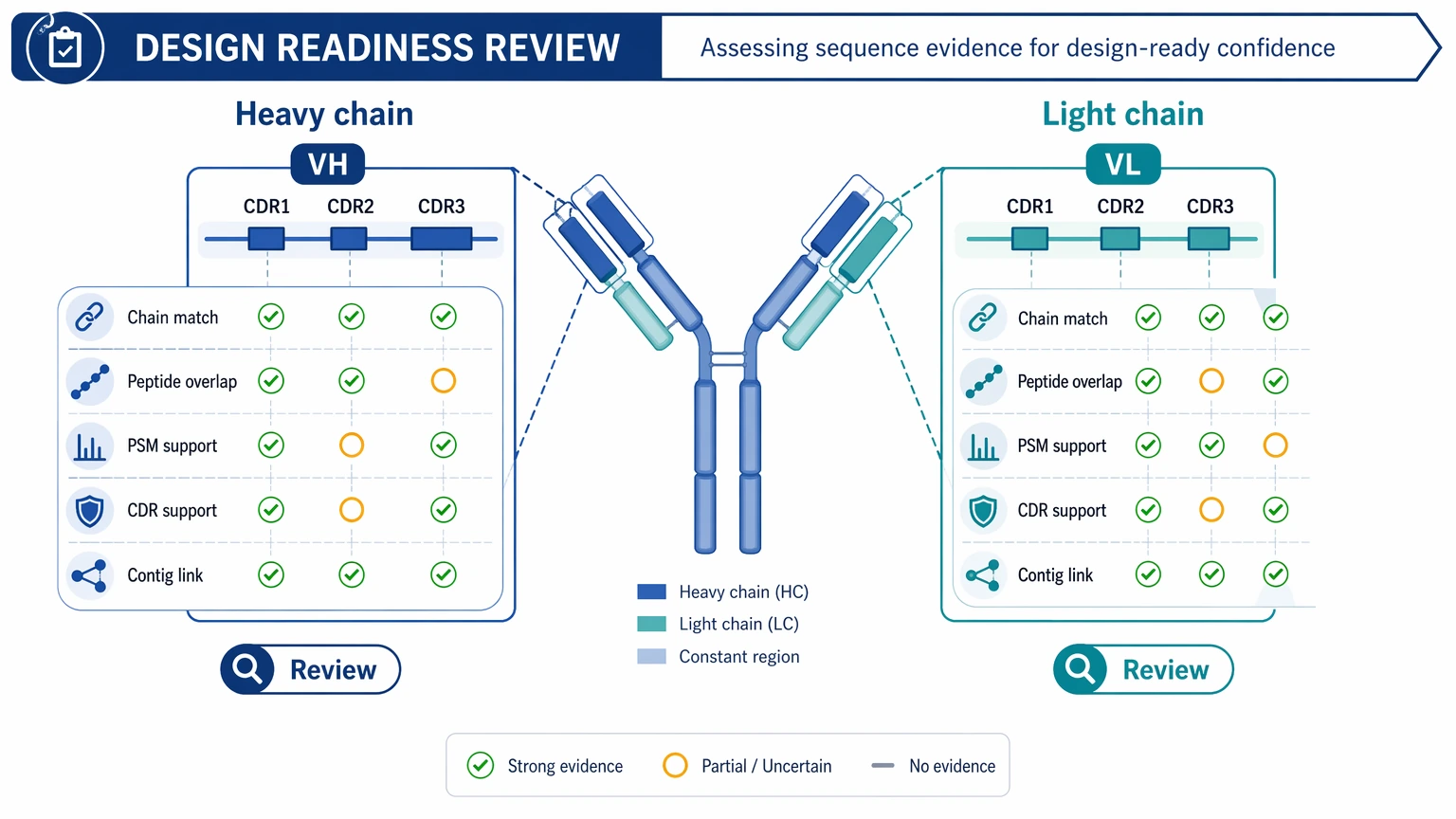
Check for:
- clear chain assignment for heavy chain and light chain
- sequence coverage across the variable region, not only full-length coverage
- residue-level confidence at important positions
- peptide-spectrum match support for CDR-containing peptides
- sequence contig continuity across framework region and CDR segments
- agreement among overlapping peptides
If the deliverable only shows a final assembled sequence, ask for peptide-level support before using it in design review.
Step 2: Judge the data by the downstream decision
The same report may be acceptable for one use and insufficient for another. Early asset triage may tolerate some framework ambiguity. Recombinant reconstruction usually cannot.
| Downstream use | What the report should support | Main risk if evidence is weak | Likely follow-up |
|---|---|---|---|
| Humanization | Strong variable region interpretation, especially CDRs and nearby framework region positions | Misreading paratope-defining residues | Targeted confirmation of uncertain CDR sites |
| Affinity engineering | Continuous CDR3 support and reliable local residue calls | Mutation strategy built on a wrong parental sequence | Orthogonal validation at hotspot residues |
| Recombinant reconstruction | Clear chain assignment, contig continuity, and boundary completeness | Construct errors or chain mismatch | Intact mass, subunit analysis, or gap closure |
| Legacy antibody confirmation | Sequence hypothesis consistent with isotype context and observed peptides | False confidence from degraded or partial evidence | Complementary digestion or repeat review |
A practical rule is simple: demand the strongest evidence where the next step is least forgiving.
Service Routes to Consider
For this project scenario, readers usually compare these service routes before requesting a quote or submitting samples.
Step 3: Read CDRs and framework regions with different risk tolerance
Not all ambiguities carry the same weight. CDR uncertainty deserves the strictest review because a single unresolved residue can change binding interpretation, lineage comparison, or engineering logic. Framework-region ambiguity may be manageable for early planning if the site is outside structurally sensitive positions and does not affect construct design.
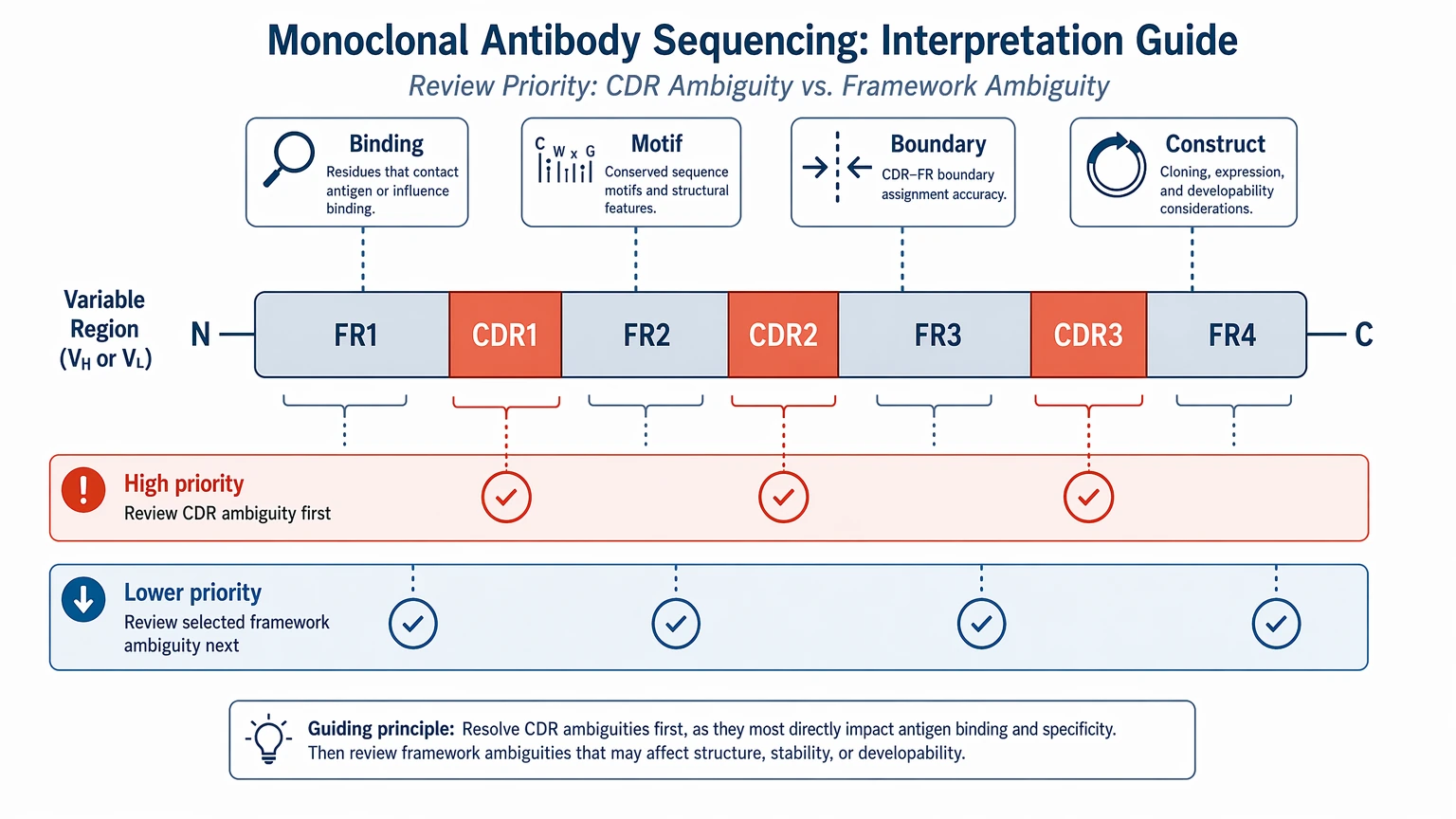
Focus on:
- residue-level confidence across CDR1, CDR2, and CDR3
- whether overlapping peptides independently support the same CDR sequence
- the number and location of low-confidence residues
- whether uncertain framework positions are near structurally influential sites
If uncertainty is limited to lower-risk framework positions, the result may still support planning with caution. If unresolved residues fall in CDR3 or at motif-defining sites, validation is usually the better next step.
Step 4: Check how PTMs, missed cleavage, and database limits affect interpretation
PTM notes are not side details. Oxidation, deamidation, clipping, glycation, and missed cleavage can weaken de novo sequence assembly and distort local residue calling. In unknown-sequence settings, database-search support may also be limited, so peptide-level evidence matters even more.
An explicit limitation is worth keeping in view: LC-MS/MS interpretation cannot always distinguish every residue unambiguously, and leucine/isoleucine ambiguity or PTM-confounded spectra may remain unresolved without orthogonal validation.
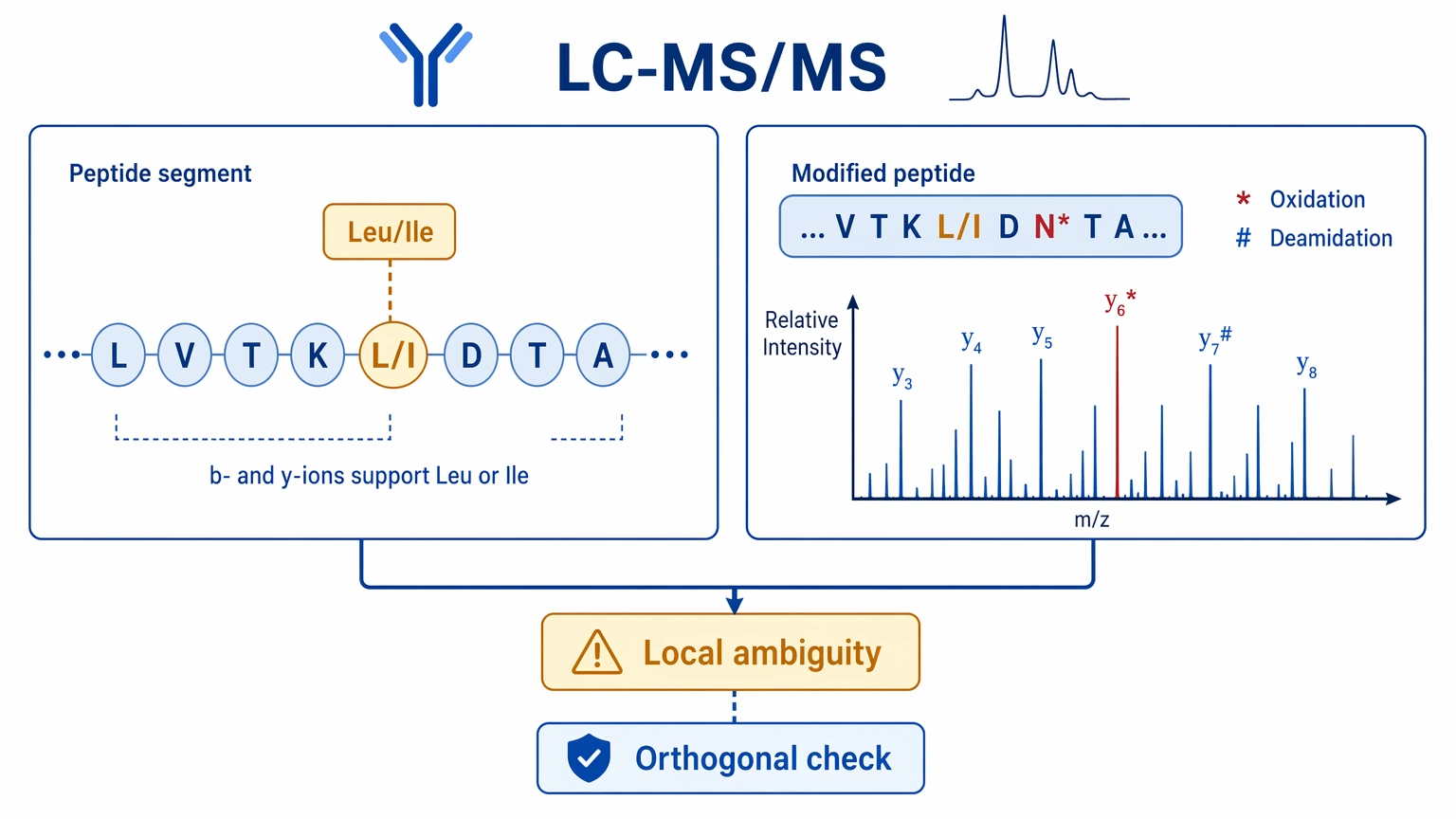
Use the evidence type, not the headline score, to decide what the report can support:
| Evidence feature | What it tells you | What it does not guarantee |
|---|---|---|
| High peptide coverage | Broad sampling of the antibody | Exact confidence at every residue |
| Clean overlapping peptides | Better local sequence assembly | Correct resolution of all isobaric residues |
| Intact mass agreement | Global consistency with the proposed sequence | Precise local confirmation in CDRs |
| PTM-rich peptides | Modified forms are present | Native residue calling at the modified site |
| Constant-region support | Helpful context for isotype and chain assignment | Full confidence in variable-region assembly |
If your team needs a focused review of ambiguous CDR positions, contig gaps, or follow-up confirmation options, you can submit your requirements to MtoZ Biolabs to evaluate your project in the context of antibody sequencing, de novo interpretation, and targeted LC-MS/MS validation.
Expected Results and Validation Methods
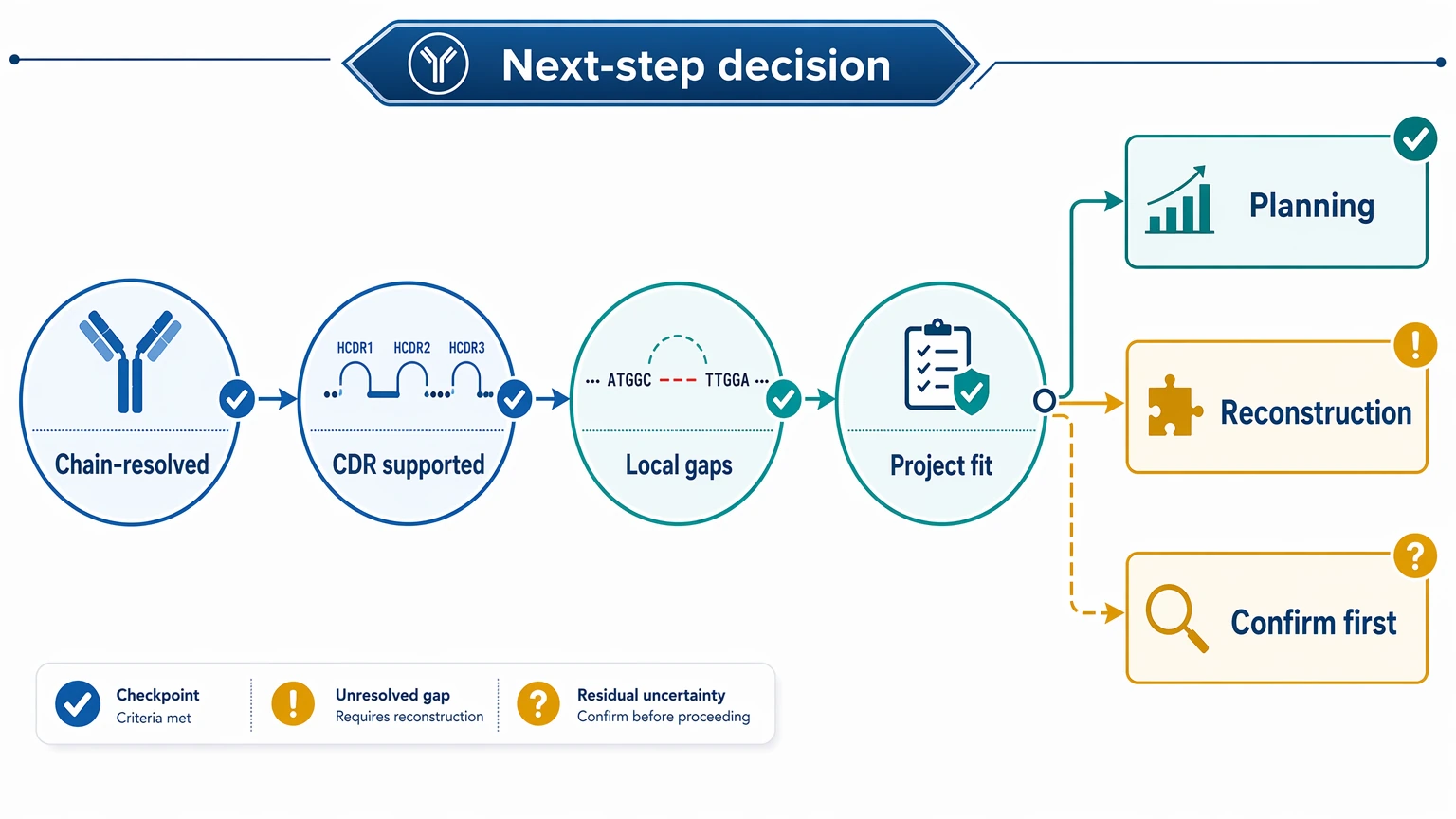
A solid interpretation process should end with a decision document, not just a cleaner reading of the report.
Immediate deliverables from the current dataset should include:
- a chain-resolved view of heavy chain and light chain evidence
- a map of well-supported, tentative, and unresolved positions in the variable region
- a list of CDR-specific ambiguity hotspots
- a decision on whether the sequence supports planning only, or recombinant reconstruction
Follow-up confirmation should be reserved for uncertainty that changes the next milestone. Appropriate options include:
- complementary protease digestion when peptide coverage is uneven
- targeted LC-MS/MS when a small number of residues require confirmation
- intact mass or subunit analysis when global consistency needs checking
- transcript recovery or recombinant verification when exact clone reconstruction is required
The goal is not to force every report into complete certainty. The goal is to define whether the remaining uncertainty is acceptable for the next project step.
Key Cautions and Practical Limits
Sample quality sets the practical ceiling for interpretation. Low-input, degraded, impure, or mixed samples often increase missed cleavage burden, reduce peptide coverage continuity, and complicate PTM interpretation. If only a small amount of material remains, plan validation carefully so follow-up work does not consume the last useful sample.
Controls and repeat logic matter when the evidence is borderline. Comparative digests, technical repeats, or independent preparations can show whether an ambiguous residue is a stable finding or an artifact from one digest or one acquisition batch.
Batch effects and contamination also deserve attention. Background immunoglobulins, co-purified proteins, or mixed antibody populations can distort chain assignment and sequence contig assembly.
Keep the interpretation boundary clear. A useful monoclonal antibody sequencing result may support project triage even when it is still not sufficient for recombinant reconstruction. If exact residue identity is needed at unresolved CDR positions, another method or outside support is a better next step than pushing design work forward on an inferred sequence.
Conclusion
Before humanization or engineering, the real question is not whether a monoclonal antibody sequencing report looks broadly complete. The question is whether the heavy chain and light chain variable regions are supported by enough local evidence to make sequence-dependent decisions responsibly. Chain assignment, CDR-specific residue-level confidence, sequence contig continuity, and the effect of PTMs or isobaric residues should drive that decision. For legacy or hybridoma-derived antibody projects where current LC-MS/MS evidence is close to usable but not fully settled, contact MtoZ Biolabs to evaluate your project, review the report context, and define a validation plan before redesign begins.
FAQ
What is the single most common mistake when reviewing antibody sequencing results?
Treating overall sequence coverage as proof that the variable region is ready for engineering. Coverage can be high while the most decision-critical CDR residues still have weak support.
When does leucine/isoleucine ambiguity become a serious problem?
It becomes a serious problem when the uncertain site is in a CDR, near a motif-defining residue, or at a position that directly affects recombinant reconstruction. The same ambiguity may be lower risk in a noncritical framework region.
Can a report be useful even if it is not ready for recombinant reconstruction?
Yes. Many reports are still useful for triage, lineage review, or planning follow-up validation even when they do not yet support direct back-translation or construct design.
Why can intact mass agreement still leave sequence risk?
Intact mass supports global consistency, but it does not resolve local ambiguity. Two candidate sequences may fit the same overall mass while differing at critical residues.
What information should a team prepare before asking for a sequencing-result review?
Prepare the proposed heavy chain and light chain sequences, peptide coverage maps, residue-level confidence notes, PTM observations, sample source, amount available, purity concerns, and the exact downstream decision such as humanization, affinity engineering, or recombinant reconstruction.
How to order?




