






De Novo Sequencing Coverage: How to Estimate Depth for Reliable Assembly Quality
- If you need only discovery-level peptide tags: modest evidence depth may be acceptable.
- If you need a regionally confident assembled sequence: plan for stronger spectral quality, peptide overlap, and replicate support.
- If you need near-complete de novo protein sequencing for synthesis, construct redesign, or publication: plan for multiple digestion routes, redundancy across sequence regions, and follow-up validation.
- If the target is PTM-rich, mixed, repetitive, or ambiguity-prone: increase validation planning before increasing run count.
- Key limitation: nominal sequence coverage does not guarantee sequence assembly confidence, and standard tandem mass spectrometry may still leave leucine/isoleucine ambiguity or uncertain modified residues unresolved.
- sequence coverage across the target length
- number and distribution of overlapping peptides
- fragment ions supporting each residue transition
- b ions and y ions continuity within each MS/MS spectrum
- local confidence across reconstructed regions
- location of each coverage gap
- intact mass consistency with the assembled sequence
- redundancy across replicate runs
- expected peptide or protein length
- approximate intact mass
- purity and enrichment status
- expected PTM burden
- whether bottom-up sequencing will use one digestion strategy or several
- whether replicate LC-MS/MS runs are feasible
- whether a few ambiguous residues are acceptable
- whether downstream use requires synthesis, cloning, or publication-ready reporting
-
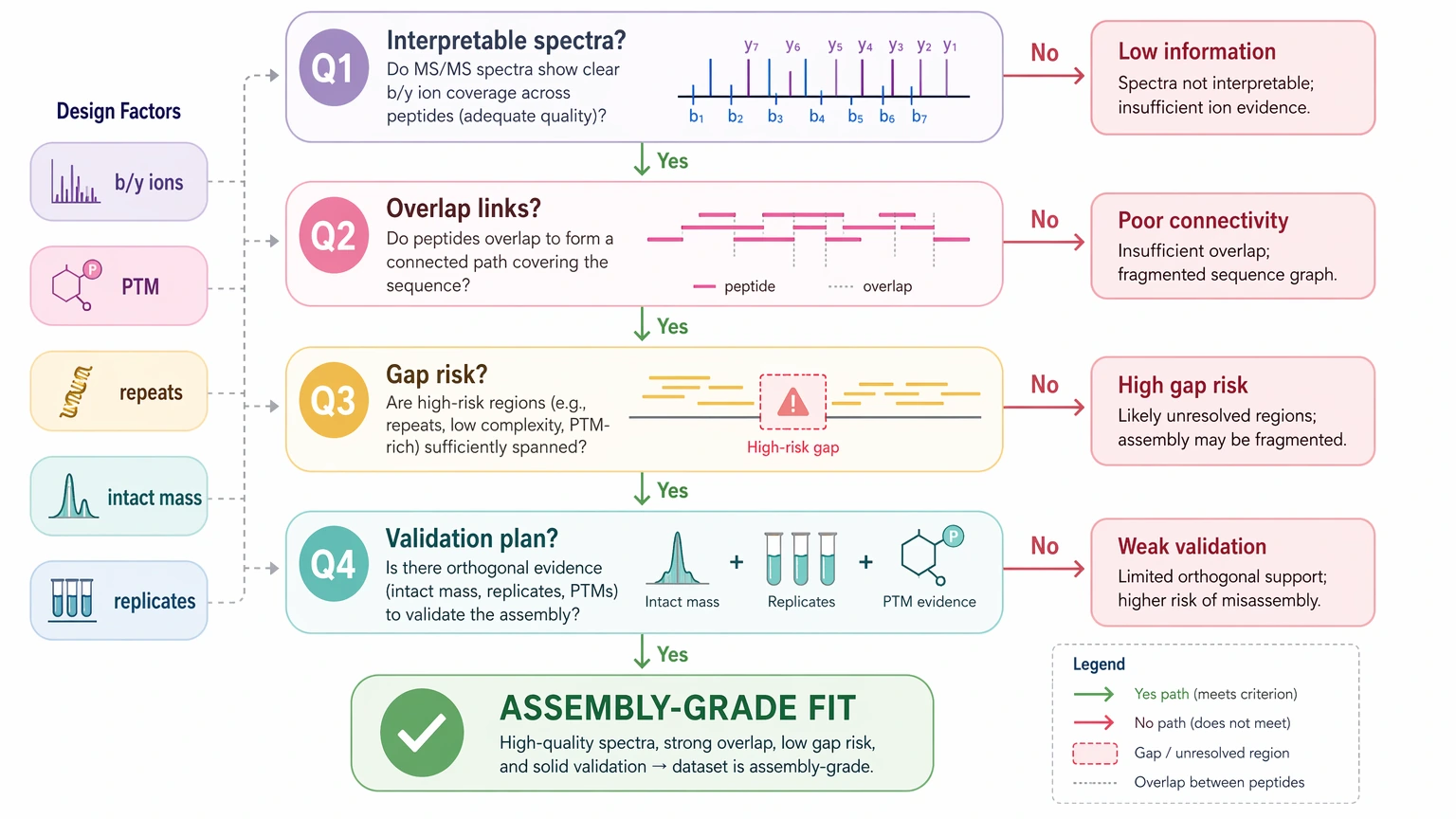
Will each local region generate an interpretable fragmentation spectrum?
You need residue-order support from fragment ions, not just precursor detection. -
Will adjacent regions be linked by overlapping peptides?
For de novo protein sequencing, overlap density often determines whether sequence reconstruction is possible. -
Are likely coverage gaps located in low-risk or high-risk regions?
A terminal gap may be manageable. An internal gap near a PTM, repeat, or variable domain may block the assembled sequence. -
What independent validation will test the interpretation?
Intact mass, replicate confirmation, alternative digestion, and targeted follow-up all add confidence. - whether the likely output is partial sequence characterization or assembled sequence reporting
- which regions must be reconstructed with strong confidence
- which ambiguities can remain acceptable
- what follow-up validation is already planned if the first-pass dataset leaves uncertainty
- sequence coverage across the target
- reconstructed peptide tags or larger assembled sequence segments
- local confidence patterns by region
- identified coverage gap positions
- overlap support from neighboring peptides
- consistency check against measured intact mass
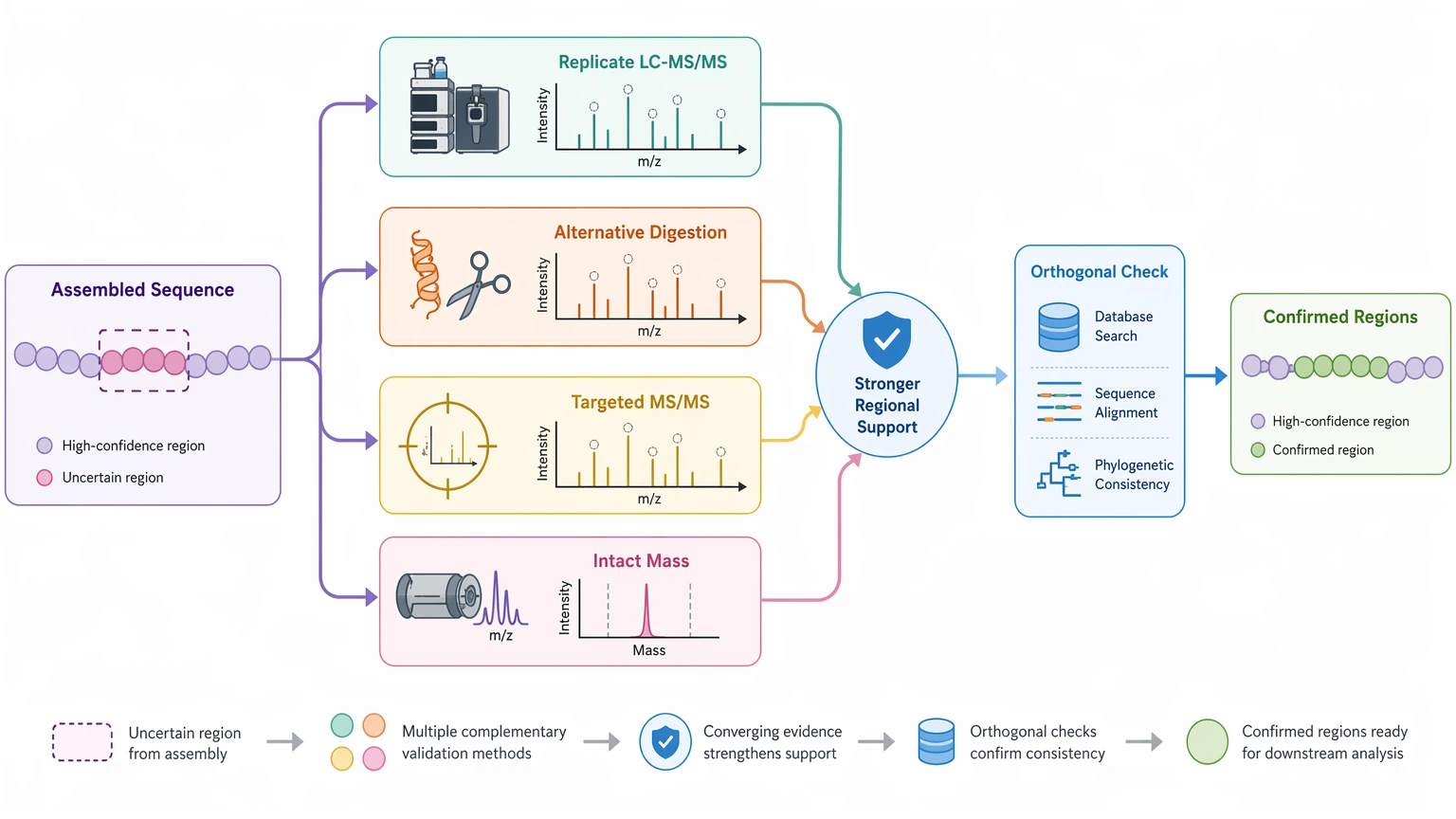
- replicate LC-MS/MS runs to test recurring sequence calls
- alternative digestion to recover missing overlap
- targeted tandem mass spectrometry around disputed regions
- intact mass confirmation for whole-sequence consistency
- an orthogonal method when sequence ambiguity remains concentrated at critical positions
De novo sequencing coverage is enough only when the planned LC-MS/MS dataset can support sequence reconstruction across the regions that matter to the project decision. In practice, that takes more than collecting a large number of MS/MS spectra. You need enough fragment-ion support, enough overlapping peptides, and enough local confidence continuity to separate a usable assembled sequence from a set of disconnected peptide tags.
Quick decision guide
What Coverage Means in De Novo Sequencing
In de novo sequencing, coverage does not mean generic data depth. It means how much of a peptide or protein is supported by interpretable fragmentation evidence and can be connected into a defensible sequence reconstruction.
That distinction matters because a project can show broad sequence coverage on paper and still fall short of a trustworthy assembled sequence. One region, for example, may produce several strong peptide tags, yet the links between neighboring residues may still be weak because the fragmentation spectrum is incomplete or the peptides do not overlap. In bottom-up sequencing, that break in continuity can stop protein-level sequence assembly even when local calls look strong on their own.
A practical coverage estimate should therefore combine several metrics instead of leaning on a single percentage:
Where Planning Usually Fails
Most under-scoped projects run into trouble for one of four reasons.
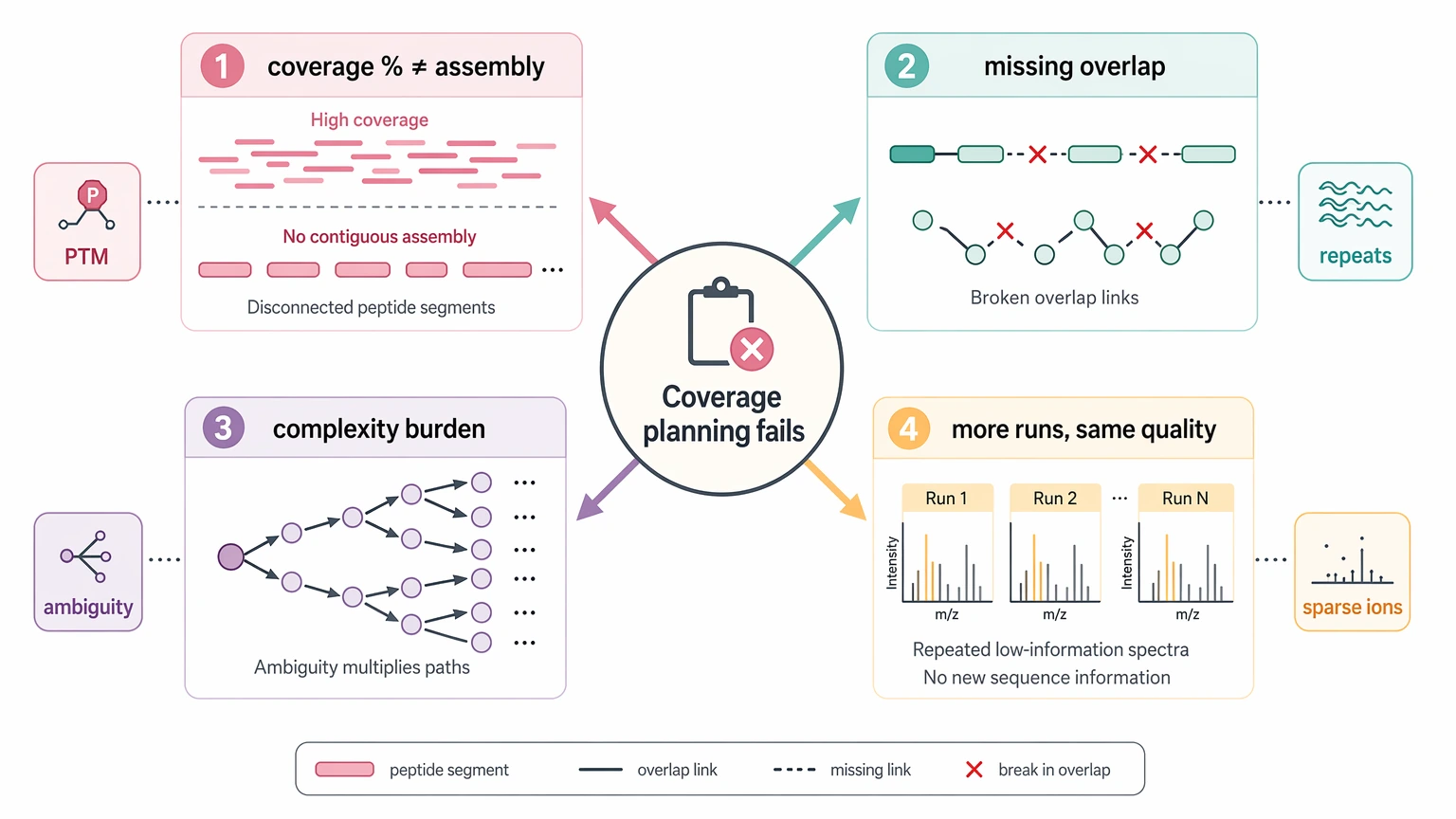
1. Coverage percentage is mistaken for sequence assembly quality
Sequence coverage answers, “How much of the target is represented by evidence?” Sequence assembly asks, “Can those supported regions be connected into a credible assembled sequence?” Those questions are related, but they are not the same. A high coverage percentage can still be weak support if critical junctions, modified regions, or internal repeats stay ambiguous.
2. Overlapping peptides are missing
For de novo protein sequencing, overlapping peptides often provide the link between peptide-level interpretation and larger sequence reconstruction. A dataset built from isolated peptides may still yield useful peptide tags, but it will not reliably support assembly across a longer target.
3. Sample and target complexity raise the evidence burden
Unknown proteins, PTM-rich targets, mixed samples, long sequences, and repeated motifs all increase the amount of evidence required. Post-translational modification (PTM) can interrupt fragment interpretation or lower local confidence. Sequence repeats can create more than one plausible assembly path. Leucine/isoleucine ambiguity can remain even when the surrounding fragmentation spectrum looks strong.
4. Run volume increases, but spectral quality does not
More data does not automatically improve de novo peptide sequencing. If precursor quality is poor or fragment ions are sparse, extra scans may simply reproduce the same uncertainty. Reliable de novo sequencing depends on informative MS/MS spectra, not just bigger files.
Project-Planning Framework for Estimating De Novo Sequencing Coverage
For this topic, the most useful structure is a project-planning workflow: define the deliverable, assess the target, estimate whether the evidence can support continuity, and set validation before kickoff.
Step 1: Define the minimum acceptable output
Start by naming the real deliverable. Coverage targets should be tied to what the project must produce, not to a general wish for “more data.”
| Deliverable goal | Typical evidence standard | Main risk if under-scoped | Best next planning move |
|---|---|---|---|
| Peptide tag discovery | Interpretable local MS/MS spectrum for selected regions | Tags may not connect into sequence assembly | Keep scope exploratory |
| Regional sequence reconstruction | Overlapping peptides plus stable local confidence | Internal coverage gap may block continuity | Add replicate support |
| Near-complete assembled sequence | Dense overlap, strong fragment ions, and orthogonal checks | Ambiguous residues can limit final confidence | Plan validation from the start |
| Decision-critical residue confirmation | Targeted evidence around a defined site | Site remains unresolved despite broad coverage | Use focused follow-up confirmation |
Takeaway: decide whether the project needs peptide tags, regional reconstruction, or an assembled sequence before setting depth expectations.
Step 2: Collect the planning inputs that actually change depth
Before discussing run count or budget, gather the variables that most directly affect evidence sufficiency:
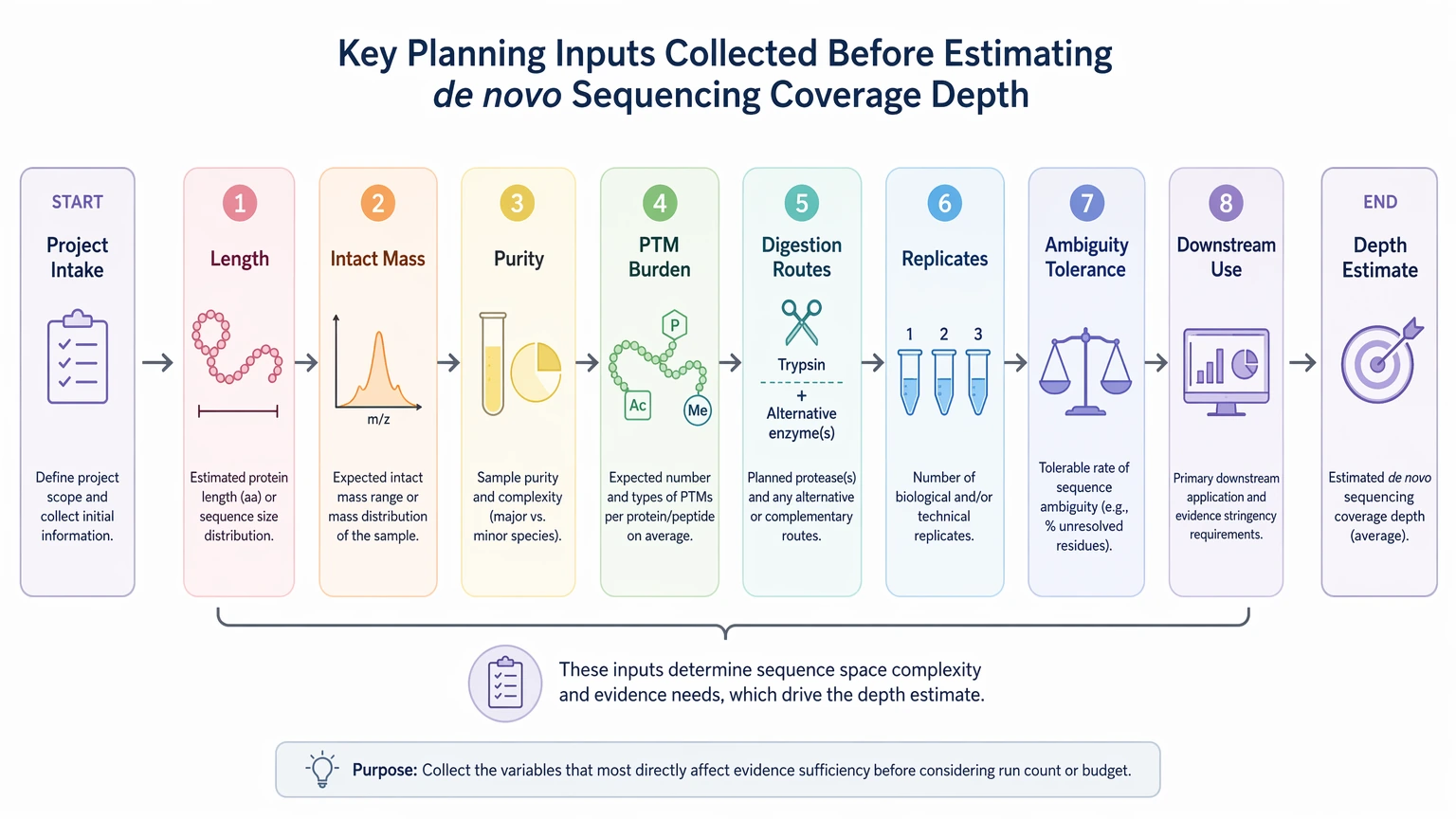
A short purified peptide and an unknown modified protein do not need the same evidence plan, even if the sample mass looks similar.
Service Routes to Consider
For this project scenario, readers usually compare these service routes before requesting a quote or submitting samples.
Step 3: Ask whether the design can support sequence continuity
Use four planning questions to estimate whether the dataset will be assembly-grade.
If your project is at the quotation stage, this is the point to submit your requirements and review the workflow rather than approve acquisition depth based on file size alone. Teams that need help translating sample condition, digestion options, and expected deliverables into a realistic de novo sequencing plan can contact MtoZ Biolabs to evaluate the project scope before locking the experiment.
Step 4: Match evidence depth to complexity instead of applying one threshold
The table below is more useful than a universal cutoff because it ties planning to the target type.
| Sample type | Likely fit for de novo sequencing | Main limitation | Planning response |
|---|---|---|---|
| Purified short peptide | De novo peptide sequencing with direct fragmentation interpretation | Isobaric residue ambiguity may persist | Add targeted confirmation if sequence use is critical |
| Purified small protein | Bottom-up sequencing with overlap-focused design | Single digestion may leave coverage gap regions | Add alternative digestion or replicates |
| PTM-rich protein | Modification-aware de novo protein sequencing | PTM localization may interrupt continuity | Reserve validation for modified regions |
| Mixed peptide or protein sample | Exploratory characterization first | Interference lowers spectral quality | Improve enrichment before assembly-focused runs |
| Antibody, toxin, or engineered variant | Redundancy-oriented workflow | Small sequence differences need dense local support | Pair sequence reconstruction with intact mass |
Takeaway: as complexity increases, prioritize overlap strategy, fragmentation quality, and validation before simply ordering more runs.
Step 5: Set the decision boundary before purchase approval
Before approving the project, define what result would count as insufficient. That boundary keeps expectations realistic and helps buyers avoid paying for data that cannot answer the decision question.
A practical scope statement should clarify:
Expected Results and Validation Methods
A well-scoped project should improve interpretability in ways that show up clearly in the deliverables.
Immediate deliverables
The first report should show:
These are immediate outputs of the LC-MS/MS workflow. They show what the current evidence supports, but they do not by themselves remove every uncertainty.
Follow-up confirmation
Follow-up validation addresses whether the assembled sequence is strong enough for the next scientific step. Useful confirmation methods include:
A clear limitation should be stated in any de novo sequencing plan: MS/MS interpretation can remain uncertain in PTM-rich regions, repeated motifs, and residue pairs such as leucine and isoleucine, even when overall sequence coverage looks favorable.
If your team is deciding whether the current sample and planned acquisition are enough for reconstruction rather than partial interpretation, submit your requirements to MtoZ Biolabs and ask for a workflow-fit review that separates immediate deliverables from the confirmation work likely to follow.
Key Cautions and Practical Limits
Coverage planning is most useful when the technical limits are stated early.
Sample quality or amount limits: low-input, impure, or mixed samples may still support exploratory de novo sequencing, but they often reduce spectral quality and limit overlap recovery. In those cases, the realistic deliverable may shift from assembled sequence to partial peptide tags.
Controls and repeat expectations: one acquisition may support a promising interpretation, but projects with high downstream consequences usually need replicate confirmation or another digestion route before the sequence is treated as stable.
Batch or contamination risk: co-eluting background, contamination, and batch-to-batch inconsistency can inflate spectral count without improving sequence reconstruction. Apparent depth is not the same as useful depth.
Interpretation boundaries: database-search failure does not prove that de novo peptide sequencing will succeed. The sample still needs strong fragmentation evidence and continuity across the important regions.
When another method or outside support is better: if ambiguity remains concentrated at decision-critical residues, if the sample cannot support the needed replicates, or if internal coverage gaps persist after redesign, a narrower validation method or an alternative sequencing approach may be the better next step.
Conclusion
Reliable de novo sequencing coverage is not a universal number. It is the point at which LC-MS/MS evidence can support the level of sequence reconstruction your project actually needs, with known ambiguities clearly bounded. For unknown peptides, purified proteins, PTM-rich targets, and database-search-limited samples, the best planning approach is to define the deliverable first, build in overlapping peptides and fragment-ion continuity, and reserve validation for the regions most likely to remain uncertain. If you are preparing a sequencing request, contact MtoZ Biolabs to discuss the sample type, expected output, and validation needs so the project can be scoped around a realistic assembled sequence goal rather than a misleading coverage headline.
FAQ
When is partial sequence characterization still worth funding?
It is worth funding when the immediate decision only needs peptide tags, family-level clues, or evidence for a modification-rich region. It is a weaker fit when the next step requires exact residue-level reconstruction for synthesis or construct design.
How many digestion routes should I plan for a de novo protein sequencing project?
One digestion route may be enough for a small, clean target, but larger or more complex proteins often benefit from at least one additional route to create overlapping peptides in different regions.
Can intact mass replace sequence-level validation?
No. Intact mass is useful for checking whether the sequence reconstruction is globally plausible, but it does not provide residue-by-residue confirmation for ambiguous regions.
What is the strongest early warning that assembly will fail?
Sparse overlap is usually the clearest warning sign. If the planned dataset is likely to generate isolated peptide tags rather than linked regions, sequence assembly confidence will stay limited.
Should I prioritize replicates or better fragmentation settings first?
Prioritize better fragmentation settings first when the current MS/MS spectrum is weak. Prioritize replicates when local interpretation is already reasonable but needs confirmation and redundancy.
How should buyers compare quotes for de novo sequencing projects?
Look for scope language that defines deliverables, ambiguity reporting, validation options, and the conditions under which the result may remain partial. A quote built only around run count is rarely enough for de novo sequencing decisions.
How to order?




