






De Novo Antibody Sequencing: Sample Requirements, Feasibility, and Expected Outputs
A previously unsequenced antibody is a practical candidate for de novo antibody sequencing when the available material is monoclonal or strongly antibody-enriched, intact enough to generate interpretable peptides, and sufficient for reduction and alkylation, proteolytic digestion, LC-MS/MS analysis, and at least limited repeat or follow-up confirmation. The first decision should center on the actual sample state, not on headline claims. Source material, purity, formulation background, molecular integrity, and chain assignment difficulty usually determine whether the output will support redevelopment or only a partial technical review.
De novo antibody sequencing usually delivers chain-level sequence candidates, coverage evidence, residue-level confidence, and explicit ambiguity notes rather than certainty at every residue. If the material is mixed, severely degraded, or nearly exhausted, the better choice is often to narrow the question or improve the sample before committing the remaining stock.
Quick Decision Guide
- Proceed when the sample is purified or enriched, likely monoclonal, not heavily degraded, and available in enough amount for discovery plus some confirmation work.
- Proceed with narrower expectations when the sample is low-input, formulation-heavy, or moderately stressed, but still likely contains one dominant antibody species.
- Pause or re-scope when the material is a mixed immunoglobulin sample, heavily contaminated, severely degraded, or nearly exhausted.
- Expected output usually includes chain-level sequence candidates, sequence coverage evidence, residue-level confidence, and explicit sequence ambiguity notes.
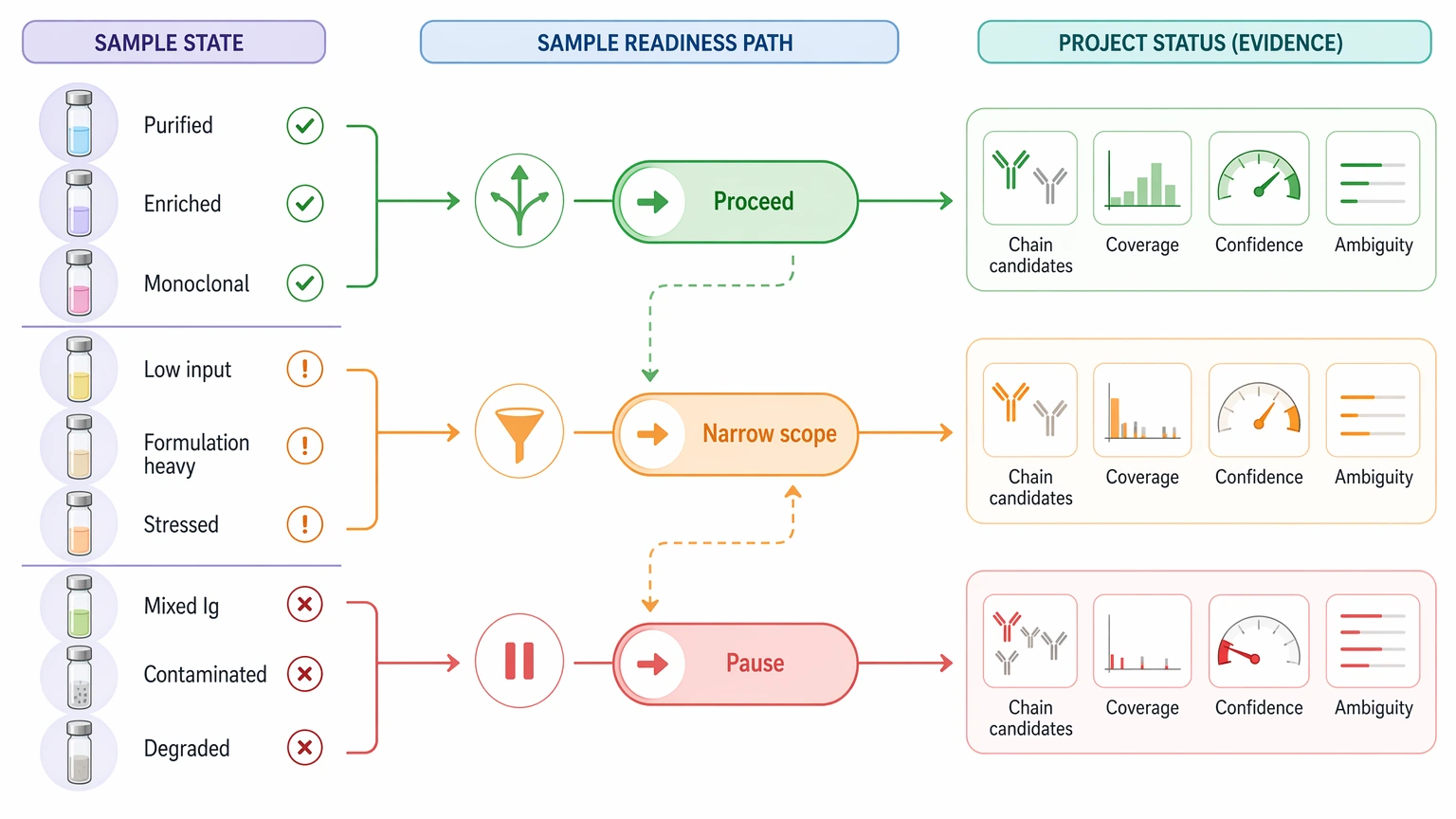
Most teams reach this stage after losing usable sequence records for an antibody asset they still need. The remaining material may be a purified monoclonal antibody vial, a hybridoma-derived preparation, an archived in-house stock, or a formulated product with an incomplete history. The practical question is not whether tandem mass spectrometry can detect antibody peptides. It is whether peptide-spectrum interpretation can support heavy chain and light chain reconstruction, especially in the variable region that matters most.
A second bottleneck appears when teams compare proposals. One provider may return only peptide lists, while another may include chain assignment, sequence coverage maps, complementarity-determining region support, intact mass checks, and orthogonal validation guidance. For a proceed-or-pause decision, the report format matters almost as much as the analytical workflow.
Where Approval Decisions Usually Stall
Approval decisions usually stall when the sample history is incomplete but the downstream use case is demanding. A team may only have one last vial, no trustworthy sequence record, and a redevelopment plan that depends on variable region recovery rather than a general identity check. In that situation, uncertainty about purity, degradation, and chain assignment directly affects whether the project should move forward or be narrowed first.
When De Novo Antibody Sequencing Is the Right Route
De novo antibody sequencing becomes relevant when reference sequence information is absent, unreliable, or unusable in a database-first workflow. If the true sequence is not represented in the searchable database, standard peptide identification cannot recover unknown variable region content. In that setting, LC-MS/MS is used to infer sequence from proteolytic peptides rather than confirm a known entry.
Antibody projects are harder than generic protein de novo work because the molecule includes a heavy chain and a light chain, disulfide bond architecture, conserved framework region segments, highly variable complementarity-determining regions, and a frequent post-translational modification burden such as glycosylation. These features do not prevent reconstruction, but they make chain-aware interpretation and transparent confidence reporting more important.
Project-Planning Steps Before You Commit the Sample
Step 1: Define the downstream decision first
Start with the technical or business use case. A project intended for recombinant rescue needs different evidence than one meant for vendor screening or identity review of a legacy reagent. If the sample may later support expression, clone recovery attempts, or diligence on a transferred asset, the report should clearly separate variable region evidence, constant region evidence, unresolved sites, and follow-up confirmation needs.
That framing keeps the scope realistic. Some samples can support near-complete chain candidates, while others are better suited to partial sequence recovery with targeted confirmation of key regions.
Step 2: Check whether the sample can enter an LC-MS/MS workflow
The most useful screening questions are simple: is the material enriched for one antibody, is the protein still intact, are interfering excipients or background proteins likely to dominate the digest, and is there enough sample for more than a single pass? The table below turns those questions into a planning filter.
| Sample type | Best fit | Constraint | Next step |
|---|---|---|---|
| Purified monoclonal IgG | Strong starting point for chain assignment and sequence coverage | PTMs and leucine/isoleucine ambiguity may remain | Move to workflow planning |
| Antibody-containing supernatant | Feasibility screening when purified stock is unavailable | Host proteins compete with antibody peptides | Consider enrichment first |
| Formulated antibody product | Useful when only final material remains | Excipients may interfere with digestion or LC-MS/MS | Review formulation details before submission |
| Archived low-volume stock | Can support partial reconstruction or targeted questions | Little reserve for repeats or orthogonal validation | Preserve aliquots and narrow priorities |
| Mixed immunoglobulin sample | Limited value for full reconstruction | Chain assignment may be confounded | Re-scope or seek purification |
Use this table as a readiness filter rather than a promise. Better starting material usually improves sequence coverage and interpretability, but no single sample category guarantees fully resolved output.
Step 3: Focus on the factors that most change feasibility
Four technical categories usually drive the decision. Sample complexity affects peptide attribution when non-antibody proteins dominate the digest. Molecular integrity affects sequence coverage because degradation, clipping, oxidation, or aggregation can reduce useful peptide overlap. PTM burden and disulfide-linked structure complicate digestion behavior and fragment interpretation. Available amount sets the depth of analysis because low-input projects limit replicate runs, multi-enzyme coverage, and orthogonal validation.
If you need a pre-submission screen tied to these decision points, submit your requirements to MtoZ Biolabs with sample type, available amount, formulation details, and intended downstream use so the project can be scoped around the material you actually have.
Step 4: Match the workflow to the sample, not to a standard package
For a purified monoclonal antibody, a stronger plan often includes reduction and alkylation, multiple proteolytic digestion conditions, peptide mapping, and chain-aware de novo assembly from LC-MS/MS evidence. For harder samples, the better plan may be narrower: targeted recovery of the variable region, partial sequence evidence, or confirmation of selected peptides rather than full reconstruction.
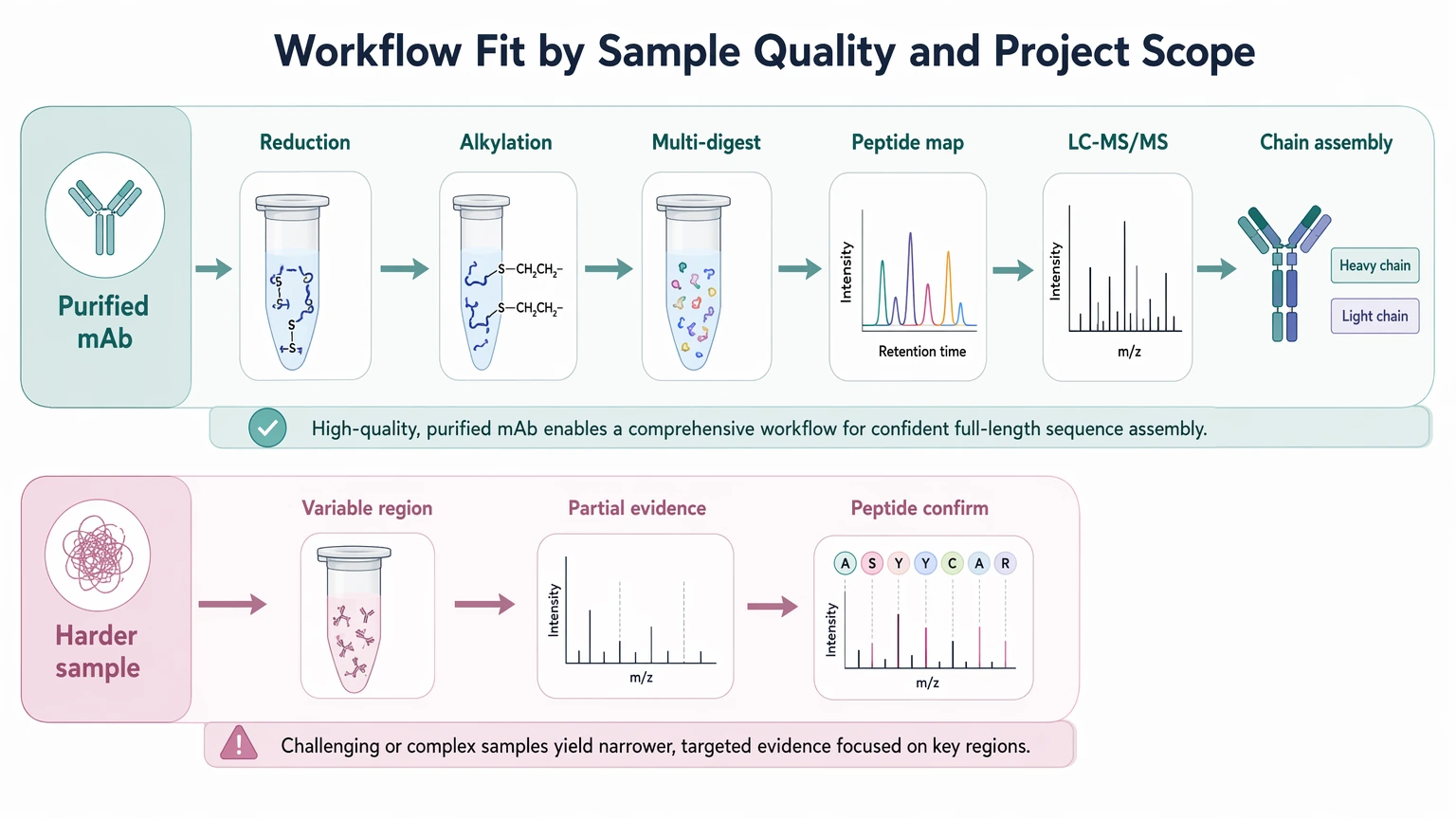
This is also the stage where teams should ask how ambiguity will be handled. Standard MS/MS does not always distinguish isobaric residues directly, so leucine/isoleucine ambiguity may remain at some positions. A credible report should flag those sites, note competing interpretations where relevant, and avoid presenting uncertain positions as settled facts. PTMs, incomplete fragmentation, and database-search limits can also leave unresolved sites even when the overall sequence confidence is still useful.
Service Routes to Consider
If the project is moving from feasibility review to sample commitment, the most useful next step is to align the service scope with the actual decision point rather than request a generic sequencing package.
Expected Outputs and Validation Methods
A useful report should separate what is delivered immediately from what still needs confirmation.
Immediate deliverables
For most de novo antibody sequencing projects, immediate outputs should include proposed heavy chain and light chain sequence candidates, chain assignment notes, sequence coverage by peptide evidence, residue-level confidence annotation, explicit sequence ambiguity flags, complementarity-determining region and framework region support context, relevant PTM observations, and peptide mapping or intact mass consistency checks when applicable.
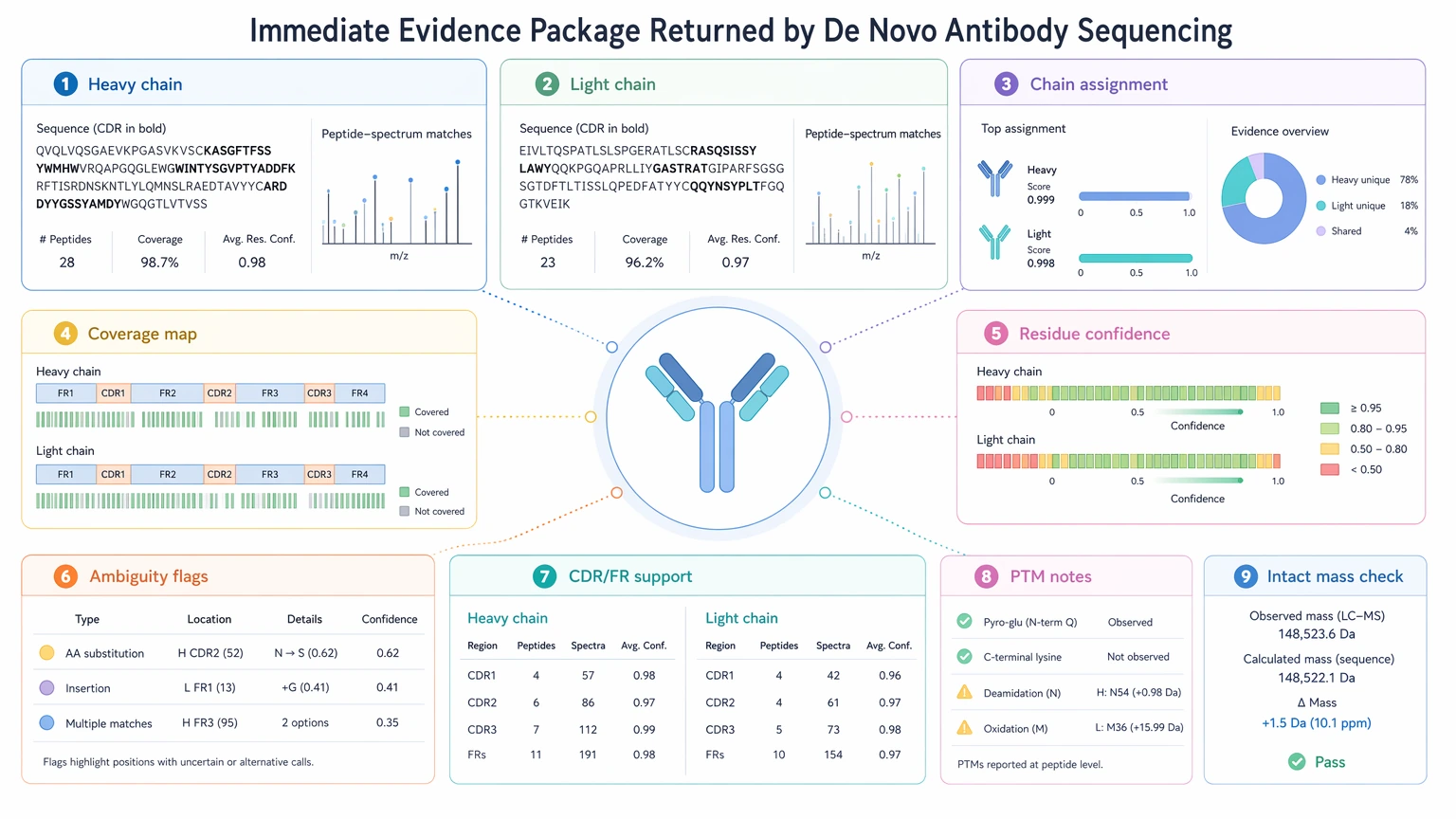
These deliverables help the reader decide whether the output is suitable for clone rebuilding, internal comparison, or technical due diligence.
Follow-up confirmation
Immediate deliverables are not the same as final confirmation. Follow-up orthogonal validation is often the next step when the sequence will be used for recombinant expression, redevelopment, or a high-stakes handoff. Common confirmation approaches include targeted LC-MS/MS for critical peptides, intact mass comparison against assembled sequences, and focused review of unresolved residues in a variable region or complementarity-determining region.
A useful handoff makes a clear distinction between what is interpretable now and what is confirmed for downstream use. That line matters most when localized uncertainty sits in functionally sensitive positions.
Key Cautions and Practical Limits
Before approval, teams should account for the limits that most often change outcome quality.
- Sample quality or amount limits: low-input, clipped, or stressed material can still produce usable spectra, but often with reduced overlap and weaker confidence in difficult regions.
- Controls and repeat expectations: if all material is consumed in one discovery pass, there may be no reserve for repeat analysis or targeted confirmation later.
- Batch or contamination risk: host-cell proteins, carrier proteins, serum background, gelatin, BSA, or formulation additives can obscure attribution and complicate chain assignment.
- Interpretation boundaries: sequence coverage does not guarantee certainty at every site. Sequence ambiguity, especially leucine/isoleucine ambiguity, low-confidence residues, or poorly fragmenting peptides, may remain even in otherwise informative datasets.
- When another route is better: if the sample is highly mixed, badly degraded, or nearly exhausted, the better next step may be antibody enrichment, recovery of new source material, hybridoma-based follow-up, or a narrower identity question rather than full de novo reconstruction.
Conclusion
De novo antibody sequencing is most useful for decision-making when the sample is sufficiently enriched, intact, and available for both discovery and at least some confirmation work. The strongest projects are scoped around a defined use case, such as legacy reagent recovery, recombinant redevelopment, or vendor evaluation, and they treat ambiguity as part of the output rather than as a reporting defect. If your team is reviewing an unknown antibody from purified IgG, archived stock, supernatant, or a formulation-exposed sample, contact MtoZ Biolabs to evaluate your project and discuss which sample state, deliverable format, and orthogonal validation path fit before you commit the remaining material.
FAQ
Can de novo antibody sequencing work if only the Fc is easy to cover?
Sometimes, but Fc-heavy evidence is usually not enough for the main decision. Constant region coverage can support isotype context and intactness checks, while redevelopment decisions depend much more on variable region and complementarity-determining region evidence.
Do heavy chain and light chain always have to be physically separated first?
Not always. Some workflows infer chain assignment from peptide evidence after digestion, but samples with cleaner chain-level information are easier to interpret than mixed or highly heterogeneous preparations.
Is glycosylation always a major problem for antibody sequence recovery?
No. Glycosylation is common and often manageable, but it can complicate peptide recovery and fragment interpretation around modified regions, especially when the sample is already limited or stressed.
What makes a vendor proposal stronger for this type of project?
Look for chain-specific reporting, sequence coverage summaries, residue-level confidence, unresolved-site flags, and a clear validation plan. A proposal that promises a clean final sequence without showing how uncertainty will be documented deserves closer review.
What should we prepare before opening a sequencing inquiry?
Prepare the sample type, approximate amount, concentration if known, purification history, buffer or excipient composition, storage history, expected monoclonality, and the intended use of the result. That information makes the feasibility discussion faster and more precise.
Related Services
Main Service |
Supporting Service |
Validation Service |
Alternative Service |
How to order?




