






Cell Proteomics: Principles, Workflow, and Applications
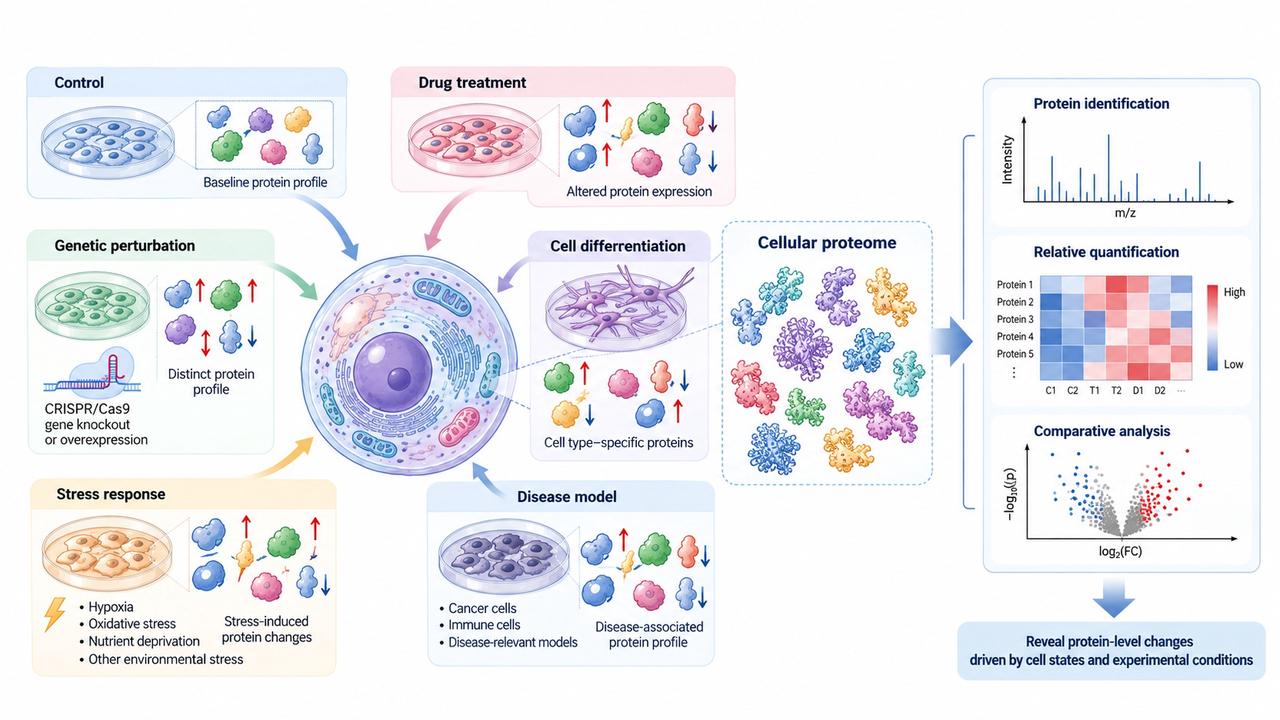
Cells are the basic structural and functional units of living systems and are widely used to study physiological changes, experimental treatments, and genetic perturbations. Cellular proteins participate in signal transduction, energy metabolism, cell-cycle regulation, stress responses, structural maintenance, and intercellular communication. Changes in cell type, culture state, treatment conditions, or genetic background can therefore be accompanied by changes in protein composition and abundance.
The cellular proteome describes the molecular state of a cell at the protein level and links experimental conditions with protein changes. Systematic analysis of cellular proteins can reveal broad differences between study groups, help prioritize proteins associated with specific experimental conditions, and provide clearer directions for subsequent functional validation and mechanism-oriented studies.
What Is Cell Proteomics?
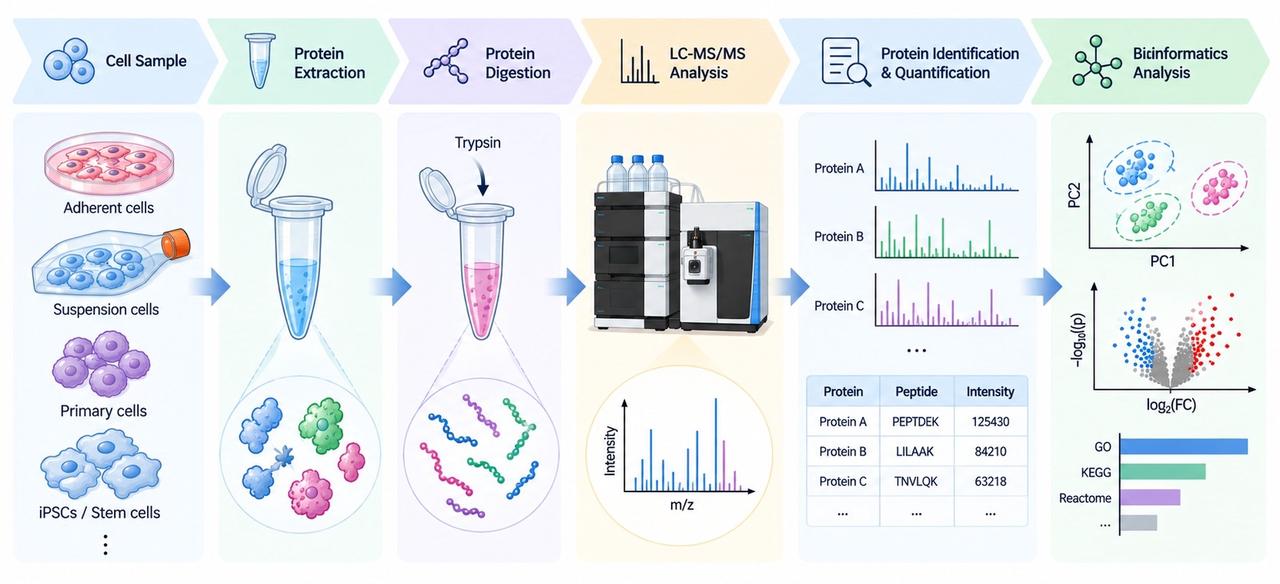
Cell Proteomics is proteomic analysis performed on cellular samples. In a typical workflow, proteins are extracted from cells, digested into peptides, analyzed by high-resolution LC-MS/MS, and processed to generate protein identification and relative quantification results.
Cell Proteomics can provide broad protein-level information for comparing abundance changes across samples or experimental groups. Differential analysis and functional analysis can then be used to identify protein changes associated with defined experimental conditions and to prioritize candidate proteins and research directions for follow-up studies.
Factors to Consider Before Cell Proteomics Analysis
Before Cell Proteomics analysis begins, the basic suitability of the cell samples should be reviewed. Cell number, cell type, sample condition, and experimental treatment history can all influence protein extraction and downstream data quality.
- Sample input: Cell number and available protein amount provide the material basis for analysis. Low-input samples may reduce protein identification depth and quantitative stability.
- Cell type: Different cells vary in structure, membrane composition, and protein content, and some cell types can be more difficult to extract efficiently.
- Sample condition and interference: Cell death, protein degradation, repeated freeze-thaw exposure, and residual culture medium, FBS, nucleic acids, lipids, or detergents can affect sample performance.
- Experimental treatment background: Drug treatment, transfection, gene editing, induced differentiation, and similar models should be accompanied by complete treatment and experimental records to support later interpretation.
Low-input samples, difficult-to-extract cells, or samples with clear quality abnormalities should be considered in relation to the sample condition and research objective. More information is available in Challenges in Cell Proteomics Analysis.
Cell Sample Types and Preparation Considerations
Before proteomic analysis, cell samples should be handled in a way that preserves the intended experimental state while minimizing interference from culture medium, serum, and other external components. Collection methods may differ by cell type, but sample condition, species information, and experimental background should be recorded clearly.
| Item | Basic Information |
| Supported cell types | Adherent cells, suspension cells, cell lines, primary cells, immune cells, stem cells, and other routine cell samples. |
| Submission format | Cell pellets, frozen cells, cell lysates, or extracted protein can be submitted; cell pellets are recommended. |
| Routine cell amount | Minimum approximately 5 × 10⁶ cells/sample; recommended approximately 1 × 10⁷ cells/sample. |
| Sample collection | PBS washing is recommended before collection to reduce culture medium and FBS residues; adherent-cell samples should also minimize trypsin carryover. |
| Storage and shipping | Liquid-nitrogen snap-freezing or storage at -80℃ is recommended, with shipment on dry ice; freeze-thaw cycles should generally be limited to 1-2. |
| Species and database information | Accurate species information is required for protein database matching; database availability should be confirmed in advance for non-model organisms. |
Samples below the routine input range can be evaluated for low-input or microscale proteomics according to cell number and research objectives. More detailed collection, storage, shipping, and submission guidance is available in Preparing Cell Samples for Proteomics Analysis: Collection, Storage, and Handling.
How to Design a Cell Proteomics Study?
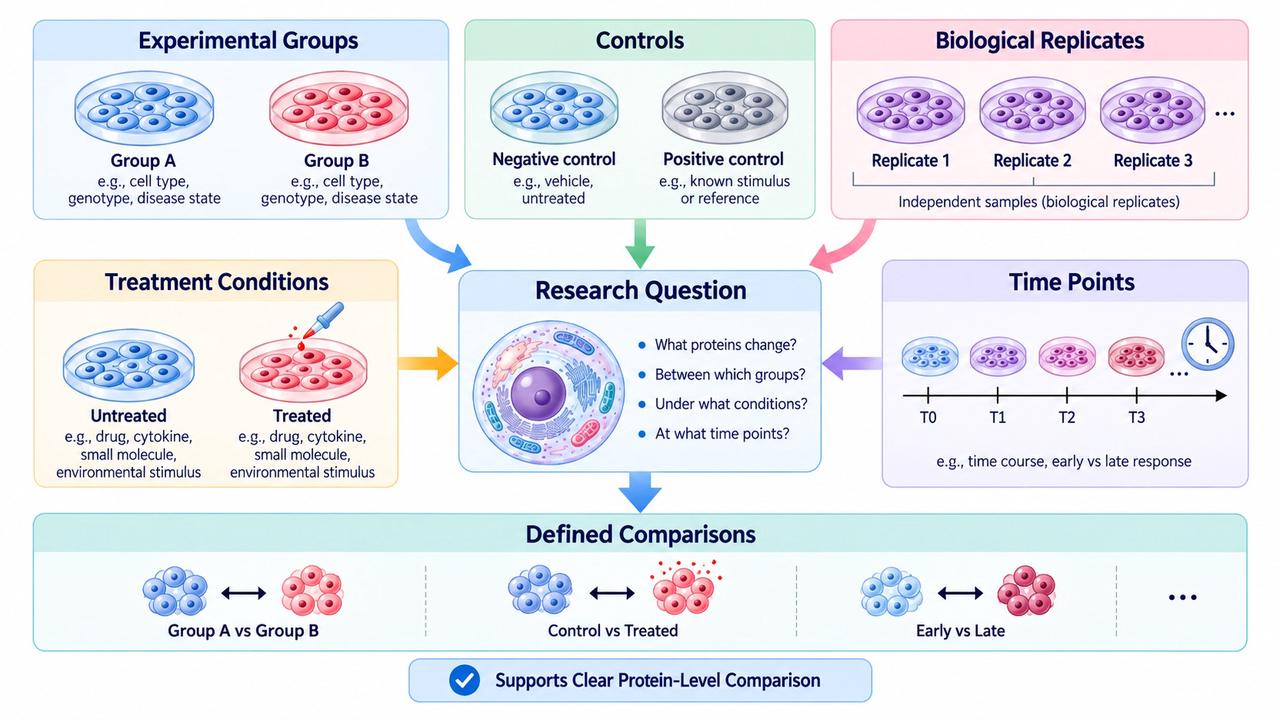
The purpose of Cell Proteomics study design is to convert a biological question into a comparison structure that can be analyzed directly. Experimental groups, controls, treatment conditions, and biological replicates should all support the same core question.
1. Define the Primary Research Question
Determine whether the project focuses on cell-state differences, treatment response, genetic perturbation, or candidate protein discovery.
2. Establish Experimental and Control Groups
Select controls that match the experimental conditions so that protein changes can be interpreted against a clear reference.
3. Control Non-Target Variables
Keep culture, collection, and storage conditions as consistent as possible across study groups to reduce variation unrelated to the research question.
4. Define the Experimental Structure
Plan biological replicates, treatment duration, time points, and batch organization according to the study objective.
More detailed study-design considerations are available in Cell Proteomics Experimental Design and Study Planning. If the cell model, experimental groups, and primary comparisons have already been defined, see Cell Proteomics Service for sample requirements, analytical workflow, and project deliverables.
Cell Proteomics Workflow
After cell samples enter the laboratory, analysis typically proceeds through sample assessment, protein preparation, peptide preparation, LC-MS/MS acquisition, and data processing.
- Sample Assessment: Confirm cell type, sample condition, and project information.
- Protein Extraction: Lyse cells and obtain protein samples suitable for downstream analysis.
- Protein Digestion and Peptide Preparation: Digest proteins into peptides suitable for LC-MS/MS measurement.
- LC-MS/MS Acquisition: Separate peptides by liquid chromatography and acquire raw data by tandem mass spectrometry.
- Data Processing: Convert mass spectrometry data into protein identification, relative quantification, and downstream analysis results.
The complete process from laboratory sample handling to protein identification and quantitative results is described in LC-MS/MS-Based Cell Proteomics Analysis Workflow.
Cell Proteomics Data Output and Deliverables
A completed Cell Proteomics project typically provides protein identification and quantification results, sample-level analyses, differential analysis, functional analysis, quality-control information, raw data, and an analysis report.
| Deliverable Module | Main Content |
| Protein identification and quantification | Protein identification results and quantitative matrix |
| Sample-level analysis | Correlation analysis, PCA, and clustering analysis |
| Differential analysis | Differential protein results for predefined comparisons |
| Functional analysis | GO, KEGG, PPI, and related results |
| Quality control | QC information related to data quality |
| Project files | Raw data and analysis report |
Subcellular localization is not part of the standard Cell Proteomics analysis scope. Projects focused on specific organelles or subcellular compartments require a dedicated analytical approach.
How to Interpret Cell Proteomics Data?
Cell Proteomics data should be interpreted by first reviewing sample and data quality, then examining protein abundance changes, and finally using functional analyses to place differential proteins into biological context. Different result types should be considered in the order in which the data are evaluated.
- Sample and data quality: Review QC information, sample correlations, PCA, and clustering to assess consistency across samples and whether the overall data pattern is broadly aligned with the experimental grouping.
- Protein quantification and differential changes: Use the quantitative matrix to compare relative protein abundance across samples or groups and identify statistically supported differential proteins for predefined comparisons. Direction of change, within-group consistency, and experimental conditions should be considered together.
- Functional analysis: GO, KEGG, and PPI results can organize differential proteins into functional categories, pathways, and protein relationships, helping define candidate directions for further study.
- Integrated interpretation: Protein changes and functional enrichment can support research hypotheses, but they do not independently prove protein function, pathway activation, or causal mechanisms.
A more detailed interpretation workflow is available in Cell Proteomics Data Analysis: From Protein Identification to Functional Interpretation.
Applications
Cell Proteomics can be used to compare protein changes across different cell states and experimental conditions and to identify broader protein patterns associated with a research question. Common research uses include:
- Comparing protein expression differences across cell states, culture conditions, or differentiation states.
- Examining cellular protein responses to drugs, stimulation, or other treatment conditions.
- Analyzing protein changes after gene knockout, overexpression, transfection, or other genetic perturbations.
- Prioritizing candidate proteins and biological directions from differential-protein and functional-analysis results.
- Investigating condition-associated protein changes in disease-related cell models, including cancer, immune, and metabolic research models.
Cell Proteomics primarily provides protein-level research evidence and can support the selection of candidates for downstream functional experiments and mechanism-oriented studies. More detailed applications are discussed in Application of Cellular Proteomics.
Frequently Asked Questions
1. If a target protein is not detected, does that mean the protein is absent from the cells?
Not necessarily. Protein detection depends on protein abundance, detectable peptides, sample complexity, and analytical coverage. A non-detected protein means that sufficient identification evidence was not obtained under the current analytical conditions; it does not establish biological absence.
2. Does identifying more proteins mean that a Cell Proteomics result is better?
Protein identification count alone is not sufficient to evaluate a project. Coverage should be interpreted together with sample type, research objective, and analytical conditions, as well as sample consistency, quantitative stability, and whether the predefined comparisons produce interpretable results.
3. Can multiple experimental groups or multiple time points be compared within one Cell Proteomics project?
Yes. Multi-group and multi-time-point designs can be included in the same project, but the primary comparisons, control conditions, replicate structure, and time-course design should be defined before the experiment to avoid confounding different experimental factors.
4. What is the typical timeline for a Cell Proteomics project?
A routine Cell Proteomics project generally takes 3-4 weeks. DIA and low-input projects typically follow a similar 3-4 week timeline, while TMT and PTM projects generally require 4-5 weeks. Expedited service is not currently available. The actual timeline can also be affected by sample number, project scale, sample condition, and analytical strategy. For a project-specific timeline, sample number, sample type, and analysis requirements can be provided for further consultation.
How to order?




