






Cell Proteomics Experimental Design and Study Planning
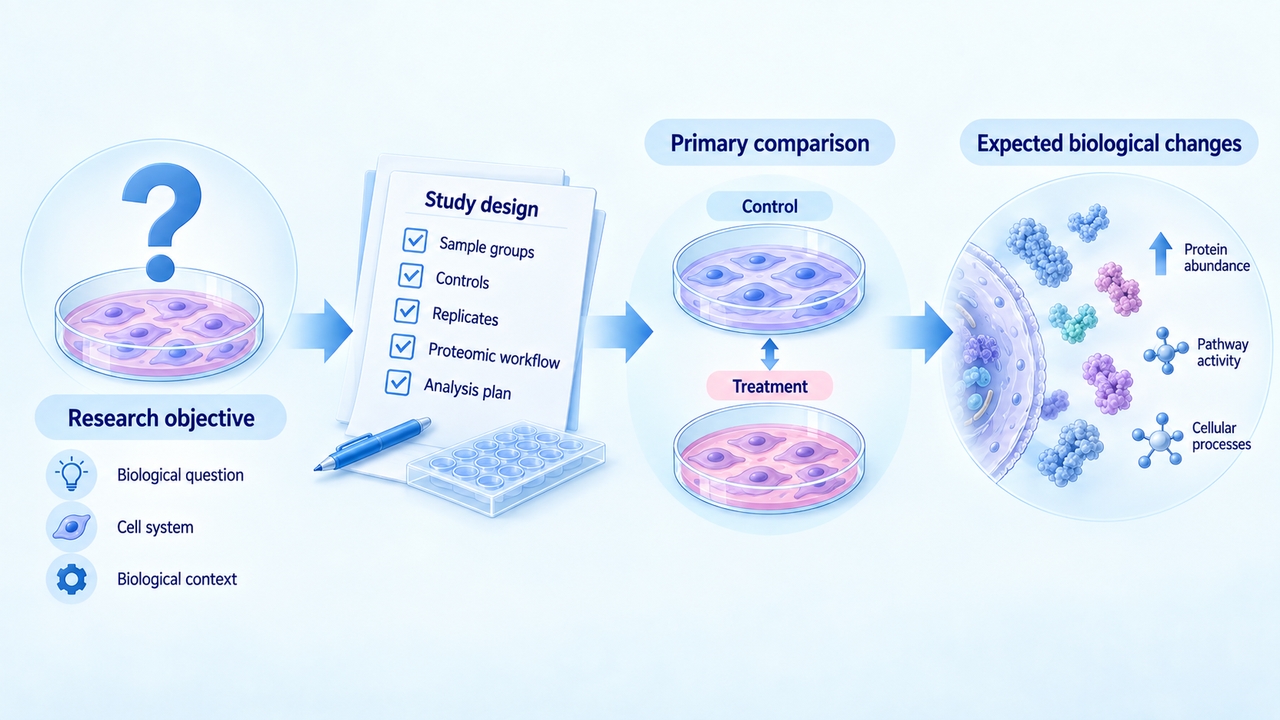
The central task in Cell Proteomics study design is to translate a biological question into a defined experimental comparison. Research objectives should correspond directly to experimental groups, control conditions, biological replicates, treatment factors, and sampling times so that protein identification, relative quantification, and group comparisons address the intended scientific question.
Study planning typically includes defining the research objective, establishing the primary comparison, selecting groups and controls, planning biological replicates, setting treatment conditions and time points, organizing experimental batches, and specifying the expected proteomics outputs. Each design element should remain aligned with the same research question throughout the study.
Defining Research Questions for Cell Proteomics Studies
1. Research Objective
The research objective should state the biological question that Cell Proteomics is expected to address. Typical objectives include comparing different cellular states, evaluating protein changes under a defined treatment, or examining protein differences associated with distinct genetic backgrounds. A clearly defined objective makes the subsequent group structure and comparison strategy more precise.
The objective does not need to predict individual differential proteins in advance. Instead, the objective should define the level of change under investigation, such as global protein-expression patterns, treatment-associated abundance changes, or protein alterations accompanying a defined cellular-state transition.
2. Primary Comparison
The primary comparison defines the central relationship between experimental conditions. Common examples include control vs treated, baseline vs post-treatment, and reference genotype vs modified genotype. Each primary comparison should include a clearly defined reference condition and comparison condition that directly correspond to the research objective.
Studies with multiple experimental groups should distinguish primary comparisons from supplementary comparisons. Primary comparisons address the central research question, whereas supplementary comparisons evaluate additional predefined relationships. A clear comparison hierarchy keeps the group structure and downstream analysis focused.
3. Expected Biological Changes
After the primary comparison is defined, the study should specify the type of biological change to be examined. The analysis may focus on broad proteome remodeling or on protein changes associated with a specific treatment, cellular state, or genetic background.
Defining the expected type of change is primarily a check on whether the planned experimental conditions can address the research objective. Studies of dynamic processes require sampling points that represent relevant stages, whereas studies focused on a single endpoint generally benefit from a simpler comparison structure.
Designing Experimental Groups and Controls
1. Experimental Groups
Experimental groups should represent the cellular states or treatment conditions being evaluated. When drug treatment, genetic perturbation, or another experimental factor is introduced, the group definition should make the corresponding condition difference explicit. When several groups are included, each group should support a predefined comparison.
2. Control Groups
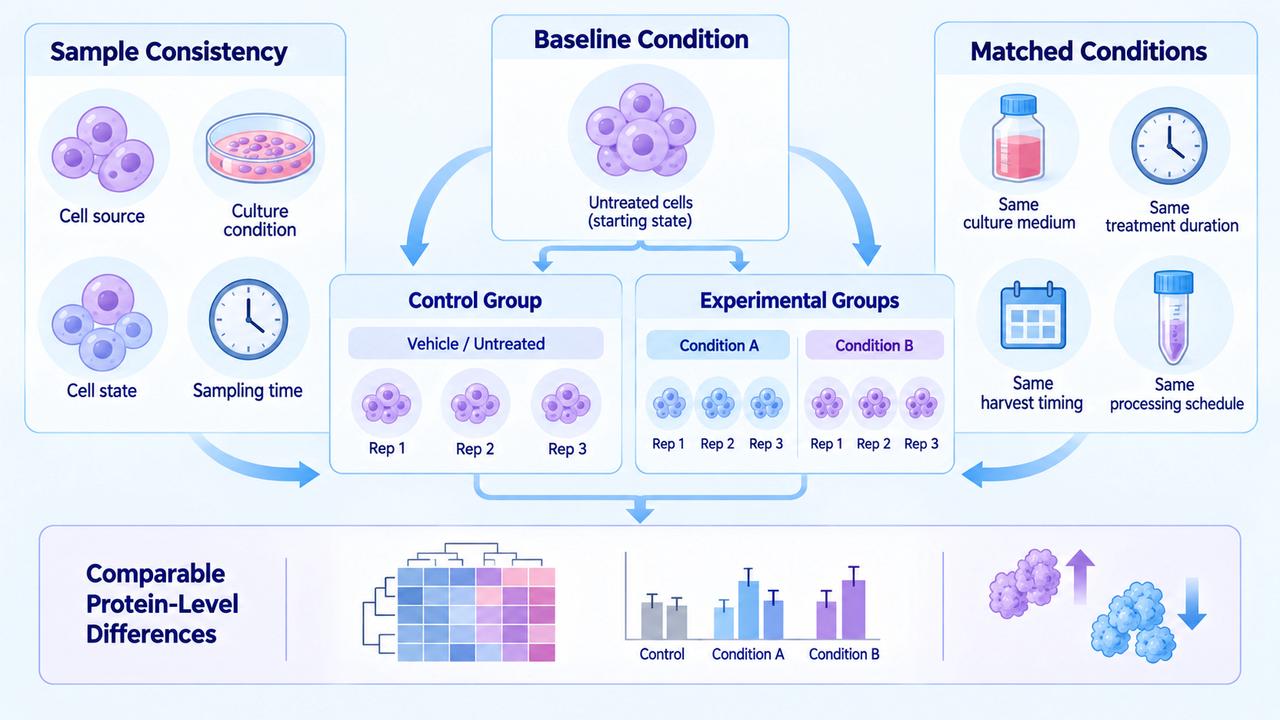
Control groups establish the reference for evaluating protein changes associated with the experimental condition. The control condition should match the study variable so that the principal difference between the control and experimental groups is the factor under investigation. The reference relationship should be defined before sample collection.
3. Baseline Conditions
Baseline conditions are particularly relevant to before-after and multi-time-point studies because they represent the state before the experimental change occurs. Baseline samples should form a continuous comparison with later treatment states or time points, allowing starting-state differences to be separated from changes observed after intervention. For studies that do not involve longitudinal comparisons, the need for a separate baseline depends on the research objective.
Biological Replicates and Sample Consistency
1. Biological Replicates
Biological replicates characterize variation among independent samples within the same experimental condition and support comparison of protein changes between groups. Replicate planning should consider the study objective, the biological variability of the cell model, the number of experimental groups, and sample availability rather than relying on a single fixed replicate number.
Replicates should cover every primary comparison. In studies with several treatment groups or time points, each major condition should include the independent samples required to preserve the intended comparison structure.
2. Sample Consistency
Samples within the same comparison should be kept consistent for experimental conditions that are unrelated to the research variable. Important factors include cell source, cultural environment, cellular state, treatment method, treatment duration, and sampling time. Consistency in these factors reduces variation that does not belong to the biological comparison.
Experimental groups are expected to differ in the biological factor defined by the study, but unrelated culture and handling conditions should remain as consistent as practical. The relevant consistency criteria should be defined during study planning and retained in the sample records.
Treatment Conditions and Time-Point Design
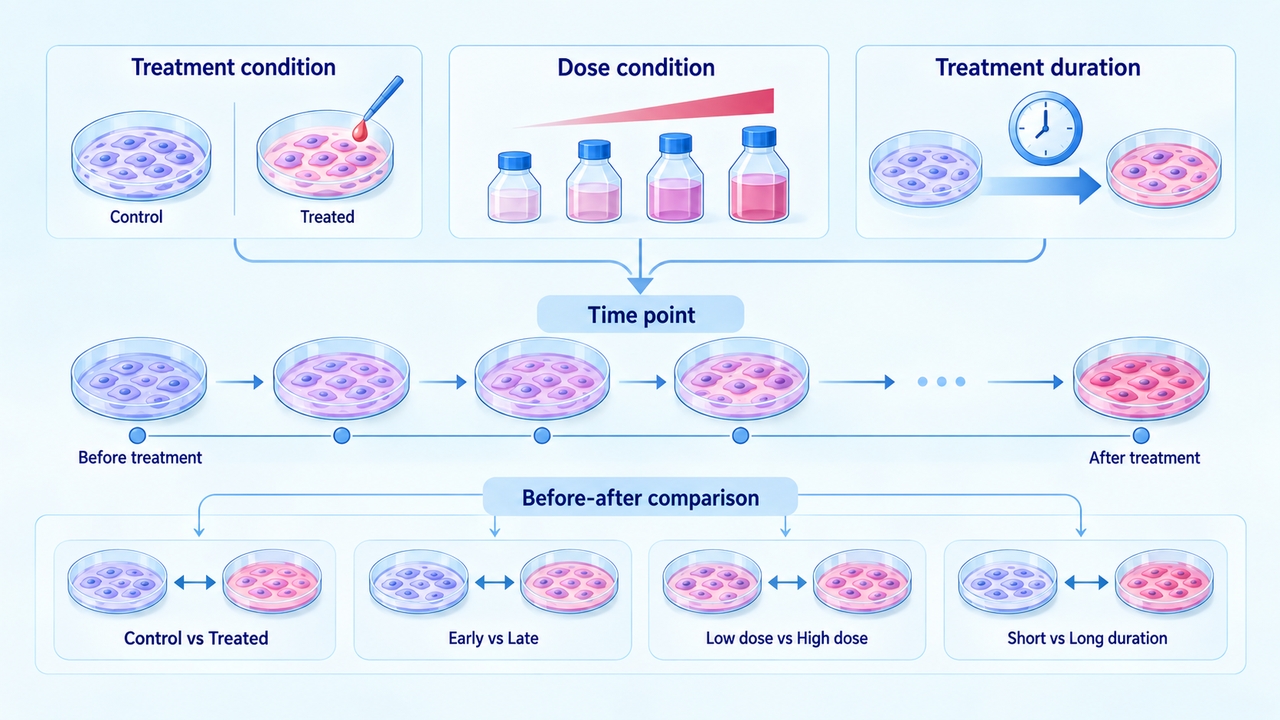
Treatment conditions and sampling times determine the biological stage represented in the proteomics dataset. Treatment condition, dose, duration, and time point should therefore be planned within the same comparison framework.
| Design Factor | Key Design Consideration |
| Treatment condition | Define the treatment state or cellular condition to be compared |
| Treatment duration | Determine the treatment stage represented by the protein changes |
| Dose condition | Define whether different treatment intensities need to be compared |
| Time point | Match sampling time to the biological stage of interest |
| Before-after comparison | Establish a direct comparison between pre-intervention and post-intervention states |
1. Treatment Conditions and Experimental Comparison
Treatment condition, dose, and duration should together form an interpretable experimental comparison. When several treatment factors are included, the comparison associated with each factor should be defined in advance, together with the condition combinations that require priority analysis. The experimental groups should remain aligned with the primary comparison.
2. Time-Point Selection
Time-point selection should reflect the cellular stage relevant to the research question. A single time point is suitable for evaluating a defined endpoint, whereas multiple time points can compare protein changes across different stages. Before-after and multi-time-point studies should specify the comparison relationships among sampling points before the experiment begins.
Increasing the number of time points also increases the number of samples and comparisons. Sampling schedules should therefore retain only the stages required to address the research objective.
Planning Experimental Consistency and Batch Organization
Cell Proteomics studies often involve multiple cellular groups and repeated experimental conditions, making consistency planning an important part of study design. Before starting the experiment, researchers should define how samples from different groups are organized and how experimental information is recorded to maintain a clear connection between samples and the intended comparison.
1. Batch Organization
Batch organization should be planned according to the structure of the experimental groups and the intended comparisons. When samples from different conditions are distributed across multiple batches, each comparison group should be considered within the overall experimental arrangement to maintain comparability between conditions.
2. Sample Order and Experimental Records
Sample order and experimental records should be established before data generation to maintain traceability throughout the Cell Proteomics study. Sample identification, group assignment, experimental conditions, and comparison relationships should be clearly documented so that each proteomics result can be associated with the corresponding cellular condition. Complete experimental records provide the necessary context for interpreting protein-level differences and maintaining consistency between the original study design and the generated dataset.
Defining Expected Outputs Before Cell Proteomics Analysis
Expected data outputs should correspond to the research question and comparison structure. Depending on the objective, the study may require protein identification, relative quantification, differential protein results, or functional analysis outputs.
| Research Need | Expected Proteomics Output |
| Describe the protein composition of cell samples | Protein identification |
| Compare protein abundance between experimental groups | Relative quantification |
| Identify protein changes associated with experimental conditions | Differential protein results |
| Summarize functional information associated with altered proteins | Functional analysis outputs |
Expected outputs provide a final check that the study design can support the research objective. Projects centered on group-level quantification should define the main quantitative comparisons during study planning, while projects that include functional analysis should ensure that the corresponding differential comparisons are already represented in the group structure.
After defining the experimental design and expected proteomics outputs, researchers can further evaluate the LC-MS/MS-Based Cell Proteomics Analysis Workflow used to generate protein identification and quantitative data.
Frequently Asked Questions
1. How many biological replicates are needed for Cell Proteomics?
The required number of biological replicates depends on the research objective, expected biological variation, and comparison design. Replicate planning should be considered together with the experimental question and the type of protein-level differences that the study aims to evaluate.
2. Can biological replicates and experimental groups be planned together in a Cell Proteomics study?
Yes. Biological replicates and experimental groups should be considered together during study planning. The relationship between experimental groups, biological variation, and comparison objectives should be defined before the experiment to ensure that the planned design matches the research question.
3. Can several time points share the same baseline?
Yes, if the baseline represents the same starting state for all later time points and the comparison structure is defined in advance.
4. Can samples generated in separate batches be included in the same study?
Yes. Experimental conditions involved in the primary comparisons should be distributed appropriately across batches, with complete batch records retained.
5. What should be reviewed if a new comparison objective is added during the study?
Reassess the experimental groups, reference conditions, biological replicates, time points, and expected data outputs required for the new comparison.
Conclusion
A Cell Proteomics study requires a clear connection between the biological question, experimental design, and expected data outputs. Defining the research objective, comparison groups, controls, treatment conditions, and required proteomics information before the experiment helps establish a clear relationship between the study design and the resulting protein-level information.
For an overview of Cell Proteomics concepts, experimental approaches, and research applications, refer to Cell Proteomics: Principles, Workflow, and Applications. When a defined research question needs to be translated into a specific Cell Proteomics study plan, MtoZ Biolabs can provide further support through the Cellular Proteomics Service or Contact Us.
How to order?




