






LC-MS/MS-Based Cell Proteomics Analysis Workflow
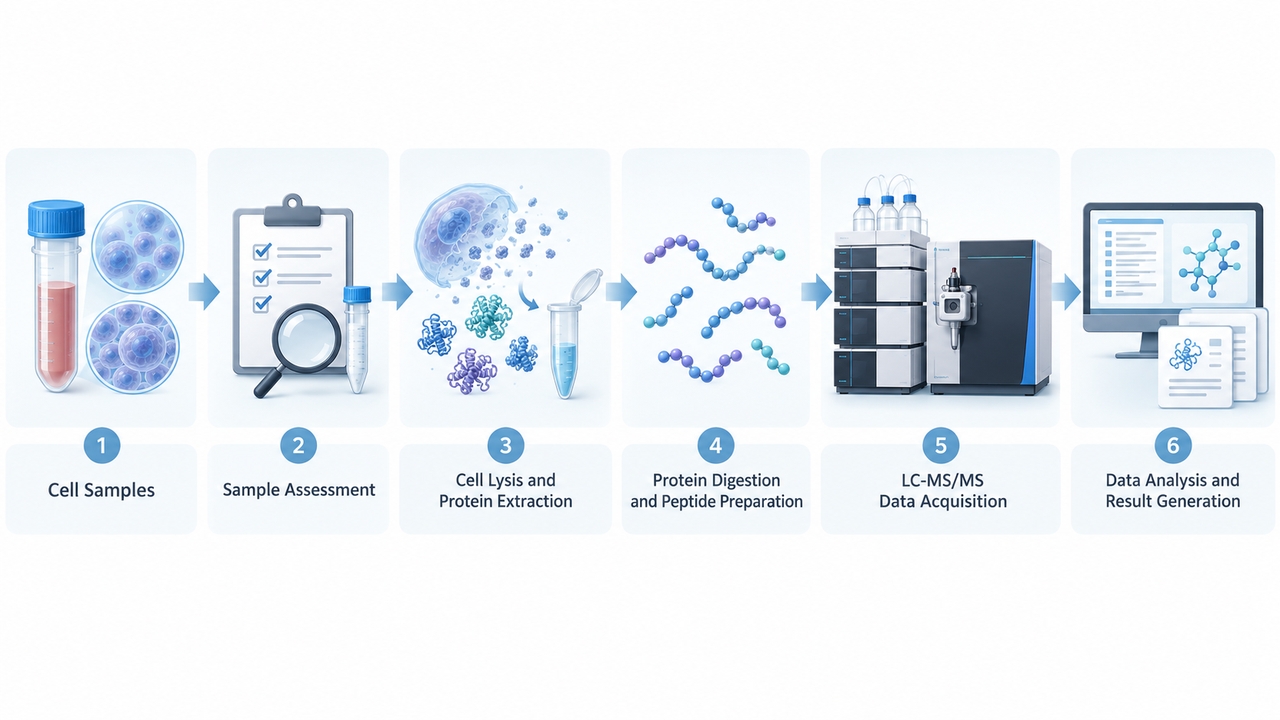
MtoZ Biolabs uses a high-resolution LC-MS/MS-based Cell Proteomics workflow to provide integrated analysis from cell samples to protein identification, relative quantification, and downstream comparative data. The workflow is applicable to common cell samples, including adherent cells, suspension cells, cell lines, primary cells, immune cells, and stem cells.
A stable and standardized analytical workflow directly affects proteomics data quality and result comparability. Protein recovery, digestion efficiency, chromatographic stability, mass spectrometric signal quality, and quantitative consistency across samples can all be influenced by sample condition and analytical settings. Depending on cell type, sample condition, available material, and study objective, protein extraction, peptide processing, or mass spectrometry strategies can be adjusted to match project-specific analytical requirements.
Sample Assessment and Pre-Analytical Preparation
1. Sample Condition Assessment
The main purpose of sample condition assessment is to determine whether the submitted material can enter the planned analytical workflow directly. Samples suitable for routine processing should have traceable sample identity, a submission format consistent with project records, sufficient usable material, and the expected storage condition. Obvious thawing, leakage, abnormal phase separation, severe viscosity, or substantial insoluble precipitate may affect subsequent protein recovery and comparability across samples.
| Assessment Item | Information to Confirm | Primary Decision |
| Sample Identity | Sample ID, group, and cell type are consistent with project records | The sample can be accurately traced and matched to downstream data |
| Submission Format | Cell pellet, frozen cells, lysate, or protein sample; confirm the processing stage already completed | Determine the starting point of the analytical workflow |
| Available Material | Cell amount or protein amount is sufficient for the planned extraction, digestion, and mass spectrometry analysis | Insufficient material may require adjustment of input or analytical strategy |
| Storage and Appearance | Expected low-temperature condition is maintained; container is intact; no obvious leakage, abnormal phase separation, severe viscosity, or substantial insoluble precipitate | Abnormal conditions require assessment of possible effects on protein recovery and processing consistency |
2. Laboratory Pre-Analytical Preparation
After sample assessment, the analytical starting point is determined according to the current processing status of the sample. Cell pellets and frozen cells generally enter cell lysis and protein extraction; cell lysates enter protein extraction or cleanup; samples that have already undergone protein extraction enter protein quality assessment and digestion preparation.
For multi-group or multi-batch projects, sample IDs, processing order, and experimental records should be standardized to avoid systematic differences between primary comparison groups caused by processing order.
Cell Lysis and Protein Extraction
1. Cell Lysis and Protein Release
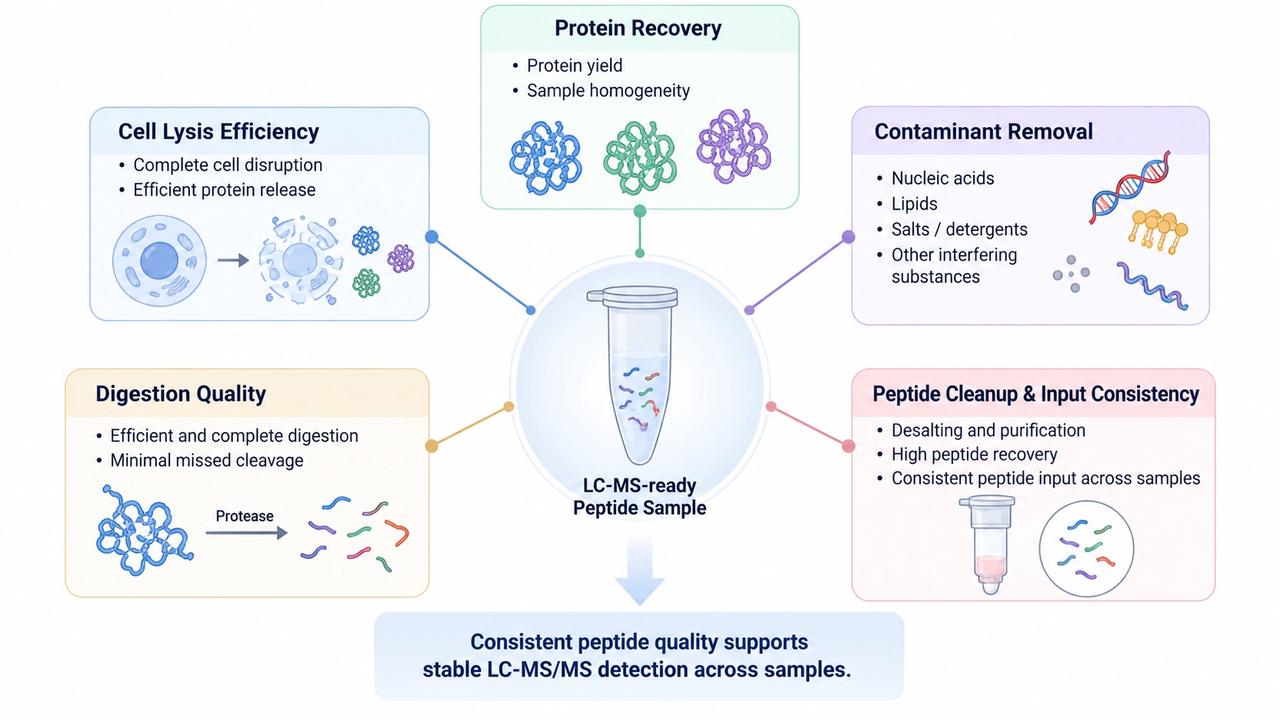
Cell lysis disrupts cellular structures and releases intracellular proteins into an extractable form. Cell types differ in cellular architecture, membrane composition, and protein composition, which can affect protein release efficiency. Routine cell samples can be processed using chemical lysis together with appropriate physical disruption to improve cell breakage and protein release.
Sample homogeneity should be examined after lysis. Nucleic acid release can cause marked viscosity, while incomplete disruption can reduce the release of some proteins. Depending on the lysate condition, appropriate homogenization, nucleic-acid reduction, and clarification steps can be used to obtain a stable sample for subsequent protein extraction.
2. Protein Extraction and Sample Cleanup
In addition to proteins, cell lysates contain nucleic acids, lipids, cellular debris, and components from the lysis system. Protein extraction aims to retain analyzable proteins while reducing substances that interfere with digestion, liquid chromatography, or mass spectrometric detection. Depending on sample condition, clarification, precipitation, filtration, or other cleanup approaches can be used to obtain a protein fraction suitable for downstream processing.
Samples with abundant membrane components, structural proteins, or high post-lysis viscosity generally require more extensive homogenization and contaminant removal to reduce interference from lipids, nucleic acids, or insoluble material during digestion and LC-MS/MS analysis.
3. Protein Quality Assessment
After protein extraction, protein recovery and consistency across samples are evaluated. Protein concentration and total protein amount are used to confirm sufficient input for digestion, while sample homogeneity and solubility indicate whether the protein material is suitable for further processing. For samples within the same comparison, pronounced imbalance in protein input should also be identified before digestion.
When protein recovery is insufficient, sample condition differs substantially across samples, or stable protein input cannot be obtained, sample processing should be adjusted before digestion; otherwise, peptide yield may be insufficient or identification depth may vary across samples.
Protein Digestion and Peptide Preparation
1. Protein Processing and Enzymatic Digestion
LC-MS/MS-based proteomics identifies and quantifies proteins primarily through peptide signals, so extracted proteins must be converted into peptides suitable for mass spectrometric analysis. Before digestion, protein samples generally undergo structural unfolding and appropriate processing so that proteases can consistently access cleavage sites. Proteins are then digested with proteases of defined cleavage specificity to generate peptide mixtures for mass spectrometry.
Digestion quality determines the completeness of peptide evidence. Incomplete digestion increases uncleaved or missed-cleavage peptides and can reduce effective peptide coverage for some proteins; large differences in digestion efficiency among samples can also reduce the comparability of relative quantification. Protein input and digestion conditions should therefore remain consistent within a routine comparative project.
2. Peptide Cleanup and Preparation for LC-MS/MS
After digestion, peptide samples are purified and desalted to reduce salts, detergents, and other components that may interfere with chromatographic separation or mass spectrometric ionization. Purified peptides are then appropriately concentrated and reconstituted to produce a peptide mixture suitable for LC injection.
Peptide preparation focuses on peptide recovery, sample clarity, and consistency of peptide input across samples. For isotope-label-based quantification, labeling can be introduced at the peptide stage. Projects requiring greater analytical depth may include peptide fractionation to reduce sample complexity in each LC-MS/MS analysis.
LC-MS/MS Data Acquisition
1. Liquid Chromatography Separation
Peptide mixtures are separated by liquid chromatography before entering the mass spectrometer. LC distributes complex peptide mixtures across different retention times according to peptide retention properties, allowing peptides to enter the mass spectrometer sequentially and reducing signal overlap caused by simultaneous detection of many peptides in complex samples.
Chromatographic quality is evaluated mainly through retention-time stability, peak shape, and signal reproducibility. Pronounced retention-time drift, peak broadening, or signal fluctuation can reduce consistency of peptide detection and affect cross-sample quantification.
2. Tandem Mass Spectrometry Acquisition
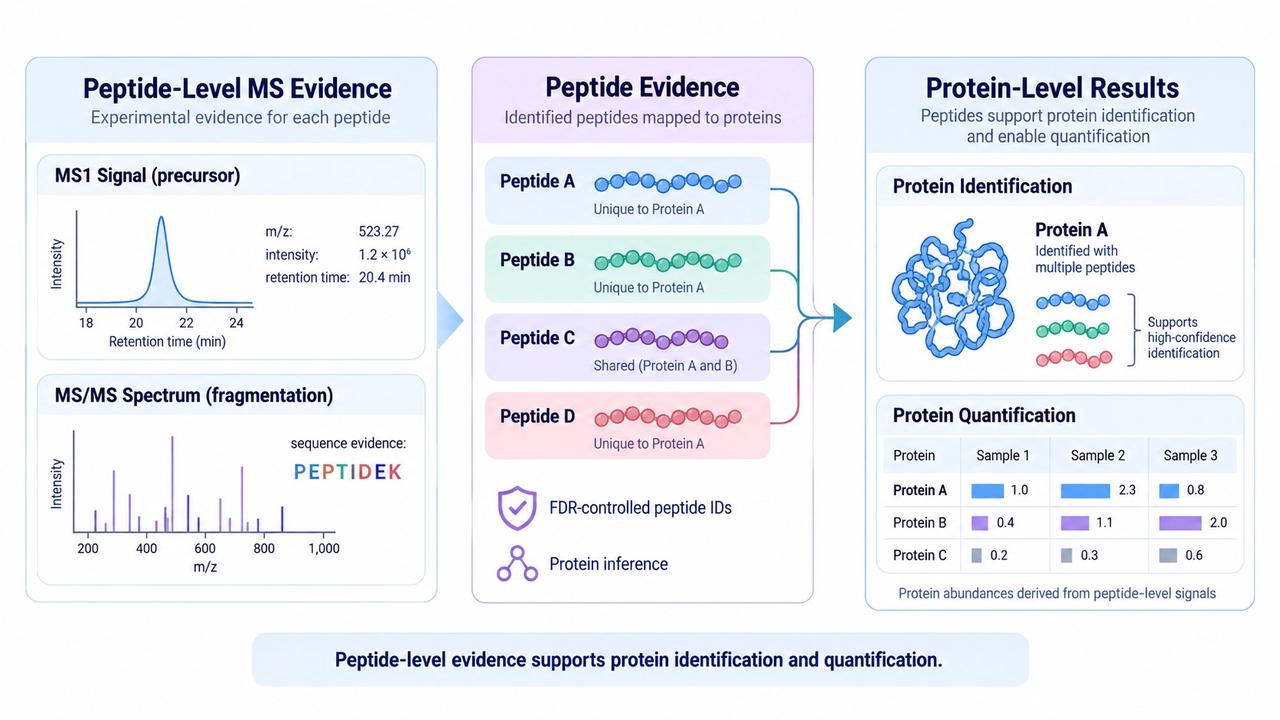
High-resolution mass spectrometry first records the mass-to-charge ratios and signal intensities of peptide precursor ions, followed by tandem mass spectrometric acquisition of fragment-ion spectra. Fragment spectra contain sequence-related information and provide the main evidence for database searching and peptide identification.
LC-MS/MS acquisition generates raw mass spectrometry data containing retention times, precursor-ion information, fragment-ion information, and quantitative signals. Spectral coverage and signal stability determine the amount of peptide evidence available for database searching and influence the completeness of the quantitative matrix.
Data Analysis and Result Generation
1. Database Search and Protein Identification
MS/MS spectra generated by LC-MS/MS are matched against the protein sequence database appropriate for the project. Database searching identifies candidate peptides using precursor-ion mass, fragment-ion information, and digestion specificity, while false discovery rate control is applied to limit incorrect identifications arising from random matches.
Peptides that pass quality control are further used for protein assignment. Unique peptides can directly support specific proteins, whereas shared peptides require integration of all peptide evidence during protein inference. The final protein identification results are supported by reliable peptide-level evidence.
2. Relative Protein Quantification
Relative protein quantification begins with extraction of quantitative signals at the peptide level, followed by cross-sample organization and protein-level aggregation. After appropriate normalization and protein summarization, a protein quantitative matrix can be generated with proteins as rows and samples as columns.
The protein quantitative matrix records relative protein abundance across samples and can be used for correlation analysis, PCA, clustering, between-group comparison, and differential protein analysis. Missing peptides, unstable signals, or differences in overall sample quality can increase missing values and cross-sample bias in the quantitative matrix.
3. Downstream Analysis Outputs
Protein identification results and protein quantitative matrices can be further used for differential protein analysis and functional analyses such as GO, KEGG, and PPI. These analyses organize and compare protein-level changes to support subsequent interpretation. For detailed interpretation of differential proteins, functional enrichment, and protein interaction results, see Cell Proteomics Data Analysis: From Protein Identification to Functional Interpretation.
Frequently Asked Questions
1. What is the relationship among PSMs, peptide identification, and protein identification?
A PSM is a match between an MS/MS spectrum and a candidate peptide sequence. Peptide evidence that passes quality control is then used for protein inference and protein identification.
2. Is relative quantification required if the project only needs protein identification?
No. Protein identification determines which proteins are supported by peptide evidence in the sample, whereas relative quantification compares protein abundance across samples.
3. Why is one protein often supported by multiple peptides?
Proteolytic digestion can generate multiple detectable peptides from the same protein. Multiple independent peptides strengthen the evidence for protein assignment and reduce uncertainty associated with a single peptide.
4. Can raw mass spectrometry data be reanalyzed using an updated database?
Yes. If the raw data and necessary analysis parameters are retained, the data can be searched again against an updated protein sequence database for renewed peptide and protein identification.
Conclusion
Cell Proteomics workflow converts cellular protein samples into proteomics datasets through sequential steps, including sample assessment, protein preparation, LC-MS/MS acquisition, and data analysis. The workflow links cellular protein samples with protein identification and quantitative results through sequential laboratory processing and LC-MS/MS analysis.
For a broader overview of Cell Proteomics principles, workflow design, and research applications, refer to Cell Proteomics: Principles, Workflow, and Applications. For specific cell sample evaluation or project requirements, refer to Cellular Proteomics Service or contact MtoZ Biolabs for further assessment.
How to order?




