






Antigen vs Epitope: Method Selection and Research Use Cases
Quick Decision Block
Use this comparison table to match the study question to the most defensible starting method before committing sample and analysis time.
| If your main question is... | Start here | Why |
|---|---|---|
| What is the target molecule or sequence? | Antigen-level identification | You need the broader identity before making a binding-site claim. |
| Where does binding occur on a known target? | Epitope mapping | The parent protein is already defined, so localization becomes the main task. |
| Why did database search fail on a plausible target? | De novo peptide sequencing or de novo protein sequencing | Direct interpretation may recover sequence evidence that reference matching misses. |
| Is the suspected binding region structure-dependent? | Epitope mapping plus orthogonal confirmation | A conformational epitope usually cannot be proven by LC-MS/MS alone. |
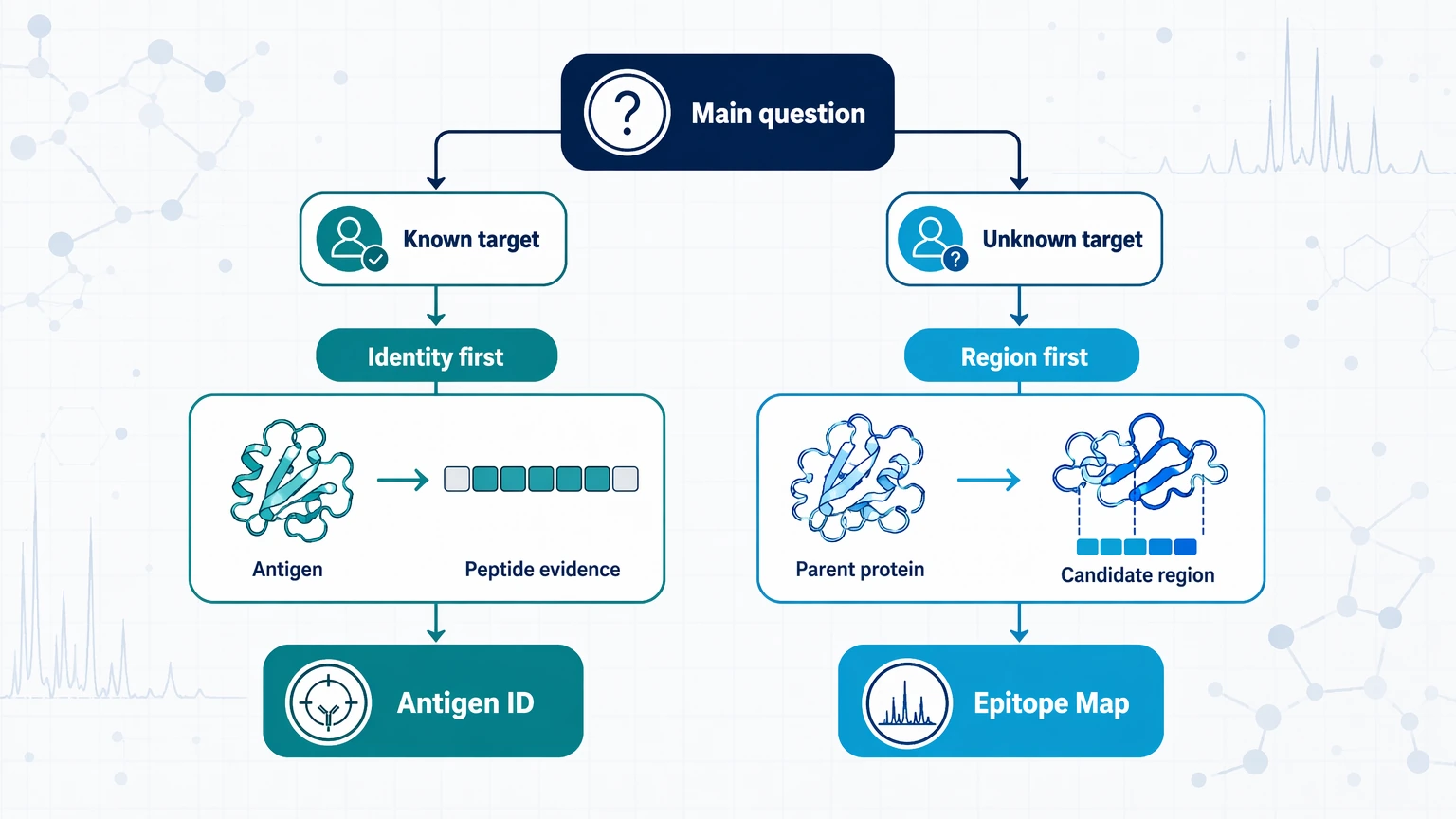
As a starting rule, choose antigen-level identification when sequence identity is still uncertain, choose epitope mapping when the parent protein is already known, and move to de novo sequencing when database search leaves too much unresolved for a clean conclusion.
Antigen vs Epitope: Why the Distinction Changes the Workflow
An antigen is the broader molecule recognized by an immune component. An epitope is the specific region, sequence segment, structural patch, or modification-dependent feature recognized within that antigen. One antigen can contain multiple epitopes, including linear epitopes and conformational epitopes.
This distinction changes what the experiment must deliver. Antigen-level identification asks what the target is. Epitope mapping asks where recognition occurs within that target. De novo peptide sequencing and de novo protein sequencing address cases where sequence cannot be recovered confidently by database matching alone.
Teams often say they need “the epitope” when the real gap is earlier in the workflow. If the parent target is still uncertain, a narrow localization claim can end up resting on weak assumptions. When the antigen is already well defined, broad identification usually adds less value, and a focused epitope strategy becomes the better first move.
When Antigen-Level Identification Should Come First
Antigen-first planning fits projects where target identity is still unresolved. Common examples include an unknown antibody-binding band, an enriched fraction from a poorly annotated species, a peptide mixture with unexpected variants, or a PTM-rich sample that produces inconsistent matches.
In these studies, the first useful deliverables are broader than a binding-region hypothesis: candidate peptide or protein assignments, sequence tag evidence, fragment-ion coverage across informative spectra, estimated peptide coverage across the parent target, a statement of sequence confidence, and PTM annotation where supported.
A database search may still be the opening step, but it should not be the only step when the evidence remains fragmentary. A few weak matches may point to a protein family without establishing the actual antigen. That pattern is common when the sample contains novel sequence content, truncation, or multiple modifications. If the next project decision depends on identity, the parent target has to be defined well enough to support antibody comparison, follow-up peptide design, or recognition analysis.
When Epitope Mapping Is the Better First Question
Epitope-first planning works best when the antigen is already known with reasonable confidence and the project is specifically about recognition. Typical examples include mapping a short region on a known construct, comparing binding differences between antibodies, or testing whether a local sequence change or PTM alters recognition.
The epitope class matters. A linear epitope is more compatible with sequence-resolved evidence because the recognized feature is tied to a contiguous amino acid segment. A conformational epitope depends on three-dimensional structure, so sequence data alone rarely captures the full recognition surface. LC-MS/MS can support local sequence context and PTM analysis, but it does not automatically prove a conformational binding site.
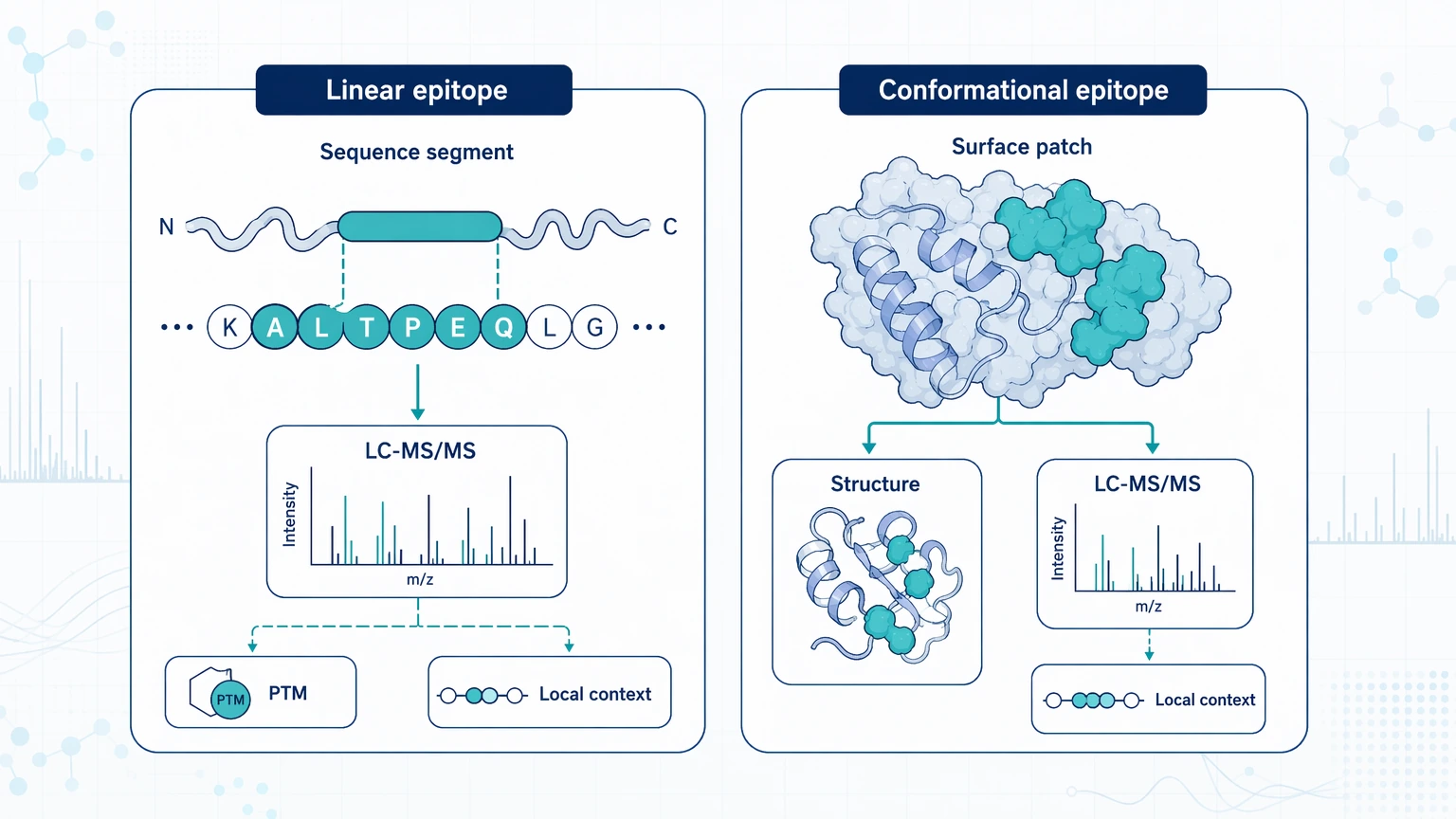
That boundary matters in practice. MS/MS-based interpretation can narrow candidate regions, but epitope claims usually stay provisional until orthogonal confirmation is added. Depending on the study, that follow-up may include peptide synthesis, targeted MS, mutational testing, or a binding assay matched to the biological question.
Why Database Search Often Stops Short
For known, well-annotated targets, database search can be enough. Problems begin when the sample no longer fits those assumptions. The most common failure modes are sequence novelty or incomplete reference coverage, heavy PTM burden, insufficient fragment-ion coverage, mixed sample composition, contamination risk, and low peptide coverage across the parent protein.
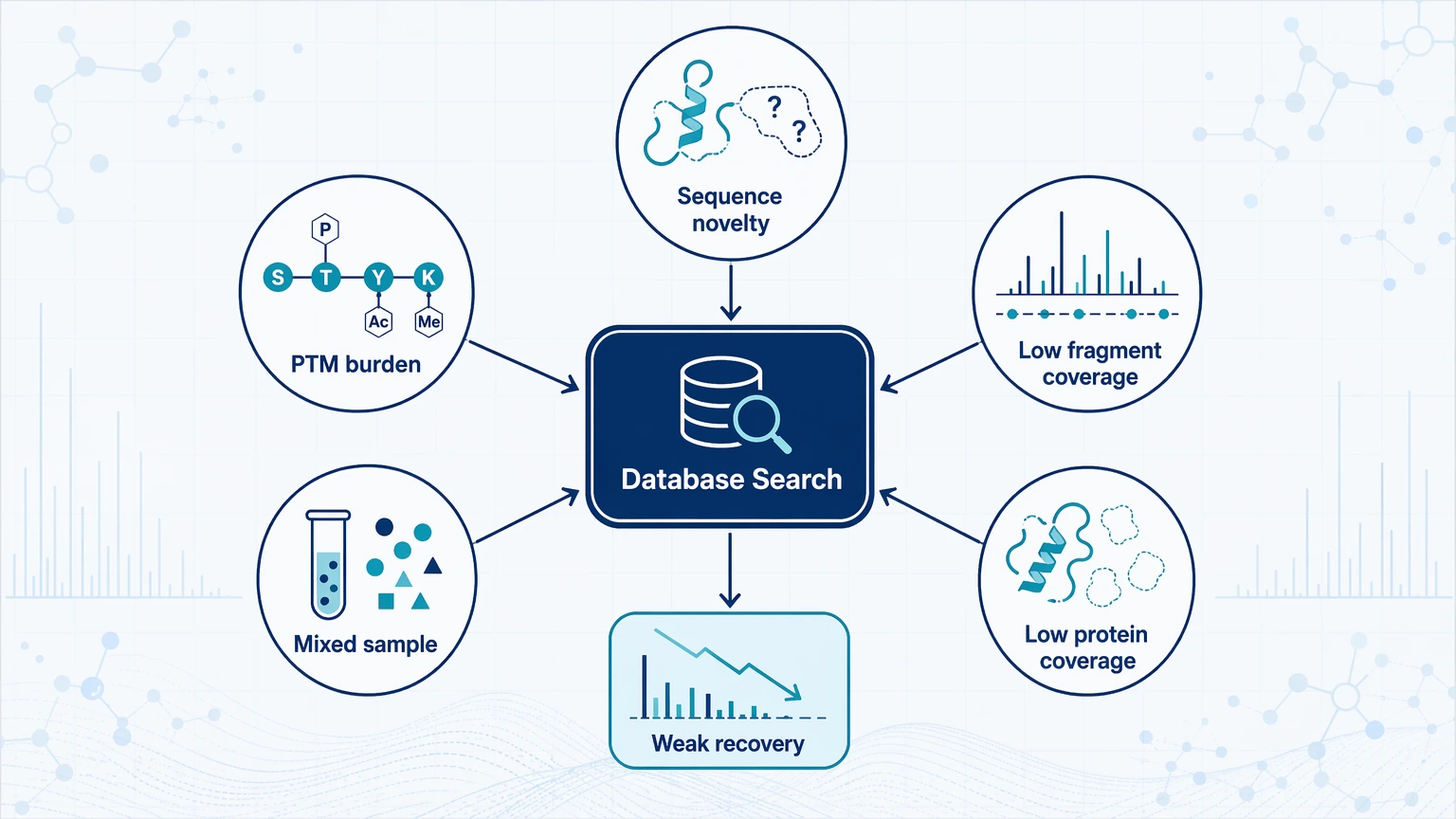
Under those conditions, partial evidence may support only a homolog or family assignment while leaving the actual antigen unresolved. Repeating the same search settings often produces the same ceiling. Once that ceiling is clear, the next question is whether direct sequence interpretation is required instead of another database-dependent pass.
When De Novo Sequencing Becomes the More Appropriate Next Step
De novo peptide sequencing is useful when the sample contains peptides that are novel, variant-bearing, truncated, or modification-heavy enough to frustrate reference matching. De novo protein sequencing becomes more relevant when the broader target must be reconstructed from multiple peptide-level observations.
This shift usually makes sense when three signs appear together: database recovery is weak, spectra still contain interpretable fragmentation, and the project needs sequence evidence rather than a loose family-level label. Typical use cases include unknown antibody-binding peptides, poorly annotated organisms or constructs, PTM-sensitive targets, biologics-related samples with sequence deviations, and enriched fractions that produce partial but not decisive hits.
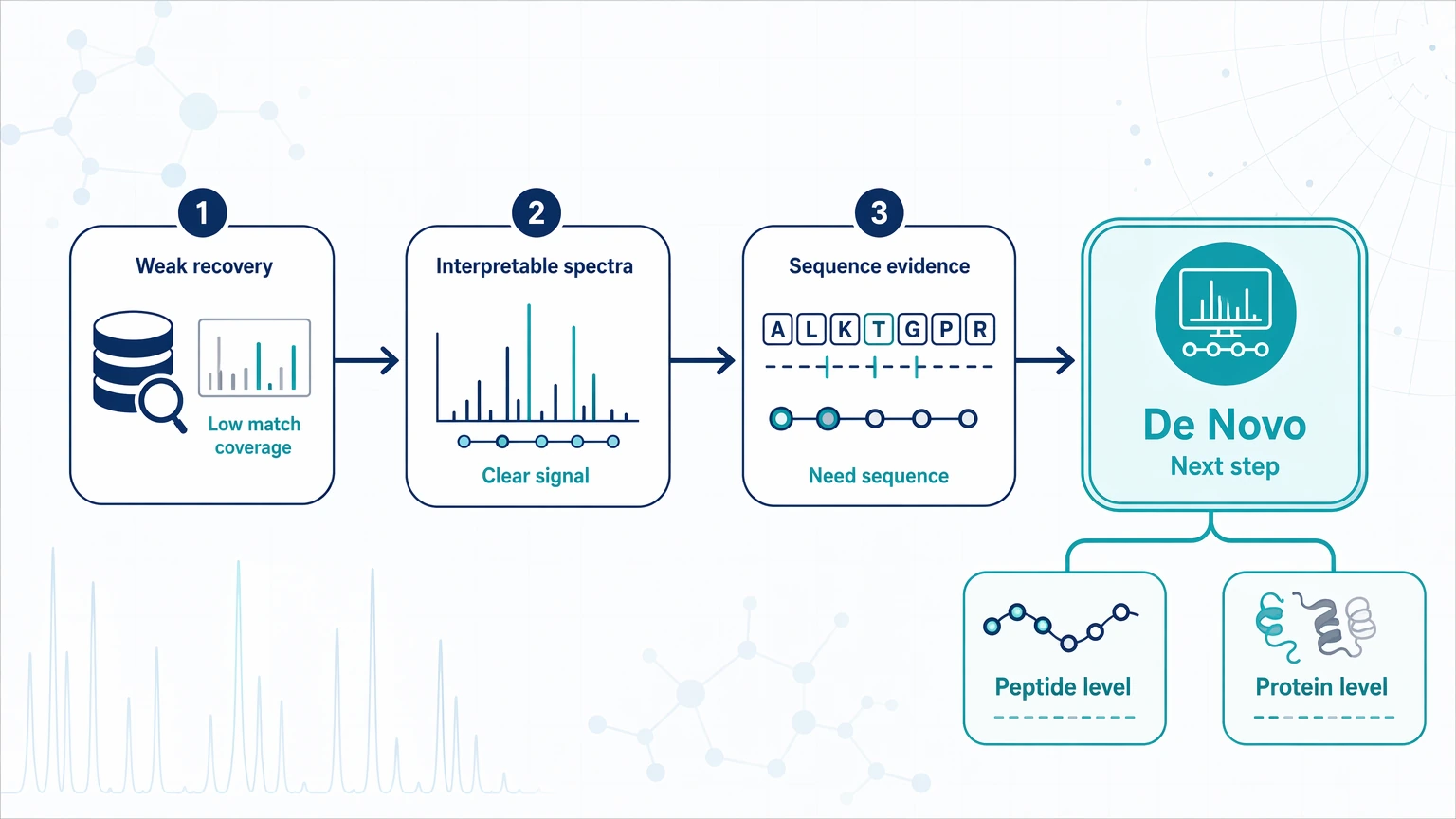
Even so, de novo interpretation generates candidate sequence paths from spectral evidence, not certainty by default. Sparse fragment-ion coverage, unresolved PTM localization, or residue-level ambiguity can limit the result to candidate sequence or candidate region evidence. If your data sit in that gray zone, you can submit your requirements to MtoZ Biolabs for a workflow review tied to sample type, LC-MS/MS evidence, de novo sequencing feasibility, and the report output the project actually needs.
Expected Results and Validation Methods
A practical plan separates immediate analytical deliverables from later confirmation. The table below shows how those outputs differ between antigen-level and epitope-oriented work.
| Project focus | Immediate deliverables | Common follow-up confirmation |
|---|---|---|
| Antigen-level identification | Candidate antigen identities, de novo sequence candidates, PTM annotations, peptide coverage summary, sequence confidence statement, unresolved regions | Targeted LC-MS/MS, MRM, synthetic peptide confirmation, orthogonal identity checks |
| Epitope-oriented characterization | Candidate localized region, support for linear epitope claims when sequence evidence is adequate, interpretation limits for conformational recognition, shortlist of next experiments | Peptide testing, mutational verification, binding assays, structure-aware methods for conformational questions |
The key takeaway is that a mapped candidate region is not the same as a functionally confirmed epitope, and partial sequence reconstruction is not the same as full antigen definition.
Key Cautions and Practical Limits
Method selection is strongest when the limits are explicit from the start. Low input, degradation, or complex mixtures can reduce peptide recovery and weaken MS/MS interpretation. Replicate runs, blank controls, and comparison samples may be necessary when the target is low abundance or contamination is plausible. Co-purified proteins, carryover, and mixed precursor isolation can also create misleading signals in enriched binding fractions.
Interpretation boundaries matter just as much. Limited fragment-ion coverage, ambiguous PTM localization, short sequence tag continuity, and incomplete peptide coverage can restrict conclusions to candidate-level rather than definitive assignment. When the main question concerns a conformational epitope, intact complex recognition, or functional binding under native structure, structural or assay-based methods may be more informative than deeper sequence interpretation alone.
Service Routes to Consider
When the project decision depends on sequence recovery quality or on moving from candidate identity to confirmation, these routes are often the most direct next steps:
- De Novo Peptide Sequencing Services for unknown peptides, variant-rich targets, and failed database recovery.
- De Novo Protein Sequencing Service for reconstructing broader target identity from peptide-level evidence.
- LC-MS/MS Analytical Service for project planning around spectral quality, sample suitability, and report scope.
- LC-MS/MS-Based Targeted Site Validation Service for checking candidate regions or modified sites after discovery work.
FAQ
Can one antigen contain several different epitopes?
Yes. A single antigen may contain multiple recognized regions, and those regions may differ in accessibility, PTM dependence, or antibody specificity. That is why antigen-level identification and epitope mapping answer different questions within the same project.
What does a family-level database hit mean for project design?
A family-level hit suggests related sequence content but may not define the actual target form. If the downstream decision depends on the exact antigen, that is usually a reason to add de novo sequencing or targeted confirmation instead of moving directly to epitope claims.
Are PTMs relevant only after the antigen has been identified?
No. A post-translational modification can interfere with database recovery, alter binding, or create ambiguity in localization. PTM-aware interpretation may be necessary during both antigen-level identification and epitope mapping.
How do you know whether sequence confidence is strong enough to act on?
Review the evidence behind the assignment: spectrum quality, continuity of fragment ions, peptide coverage, agreement across replicates, and whether orthogonal confirmation is planned. Stronger confidence supports narrower decisions, while weaker confidence supports staged follow-up rather than a final claim.
Conclusion
For sequence-uncertain projects, the practical choice is not antigen or epitope in the abstract. The more useful question is which problem needs to be solved first: target identity, binding-region localization, or a staged transition from one to the other. Antigen-level identification fits unknown, incomplete, or poorly recovered targets. Epitope mapping fits recognition-focused studies where the parent sequence is already defined. De novo sequencing becomes the logical bridge when database search leaves too much unresolved to support either conclusion cleanly. For antibody-binding fractions, novel peptides, PTM-rich targets, or incomplete annotations, the defensible path is a technical summary of the current evidence paired with a realistic validation plan and the report output needed by the project. If you are at that decision point, contact us at MtoZ Biolabs to evaluate your project in the context of sample constraints, LC-MS/MS data quality, sequence confidence, and follow-up confirmation strategy.
Related Services
Main Service |
Supporting Service |
Validation Service |
Alternative Service |
How to order?




