






Antibody Sequencing NGS vs Sanger-Based Clone Recovery: How to Choose for Redevelopment Timelines and Sequence Confidence
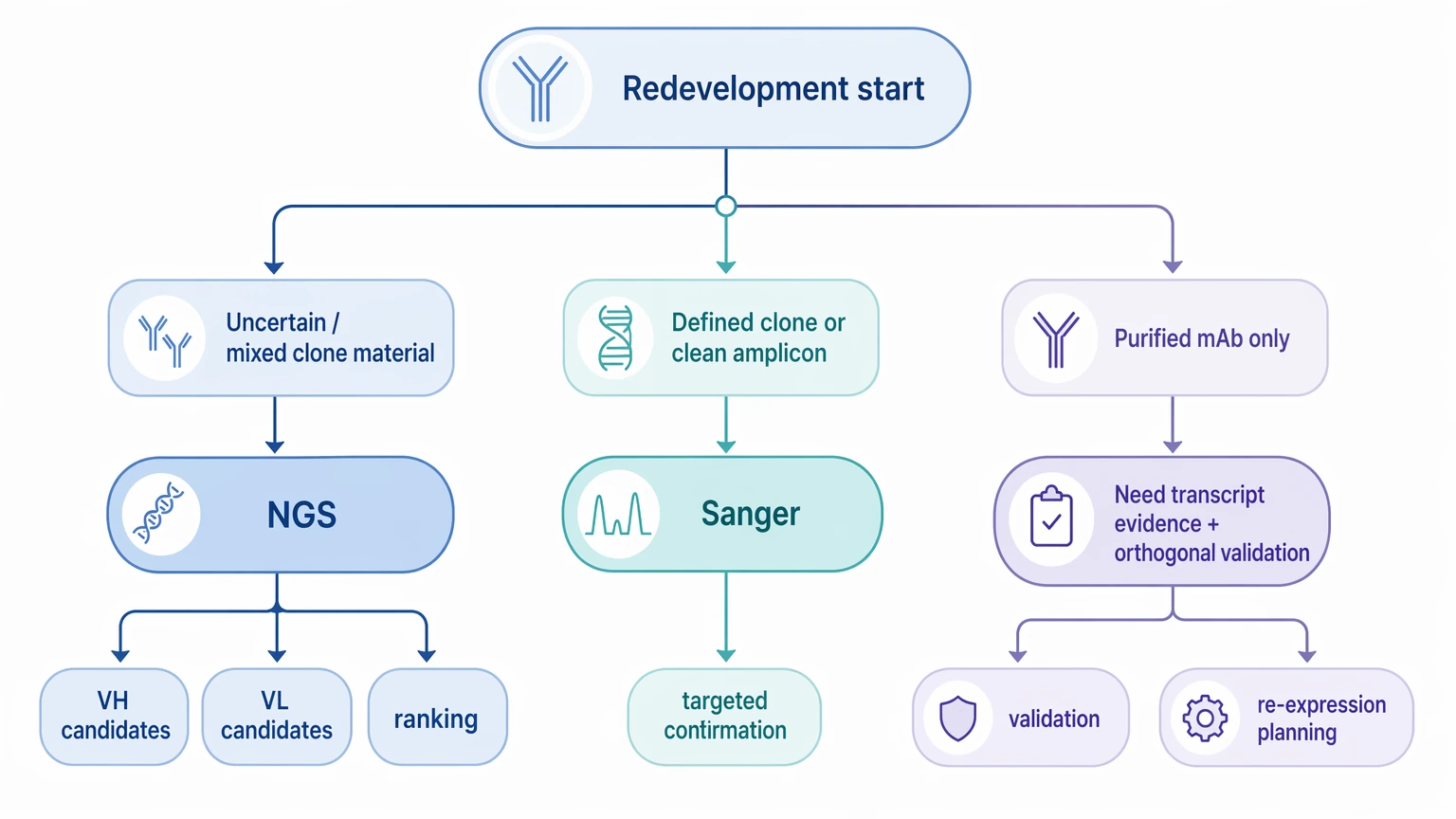
Choose antibody sequencing NGS when your redevelopment project begins with uncertain, mixed, or incomplete clone material and you need to recover plausible heavy chain / VH and light chain / VL candidates fast enough to keep the program moving. Choose Sanger-based clone recovery when you already have a defined clone source, a clean targeted amplicon, or a narrow archival confirmation question. If the only material left is a purified monoclonal antibody, neither route works as a simple default. At that point, the real choice is about how much transcript evidence still exists and what orthogonal validation is required before recombinant re-expression.
That distinction matters because redevelopment teams are not comparing platforms in a vacuum. They are deciding what kind of deliverable they actually need: a clone-confirmed sequence, a ranked set of dominant transcript candidates, or a sequence package solid enough to support construct design without pushing the project toward the wrong chain combination.
Where This Decision Usually Arises
This choice tends to come up during a program restart, technology transfer, legacy reagent review, or archive cleanup. The original plasmid may be missing. The stored hybridoma may be unstable, mixed, or poorly documented. Historical records may contain only partial CDRs / complementarity-determining regions rather than a full-length variable-region sequence. In some cases, the only usable sample is a vial of purified monoclonal antibody.
Under those conditions, redevelopment teams usually focus on three immediate concerns:
- protecting the redevelopment timeline
- recovering the correct variable region sequence for both chains
- avoiding an expensive round of synthesis and testing built on the wrong sequence
A method comparison only helps if it reflects those real pressures. For this topic, the most useful decision points are starting material, sequence scope, chain pairing, sequence confidence, and how much follow-up confirmation will still be needed.
The Comparison Framework That Matters Most
Starting Material Compatibility
Sample type is usually the first split in the decision tree. Cell-derived material from a hybridoma can support transcript-based recovery. Degraded, mixed, or uncertain material may push the project toward broader repertoire sequencing. Protein-only input constrains both NGS and Sanger-based transcript workflows and often calls for an evidence-integration strategy instead.
Sequence Scope
Some teams only need a targeted identity check. Others need both VH and VL sequences, including frameworks, intact reading frames, and biologically plausible productive rearrangement logic. The broader the redevelopment goal, the less useful a narrow confirmatory workflow becomes by itself.
Chain Pairing and Confidence
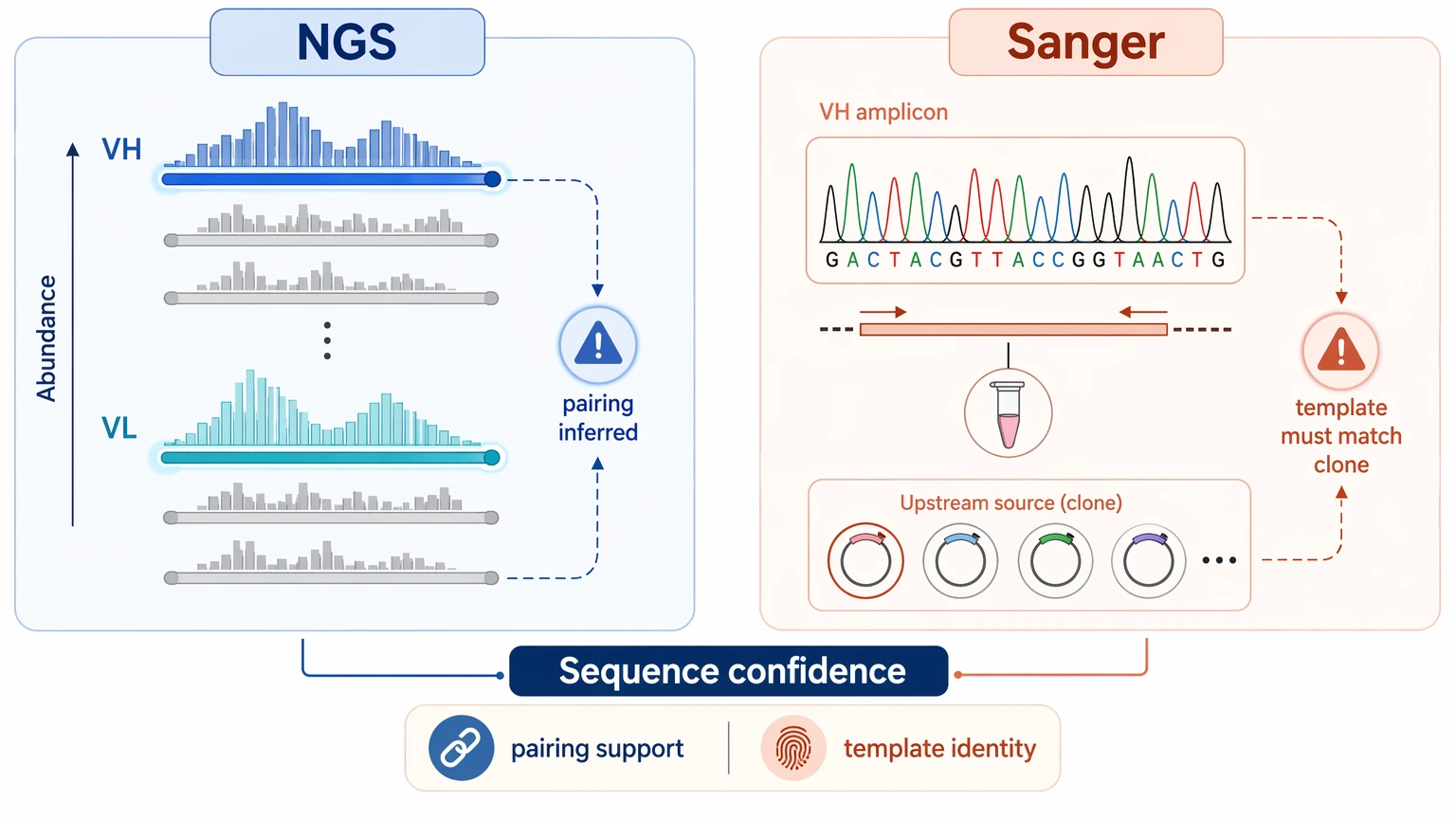
The main redevelopment risk is not just whether a sequence can be read, but whether the recovered VH and VL actually belong together in a form suitable for re-expression planning. A strong sequence package should reduce sequence ambiguity, show coherent CDRs / complementarity-determining regions, and support a defensible pairing decision.
Timeline Risk
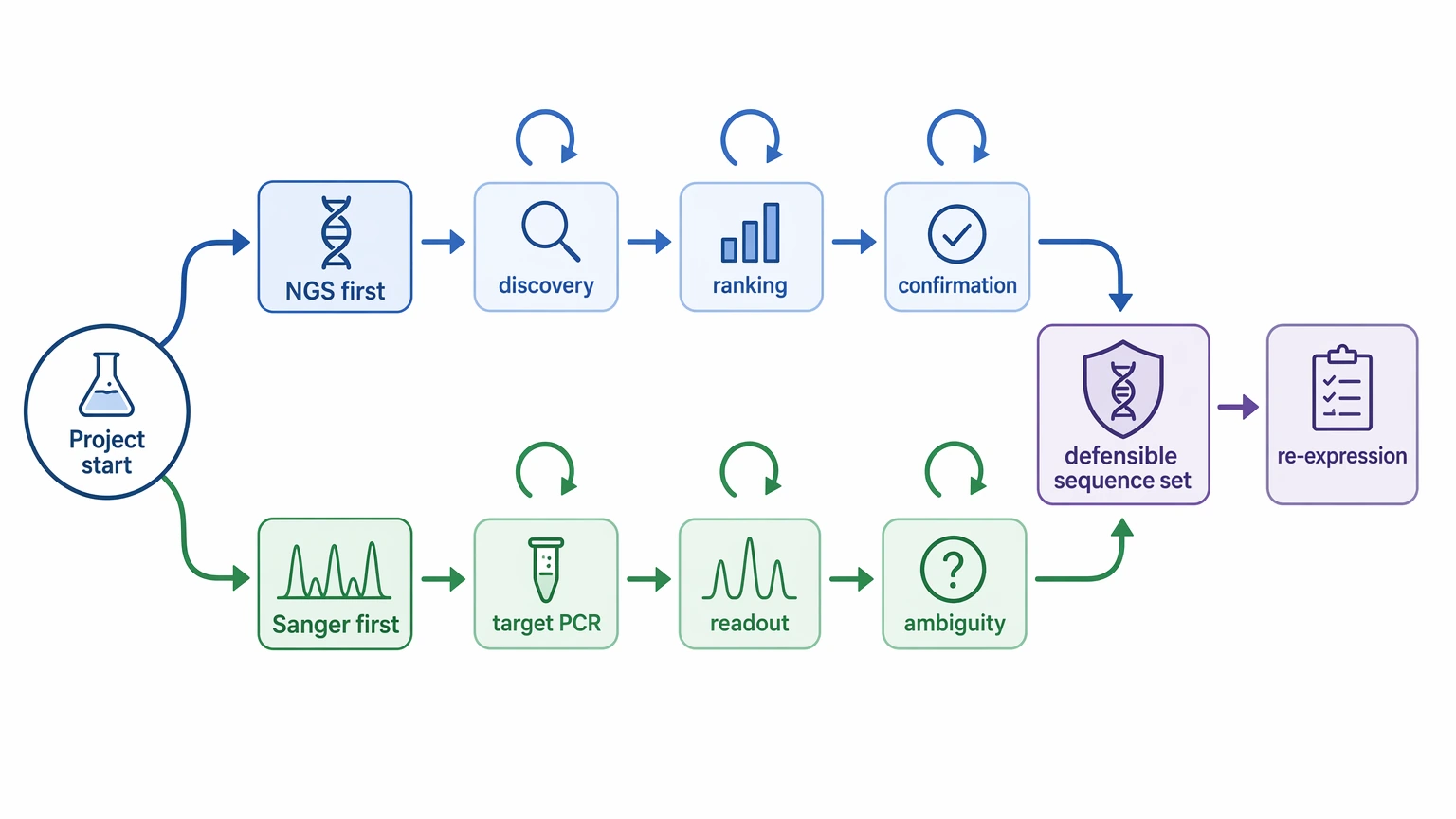
A method that starts quickly can still slow the project down if it returns unclear candidates and leads to repeated rounds of validation. Redevelopment timelines are shaped by the whole workflow, not by the sequencing step alone.
NGS and Sanger Side by Side
Before getting into special cases, the comparison below captures the tradeoffs most teams are weighing.
| Dimension | Antibody sequencing NGS | Sanger-based clone recovery |
|---|---|---|
| Best starting point | Hybridoma-derived material with uncertainty, mixed populations, missing records, or broader recovery needs | Defined clone, isolated subclone, targeted amplicon, or focused transcript confirmation |
| Typical readout | Dominant clone candidates, consensus sequence, repertoire distribution, contig assembly | Chromatogram-confirmed targeted amplicon or clone-linked sequence |
| Main strength | Broader recovery search when the relevant transcript source is unclear | Strong direct confirmation once the correct source is already isolated |
| Main weakness | Abundance alone does not prove native chain pairing | Mixed populations are hard to resolve without prior separation |
| Confidence model | Built from coverage, candidate ranking, productive sequence logic, and follow-up confirmation | Built from template definition, chromatogram clarity, and low ambiguity in targeted regions |
When Antibody Sequencing NGS Is Usually the Better First Choice
Antibody sequencing NGS is often the better first move when recovery risk is the central problem. That is common when a hybridoma has a messy history, records are incomplete, or the sample may contain more than one immunoglobulin transcript source.
For redevelopment work, the practical advantage is broader visibility. Instead of testing one assumption at a time, NGS can surface a set of dominant candidates and show whether the transcript background looks simple or heterogeneous. That makes it a good fit when the real question is, “What are the most plausible VH and VL sequences still present in this material?”
Still, NGS does not settle every redevelopment question on its own. If heavy and light chains are inferred from repertoire abundance rather than directly linked to a single clone, additional work may be needed before construct design. That can include RACE, targeted follow-up sequencing, peptide-level confirmation, or a recombinant check.
If your team is deciding whether uncertain hybridoma-derived material supports an NGS-first recovery strategy, MtoZ Biolabs can evaluate your project and help define the sequence-recovery workflow before you submit your requirements for redevelopment planning.
When Sanger-Based Clone Recovery Is the Better First Choice
Sanger sequencing works best when the biological source is already narrowed. If you have an isolated clone, a clean cDNA template, or a targeted clone recovery question, Sanger-based clone recovery can provide direct confirmation efficiently.
This is especially true for narrower questions such as:
- confirming a known VH or VL segment
- checking a suspected framework or CDR region
- verifying an archival record against a defined amplicon
- confirming a narrowed candidate after another discovery step
Its limitation matters just as much as its strength. Sanger is not built to sort out a biologically mixed source on its own. A clean chromatogram does not prove that the underlying sample represented the correct clone. In redevelopment work, that distinction can determine whether a project moves forward cleanly or circles back into rework.
Why Chain Pairing Is the Most Important Misunderstood Issue
A common assumption is that NGS gives better answers simply because it produces more reads, or that Sanger gives better answers simply because chromatograms look cleaner. In antibody redevelopment, neither shortcut holds up very well.
For antibody sequencing NGS, high transcript abundance can help rank candidates, but it does not prove that the top VH and top VL form the original native pair. For Sanger-based clone recovery, strong direct sequence confirmation only helps if the upstream template truly comes from the intended clone.
That is why sequence confidence should be defined by redevelopment criteria rather than generic sequencing language. Before moving to synthesis or codon optimization, teams should review whether the recovered sequences show:
- full coverage across the decision-critical variable region
- intact reading frame and plausible productive rearrangement
- interpretable CDR continuity without unresolved bases
- agreement across independent evidence streams
- a clear statement of whether pairing was directly clone-linked or inferred
What Changes When Only Purified Antibody Remains
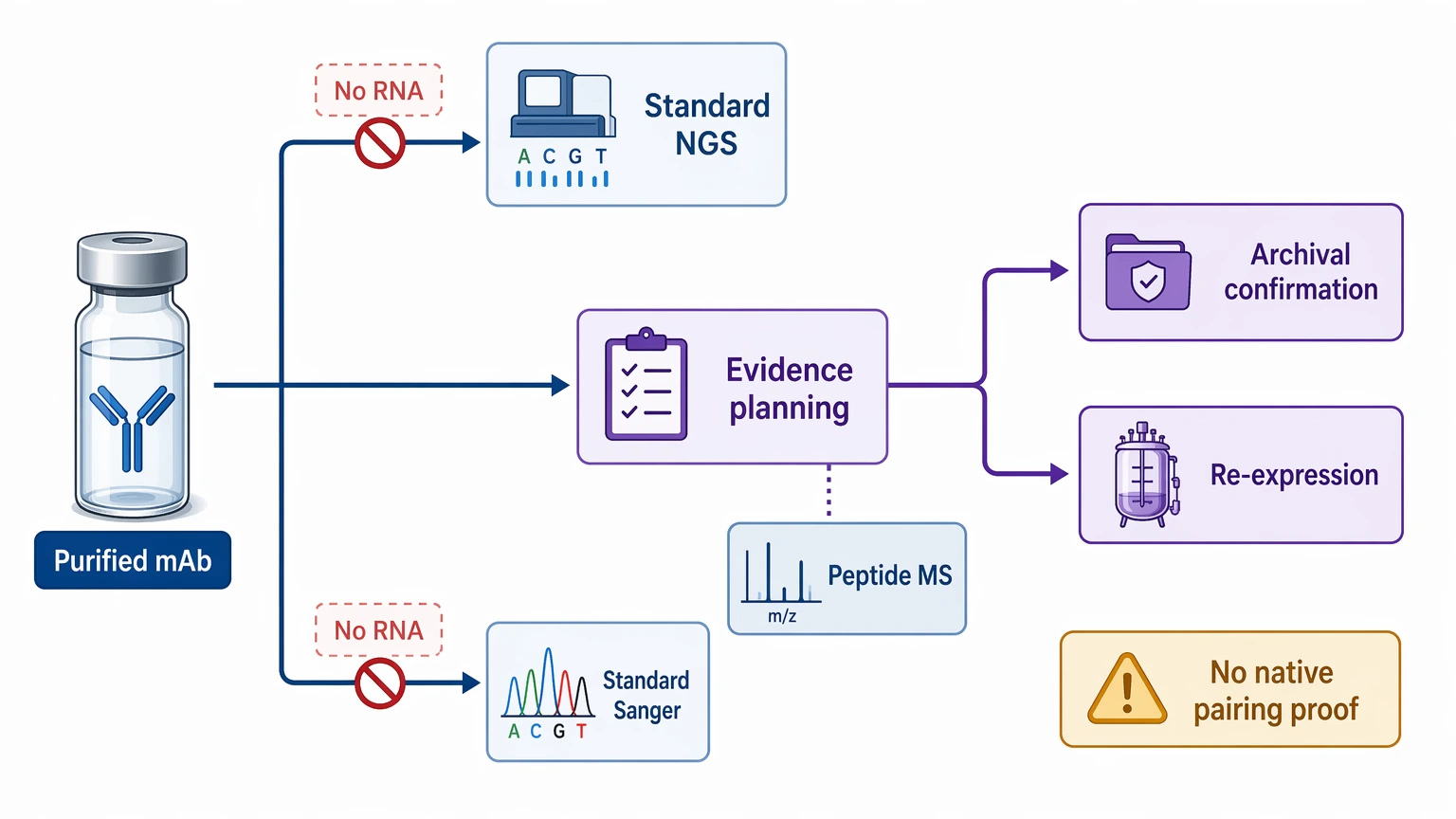
A purified monoclonal antibody changes the problem completely. Without accessible RNA, neither standard NGS nor standard Sanger transcript recovery is directly informative. At that point, the project should be framed around the evidence needed for the actual redevelopment goal.
If the goal is only archival confirmation, partial identity evidence may be enough. If the goal is full antibody redevelopment and recombinant re-expression, protein-derived evidence alone may not answer the same questions as transcript-linked recovery. Peptide-level mass spectrometry can support confirmation, but it does not replace clone context or native transcript pairing logic.
In that situation, the most useful planning question is no longer “NGS or Sanger?” but “What combination of evidence can reduce sequence uncertainty enough for the next redevelopment decision?”
How to Compare Timeline Risk Realistically
Redevelopment teams often underestimate validation time. A fast first readout is not the same thing as a fast project.
Sanger-based workflows can move quickly when the template is clean and the question is narrow. They slow down when clone isolation, repeated PCR targeting, or multiple rounds of ambiguity resolution become necessary.
NGS-based workflows can add front-end analysis, but they may cut down on blind alleys when sample history is poor. Their timeline risk usually shifts to downstream confirmation, especially when chain pairing remains inferred rather than directly proven.
A practical way to compare options is to ask which path is most likely to produce a defensible sequence set with the fewest total iterations before re-expression planning.
A Practical Selection Guide
Use this simplified guide for project triage:
| If your project situation is... | Usually start with... | Why |
|---|---|---|
| Mixed or poorly documented hybridoma-derived material | Antibody sequencing NGS | Better at recovery exploration and dominant candidate discovery |
| Isolated clone or defined transcript target | Sanger-based clone recovery | Efficient direct confirmation from a known source |
| Full VH/VL recovery needed for construct design | NGS, then confirmation as needed | Broader sequence scope supports redevelopment screening |
| Narrow identity check or archival record check | Sanger sequencing | Focused confirmation is usually enough |
| Pairing remains uncertain after sequencing | Orthogonal validation | Additional evidence is needed before construct commitment |
Conclusion
For redevelopment projects, antibody sequencing NGS is usually the stronger first option when the source is uncertain, heterogeneous, or incompletely documented and the team needs broad recovery of VH and VL candidates. Sanger-based clone recovery is usually the better first option when the source is already well defined and the project only needs targeted confirmation. The better fit comes down to the immediate bottleneck: discovery, confirmation, or pairing confidence.
If your program involves hybridoma drift, partial sequence records, limited sample volume, or a protein-only legacy asset, define the required deliverable before choosing the sequencing path. For teams preparing a redevelopment restart, contact MtoZ Biolabs to evaluate your project, discuss sample constraints, and plan the confirmation steps needed before recombinant re-expression.
FAQ
Does NGS always recover both chains in a form ready for expression?
No. NGS may recover strong VH and VL candidates, but expression readiness still depends on pairing confidence, sequence completeness, and whether ambiguities remain in decision-critical regions.
When is Sanger enough for archival confirmation but not enough for redevelopment?
Sanger can be sufficient when the goal is to verify a known region against a defined template. It becomes less sufficient when the team needs full VH/VL recovery, pairing support, or recovery from mixed material.
Can a mixed hybridoma mislead both methods?
Yes. A mixed or drifting hybridoma can distort repertoire abundance in NGS and can also produce apparently clean Sanger reads from the wrong transcript source if the sample is not first resolved.
What is a useful minimum sequence package before recombinant re-expression?
At minimum, teams usually want full decision-critical variable-region coverage, productive rearrangement logic, interpretable CDRs, low ambiguity, and a documented rationale for how VH and VL were assigned.
When should RACE be added to a recovery workflow?
RACE is often useful when variable-region ends are incomplete, when transcript recovery needs extension or confirmation, or when another method has produced plausible but still incomplete candidates.
Is it reasonable to combine NGS and Sanger in one redevelopment project?
Yes. A common pattern is to use NGS for candidate discovery from uncertain material and then use Sanger sequencing for focused confirmation once the candidate space has narrowed.
How to order?




