






Antibody Sequencing Mass Spectrometry vs NGS: Which Route Fits Your Sample Reality?
If you need antibody sequence recovery, the first question is simple: what sample do you actually have? Antibody sequencing mass spectrometry is usually the practical starting point when only purified antibody is left. A nucleic-acid route such as next-generation sequencing (NGS), RT-PCR, or 5' RACE is usually more direct when hybridoma cells or other antibody-producing cells are still available. When the source is a single B cell and native heavy/light chain pairing matters, an NGS-first workflow is generally the better fit.
This is not really a platform contest. It is a sample-compatibility decision. Protein-derived sequence from LC-MS/MS can be recovered from an intact antibody or reduced chains even when no RNA or cells remain. Transcript-derived sequence, by contrast, starts from cellular material and often gives a more direct route to VH and VL recovery for recombinant re-expression. In some projects, the strongest plan is not MS or NGS by itself, but one primary route backed by orthogonal validation.
Why Sample Reality Should Drive the Decision
Teams usually end up making this comparison when records are incomplete but the antibody still matters. One project may involve an archived monoclonal antibody with no surviving cell source. Another may still have a hybridoma, but the documentation is shaky. A discovery program may trace back to a single cell, where preserving native chain linkage is part of the scientific requirement rather than a nice extra.
A mismatched starting route costs time for a basic reason: each technology needs different input. Purified protein cannot go through a transcript workflow if no nucleic-acid source exists. On the other hand, using protein-only reconstruction when a usable hybridoma is available can create extra interpretation work for no real gain. The more efficient choice usually comes from matching the method to the material, then checking whether the output will be usable for re-expression rather than just informative.
The Comparison Criteria That Matter Most
A practical route comparison usually comes down to four questions.
Starting material
Do you have purified antibody, reduced chains, a hybridoma, bulk B-cell material, or a single B cell? This is the first filter because MS and NGS do not start from the same material.
Sequence objective
Do you need CDR information only, or do you need full variable region recovery across VH and VL for construct design? That answer sets the tolerance for ambiguity.
Chain relationship
Does the project require native heavy/light chain pairing, or is it enough to recover strong heavy- and light-chain candidates separately? Pairing requirements often settle the route before anyone gets into platform preference.
Re-expression readiness
Will the final sequence be used for documentation, analytical comparison, or recombinant re-expression? A sequence that is directionally useful is not always ready to rebuild without another review step.
Side-by-Side Comparison
The table below shows where each route is structurally strongest.
| Decision dimension | Antibody sequencing mass spectrometry | NGS-based route |
|---|---|---|
| Best starting material | Purified antibody, intact antibody, reduced chains | Hybridoma cells, B-cell material, single B cell |
| Evidence type | Protein-derived sequence | Transcript-derived sequence |
| Works from protein only | Yes | No |
| Native heavy/light chain pairing | Limited at the protein-sequencing level | Strongest in single-cell workflows |
| Main interpretation burden | De novo peptide assembly, chain assignment, isoleucine/leucine ambiguity, PTMs | Primer strategy, transcript bias, background products, pairing uncertainty outside single-cell formats |
| Fit for archived undocumented antibody | Often favorable when only protein remains | Only if usable cellular material still exists |
| Route to VH and VL recovery | Inferred from peptide evidence and assembly | Directly recovered from the coding source |
| Typical validation need | Often benefits from follow-up review before rebuild | Protein-level confirmation may still be useful |
When Purified Antibody Is the Only Material Left
This is the clearest MS-first case. If no viable cells, RNA, cDNA, or preserved cell bank remains, next-generation sequencing (NGS) cannot begin because the required nucleic-acid input is gone. In that situation, de novo antibody sequencing by LC-MS/MS becomes the workable route for sequence recovery.
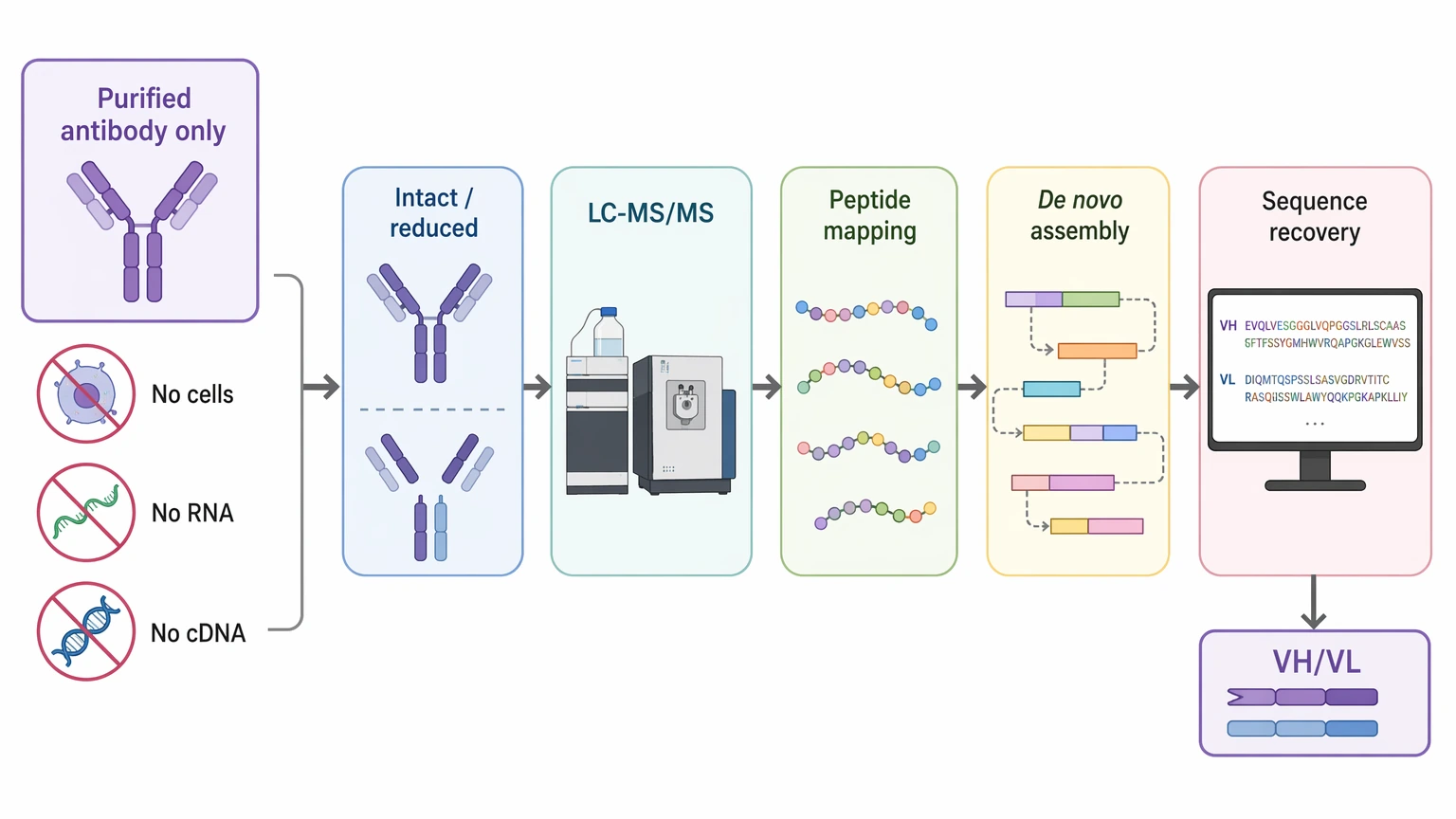
The advantage is straightforward: MS reads the expressed protein product rather than an inferred cellular precursor. That makes it especially relevant for purchased antibodies with incomplete records, archived IgG from older programs, and legacy reagents that survived only as purified material.
The tradeoff sits in the interpretation. Peptide mapping and tandem MS can reconstruct large portions of the variable region, but some issues may still need manual review. Common examples include incomplete peptide overlap, chain assembly complexity, post-translational modifications, and isoleucine/leucine ambiguity. Those limits do not make MS the wrong tool. They do mean that a protein-derived sequence may need targeted review before a team commits to expression constructs.
If your project falls into this branch and the output must support downstream rebuilding, it helps to define the real use case before a feasibility call. For archived purified antibody projects, you can submit your requirements to MtoZ Biolabs to evaluate your project against the available protein form, desired VH and VL completeness, and any expected need for orthogonal validation.
When a Hybridoma Is Still Available
A hybridoma changes the logic. Once the project still has access to cellular transcripts, RT-PCR, 5' RACE, or next-generation sequencing (NGS) usually becomes the more direct first route. Instead of reconstructing sequence from peptide fragments, the workflow can query the coding source itself.
That matters for two reasons. First, transcript-based recovery is often better aligned with full variable region recovery across both chains. Second, it can remove much of the de novo assembly burden that comes with protein-only sequencing. For many legacy cell-line programs, that makes NGS-first or RACE-first the cleaner path toward recombinant re-expression.
MS still has a place here, but usually not as the first move. It can serve as orthogonal validation when the hybridoma record is uncertain, when mixed productivity is suspected, or when the team wants to compare transcript-derived candidates with the dominant expressed protein species. In other words, hybridoma availability does not erase the value of antibody sequencing mass spectrometry; it usually shifts that value from primary recovery to confirmation or fallback support.
When the Starting Point Is a Single B Cell
Single-cell projects should be treated as their own branch, not as a smaller version of hybridoma work. The main issue is preserving native heavy/light chain pairing at the clone level. If the biological question depends on a faithful heavy-light relationship from one cell of origin, that requirement strongly favors a single B cell transcript workflow.
Here, an NGS-first route is usually the right starting choice. Protein-level sequencing does not preserve clone linkage in the same way because it analyzes protein molecules rather than paired transcripts from one defined cell. That difference matters when the goal is to recover a rare clone, support a discovery hit, or rebuild an antibody with confidence that the recovered VH and VL truly belong together.
MS may still become useful later, especially after recombinant production, when the expressed antibody needs protein-level confirmation. But for clone-faithful recovery from a single cell, the pairing requirement usually decides the route before other metrics enter the discussion.
When MS and NGS Work Best Together
Some projects work better with a combined strategy. A hybridoma may yield transcript candidates by RT-PCR or 5' RACE, while MS checks whether the dominant secreted protein matches that transcript-derived sequence. A purified antibody project may start with LC-MS/MS, then use targeted follow-up work to resolve uncertain residues or confirm a construct before expression. In both cases, the practical question is not which platform is superior in the abstract. It is which platform should establish the first usable sequence, and which one should reduce the uncertainty that remains.
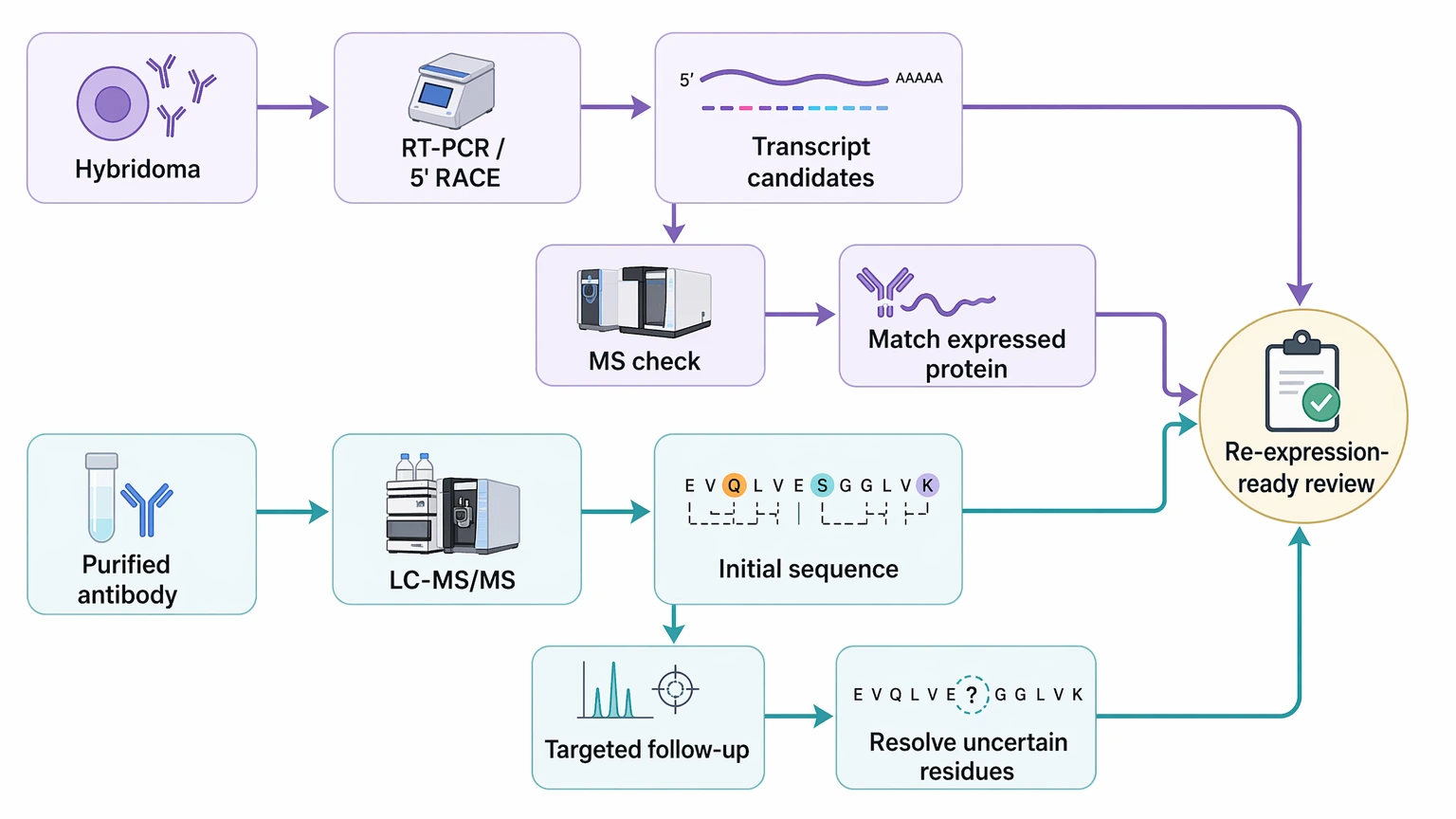
That distinction matters for teams planning recombinant re-expression. A technically plausible sequence is useful, but rebuild decisions often depend on chain assignment confidence, variable-domain completeness, and whether the final deliverable matches the expressed molecule closely enough for the intended application.
What to Prepare Before a Feasibility Discussion
Before you ask a provider to compare routes, gather the details that actually shape the recommendation:
- Sample type: purified antibody, hybridoma, bulk B-cell material, or single B cell
- Whether any cellular source still exists
- Whether the antibody is available as an intact antibody or as reduced chains
- Whether the goal is CDR recovery only or full VH and VL variable region recovery
- Whether native heavy/light chain pairing is mandatory
- Whether the endpoint is documentation, clone confirmation, or recombinant re-expression
- Whether prior species information, partial sequence records, or protein characterization data already exist
Those details let a provider judge whether a route is merely feasible or likely to produce output you can actually use.
Comparison Summary and Consultation Guidance
The split is usually clear once the sample is clear. Choose antibody sequencing mass spectrometry when only purified protein remains. Choose an NGS-based route when a hybridoma or other usable cellular source is still available. Choose a single-cell transcript workflow when clone-level heavy/light chain pairing is central to the project. For archived IgG recovery, legacy hybridoma documentation, or paired-sequence rebuilding programs, the best next step is to define the sample source, sequence endpoint, and validation burden up front, then contact MtoZ Biolabs to discuss the study, submit your requirements, and evaluate your project against a realistic sequence-recovery and confirmation plan.
FAQ
If I already have a partial antibody sequence, does that change the route choice?
Yes. A partial record can narrow the scope of confirmation work. For a purified antibody, it may help prioritize uncertain regions in an MS-first plan. For a hybridoma, it can help confirm primer design or transcript identity instead of starting from a blank sequence search.
Can bulk B-cell NGS replace a single-cell workflow when pairing matters?
Usually not if native pairing is the key output. Bulk repertoire data may recover many heavy- and light-chain reads, but linking the correct partners to one clone is much harder than in a true single-cell design.
Is a transcript-derived sequence always enough for recombinant re-expression?
Not always. Transcript recovery is often the fastest route to construct candidates, but some projects still benefit from protein-level confirmation, especially when expression records are unclear or multiple productive variants may be present.
Are post-translational modifications a reason to prefer MS?
They can be. MS gives direct evidence from the expressed antibody and can reveal modification complexity that transcript sequencing does not capture. That does not replace transcript recovery, but it can matter when protein behavior is part of the question.
What sample details most often delay route selection?
The biggest delays usually come from not knowing whether cells still exist, whether the material is purified intact IgG or a more complex preparation, and whether the project needs full variable region recovery or only targeted confirmation.
How to order?




